Light Academia Bedroom Wall Art: Six Quiet Old Master Paintings for the Reading-Nook Aesthetic
Light academia is the cream-and-linen counterpart of dark academia — the same library-and-letters reading mood, the same Romantic-poetry-on-a-rainy-afternoon emotional register, but in warm muted neutrals instead of black-and-burgundy. A light-academia bedroom takes its colour register from old library wallpaper, faded linen drapery, vintage Italian poetry editions, hand-bound notebooks in pale ivory leather, the natural cream of a candle-lit afternoon. The colour vocabulary is dusty rose, oat, butter-yellow, sage, dusty blue, soft eggshell, and the wood register is light: ash, beech, raw oak, lime-washed pine. It is the bedroom of a person who reads in the late morning with the curtains half-drawn and writes letters in the early evening on a small writing-desk by the window. The Old Master canon has six paintings that hold this aesthetic without breaking it — and six paintings that, if put on the wrong wall, would break it instantly.

What 'light academia' actually asks of wall art
Light academia is, in interior-design terms, a colour palette and a mood rather than a strict historical reference. The colour palette is the muted-neutral end of the cream-and-cottage range: dusty rose, oat, butter, sage, dusty blue, eggshell, vintage cream. The mood is contemplative-readerly: the bedroom is a room one reads in, writes letters in, drinks tea in. The interior reads as if it has been lived in by someone for ten or fifteen years and has acquired a slow patina of small objects (a brass desk lamp, a stack of poetry books, a single dried rose in a small ceramic jar, an old shawl thrown over the chair). Light academia is, in practice, the daytime / morning aesthetic where dark academia is the evening / night aesthetic. The light-academia bedroom is the room before the candle is lit; the dark-academia bedroom is the room after.
The wall art for a light-academia bedroom therefore has to do four specific things. First, the painting must be muted in colour — saturated colours read as loud against the room's pale palette and break the aesthetic. Second, the painting must be contemplative in subject — a reading figure, a quiet interior, a still life, a soft landscape — rather than active or dramatic (no battle scenes, no executions, no nudes, no dramatic gestures). Third, the painting must be small to medium in scale — a 30 × 40 cm or 40 × 60 cm framed print rather than a 80 × 120 cm statement piece, because the light-academia bedroom is composed of many small objects rather than one dominant one. Fourth, the painting should reference reading, writing, or domestic intelligence (a figure with a book, a woman at a writing-desk, a vase of flowers in a study) so that the painting's subject reinforces the bedroom's primary function as a contemplative-readerly space.
Six paintings that hold the aesthetic
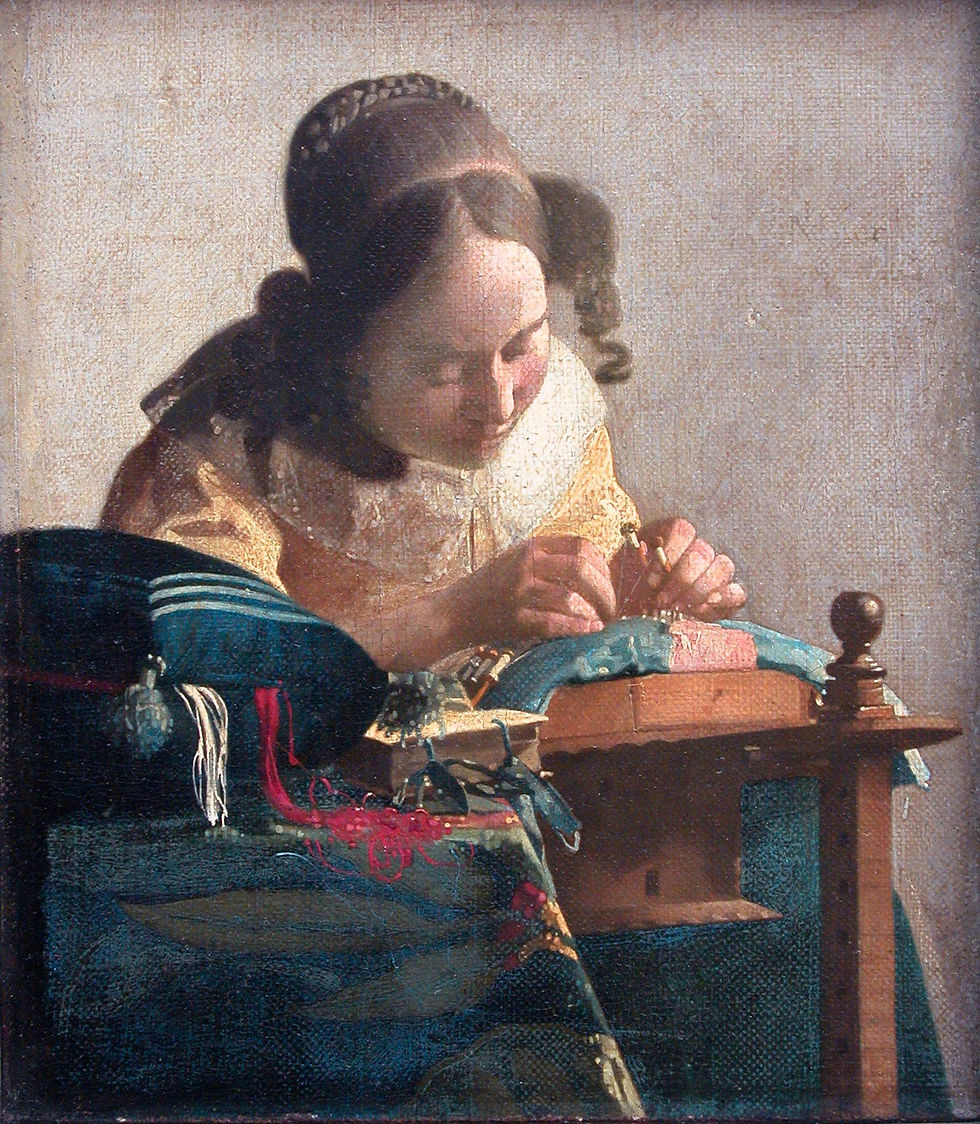
The first painting that fits the brief is Renoir's Young Girl Reading (c. 1890) — a small late-Impressionist canvas in muted late-Renoir colour register, with a young woman in profile reading a small book at a half-turned angle. The figure's pale dress and the book's pale paper produce a calm tonal range that holds up well in dim warm bedroom lighting; the subject (reading) is the canonical light-academia activity. A 30 × 40 cm framed reproduction above the bedside table is the standard application. The second painting is Vermeer's The Lacemaker (c. 1669-71) — Vermeer's smallest signed canvas (24 × 21 cm), a contained domestic interior in cream-yellow-blue-and-red, painted at the original light-academia hand-held scale. The Lacemaker works particularly well above a writing-desk or beside a reading lamp. The two paintings together — Renoir's young woman with a book and Vermeer's young woman with lace — define the female-figure-at-quiet-task light-academia subgenre.

The third painting is Cassatt's The Tea (c. 1880) — two well-dressed Parisian women seated together over a silver tea-service in a softly-lit interior, painted in the canonical light-academia colour palette of dusty rose, cream, oat, and soft sage. The painting's central subject — quiet companionship over tea — is the canonical light-academia activity. The fourth painting is Burne-Jones's The Golden Stairs (c. 1880) — eighteen pale-robed women descending a spiral staircase carrying musical instruments, painted by the Pre-Raphaelite Edward Burne-Jones in a continuous cream-and-pale-gold register. The painting is unusual in its tall narrow proportions (40 × 100 cm at original scale) and works particularly well in a tall-narrow alcove next to a wardrobe or in the vertical slot between a bedroom window and a bookshelf. The subject (women carrying lyres and flutes down a staircase) is the high-light-academia activity: the gentle classical reference, the muted female group, the slow descending procession.

The fifth painting is Friedrich's Wanderer above the Sea of Fog (c. 1818) — a single figure on a rocky promontory looking out over a sea of fog rolling between mountain peaks. Friedrich is the light-academia German Romantic anchor: muted colour register, contemplative-figure subject, the canonical Rückenfigur (figure-from-behind) compositional device that lets the viewer step inside the painting's contemplation. The painting works particularly well above the bed-head in a light-academia bedroom, where the figure's back is the first thing the reader sees when they lie back from a book. The sixth painting is Cassatt's Young Mother Reading to her Children or any Cassatt mother-and-child reading composition — Cassatt painted approximately fifteen of these in the 1890s-1900s, all in the same light-academia palette of soft creams and dusty blues. The mother-reading-to-child subject is the canonical light-academia family scene and works particularly well in a guest bedroom or a child's reading-room.
Six paintings that break the aesthetic (avoid these)
The same Old Master canon has approximately as many paintings that look light-academia at first glance but break the aesthetic on closer inspection. The first failure category is saturated colour: a Klimt Kiss or a Gauguin Tahiti canvas reads as 'gold-leaf' or 'jewel-tone' rather than 'soft-cream' and clashes against the muted light-academia palette. The second failure category is dramatic action: a Caravaggio decapitation, a Goya battle scene, or a Delacroix Liberty leading the people breaks the contemplative mood instantly. The third failure category is large scale: a 100 × 150 cm Botticelli Birth of Venus reproduction takes over the entire bedroom wall and breaks the many-small-objects light-academia composition logic. The fourth failure category is religious narrative: a Renaissance Madonna or a Crucifixion scene reads as too religiously specific for the secular-contemplative light-academia mood.

The fifth failure category is portraits of specific famous individuals — a known Sargent society portrait, a known Madame X, a known Whistler's Mother — these all read as 'museum decoration' rather than as 'lived-in personal art' and break the lived-in-many-years light-academia mood. (Whistler's Mother is a partial exception because it is so domestic in subject; if used, it should be hung in a smaller side room rather than the main bedroom wall.) The sixth failure category is heavy-baroque ornamentation: any seventeenth-century Spanish or Italian baroque canvas with elaborate gold-and-crimson colour will overwhelm the muted neutrals of the light-academia palette. Caravaggio's Bacchus, Velázquez's Las Meninas, and almost any Rubens or Tiepolo canvas all read as 'palace decoration' rather than 'reading-nook decoration' in a light-academia context.
How to hang the prints
Light-academia bedroom wall art is hung at a lower height than standard gallery wall art: the centre of each painting should be at approximately one hundred and forty centimetres above the floor (the standard eye-line for a seated reader on a chair or bed), not the gallery-standard hundred-and-fifty-five centimetres for a standing viewer. The frame selection should follow the room's wood register: light wood frames (raw oak, ash, beech, lime-washed pine) for warm-toned interiors; aged brass or pale-gold metal frames as the only acceptable metal option (no blackened steel, no chrome, no copper). The matting should be cream or oat rather than pure white, with a wide mat (approximately fifteen to twenty per cent of the painting's width) that gives each piece visual breathing room against the pale walls.

The room's overall painting count should be three to five framed prints rather than a single large statement piece. A typical light-academia bedroom hang is: one medium painting (40 × 60 cm) above the bedside table or chest of drawers, one tall-narrow painting (30 × 80 cm) in a vertical alcove, one small painting (20 × 30 cm) on the bedside table on a small easel rather than on the wall, and one small painting (20 × 25 cm) over the writing-desk if the bedroom has one. The remaining wall space should be left bare or treated with a small antique mirror, a small embroidery hoop, a single dried botanical specimen in a glass case, or a slim wall-mounted brass coat hook for the dressing gown. The instinct to fill every wall is, as in commercial fine-dining design, the single most common failure of light-academia interior design: the room reads as 'museum gift shop' rather than 'lived-in reading retreat.'
Key takeaways
Light academia is the cream-and-linen daytime counterpart of dark academia — same library-and-letters reading mood but in muted warm neutrals (dusty rose, oat, butter, sage, dusty blue, eggshell) instead of black-and-burgundy. Light wood register: ash, beech, raw oak, lime-washed pine.
Wall art for the aesthetic must be muted in colour, contemplative in subject, small-to-medium in scale (30-60 cm), and ideally reference reading, writing, or domestic intelligence — the bedroom's primary function as a readerly retreat.
Six paintings that fit: Renoir's Young Girl Reading (canonical anchor), Vermeer's Lacemaker (original hand-held scale), Cassatt's The Tea (women's quiet companionship), Burne-Jones's Golden Stairs (tall-narrow Pre-Raphaelite), Friedrich's Wanderer (bed-head Rückenfigur), Cassatt's mother-reading compositions.
Six failure modes to avoid: saturated colour (Klimt Kiss, Gauguin Tahiti); dramatic action (Caravaggio, Delacroix); large scale (>100 cm Botticelli); religious narrative (Madonnas, Crucifixions); famous-portrait reading-as-museum-decoration; heavy-baroque ornamentation (Spanish/Italian gilt-and-crimson).
Hang lower than gallery standard: paintings' centre at 140 cm above floor (seated reader eye-line), not 155 cm (gallery standing-viewer line). Light-wood frames, cream/oat matting (not pure white), wide mats (15-20% of painting width).
Total painting count: 3-5 framed prints, not one statement piece. Standard hang: medium 40 × 60 cm above bedside or chest, tall-narrow 30 × 80 cm in alcove, small 20 × 30 cm on bedside-table easel, small 20 × 25 cm over writing-desk. Remaining wall left bare or with small antique mirror / single dried botanical / brass coat hook.
Whistler's Mother is the most well-known exception to the 'no famous portraits' rule — it works because the entire composition is in canonical light-academia palette and the subject is contemplative-domestic. Use in a secondary room (guest bedroom, hallway) rather than the primary bedroom wall.
Common failure: filling every wall. The bedroom reads as 'museum gift shop' rather than 'lived-in reading retreat.' Light-academia bedrooms are composed of many small objects with breathing room between them — fewer paintings, hung at lower eye-line, with bare wall sections between.
Browse light-academia prints in muted Old Master palettes at zocineartdesign.etsy.com, or browse the full archive of bedroom wall art at zocineartdesign.etsy.com.
Comments