Michelangelo's Anatomy Obsession: The Sculptor Hiding Inside the Painter
Updated: Aug 5
In 1492, when Michelangelo was seventeen years old and living in Florence as an apprentice to Lorenzo de' Medici, he asked the prior of the church of Santo Spirito for permission to use the corpses of the patients who died in the hospital attached to the monastery. The prior agreed. For the next several years Michelangelo dissected bodies by candlelight in a small back room of the church, drawing tendons and ligaments and bone structure with a methodical patience that would not have been out of place in a medical lecture two hundred years later. He paid the prior with a wooden crucifix carved from the same hospital's leftover lumber, which still hangs in the church today.
Everything Michelangelo would later make depends on what he learned in that back room. The David, the Sistine Chapel ceiling, the Last Judgment, the Pietà of his old age — all of them are, in the end, the same project: the human body, rendered as if the painter could see directly through the skin to the structure beneath. He always said he was a sculptor and not a painter; he resented the Sistine ceiling commission because it took him away from marble for four years. The paintings prove him right. Even on a flat surface, Michelangelo is carving.

The dissection years
The Florence in which Michelangelo trained was, by Renaissance standards, the most anatomically literate city in Europe. Leonardo da Vinci had already begun the dissection drawings that would occupy him for the rest of his life. The Medici library held copies of the recently rediscovered Greek anatomical texts. Florentine guild painters were expected to know the structure of a hand and a thigh as well as a surgeon would. Michelangelo arrived in this culture from a more provincial Tuscan town, with a sculptor's apprenticeship rather than a painter's, and decided very early that he would know more than anyone else.
The Santo Spirito hospital dissections lasted, at minimum, from 1492 to 1495 — three years of regular night work — and possibly longer. The drawings have mostly been lost. What survives is the body of finished work that came after: every figure Michelangelo would ever make, sculpted or painted, was built on a complete internal understanding of where the muscle ended and the bone began. The contemporary biographer Giorgio Vasari, who knew him personally, wrote that Michelangelo had spent so long inside corpses that he eventually gave up the practice because the smell had begun to make him physically ill. He was twenty when he stopped. The work was done.
David and the language of marble
In 1501, when he was twenty-six, Michelangelo was offered a problem. The Florentine wool guild owned a block of Carrara marble that had been roughed out forty years earlier by another sculptor and then abandoned because the block was unworkable: too tall, too narrow, with a flaw running down the centre. Two other major sculptors — including Leonardo — had been asked to do something with it and had refused. Michelangelo agreed.
The David that emerged over the next two and a half years is the most reproduced sculpture in Western art. It is five metres tall — bigger than human scale — and shows the biblical hero in the moment before the fight with Goliath, body relaxed at the hips but visibly tense in the shoulders and neck, sling held loosely across the right shoulder, eyes fixed at a target outside the picture. The figure is not idealised. The proportions of the head and the hands are slightly enlarged — Michelangelo knew the sculpture would be viewed from below, and adjusted the figure so that the parts a ground-level viewer sees most clearly would read correctly. The technical solution is invisible to most viewers and is one of the cleverest decisions in the entire Renaissance.
What makes the David work is the anatomical accuracy. The standing-rest position — weight on the right leg, hip jutting slightly to the right, shoulders rotated slightly to the left — is one that real bodies actually do, and Michelangelo had spent enough hours watching real bodies that he knew exactly how the muscles redistribute when a man shifts his weight in this posture. The vein running across the back of the right hand is correctly placed. The hollow in the throat where the collarbones meet is correctly modelled. The Florentines who saw the sculpture installed in 1504 understood immediately that they were looking at a new kind of body — not the idealised classical figure of Greek statuary, but something that felt like a particular living man.
The ceiling problem
In 1508 Pope Julius II ordered Michelangelo, against his will, to paint the ceiling of the Sistine Chapel. Michelangelo was thirty-three and considered himself a sculptor; he had painted very little, never frescoed at scale, and resented being pulled off the major sculptural commission he was working on (the never-completed tomb for Julius himself). The contract was signed under duress. The ceiling fresco — five hundred square metres at a height of twenty metres above the chapel floor — would take him four years and ruin his eyesight, his neck, and his temper.
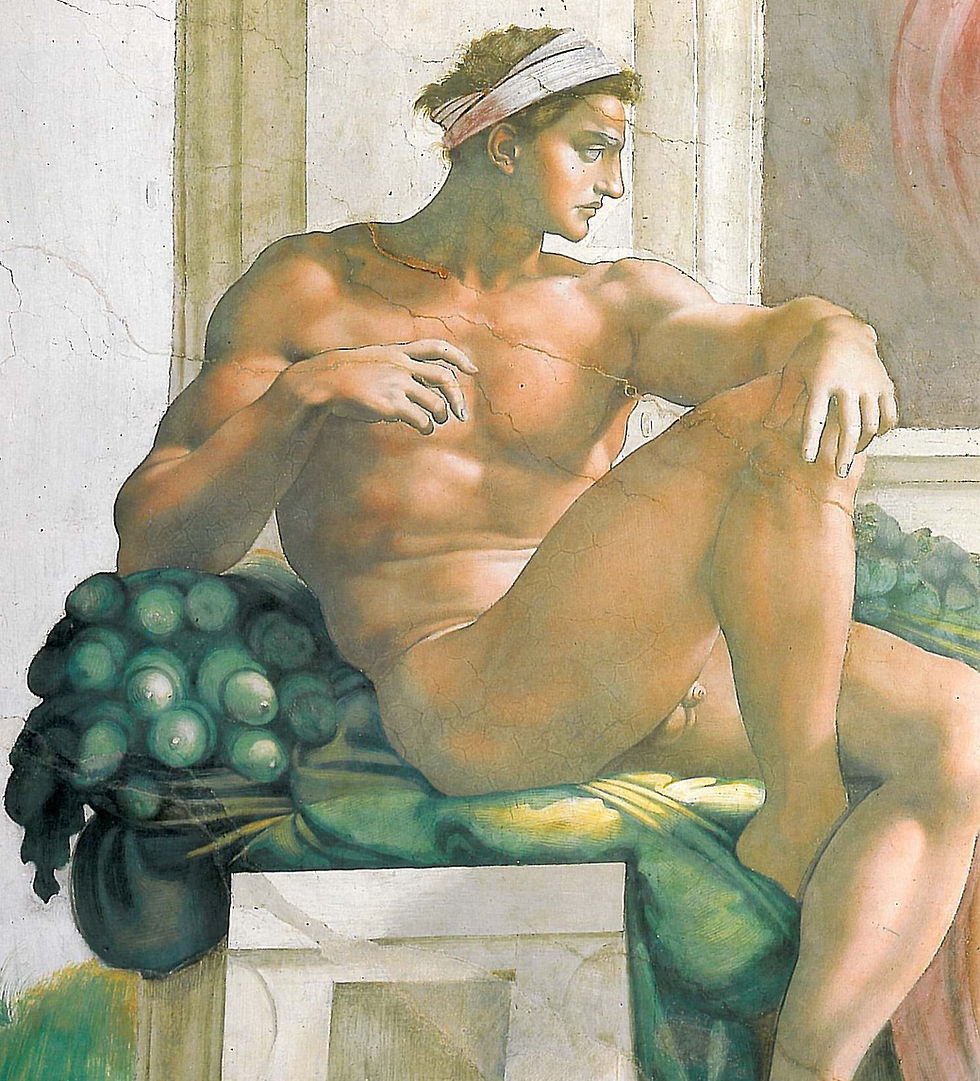
The ceiling contains nine large biblical scenes from the book of Genesis — the Creation of Adam being the most famous — running along the central axis. But the figures the contemporary visitor's eye most quickly catches are not the biblical scenes. They are the twenty male nude figures positioned around the edges of the architectural frame, holding garlands of oak leaves and seated on stone plinths. These figures are called the ignudi, and they have no specific biblical role. They are anatomy exercises at architectural scale.
The ignudi are the most direct visible record of the Santo Spirito years anywhere in Michelangelo's work. Every figure is a different pose. Every muscle group is rendered with the kind of confidence that comes only from having drawn the same body fifty times. The light in the Sistine Chapel is poor — Michelangelo painted in candlelight and the figures are now lit by very dim ambient light from the chapel's small windows — but even in low light the figures hold up. The bodies feel structurally true. The viewer's eye reads them as living anatomy seated on stone.
Most viewers do not notice the ignudi consciously. Most viewers come to see the Creation of Adam and the hand of God reaching toward the hand of man. But the ignudi are the figures that hold the entire architectural illusion of the ceiling together, and they are the figures in which Michelangelo's anatomy obsession is most directly visible. Vasari wrote that any other painter would have been satisfied with painting one or two of them. Michelangelo painted twenty.
The Last Judgment and the late style
Twenty-five years after he finished the ceiling, Michelangelo returned to the Sistine Chapel as a sixty-seven-year-old man to paint the altar wall. The commission was for the Last Judgment — Christ returning at the end of time to separate the saved from the damned. The painting took him five years (1536-1541) and is, in mood and in handling of the body, almost completely different from the ceiling above it.

The Last Judgment is approximately twenty metres tall by ten metres wide and contains nearly four hundred figures. Christ stands in the centre, his right arm raised in the gesture of separation, his body twisted in a posture of explosive movement. The saved rise on his right; the damned fall on his left. Around them swirl ranks of saints, martyrs, angels, demons, and the resurrected dead climbing out of their graves at the bottom of the picture. Every figure is anatomically built, and the entire painting is in motion.
The bodies in the Last Judgment are the same bodies as the ceiling ignudi, but the mood is harder. Michelangelo by 1536 had lost most of his early friends, watched the Sack of Rome in 1527, become a religious melancholic, and produced a body of poetry full of anxious self-examination. The painting was controversial almost immediately for the nudity — figures are nude where there was no biblical reason for nudity — and Pope Pius IV ordered the genitals painted over with drapery after Michelangelo's death. (The drapery was later removed in stages; some of it is still there.) The painting was understood at the time, and still is now, as the moment when Renaissance optimism about the human body began to give way to Counter-Reformation anxiety about it.
Why anatomy mattered
Anatomy mattered to Michelangelo because anatomy was the way he could make the picture true. Most painters of his generation were content to render bodies that read correctly at first glance. Michelangelo wanted bodies that would still read correctly when a viewer looked at the same painting for an hour — bodies whose internal structure would hold up under sustained attention. The only way to get that was to know what was happening under the skin.
This is why the late Michelangelo bodies feel different from the bodies of any other Renaissance painter. They are not handsome in the conventional sense. The muscles are sometimes too pronounced, the limbs sometimes too long, the proportions sometimes pushed beyond ordinary human range. But the structure beneath the surface is always exactly right. Michelangelo's bodies persuade not because they are beautiful but because they are anatomically possible. The viewer's eye, looking at them, recognises a real arrangement of bone and tendon and muscle even when the figure is doing something — flying, falling, twisting — that real bodies could not actually do.
In the seventeenth and eighteenth centuries, art-academy instructors used Michelangelo's figures as the standard against which student work was measured. A student who could draw a figure that held up next to a Michelangelo was considered ready. A student who could not was sent back to drawing class. The standard held for three hundred years. It only began to lapse in the late nineteenth century, when the academic system itself collapsed and figurative drawing stopped being a basic requirement of serious painting.
The sculptor inside
Michelangelo wrote, in a letter to a friend in 1542 when he was sixty-seven, that he had spent his life trying to free the figure from the marble in which it was already buried. The line is famous. What is less often remarked on is that he applied the same logic to painting. The figures in the Sistine ceiling and the Last Judgment were, to Michelangelo, already inside the wall; his job was to find the body that was buried in the plaster and pull it out. He painted with the same patient attention to internal structure that he carved with. The four-year strain of the ceiling project was, in his own description, the strain of doing sculpture on a flat surface with the wrong tools.
This is the simplest explanation of why his paintings still feel different from any other Renaissance frescoes when seen in person. The figures are not painted onto the wall; they are dug out of it. The viewer's eye, standing in the Sistine Chapel, reads the bodies as inhabiting a real internal volume rather than a flat decorative surface. The illusion is the result of a hundred small anatomical decisions Michelangelo had been making since he was seventeen, in the back room of the Santo Spirito hospital, by candlelight.
Key takeaways
Michelangelo dissected cadavers at the Santo Spirito hospital in Florence from roughly 1492 to 1495, between the ages of seventeen and twenty. The drawings have been mostly lost but the knowledge underwrites every figure he made afterward.
The David (1501-04) was carved from a block of marble two earlier sculptors had rejected as unworkable. The figure's proportions are slightly enlarged in the head and hands to read correctly from ground-level viewing — an early technical solution invisible to most viewers.
The Sistine Chapel ceiling (1508-1512) contains nine biblical scenes and twenty male nude figures (the ignudi) that hold the architectural illusion together. The ignudi are anatomy studies at architectural scale and the most direct surviving record of the dissection years.
The Last Judgment (1536-1541) on the Sistine altar wall returned Michelangelo to the same chapel as a sixty-seven-year-old man. The painting contains nearly four hundred figures, is dominated by Christ's gesture of separation, and was controversial for its nudity within months of completion.
Michelangelo always said he was a sculptor and not a painter. The paintings prove it: the bodies in the Sistine ceiling and the Last Judgment are sculpted on a flat surface, with the same patient attention to internal structure he gave to marble.
Academic painters used Michelangelo's figures as the standard for figure drawing from the seventeenth through the late nineteenth centuries. A student who could draw a figure that held up next to a Michelangelo was considered trained.
Browse Renaissance and figure-study prints in the archive at zocineartdesign.etsy.com.
New in the Journal: Holbein's Anne of Cleves: The Portrait That Arranged a Royal Marriage


Comments