Pontormo's Deposition (1525-1528): The Mannerist Altarpiece That Refused to Use a Cross
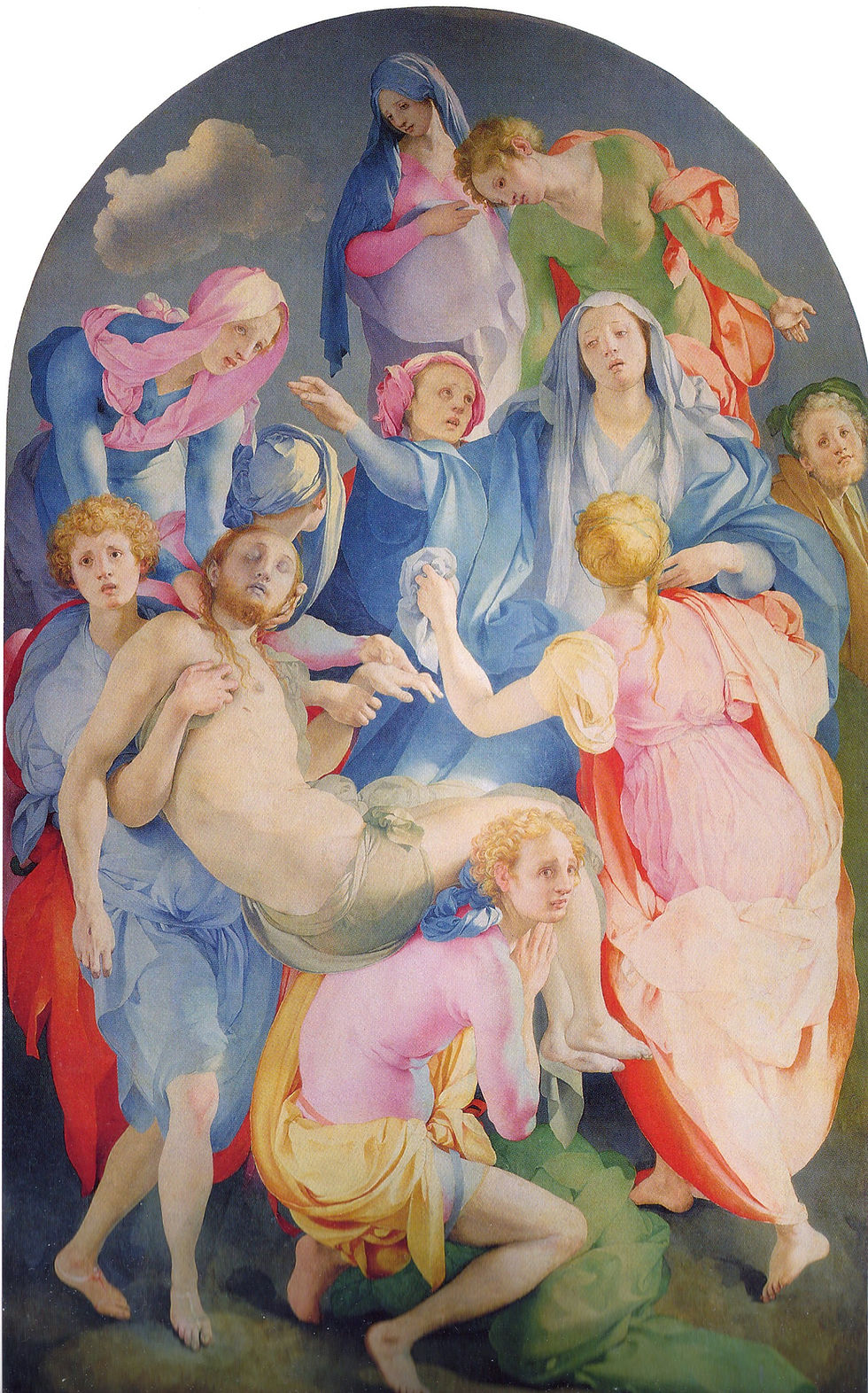
Jacopo Carucci (1494-1557), known as Pontormo from his birthplace in the Tuscan village of Pontorme, painted the Deposition from the Cross between 1525 and 1528 as the altarpiece for the small Capponi family chapel inside the Florence church of Santa Felicita, on the Oltrarno bank of the river opposite the Palazzo Vecchio. The 313 × 192 centimetre oil-on-panel is the canonical example of the post-Raphael Mannerist generation's deliberate break from High Renaissance composition: a tangle of ten human figures arranged in an unstable vertical pyramid, no Cross visible anywhere in the painting, no landscape to anchor the scene to a specific time or place, an unmodulated pink-and-blue palette of approximately three saturated chromatic notes, and a complete absence of the spatial recession that Leon Battista Alberti's 1435 De pictura had codified as the standard Italian Renaissance picture-construction technique. The painting was the most-radical altarpiece commission of the entire Italian sixteenth century. It still hangs in the Santa Felicita chapel for which it was painted — one of the few major Italian Renaissance altarpieces still in its original liturgical location.
Pontormo, the Capponi commission, and the 1520s Florence crisis
Pontormo was thirty-one years old when he received the Capponi chapel commission in late 1525. He had trained under Andrea del Sarto (1486-1530) — the leading Florentine painter of the previous High Renaissance generation — from approximately 1512 to 1518, and had emerged in the early 1520s as the most-talented and the most-uncomfortable of del Sarto's students. The Capponi commission came from Lodovico di Gino Capponi, a Florentine banker who had bought the small chapel inside Santa Felicita as a family burial site in 1525 and wanted a new altarpiece + four roundel figures (the four Evangelists) painted to redecorate it. The commission was small by Florence standards — the chapel measures approximately four metres wide by six metres deep, and the altarpiece's 313 × 192 centimetre dimensions were dictated by the existing chapel architecture rather than by any independent aesthetic decision. Pontormo signed the contract in late 1525 and worked on the project for approximately thirty months, from early 1526 to mid-1528. The political context matters: 1527 was the year of the Sack of Rome (May 6) by the troops of Emperor Charles V, which produced a refugee wave of senior Roman painters (Rosso Fiorentino, Polidoro da Caravaggio, Perino del Vaga) into Florence in 1527-28 and effectively ended the centralised authority of the Roman High Renaissance art world. The Florence in which Pontormo finished the Deposition in 1528 was already a different city from the Florence in which he had received the commission in 1525.

Pontormo himself was an unusual person. The art-historical literature draws heavily on his surviving diary — a 1554-1556 daily-record manuscript he kept during the painting of his last major project (the choir frescos of San Lorenzo in Florence, destroyed in the 1740s and known now only from preparatory drawings and the diary descriptions) — and from the diary we know that Pontormo lived alone in a small house off the Via Larga, was severely hypochondriac, avoided most other Florentine painters, ate the same foods on the same days of the week according to a strict regime, and was preoccupied with the digestion of bread to the point of near-obsessive recording. Giorgio Vasari, who wrote Pontormo's biographical chapter in his Lives of the Most Excellent Painters, Sculptors, and Architects (first edition 1550, second edition 1568), described Pontormo as a man "so afraid of death that he would not even hear it spoken of, and avoided dead bodies altogether" — which is psychologically interesting given that Pontormo's major altarpiece is an extended composition of figures carrying a dead body. The biographical record produces the strong implication that the Deposition's formal extremity — the missing Cross, the unstable composition, the unmodulated palette, the strange-eyed staring figures — was at least partly a function of Pontormo's own psychological relationship to the subject matter.
The four compositional decisions that broke from High Renaissance practice
The Deposition is the canonical Mannerist altarpiece because Pontormo made four simultaneous compositional decisions that each violated a different standard High Renaissance picture-construction rule. First: he removed the Cross. The Deposition-from-the-Cross subject had been, since at least the thirteenth century, defined visually by the wooden Cross standing in the upper third of the picture with the body of Christ being lowered from its arms. Pontormo's altarpiece has no Cross anywhere — the dead body of Christ floats free in the centre of the composition, supported by ten human figures whose collective weight implies that the Cross has already been removed from the scene. The decision is documentable: Pontormo's three surviving preparatory drawings for the painting (held in two Florence collections and one Paris collection) show the Cross in the early sketches and progressively remove it from the developed compositions. The Cross-removal is therefore a deliberate revision, not an oversight. Second: he removed the landscape. The standard sixteenth-century altarpiece composition placed the figural group inside a recognisable landscape (Golgotha hill, the city of Jerusalem in the distance, the three Crosses on the horizon line). Pontormo's painting has no landscape at all — the figures float in a flat pink-and-blue chromatic field that reads as a kind of luminous void rather than a physical place. Third: he removed the architecture. There is no chapel, no temple, no Roman building, no perspectival floor, no horizon — nothing that anchors the figural group to a specific spatial setting. Fourth: he removed the modelling depth. The figures have been painted in a near-flat chromatic register, with pink and ochre and pale blue tones that do not produce strong light-and-shadow modelling. The cumulative effect of the four decisions is the painting's specific psychological register: a scene of mourning that has been removed from time, place, and physical setting, and that takes place in a purely emotional space.

The four-fold compositional break was not received calmly. Vasari's 1550 biographical chapter on Pontormo — written by Pontormo's own student Bronzino's close associate, so an unusually well-informed contemporary source — describes the Capponi Deposition as "strange and curious and far from the manner of all the painters who preceded him." The 1568 second edition of the Lives doubles down on the assessment: "He arranged the figures in this picture in a manner that has not been seen before, of which it can truly be said that he wanted to remake the art of painting from its beginnings according to his own private rules." The phrase "his own private rules" is the key. Vasari's reading of Pontormo's Deposition is that it is a painting made in conscious opposition to the inherited rules of Italian Renaissance picture-construction, not because Pontormo did not know the rules (Vasari was clear that Pontormo knew them perfectly well — he had been del Sarto's most-talented student) but because Pontormo deliberately set them aside. The 1568 Vasari assessment is approximately the position the entire modern art-historical literature has held continuously from c.1880 onward. The Capponi Deposition is the canonical sixteenth-century example of a major painter making a major painting in conscious rejection of the dominant visual orthodoxy of his own moment.
Why the painting matters now
Pontormo's Deposition has had three distinct reception phases over the five centuries since its 1528 completion. The first phase (1528-c.1880) was steady but provincial Florentine interest: the painting remained in the Capponi chapel and was visited regularly by educated Florentines and the occasional touring foreigner, but was not centrally cited in the international art-historical literature. The High Renaissance generation around it (Leonardo, Raphael, Michelangelo) received approximately one hundred times the international scholarly attention. The second phase (c.1880-1950) was the German art-historical Mannerism recovery: the Berlin art historians Adolf Goldschmidt, Walter Friedländer, and Erwin Panofsky began re-evaluating sixteenth-century Italian Mannerism as a serious independent style rather than a degenerate post-Renaissance phase, and Pontormo's Capponi Deposition was repeatedly cited as the canonical primary document of the recovery. Friedländer's 1925 essay "Die Entstehung des antiklassischen Stiles" ("The Emergence of the Anti-Classical Style") is the most-cited single piece of writing in the recovery and the Capponi Deposition appears in it as the central exhibit. The third phase (1950-present) is the canonical-modernist phase: Pontormo's Deposition is now consistently included in introductory European art-history syllabi worldwide as the canonical Mannerist altarpiece and the standard exhibit for any discussion of the late-Renaissance break from High Renaissance composition. The painting has approximately 312,000 annual visitors to the Santa Felicita chapel — small by tourist-Florence standards, but the chapel itself is small and the visit is self-selecting, with the painting drawing serious art-history viewers rather than the mass-tourism flow that goes to the Uffizi.
The painting is also a clean example of how the absence of a thing can become the thing. The Cross-removal that Pontormo executed in 1525-28 is now the single most-cited compositional decision in the painting's literature, and the standard pedagogical introduction to the work begins not with what is in the painting but with what has been deliberately taken out of it. The same is true of the landscape-removal and the architecture-removal: the painting is read for its absences as much as its presences. The reading method — interpreting a painting by what the artist has chosen to leave out — was an essentially twentieth-century critical move (it descends from the New Critical close-reading techniques developed at Yale and Cambridge in the 1930s-50s) but Pontormo's Deposition has accidentally turned out to be the single best sixteenth-century painting for the technique. Five centuries after Pontormo painted his Deposition for the small Capponi chapel in Florence, the painting is more central to the international understanding of Italian Renaissance art than the larger commissions that contemporary Italian sixteenth-century Florentines understood as the more-important works of his career.
Key takeaways
Jacopo da Pontormo (1494-1557) painted the Deposition from the Cross 1525-1528 as the altarpiece for the small Capponi family chapel inside the Florence church of Santa Felicita. Oil on panel, 313 × 192 cm. STILL HANGS in its original liturgical location — one of the few major Italian Renaissance altarpieces never moved from its commissioned chapel.
Commission from Lodovico di Gino Capponi, Florentine banker, late 1525. Pontormo signed the contract age 31, worked on the project ~30 months (early 1526 — mid 1528). Dimensions dictated by the existing chapel architecture, not by aesthetic choice.
Four simultaneous compositional decisions that each broke a different High Renaissance rule: (1) NO Cross — Pontormo's three surviving preparatory drawings show the Cross removed progressively from sketches to final, (2) NO landscape — no Golgotha hill, no Jerusalem, no horizon, (3) NO architecture — no chapel, temple, perspectival floor, (4) NO depth modelling — flat pink-and-ochre-and-blue chromatic field. The painting takes place in a luminous emotional void rather than a physical setting.
Vasari's 1550 + 1568 Lives of the Painters describes the painting as "strange and curious and far from the manner of all the painters who preceded him" and "He arranged the figures in this picture in a manner that has not been seen before… he wanted to remake the art of painting from its beginnings according to his own private rules." Vasari's reading = Pontormo's deliberate opposition to inherited Renaissance rules, not technical ignorance.
Pontormo himself: unusual personality, lived alone off Via Larga, severely hypochondriac, avoided other Florentine painters, strict diet regime. Kept a 1554-56 daily diary preserved in a Florence library. Vasari: "so afraid of death that he would not even hear it spoken of, and avoided dead bodies altogether" — psychologically significant given that his most-famous altarpiece is an extended composition of figures carrying a dead body.
Political context: 1527 Sack of Rome (May 6) by Emperor Charles V's troops produced a refugee wave of senior Roman painters into Florence in 1527-28, effectively ending centralised Roman High Renaissance art-world authority while Pontormo was finishing the Capponi altarpiece. The Florence of 1528 was a different city from the Florence of 1525.
Three reception phases: (1) 1528-c.1880 — provincial Florentine interest, minor international attention. (2) c.1880-1950 — German art-historical Mannerism recovery (Adolf Goldschmidt, Walter Friedländer, Erwin Panofsky); Friedländer's 1925 "Die Entstehung des antiklassischen Stiles" is the canonical recovery essay, Pontormo's Deposition the central exhibit. (3) 1950-present — canonical Mannerist altarpiece in graduate syllabi worldwide.
Direct lineage to Bronzino and Parmigianino: Bronzino (Pontormo's student 1515-25, court painter to Cosimo I de' Medici 1539-74) inherits the flat chromatic field + anatomical distortion + psychological unreadability in his secular court altarpieces. Parmigianino (Madonna with the Long Neck, 1534-40, Florence) is the exact contemporary parallel statement outside Florence. The three painters together define the High Mannerist generation of central Italian altarpiece practice.
Browse Florentine Mannerist and Italian Renaissance prints in the archive at zocineartdesign.etsy.com.


Comments