Powder Room Wall Art: Six Small-Scale Compositions
The powder room is the smallest, most concentrated wall in the house. A guest is in the room for ninety seconds. They face one wall. There is no second focal point, no sofa, no shelf, no view. The art either earns the space or it doesn't.
Six painting choices that earn it — small enough to read at a glance, considered enough to hold up to close looking, and quiet enough that the room reads as composed rather than decorated.
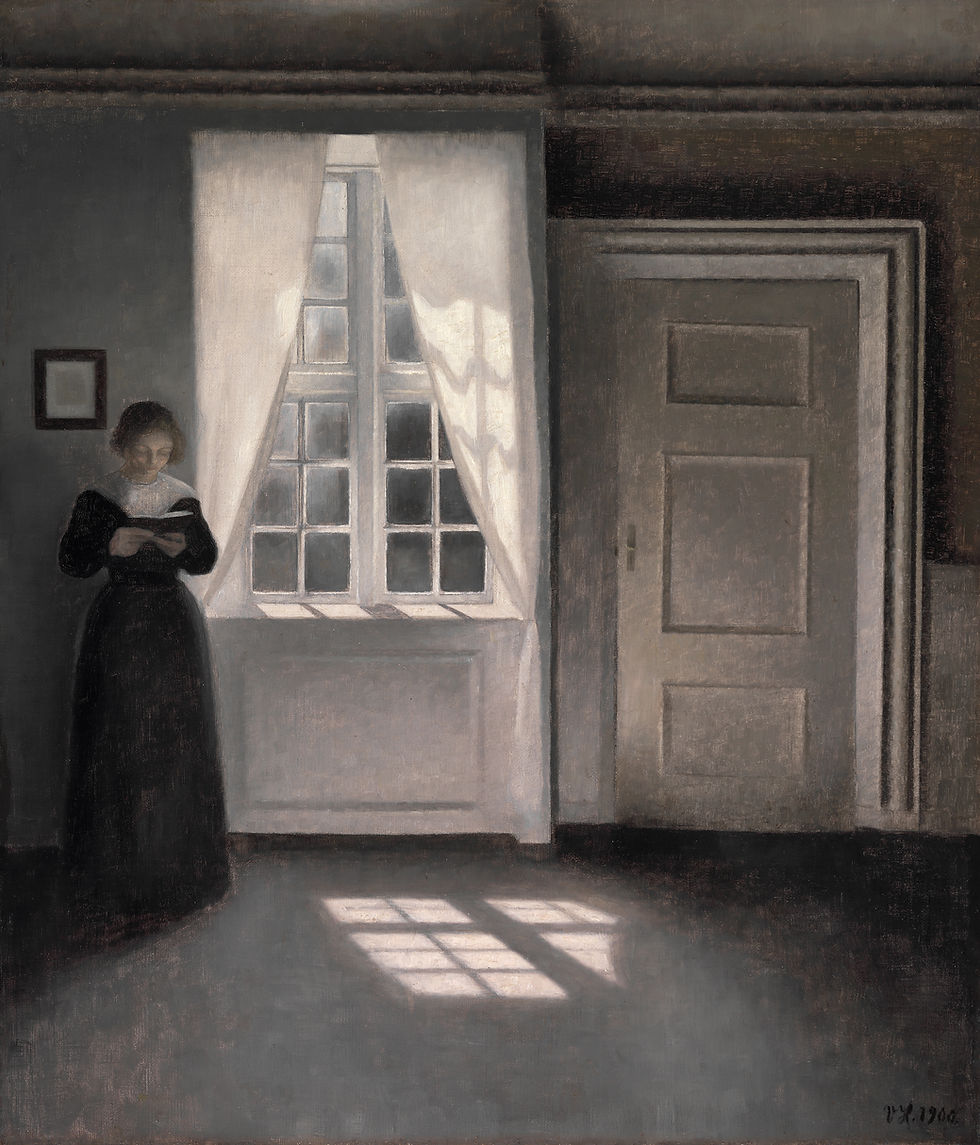
1. A single small Hammershoi interior
Vilhelm Hammershoi painted the inside of his own Copenhagen apartment for twenty-five years. The interiors are almost always small in scale, almost always quiet — empty rooms, a doorway, a back-turned figure, a single shaft of sunlight on a wooden floor. Hung in a powder room, a small Hammershoi reads as an extension of the room itself: a quiet, considered, slightly grey-cream interior, hung inside another quiet, considered, slightly grey-cream interior.
Frame him in matte black or unfinished oak. Keep the print under eleven inches on the long side. He works best at the height of the eye when standing, not above the basin.
2. A small Cassatt portrait

Mary Cassatt's smaller portraits — a girl reading, a woman taking tea, a mother bathing a child — read at any size. The faces are constructed to hold attention at six inches across as easily as at thirty. Choose one of the quieter prints (not the Boating Party, not the Child's Bath — those are landscape-format crowd-pieces). A single seated figure, a single book, a single cup. Cassatt taught herself this from late Edo Japanese woodblocks; the prints work in tight spaces because they were built from prints made for tight spaces.
3. A Hokusai woodblock, single image

Powder rooms are the natural home of single Japanese woodblocks. The prints were designed for small-room display — they read at a glance from across a tatami room and reward minutes of close looking once you are standing in front of them. A single sheet from Hokusai's 36 Views of Mount Fuji or Hiroshige's 100 Famous Views of Edo, in a thin black frame, hung at eye level, becomes the powder room's whole personality.
Avoid the temptation to triple them up into a grid. One sheet is more powerful than three. The powder room is too small to read a grid as anything but pattern.
4. A small Whistler nocturne

James McNeill Whistler's Nocturnes are dark, restrained, almost monochromatic small paintings of London and Venice at night. They were already small in the original — Whistler made them at a scale that suited the parlour walls of his clients. Reproduced as a small framed print, hung against a deep paint colour, a Whistler nocturne turns a powder room into something closer to a candle-lit room in a townhouse.
This is the one anchor on the list that genuinely benefits from a darker wall behind it. Painted-out powder rooms (deep teal, slate, midnight blue) are made for the Whistler treatment.
5. A single Caravaggio scholar
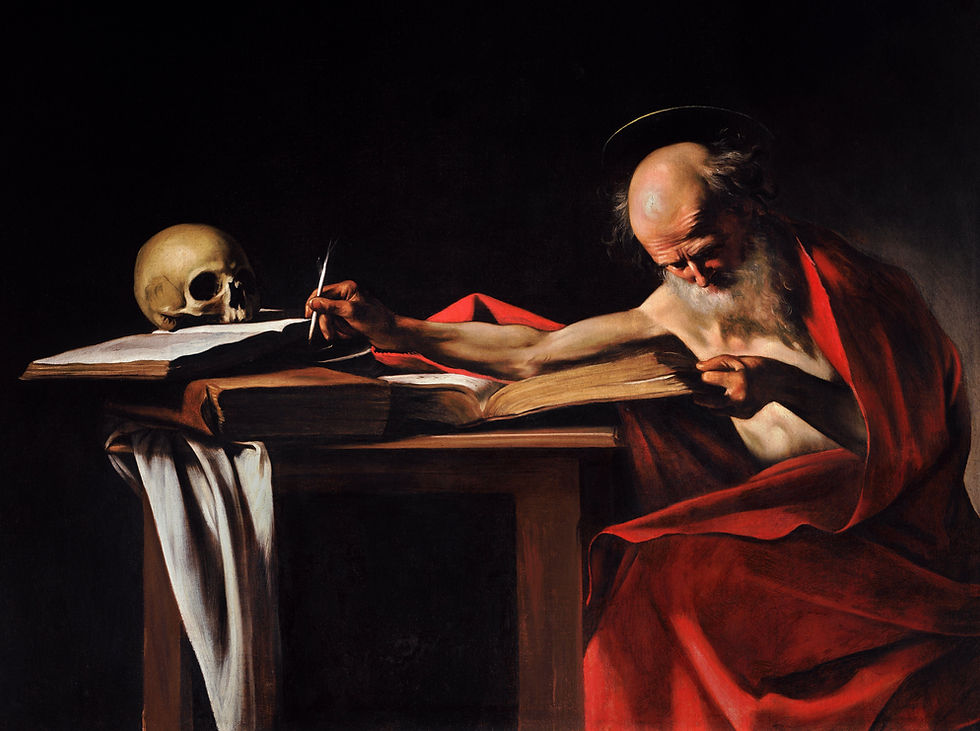
This one surprises people. Caravaggio is associated with enormous, dramatic, dark church paintings — Calling of Saint Matthew, Supper at Emmaus, Judith Beheading Holofernes. But his portrait-sized scholar pictures — Saint Jerome Writing, Saint Francis in Meditation — are intimate, small-scale, deeply private. They translate to small prints better than almost any other Baroque painter's.
The Saint Jerome works because the powder room and the cell are the same scale. A single figure, a desk, a book, a skull, one candle. The room becomes a small, private, considered space.
6. A single Renoir portrait

Renoir's small portraits — a girl reading, two sisters at a table, a child with a watering can — are the warmest single objects on this list. They are not landscape. They are not crowded. They are not loud. A Renoir at twelve inches square, framed in plain oak or walnut, brings a small concentrated warmth into a room that is otherwise hardware (taps, mirror, light fixtures).
Pair with one of the cooler anchors above (Hammershoi, Whistler, Hokusai) if you want a powder room that reads as two-colour: one warm portrait, one cool tonal painting, the rest of the room neutral.
Choosing rules for the powder room wall
Single image, not a grid. A grid reads as pattern at this scale.
Hang at standing eye level. The powder room is read standing, not sitting.
Frame in matte black, unfinished oak, walnut, or thin brass. No ornate gilt frames — they fight the small space.
Mat generously. A wide mat (two to three inches around an eight-by-ten print) makes a small print feel considered rather than tentative.
Resist over-coordinating. The painting should not match the towel colour. It should be its own thing.
Key takeaways
The powder room is the smallest, most concentrated wall in the house — it rewards single, small-scale, considered prints over groupings.
Six painting families work especially well at this scale: Hammershoi interiors, Cassatt portraits, Hokusai or Hiroshige woodblocks, Whistler nocturnes, Caravaggio scholar portraits, small Renoir portraits.
Choose one image, not a grid. Frame in matte black, oak, walnut, or thin brass. Mat generously. Hang at standing eye level.
Darker paint colours behind the print extend the range of what works — Whistler nocturnes in particular need a darker wall.
The painting should be the room's only decorative argument. Everything else in the powder room is hardware.
Featured prints
Vilhelm Hammershoi, Sunlight on the Floor — zocineartdesign.etsy.com/listing/1145509895
Mary Cassatt, Young Woman Reading — zocineartdesign.etsy.com/listing/1864743357
Katsushika Hokusai, Fine Wind, Clear Morning (Red Fuji) — zocineartdesign.etsy.com/listing/1858260434
James McNeill Whistler, Nocturne in Black and Gold — zocineartdesign.etsy.com/listing/1269609092
Caravaggio, Saint Jerome Writing — zocineartdesign.etsy.com/listing/982346924
Pierre-Auguste Renoir, Young Girl Reading — zocineartdesign.etsy.com/listing/1261335386
Browse the full archive at zocineartdesign.etsy.com.

Comments