Quentin Massys and the Strange Story of The Ugly Duchess
Updated: Aug 1
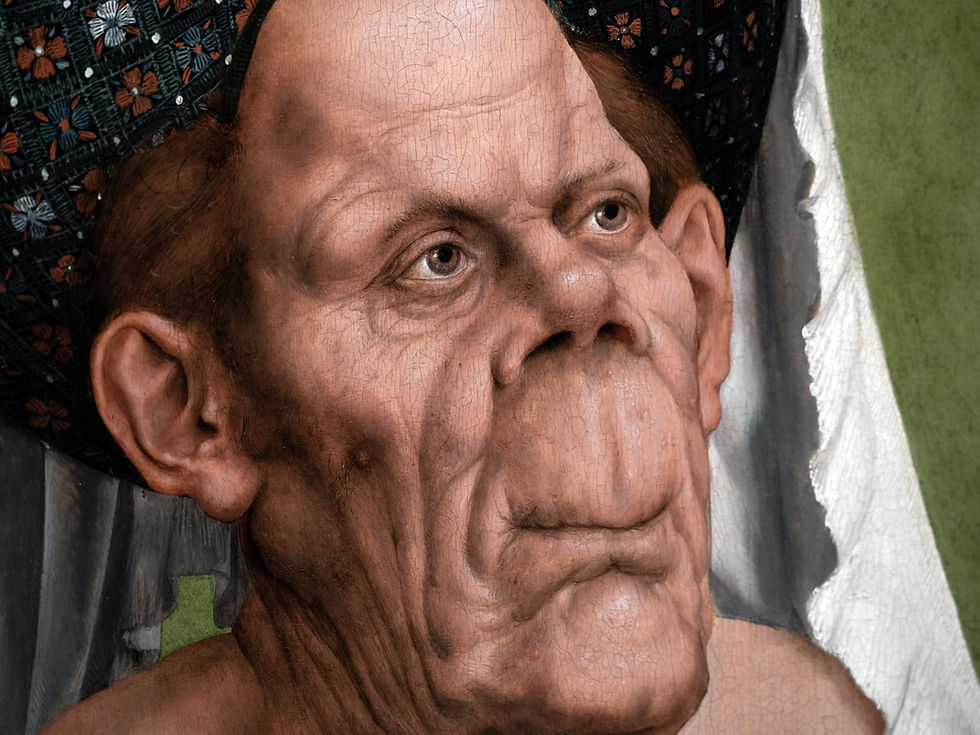
Quentin Massys's so-called Ugly Duchess is a small painting — sixty-four by forty-five centimetres on an oak panel — and one of the strangest portraits in Northern Renaissance art. An elderly woman with deep wrinkles, a flat nose, a protruding lower jaw, and skin thickened across her brow and chin sits looking slightly to the viewer's left. She wears the elaborate horned headdress of a Burgundian noblewoman from a fashion two generations out of date. Her shoulders bulge under tight red velvet. Her cleavage is exposed. She holds a small rose in her right hand, its petals just opening. The painting was made around 1513 in Antwerp by Quentin Massys, the most prominent painter in the city, and it now hangs in a London collection.
Most viewers who have seen the painting have seen it without knowing that — they have seen John Tenniel's 1865 wood-engraving of the Duchess from Alice's Adventures in Wonderland, who is Tenniel's direct copy of the Massys panel, who is the source for every Duchess in every Disney adaptation since 1951. The painting has been hiding in plain sight for over a century inside another book that is itself hiding inside a film franchise. This is the story of how that happened, and of the strange medical reading the painting has acquired over the last seventy years.
The painter and the picture
Quentin Massys was born in 1466 in Leuven, in what is now Belgium, and trained as a blacksmith before turning to painting in his twenties. He moved to Antwerp around 1491, joined the painters' guild there as a master in the same year, and worked in the city for the rest of his life. By 1500 he was the most commercially successful painter in Antwerp — a city that was, in the early sixteenth century, the largest port in Europe and the wealthiest centre of Flemish art outside the older Bruges school. He died in Antwerp in 1530. His major works include large altarpieces for the city's cathedrals, a small group of formal portraits of humanist scholars (Erasmus and Pieter Gillis sat for him in 1517), and a smaller group of moralising genre pictures — money changers, ill-matched lovers, a usurer and his wife — that established the satirical-genre tradition Pieter Bruegel the Elder would inherit a generation later.
The Ugly Duchess sits between two of these traditions. It is composed as a formal half-length portrait — the same scale and pose Massys used for his Erasmus — but the sitter is grotesque in the way the moralising genre pictures are grotesque. The picture's earliest documented title, in a seventeenth-century inventory, is A Grotesque Old Woman. The title The Ugly Duchess is nineteenth-century, attached to the painting only after Tenniel's Alice illustrations made the image a Duchess in popular imagination.
The moralising reading: vanity, late in the day
The painting's first life is as a moralising allegory. By 1513 the horned headdress (the hennin) had been out of high fashion in the Burgundian-Flemish courts for at least two generations. Massys's sitter is wearing the clothes of her own grandmother's youth, sometime around 1450, but is herself an elderly woman in 1513. The dress is too tight. The bodice exposes a chest that is no longer a young woman's chest. The rose, in the visual vocabulary of the period, is the standard emblem of feminine beauty offered to a lover — a woman holds out a rose, in dozens of contemporary portraits, to signal availability and desire. An elderly woman in outdated finery offering a rose was a fixed satirical type in early sixteenth-century Flemish painting and literature; the image was used to allegorise vanity, the refusal to age gracefully, the persistence of desire past the body's capacity to act on it.
There may have been a male pendant. Several inventories from the seventeenth century list the Ugly Duchess alongside a male portrait — sometimes identified as a satirical Old Man by Massys, sometimes as a piece by a different Flemish hand — in which the man also wears outdated finery and is also holding a flower. The pendant arrangement would have made the satire mutual: the painting becomes a mésalliance or ill-matched lover picture, a category Massys returned to multiple times, in which two old people preen at each other in clothes they should no longer be wearing. The Old Man currently identified as the pendant is in a Paris collection. The two paintings have not hung together since the seventeenth century.
The Leonardo connection: a Flemish painter copying an Italian sketchbook
The second life of the painting begins with the observation, made in print first by Ludwig Goldscheider in 1944, that the Ugly Duchess is structurally similar to a Leonardo da Vinci drawing of a grotesque profile. Leonardo had spent his career — particularly his Milan years in the 1490s — making small drawings of deformed or caricatured faces, which he called teste grottesche, grotesque heads. He used them as exercises in physiognomic extremes; the standard reading is that Leonardo, who had absorbed the late-medieval theory that the face revealed the soul, was testing the limits of that theory by drawing faces at the limit of human variation. Around twenty of the sketches survive.

One of these drawings — known from a copy now in a Royal Collection at Windsor and from several other copies that circulated in the early sixteenth century — shows an elderly woman in profile with a flat nose, a protruding jaw, a thickened brow, and the same generally simian facial structure that appears in Massys's Ugly Duchess. The compositional parallels are too close to be coincidence. Leonardo had drawn it, probably in Milan in the 1490s. Massys, painting in Antwerp around 1513, must have had access to a copy. The route is the painter Francesco Melzi, Leonardo's pupil and heir, who kept Leonardo's drawings after his death in 1519 and lent or sold copies to Flemish artists through the 1520s; alternatively, the drawing may have travelled to Flanders earlier through one of the Italian or Flemish merchants moving between Milan, Antwerp, and Bruges in the first decade of the sixteenth century.
The Massys-Leonardo connection means that the Ugly Duchess is not, as it appears, a portrait of a specific Flemish noblewoman observed from life. It is a Flemish translation of an Italian theoretical drawing into a finished portrait — a grotesque profile exercise turned into a moralising allegory by adding the period clothes, the rose, the half-public setting. Massys took Leonardo's anatomical sketch and made it into a Northern Renaissance social comment. The picture is, in this reading, the only finished oil painting that survives anywhere in Europe based on a Leonardo grotesque head.
Tenniel and Alice: the Duchess enters the English language
The painting's third life began in 1865. The Oxford mathematician Charles Dodgson, writing under the name Lewis Carroll, had just finished the manuscript of Alice's Adventures in Wonderland and had hired the political cartoonist John Tenniel to illustrate the first edition. Among the figures Carroll's text required was a peppery Duchess who appears in chapter six holding a screaming baby that turns into a pig. Tenniel needed a face. He went looking in the visual archive and, with or without Carroll's input, found Massys's painting — at the time owned by the Earl of Carlisle and on view in the National Gallery in London.

Tenniel's Duchess is recognisably the Massys panel in a different medium. The horned headdress is identical. The protruding jaw, the flat nose, the heavy brow, the thickened lips — all transferred directly from oil panel to wood engraving. The rose is gone; a baby has taken its place. The clothes have been adjusted to the English mid-Victorian sense of "medieval costume." The pose is reversed left to right because Tenniel's engraving block printed in mirror. Otherwise the Duchess is a Tudor-era Antwerp moralising portrait re-staged as a Victorian children's-book character.
The Disney adaptation of Alice in Wonderland in 1951 used Tenniel's Duchess as its model. The Tim Burton film of 2010 used both Tenniel and the Disney version. Every Alice Duchess in every translation, every illustrated edition, every theatrical adaptation, every animated version since 1865 descends, by a chain of copies, from Quentin Massys's small Antwerp panel of 1513. The painting has been circulating, mostly unrecognised, for one hundred and sixty years inside one of the most-reproduced English-language children's books ever written.
The medical reading: Paget's disease, by way of a 1950s pathologist
The painting's fourth life began in 1950, when the British medical journal The Lancet published a letter from the pathologist Michael Baum proposing that the Ugly Duchess's facial structure was not a fanciful Leonardo invention but the documented appearance of advanced Paget's disease of bone. Paget's disease, named for the British surgeon Sir James Paget who first described it in 1877, is a chronic disorder of bone remodelling in which old bone is broken down faster than new bone is laid down to replace it. The condition produces, in the skull, exactly the pattern visible in the painting: thickening of the frontal bone above the eyes, enlargement of the maxilla (upper jaw), forward protrusion of the mandible (lower jaw), and broadening of the nasal bones.
The 1950 letter started a small medical literature. Articles in Annals of Internal Medicine, Plastic and Reconstructive Surgery, and The British Medical Journal over the following decades agreed: the Duchess's skull is anatomically consistent with advanced Paget's. The picture was, in this reading, not a moralising allegory or a copy of a Leonardo grotesque — it was a clinically accurate portrait of a real woman with a real disease, painted before the disease had a name. Leonardo's earlier drawing of the same face type, by this argument, was also drawn from life: somewhere in late-fifteenth-century Milan was a woman with the same condition, and Leonardo drew her, and Massys re-staged the drawing as a finished portrait.
Whether the 1950s medical reading is correct is still contested. Some art historians find the diagnosis-from-painting move methodologically slippery: it treats Renaissance pictures as photographs, ignores the satirical-genre framing, and reads symptoms back into the painting without accounting for the painter's stylistic choices. Other art historians have accepted the reading. The current National Gallery wall text leaves the question open. What the case demonstrates is that a single small Flemish panel can carry four entirely different readings — moralising allegory, Italian-source copy, English literary monument, medical specimen — and that none of the readings cancels the others. The painting can be all four at once.
Why the Ugly Duchess endures
Most paintings of 1513 have settled into a single reading by now. They are altarpieces, or portraits of named patrons, or genre scenes, and the art-historical apparatus has decided what they mean and where to file them. The Ugly Duchess has resisted that filing for five hundred years. It is one of a small set of European paintings — Bosch's Garden of Earthly Delights, Holbein's Ambassadors, Velázquez's Las Meninas, Goya's Black Paintings — that keep generating new readings because they are formally complete in themselves and structurally underdetermined as content. The picture shows what it shows. The viewer has to bring the frame.
This is what art historians mean when they call a painting rich. The Ugly Duchess is rich because Massys built it as a moralising allegory but used a Leonardo source whose theoretical commitments cut across the moralising frame, and because the resulting image was strange enough to attract Tenniel three hundred and fifty years later, and clinical enough to attract a pathologist four hundred and thirty years later. The painting absorbs each new reading without losing the previous one. It is the same panel that hung in the Carlisle collection in 1860, that hangs in the London collection now, and that will keep generating new readings as the next centuries find new things to look for in it.
Key takeaways
The Ugly Duchess (c. 1513) is a small Flemish panel by Quentin Massys (1466-1530), painted in Antwerp, showing an elderly woman in a horned headdress holding a half-opened rose. The earliest documented title is A Grotesque Old Woman; the title "Ugly Duchess" is nineteenth-century.
The painting's first reading is as a moralising allegory of vanity: an elderly woman in outdated finery offering a rose was a fixed Flemish satirical type for the refusal to age gracefully. A male pendant — a satirical Old Man — may have hung beside it as a ill-matched-lovers picture.
Massys's source for the face is a Leonardo da Vinci grotesque-head drawing (one of the teste grottesche) made in Milan around 1500. Copies of Leonardo's drawings reached Antwerp through Francesco Melzi or Italian merchants; the Ugly Duchess is the only finished oil painting based on a Leonardo grotesque that survives.
John Tenniel used the Massys panel as the direct source for his 1865 Duchess illustration in Lewis Carroll's Alice's Adventures in Wonderland. Every subsequent Alice Duchess — including Disney's 1951 animation and Tim Burton's 2010 film — descends by a chain of copies from the Massys painting.
In 1950 the pathologist Michael Baum proposed in The Lancet that the Duchess's facial structure was anatomically consistent with advanced Paget's disease of bone, named for the British surgeon Sir James Paget who first described the condition in 1877. The medical reading is still contested but has appeared in serious peer-reviewed journals.
The Ugly Duchess endures because it carries four entirely separate readings — moralising allegory, Italian-source copy, English literary monument, medical specimen — without any one of them cancelling the others. The painting is formally complete and structurally underdetermined; each century brings a new frame, and the picture absorbs it.
Browse Northern Renaissance and Flemish prints — Massys, van Eyck, Bosch, Bruegel — in the archive at zocineartdesign.etsy.com.
New in the Journal: Raphael's School of Athens: A Walking Catalogue of Ancient Philosophy


Comments