Rain, Glass, Cobblestones: How Hiroshige Built a City from Rain
- Zocine Art
- Jun 25
- 3 min read
Almost every cartoon rainstorm you have seen since 1900 began here. Diagonal black lines across a yellow sky. A wooden bridge soaked through. Figures bent under conical straw hats, hurrying. The print is small, the size of a placemat. The rain inside it is enormous.
This is Utagawa Hiroshige's Sudden Shower over Shin-Ohashi Bridge and Atake, carved as a woodblock print in 1857. It is the fifty-eighth plate of his last great series, One Hundred Famous Views of Edo. Hiroshige died the year after he finished it.

Utagawa Hiroshige, Sudden Shower over Shin-Ohashi Bridge and Atake, 1857.
What is happening in the print
A shower has arrived over the Sumida River. The view looks south from the eastern bank. The Shin-Ohashi (the New Great Bridge) crosses the frame as a diagonal. Five figures cross it. Each one is alone in his own race against the weather.
On the far bank, the rice warehouses of the Atake district sit half hidden by the downpour. A single boat is being poled away from the bridge. The river itself is a strip of dark green-grey. The sky above is the famous yellow that Hiroshige used to mean: the storm is breaking.
The rain itself is the subject. It crosses every other element. It collapses distance. It makes the bridge wet, the river busier, the warehouses softer. There is no hierarchy in the composition. The rain is in charge.
How a print is made of rain
A woodblock print is built in passes. One block carves the outlines. Each color gets its own block. The artist hands the master drawing to the carver, who cuts away the negative space. The printer then inks and presses each block onto the same sheet, in sequence.
Rain is the hardest pass. The lines must be perfectly thin, perfectly straight, perfectly parallel. They must not break. They must not blur. They are carved into a piece of cherry wood the size of the printed sheet, by hand, with a small knife. One slip and the entire block is wasted.
Hiroshige had carved rain on earlier prints. Night Rain at Karasaki (about 1835) was his first serious attempt. The lines there are softer, more vertical, drawn more like falling threads than streaks. By 1857 he had found the answer: cut the rain at a diagonal, vary the spacing slightly, run a few lines all the way across the image, end others short. The eye reads the difference as wind.
Almost no one had done this before. Almost everyone has done it since.
The companion print
The One Hundred Famous Views of Edo is a series. Each plate stands alone, but they answer one another. Two months after the Shin-Ohashi shower, Hiroshige carved the Plum Garden in Kameido: a single dark plum branch slashes across a vivid pink sky, the orchard fading behind it.
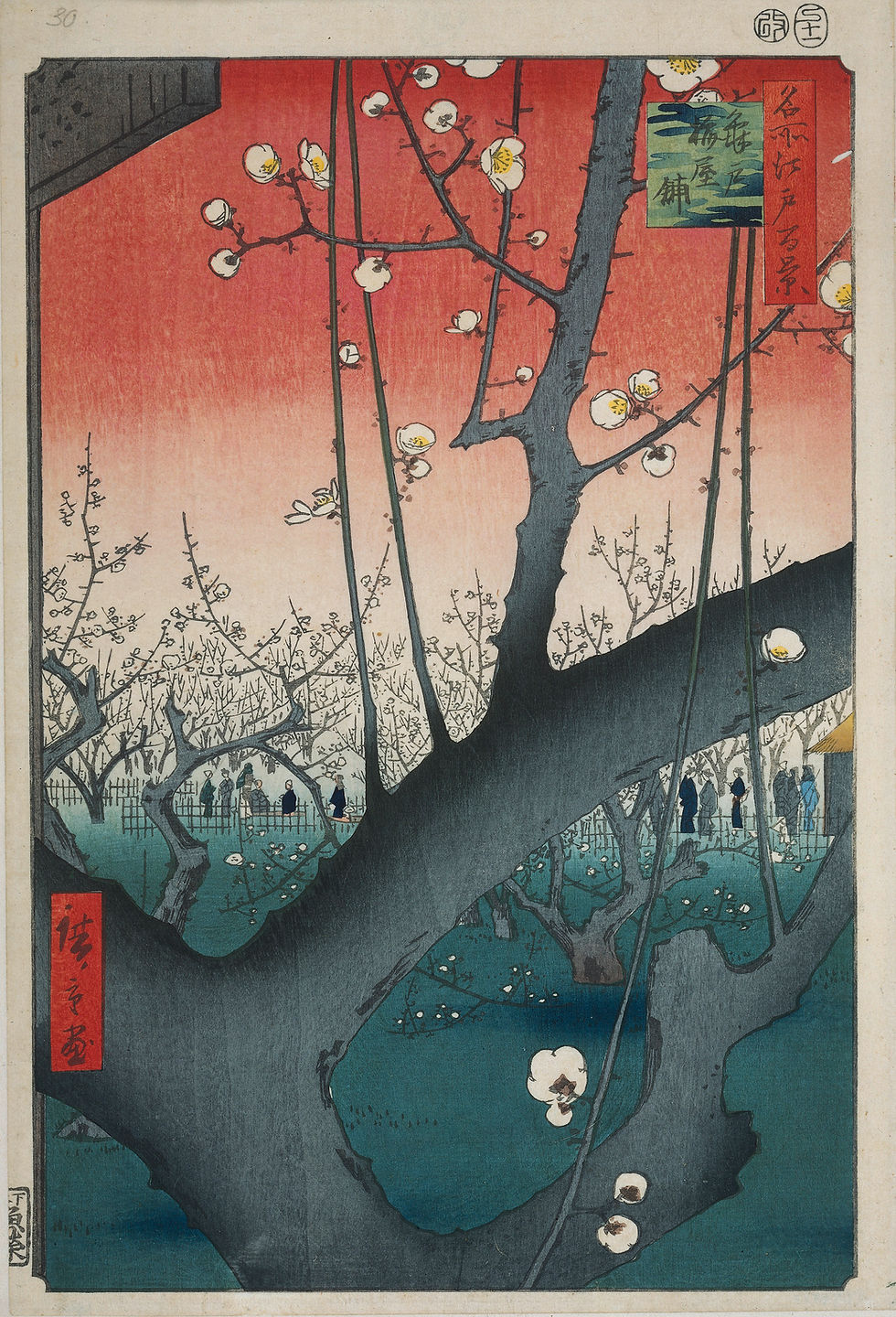
Utagawa Hiroshige, The Plum Garden in Kameido, 1857. The companion print.
Both prints share the same trick. A near object lays a strong diagonal across the entire frame. The far world is whispered behind it. This is the move that Van Gogh stole when he copied the Plum Garden in oil in 1887: the world reduced to a foreground gesture and a softer backdrop.
Hiroshige's rain print taught Europe how to crop. The diagonal cropping of late Impressionism, the off-center compositions of Degas and Whistler, the woodblock-flat shapes of Vuillard and Bonnard: all of them traveled out of Edo on the same ship.
Why it still works today
Open Pinterest. Search for "rainy day painting." You will see hundreds of prints that copy the trick of the diagonal streak across a yellow sky. They were copied from Disney. Disney copied them from European illustration. European illustration copied them from Hiroshige.
The technique works because it does what real rain does. It reads as direction. It reads as time. It reads as weight. And because the print is small and the rain is so legible, the eye accepts the abstraction immediately. Then the figures on the bridge become real. Then the warehouses become real. Then you remember that you have been caught in a sudden shower yourself.
A note for collectors
Original 1857 impressions of the Shin-Ohashi rain print exist in roughly two hundred public collections worldwide and command five-figure prices at auction. Fine prints of the image are another matter. Hiroshige carved the work to be printed; reprints of the woodblock and reproductions of the design have been in continuous production for a century and a half. A well chosen reproduction, printed on cotton paper at the original size, framed with a deep mat in oak or black wood, returns a room to the year 1857.
Browse the full archive of Japanese woodblock prints at zocineartdesign.etsy.com.
Reading this on a dry afternoon? Look out the window first.


Comments