Van Eyck's Arnolfini Portrait (1434): The Single Painting That Contains Six Different Riddles in One Convex Mirror
Jan van Eyck (c.1390-1441) painted what is now called the Arnolfini Portrait in 1434 in his Bruges workshop, almost certainly on commission from the Italian merchant Giovanni di Nicolao Arnolfini for an unknown purpose that has been debated continuously for almost six hundred years. The 82.2 × 60 centimetre oak-panel painting in oil and tempera shows two figures — a man in a dark plum cloak and a woman in a green wool gown — standing in a wood-floored Bruges merchant's bedroom in front of a curtained four-poster bed; a small dog stands between them, a single brass chandelier holds a single lit candle in daylight, ten oranges are scattered on the window-sill and the small chest beside the bed, and a six-circle convex mirror on the rear wall reflects the room's interior plus two additional figures standing at the painting's threshold whom the rest of the composition does not see. Above the mirror Van Eyck has signed the painting in elaborate Latin script: Johannes de Eyck fuit hic 1434 — "Jan van Eyck was here, 1434."

Six unresolved riddles, six centuries of debate
The Arnolfini Portrait is the most-discussed single image of fifteenth-century Northern European painting and has held that position approximately since the 1842 acquisition by its current London collection. The art-historical literature contains six distinct unresolved interpretive debates that recur across the secondary literature continuously from c.1900 to the present. First: WHO is the woman? The man is identified as Giovanni di Nicolao Arnolfini, the Lucca-born Bruges merchant, with very high confidence from contemporary 1430s Bruges documents. The woman's identity is uncertain — for most of the twentieth century she was identified as Giovanna Cenami (an Italian Bruges merchant's daughter Arnolfini may have married), but the 1997 archival discovery by Lorne Campbell in the Burgundian court records established that the Giovanna Cenami marriage actually occurred in 1447 — six years after Van Eyck's death — meaning the woman in the painting cannot be Giovanna Cenami. The current art-historical consensus is that she is most likely an earlier Arnolfini wife whose first name has been lost from the surviving Bruges archive. Second: IS she pregnant? The visible swelling under the green gown has been read as either an actual pregnancy or as the standard fifteenth-century Northern European fashion convention of gathering the gown at the high waist to suggest fertility. The 2007 reflectography analysis showed no underlying-drawing changes to the figure's stomach area, which would be expected if the figure had been actively pregnant during the sittings. The current consensus is that the swelling is fashion-convention, not pregnancy.
Third: WHAT is the painting for? The traditional Erwin Panofsky 1934 reading — that the painting is a marriage contract, with Van Eyck's signature on the rear wall functioning as the witnessing notary's record and the mirror's two reflected figures the actual marriage witnesses — has been the standard reading for most of the twentieth century. The 2014 Edwin Hall counter-reading argues that the painting is not a marriage contract (which would have required formal notarial seals not present in the panel) but a private commemorative portrait commissioned several years after the actual marriage. The current consensus is mixed; both readings are still actively defended in the secondary literature. Fourth: WHAT does the mirror show? The convex mirror on the rear wall reflects the painted couple from behind plus two additional figures standing at the painting's foreground threshold. The two figures are visible only in the mirror's reflection — the rest of the painting cannot see them. The two figures have been variously identified as Jan van Eyck himself plus an assistant, as two marriage-witnesses, as the two named witnesses recorded in the 1434 Burgundian court documents (Pieter de Goes and a second figure whose name has been partially erased from the Bruges archive), or — in the 2009 David Hockney optical-projection reading — as the two assistants needed to operate the camera-obscura or concave-mirror device Hockney argued Van Eyck used to compose the painting. Hockney's reading has not been accepted by the art-historical consensus but has been widely circulated in non-specialist secondary writing.
Van Eyck's oil glaze technique and what it made possible
The Arnolfini Portrait is also the canonical exhibit for Van Eyck's specific late-1420s technical contribution to the history of Western painting: the systematic use of oil glaze layers to produce chromatic depth, surface luminosity, and material-specific texture that the earlier Northern European tempera-on-panel and Italian fresco traditions could not match. The fifteenth-century myth — repeated in Giorgio Vasari's 1550 Lives of the Painters and uncritically repeated for the next three hundred years — was that Jan van Eyck personally invented oil painting around 1410-1420. The 1990s-2010s technical art-historical work (most importantly the 2009 Antwerp KIK-IRPA conservation analysis of the Ghent Altarpiece) established that oil binders had been in continuous Northern European use for at least 150 years before Van Eyck. What Van Eyck actually contributed was not the oil-binder discovery but the specific technique of building thin transparent oil-glaze layers on top of a fully-modelled tempera under-painting. The layered technique produces the optical effect that no earlier or contemporary painter — Italian or Northern — was capable of: each pigment particle is suspended in a slowly-drying oil medium that allows light to pass through the layer, refract off the under-painting, and re-emerge through the layer with its chromatic temperature modified by the glaze. The result is the Van Eyck-specific luminosity that the Arnolfini Portrait demonstrates at every painted surface: the deep dark green of the wool gown, the cool brass of the chandelier, the warm red of the bed-hanging, the polished pewter mirror-frame, the wood grain of the floor planks, the woman's near-translucent white linen veil.
The technique was specific to Van Eyck and his immediate Bruges workshop; later fifteenth-century Northern painters (Rogier van der Weyden, Hans Memling, Hugo van der Goes) used variations on the technique but never achieved the same surface optical effect. The Italian Renaissance painters of the same decades — Masaccio, Fra Angelico, Andrea del Castagno — were working in fresco and tempera and produced very different surface results: more chalky in finish, less chromatically deep, less able to render the specific materials Van Eyck made his subject. The Italian painters did not learn the Van Eyck oil-glaze technique until approximately the 1460s-70s, when Antonello da Messina (1430-1479) travelled to Bruges, studied Van Eyck's surviving panels and the working techniques of the surviving Van Eyck workshop assistants, and returned to Venice in c.1470 to introduce the technique to Venetian painters (most importantly to Giovanni Bellini and through Bellini to Titian and the early sixteenth-century Venetian generation). The Italian Renaissance's oil-glaze technique therefore descends, by an approximately forty-year delay, from the Van Eyck workshop in Bruges in the late 1420s. The Arnolfini Portrait is the surviving exhibit for the Northern technical contribution that the Italian Renaissance eventually absorbed.
Why the painting matters now
The Arnolfini Portrait has become — across the 2010s-2020s — the single most-circulated fifteenth-century Western painting in online visual culture, exceeded only by Leonardo's Mona Lisa among pre-1500 canvases. The reception drivers are different from those of the Black Paintings or the Saturn Devouring His Son canvases. The Arnolfini Portrait's online virality has three sources. First: the painting is the canonical "riddle painting" of Western art history — every single element in the canvas (the dog, the oranges, the single lit candle in daylight, the discarded clogs near the figures' feet, the convex mirror, the prayer beads on the back wall, the carved figure of Saint Margaret on the bedstead) has been interpreted multiply and the secondary literature continues to debate each one. The painting therefore rewards exactly the kind of detail-by-detail close-reading that produces high-engagement social-media content (TikTok carousel posts, YouTube fifteen-to-twenty minute analytical videos, Reddit r/ArtHistory deep threads, Instagram annotated-detail carousels). Second: the painting's specific compositional structure — the single domestic interior, the two facing figures, the small dog between them, the convex mirror at the rear — translates almost perfectly into still-image meme formats. The painting is one of the most-frequently captioned, edited, and re-circulated old-master images in contemporary internet visual culture. Third: the painting's unresolved interpretive status (six different unresolved debates) produces a continuous pipeline of new academic and quasi-academic publications, each generating its own secondary online discussion. The Arnolfini Portrait is, in a real sense, the perfect painting for the contemporary internet attention economy.
The painting is also the cleanest single fifteenth-century exhibit for a particular kind of contemporary art-historical reading: the reading that treats every visible detail as a deliberate signifier. The Panofsky 1934 essay that established the modern interpretive method — "Jan van Eyck's Arnolfini Portrait" in the Burlington Magazine — explicitly argued that nothing in the painting is decorative, that every object (the orange, the dog, the candle, the prayer beads, the discarded clogs) is a coded signifier that fifteenth-century Bruges viewers would have recognised and that twentieth-century viewers can decode through careful research. Panofsky's reading has not held up entirely — the 2014 Hall counter-reading argues that several of Panofsky's coded readings are over-interpretations — but the interpretive method has survived. The Arnolfini Portrait is now the standard pedagogical example used to introduce undergraduates to the iconographic close-reading technique. Six centuries after Van Eyck painted it on his oak panel in Bruges, the painting has become the canonical exercise for teaching students how to look carefully at any image.
Key takeaways
Jan van Eyck (c.1390-1441) painted the Arnolfini Portrait in 1434 in his Bruges workshop on commission from Italian merchant Giovanni di Nicolao Arnolfini. Oil and tempera on oak panel, 82.2 × 60 cm. Held in a London collection continuously since 1842 (acquired from the Spanish royal collection). Signature on rear wall above the convex mirror: "Johannes de Eyck fuit hic 1434."
SIX unresolved interpretive debates (continuous in the literature from c.1900 to present): (1) WHO is the woman? — NOT Giovanna Cenami (1997 archival discovery showed Cenami marriage was 1447, six years post-Van Eyck-death); current consensus = earlier Arnolfini wife, name lost. (2) IS she pregnant? — 2007 reflectography suggests fashion-convention swelling, not actual pregnancy. (3) WHAT is the painting for? — Panofsky 1934 marriage-contract reading vs Hall 2014 commemorative-portrait reading, currently unresolved.
(4) WHAT does the convex mirror show? — reflects the couple from behind PLUS two additional figures at the painting's foreground threshold. Identifications variously proposed: Van Eyck + assistant, two marriage-witnesses, the 1434 Burgundian court-documented witnesses (Pieter de Goes + erased second name), or Hockney 2009 optical-projection assistants. (5) WHY ten oranges? — symbol of Mediterranean wealth (oranges were luxury imports in 1430s Bruges) OR symbol of fertility OR neither. (6) WHY the single lit candle in daylight? — eternal-presence-of-Christ symbol OR practical lamp OR neither.
Technical innovation: Van Eyck's specific contribution to Western painting was the systematic use of thin transparent oil-glaze layers on top of fully-modelled tempera under-painting. The Vasari 1550 myth that Van Eyck "invented oil painting" is false (oil binders were in 150-year Northern use before him). The actual contribution was the layering technique — produces the Van Eyck-specific luminosity at every painted surface.
Transmission to Italian Renaissance painting: oil-glaze technique reached Italian painters c.1460-70 via Antonello da Messina (Sicily-born 1430-79), who travelled to Bruges, studied surviving Van Eyck workshop techniques, and brought them to Venice c.1470. From Antonello → Giovanni Bellini → Titian → the early-sixteenth-century Venetian generation. Italian Renaissance oil painting descends from the Van Eyck workshop with approximately 40 years' delay.
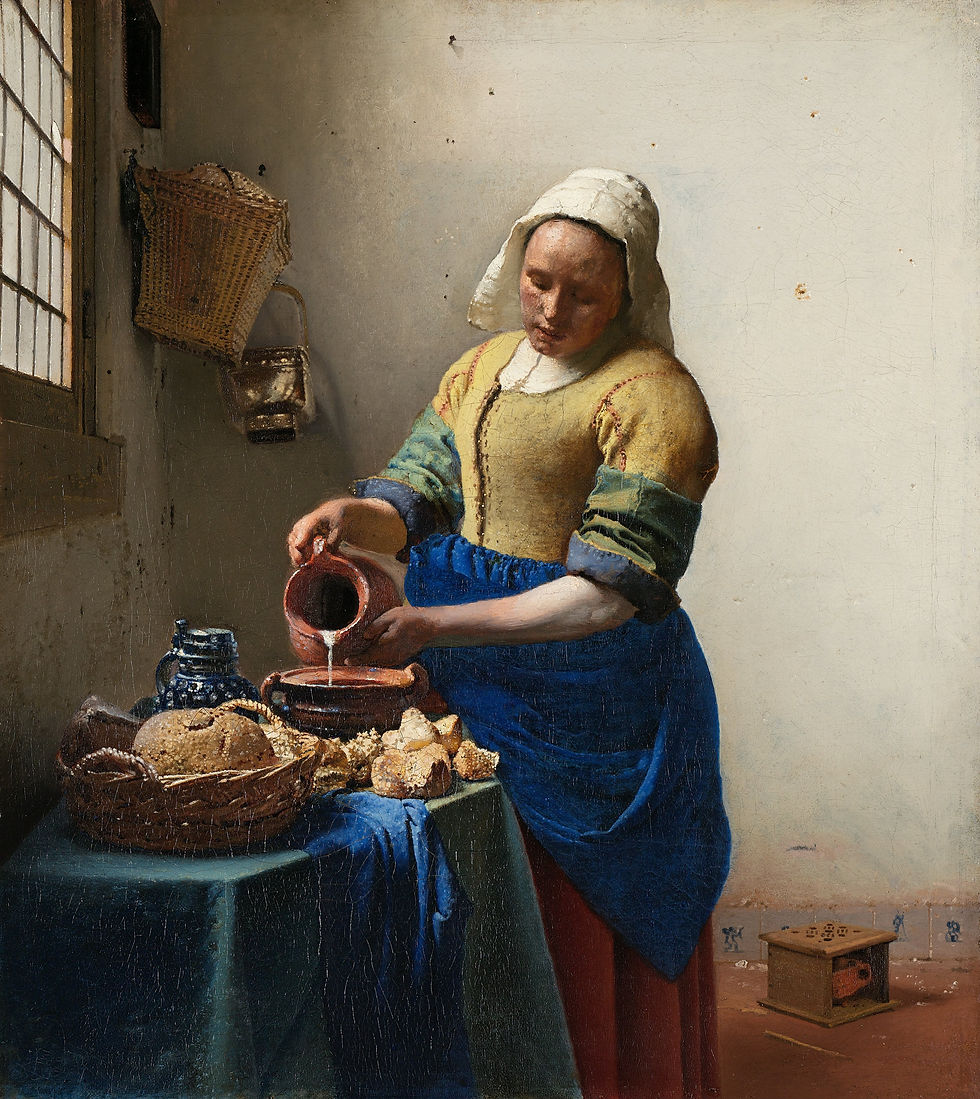
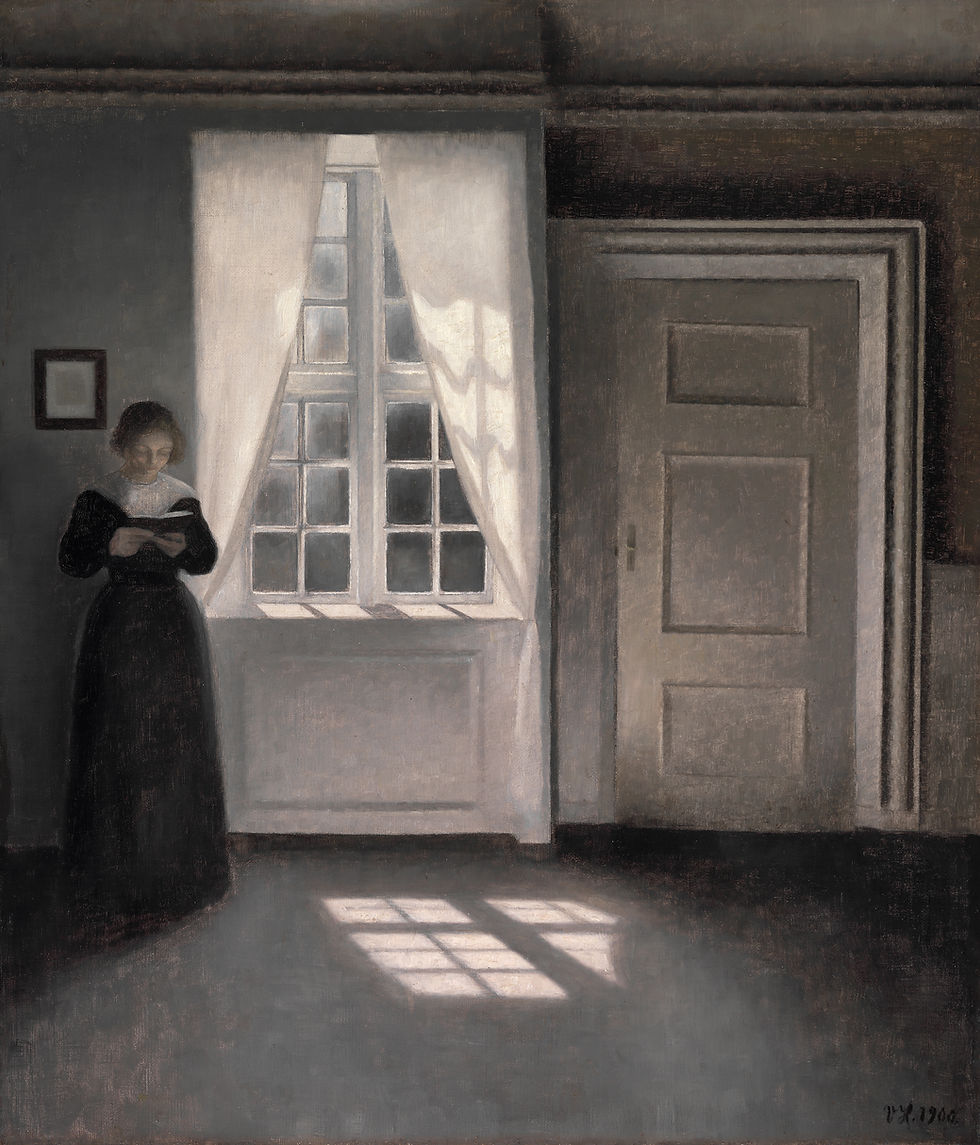
Lineage continuation in the Northern European interior-painting tradition: Van Eyck Bruges 1434 → Vermeer Delft c.1660 (226-year continuation, same compositional logic) → Hammershøi Copenhagen 1900 (466-year continuation, three documented London visits 1894/98/06 to study the Arnolfini Portrait in person). The three painters form an unbroken Northern European interior-painting lineage.
Twenty-first-century online virality: Arnolfini Portrait is now the SECOND most-circulated pre-1500 Western painting online (after Leonardo's Mona Lisa) — driven by (a) the riddle-painting close-reading format, (b) the painting's translation into still-image meme formats, (c) the unresolved interpretive status producing continuous new secondary publications.
Pedagogical legacy: Erwin Panofsky's 1934 Burlington Magazine essay established the iconographic close-reading technique (every visible detail = deliberate signifier). The Arnolfini Portrait is now the standard undergraduate introductory exercise for teaching how to look carefully at any image. Method has survived even where individual Panofsky readings have been revised.
Browse Northern Renaissance and Flemish painting prints in the archive at zocineartdesign.etsy.com.


Comments