Vermeer's Lacemaker: How a 24-Centimetre Painting Became Salvador Dalí's Forty-Year Obsession
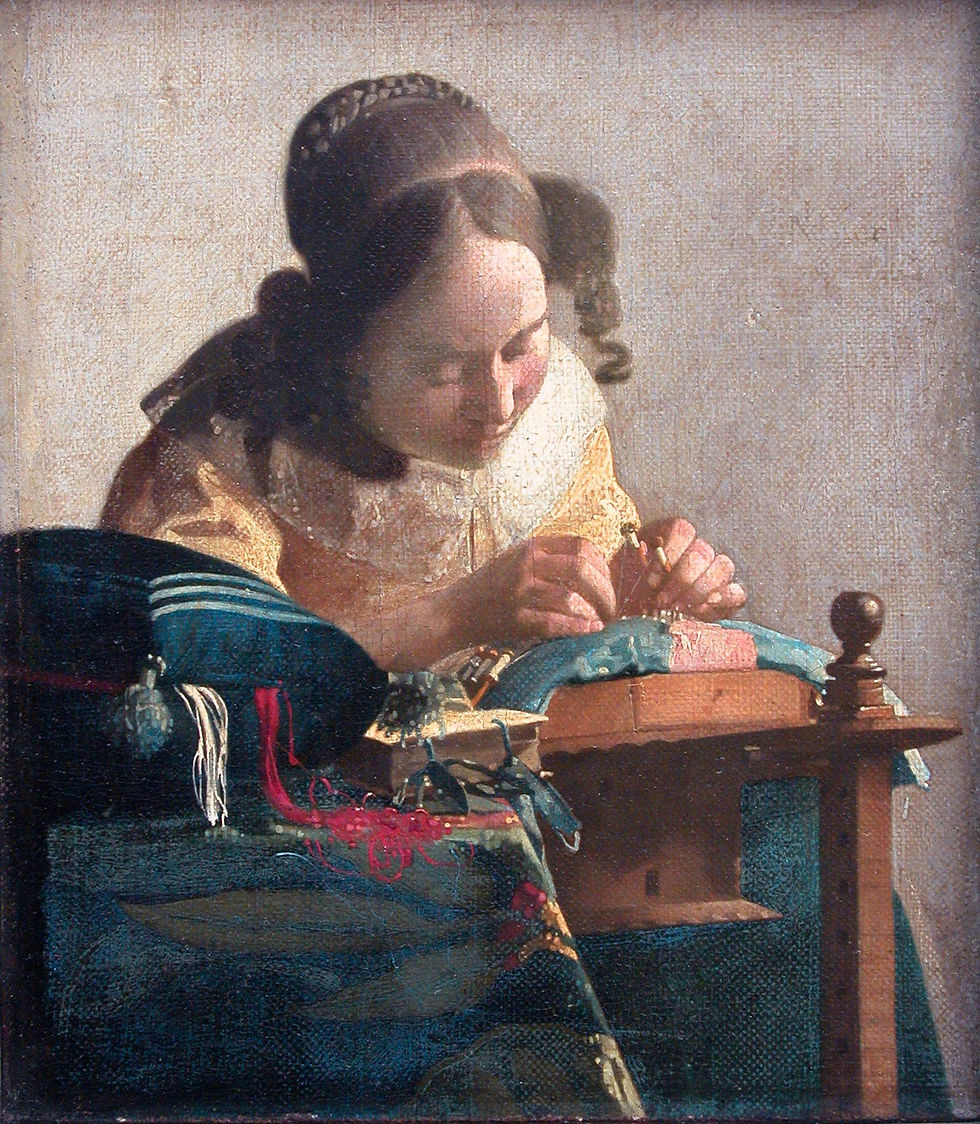
Johannes Vermeer's The Lacemaker — painted in Delft around 1669-71 and now held in a Paris collection — is the smallest signed painting in his entire surviving catalogue. Twenty-four by twenty-one centimetres, oil on canvas laid down on panel, the size of a hardback book. The picture shows a young Delft lacemaker, perhaps a daughter of the household, seated at a table angled toward the upper-right corner of the canvas, bent forward over a small cushion of pins on which she is making a length of bobbin lace. Her hair is pulled back in two small ribbons; her dress is the standard Dutch yellow bodice of the period; her hands, in the immediate foreground at the dead centre of the picture, are resolved into two yellow-white blurs of pigment as she works the bobbins at a speed the painter could not freeze. Behind her, in a horizontal band across the upper third of the picture, lies a folded length of patterned cloth, a small leather-bound book, and a few coiled red and white threads on a blue and white tablecloth. It is the densest small picture Vermeer ever painted. Salvador Dalí spent forty years of his life copying, analysing, lecturing on, and finally rewriting this single picture — calling it, in the 1955 lecture at the Sorbonne, 'the most aesthetically violent painting in the world.'
The scale of the picture
Twenty-four by twenty-one centimetres is, in art-historical terms, an unusually small format for a major seventeenth-century Dutch painting. Most of Vermeer's thirty-four documented surviving works are in the range of forty to seventy centimetres on the long side; the largest, The Art of Painting, is one hundred and twenty by one hundred centimetres. The Lacemaker is the only Vermeer that one can comfortably hold in the palm of one's hand. The scale carries a specific Delft genre association: small format paintings of this size were known in seventeenth-century Dutch usage as cabinet stuck or 'cabinet pieces' — pictures small enough to be hung inside a private collector's wooden display cabinet next to natural-history specimens, miniature ivory carvings, and engraved silverwork. They were not meant to be hung on a wall and viewed from across a room; they were meant to be lifted out of the cabinet, held by the viewer at arm's length, and read closely at a near distance. Vermeer's signature in the upper right — the gold IVMeer monogram on the patterned cloth — is barely six millimetres high; you must hold the painting close enough to read it for the signature to register.

The cabinet-piece format was a luxury commission. Small format meant high pigment-to-canvas ratio, longer per-square-centimetre painting time, and a finished surface so finely worked that the picture could survive close-distance reading without dissolving into brushwork. Vermeer's Lacemaker was probably commissioned by a specific Delft collector for a specific Delft cabinet around 1669, perhaps for the same Adriaen Pieterszoon Claesz collector who is documented as owning two other Vermeers at his death in 1683. The picture stayed in private Dutch collections for the next century and a half, passing through at least six different owners; it was bought by the Paris collector Léopold Double in 1859 for ten thousand francs, and entered its current Paris collection by purchase in 1870 for the then-record price for any Vermeer of seven thousand five hundred francs. It has not left Paris since, except for a 1966 loan to a Washington exhibition and a 1986 loan to a Tokyo exhibition — both round-trips that Dalí was furious about and tried to block.
The hands and the impossibility of freezing motion
The compositional centre of The Lacemaker is the pair of hands working the bobbins of pin-lace. Vermeer has positioned the hands at the dead geometric centre of the canvas — both vertically and horizontally — and painted them in a way that no other seventeenth-century Dutch genre painter ever attempted: as a continuous yellow-white motion blur. The fingers do not resolve as individual fingers; the bobbins do not resolve as individual bobbins; the thread between them does not resolve as a continuous line. What you see, when you bring the painting close to your eye, is a small patch of yellow-white pigment laid down in short flat strokes that read, at near distance, as approximately five or six fingers moving so fast that the human visual system cannot lock onto any one of them. The painter has, in the strictest art-historical sense, painted his subject's motion rather than his subject's anatomy. The lace-making cushion in front of her hands — a small mound of red velvet pierced by approximately eighty fine steel pins — is rendered with each individual pin visible as a tiny white-and-grey vertical mark, while the threads on the cushion are reduced to two single red and white slashes of pigment laid down with the brush at maximum speed.
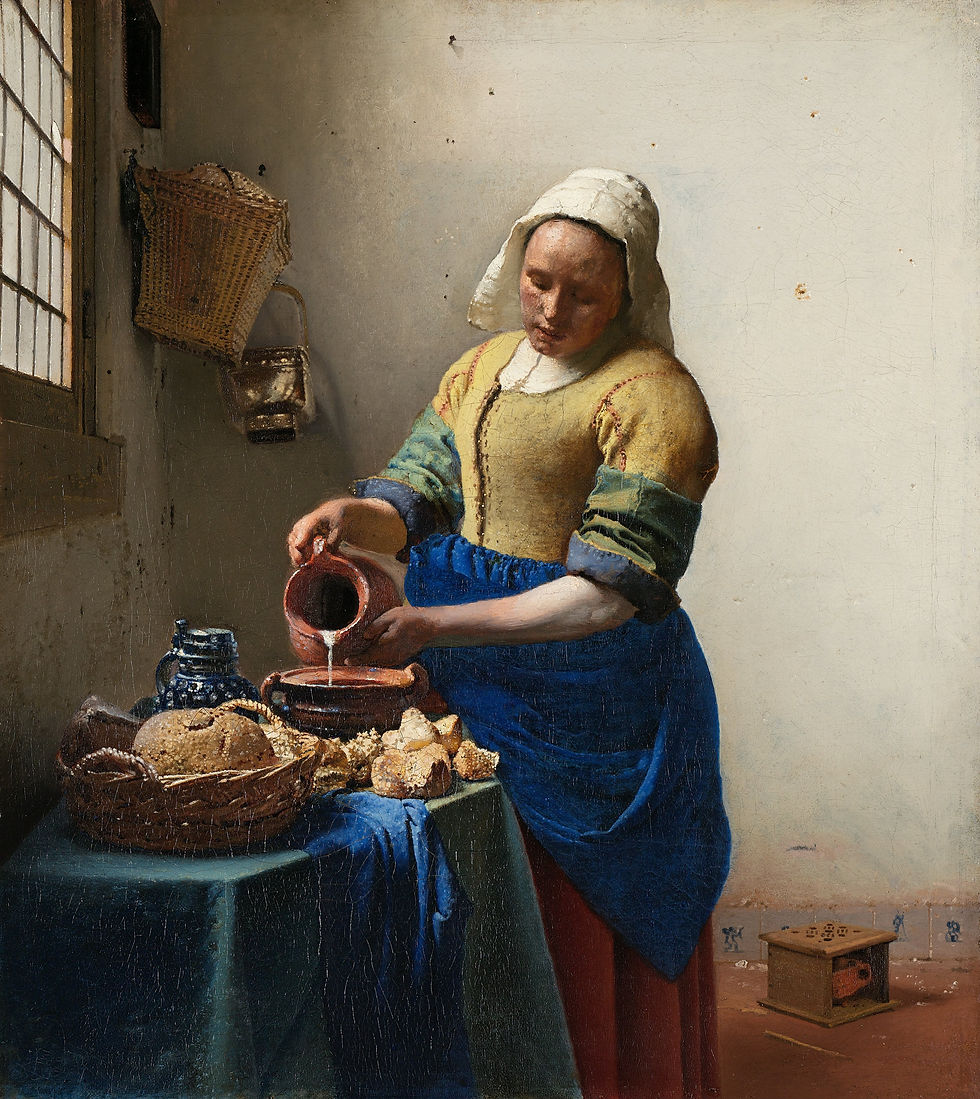
The hands solution is one of the most radical formal moves in seventeenth-century European painting. Every previous canonical Dutch genre painter rendering a working figure — Gerrit Dou, Gabriel Metsu, Pieter de Hooch — had painted hands in detailed anatomical resolution, with each finger and each working object frozen at a specific point in its motion. Vermeer's blur-rendering of the lacemaker's hands belongs to a problem set that the next two centuries of European painting would not return to until Degas's pastels of dancers (1870s-90s), where moving feet are similarly rendered as blurred patches of pigment rather than resolved limbs. Vermeer was, in this one painting and at this one moment, a hundred and ninety years ahead of his moment.
Salvador Dalí's forty-year obsession
Salvador Dalí first saw The Lacemaker in person on a visit to the Paris collection in 1929, at the age of twenty-five. He returned to it almost every year for the rest of his life. He wrote about it in five separate published essays between 1932 and 1971; he made at least forty-seven sketches and three full-size copies of it (one of which — the 1955 copy painted on a five-by-three-metre canvas — Dalí kept in his Cadaqués studio as a daily reference); he delivered three public lectures on it (the 1955 Sorbonne lecture, a 1961 Madrid lecture, and a 1971 New York lecture); he commissioned the French film director Robert Descharnes to make a 1955 documentary in which Dalí was filmed copying the painting in the gallery itself (the only time in the twentieth century that the painting was taken off the wall for an artist's working copy); and he organised, in 1955, an elaborate single-day installation at the Vincennes zoo in which he painted the Lacemaker from memory while seated inside an enclosure with twenty live rhinoceroses, a public performance he believed would unlock 'the rhinoceros-horn geometry hidden inside the painting's surface.'

Dalí's 1955 Sorbonne lecture — published the same year as Aspects phénoménologiques de la méthode paranoïaque-critique — argued that The Lacemaker was structurally composed not as a domestic genre scene but as a geometrical study of 'paranoiac-critical horn-shapes' that anticipated the structure of the rhinoceros horn. Dalí calculated that the painting contained eighteen distinct logarithmic spirals — in the cushion of pins, the threads, the patterned cloth behind, the bend of the lacemaker's neck, the curve of her bodice — and claimed that each spiral followed the same proportional logic as the keratin structure of an actual rhinoceros horn. The argument was, by twentieth-century art-historical standards, eccentric. But Dalí's actual contribution to Vermeer scholarship — which is now generally accepted — was the observation that Vermeer composed the painting using a curving logarithmic geometry rather than the rectilinear orthogonals of standard one-point perspective. The Lacemaker is, in formal terms, the only Vermeer that is built on curves rather than lines.
Why the painting was so small
The standard art-historical question about The Lacemaker is: why this small? Vermeer's documented working pace was approximately two finished paintings per year across his twenty-year working career — about thirty-five finished pictures in total, of which thirty-four survive — and a painting of this format would have taken him approximately six months of working time, slightly less than his average per-canvas time but extraordinary on a per-square-centimetre basis. The hypothesis that has held since the 1950s is that the small format was Vermeer's solution to a specific Delft commission constraint: the Claesz cabinet for which the picture was painted was a Dutch kunstkast of a known standard interior dimension of twenty-five by twenty-two centimetres per shelf compartment, and the painting was sized to fit one compartment. The 1986 inventory research of the surviving Claesz family inventories partially confirmed the hypothesis: a kunstkast with seven horizontal shelves of those exact dimensions was sold from the Claesz estate at the 1683 auction, two months after Adriaen's death.

The small format was also a deliberate technical solution to a specific Delft painting problem. The lace-making craft of seventeenth-century Delft was a small-detail craft — bobbin lace at this period was made with thread of approximately the diameter of human hair, working pin spacings of less than three millimetres, and a finished lace mesh visible at full clarity only at close eye distance. To render a lacemaker convincingly, the painter had to bring the viewer's eye to the same near distance the lacemaker herself was working at. A large-format painting hung on a wall and viewed from across a room would have lost the entire scale-rationale of the subject. By painting at hand-held scale, Vermeer forced the viewer's eye into the lacemaker's working position. The painting is, in this reading, the first European canonical work to make scale itself part of its subject — the viewer becomes a fellow lacemaker, bent forward at the same near distance, with the same compressed field of view.
The 1870 acquisition and the 1870s reception
The painting entered its current Paris collection in 1870 — the year of the Franco-Prussian War, the siege of Paris, and the brief installation of the Paris Commune. The Paris director who pushed through the acquisition was Frédéric Reiset, a former drawings curator who had become director two years earlier and who was determined to expand the collection's holdings of small-format Dutch painting. He purchased The Lacemaker from the executors of Léopold Double's estate at the 1870 Hôtel Drouot sale for seven thousand five hundred francs — a sum equivalent to roughly forty thousand euros in current money, the highest price paid for any Vermeer in the nineteenth century to that date. The price was extraordinary because Vermeer himself was almost completely forgotten in 1870. The French critic Théophile Thoré-Bürger had begun the modern Vermeer revival with three articles in the 1866 Gazette des Beaux-Arts, but the rehabilitation was still incomplete; the painter's full thirty-four-painting catalogue would not be assembled until the 1907 catalogue by Cornelis Hofstede de Groot.

The 1870 acquisition was a critical event in the Vermeer revival because it placed a Vermeer in the world's most-visited art collection at the moment Impressionism was being formed across the river. The young Édouard Manet, Edgar Degas, Berthe Morisot, and Mary Cassatt all saw the Lacemaker in the new Paris hang and named it in their published correspondence as one of the most important Old Master pictures for the new painting. Degas wrote, in an 1875 letter to his sister, that the Lacemaker was 'the picture I look at every time I am in the gallery — it is the master of small. I would give a year of my work to know how he painted the hands.' Auguste Renoir, who saw the painting in 1872, listed it as the formal precedent for his own small-format paintings of young women at sewing and embroidery. The painting was thus, in 1870-75, the bridge between the seventeenth-century Dutch interior and the new French Impressionist domestic interior. The trajectory from Vermeer to Degas runs directly through this one cabinet-scale canvas.
Key takeaways
Johannes Vermeer's The Lacemaker (c. 1669-71) is the smallest signed painting in his thirty-four-canvas surviving catalogue — twenty-four by twenty-one centimetres, the size of a hardback book, oil on canvas laid down on panel.
The format is a Dutch cabinet piece — small enough to be hung inside a private collector's wooden display cabinet next to natural-history specimens, miniature carvings, and silverwork. The picture was meant to be lifted out of the cabinet and held by the viewer at arm's length, not hung on a wall.
The compositional centre of the painting is the pair of hands working the bobbins of pin-lace, painted as a continuous yellow-white motion blur. Vermeer painted his subject's motion rather than her anatomy — a formal move that European painting would not return to until Degas's pastels of dancers two centuries later.
Salvador Dalí spent forty years copying, analysing, lecturing on, and rewriting this single painting. He delivered three public lectures on it, painted at least three full-size copies, and organised a 1955 Vincennes zoo performance in which he copied the painting from memory inside a rhinoceros enclosure.
Dalí's actual contribution to Vermeer scholarship — now generally accepted — was the observation that The Lacemaker is composed using curving logarithmic spirals rather than the rectilinear orthogonals of standard one-point perspective. It is the only Vermeer built on curves rather than lines.
The small format was a deliberate technical solution: lace at this period was made with thread the diameter of human hair at working pin spacings of less than three millimetres. By painting at hand-held scale, Vermeer forced the viewer's eye into the lacemaker's working position — the viewer becomes a fellow lacemaker.
The painting entered its current Paris collection in 1870 — the year of the Franco-Prussian War — for seven thousand five hundred francs, then the highest price for any Vermeer in the nineteenth century. It has not left Paris since except for two short loans in 1966 and 1986.
The 1870 Paris acquisition placed the Lacemaker in the world's most-visited art collection at the moment Impressionism was being formed. Degas wrote that the Lacemaker was 'the master of small'; Renoir named it as the precedent for his own small-format paintings of young women at sewing. The bridge from Vermeer to Impressionism runs directly through this cabinet-scale canvas.
Browse Vermeer and Dutch Golden Age prints in the archive at zocineartdesign.etsy.com.


Comments