Vermeer's Astronomer: The Painter of Quiet Knowledge
Johannes Vermeer painted The Astronomer in 1668. It is one of only two paintings he signed and dated with the year, one of only two male portraits he ever produced, and the only one of his known interiors where the subject is reading a book. Vermeer painted thirty-six pictures in his lifetime. He gave very few of them to men. This is one.
A scholar in a long blue-and-gold robe leans over a table. His right hand reaches forward and rests on a celestial globe; his left holds the place in a book. A window to his left throws clean Delft daylight across his shoulder and onto the cloth on the table. Nothing dramatic is happening. He is thinking. The painting is about the act of thinking.

Below is a reading of the picture at five levels: who the sitter probably was, what is on the table, what the book on the table says, how the painting relates to its sister picture The Geographer, and where it belongs in a contemporary room.
Who the sitter is
Scholars have long argued that the model for both The Astronomer and The Geographer was Antoni van Leeuwenhoek, Vermeer's close contemporary in Delft and the inventor of the microscope. Van Leeuwenhoek and Vermeer were both born in Delft in 1632, and both died there. Van Leeuwenhoek was named the executor of Vermeer's estate after the painter died in 1675. The two men knew each other; the resemblance of the model to the only authenticated portrait of van Leeuwenhoek is suggestive.
The case is circumstantial, not proven. What is certain is that Vermeer painted a man practising science with the same attention he gave to his women practising music, weighing pearls, or writing letters. The act of inquiry has the same dignity in Vermeer's world as the act of needlework. There is no hierarchy of subject. There is only what a person, looking carefully, can do.
What is on the table
The celestial globe. The most accurate identification — made by 20th-century historians of astronomy — is a globe produced by Jodocus Hondius in Amsterdam in 1600. It shows the constellations as they were mapped in the late sixteenth century, when Tycho Brahe's stellar coordinates were still the standard. Vermeer painted the visible constellations on its surface with enough accuracy that scholars have been able to identify Draco, Hercules, and the Lyre.
The book on the table is open to a specific section of a real Dutch astronomical treatise: Adriaen Metius's Institutiones Astronomicae Geographicae of 1621, open at Book III, the section on celestial geography. The text on the visible page is legible enough that bibliographers have matched it to the second edition. Vermeer is painting a specific book opened to a specific page.
On the wall behind the astronomer hangs a framed painting — a picture within a picture. It is a depiction of Moses being drawn from the river Nile, the moment in Exodus when the Hebrew prophet is saved as an infant. Moses, in the Christian iconographic tradition, was understood as a precursor of Christ: the lawgiver, the seer, the man who reads the sky for signs. Vermeer has hung a picture of a prophet above his scientist. The juxtaposition is not accidental.
The Geographer companion
Vermeer painted The Geographer in 1669, a year after The Astronomer. The two are sister paintings. They share the model, the room, the angle of light, the table, the chest of drawers, even some of the props. The astronomer studies the heavens; the geographer studies the earth. Together they describe the full sweep of seventeenth-century Dutch inquiry into the natural world.
The two paintings were sold as a pair in 1713 to a Rotterdam collector and stayed together until 1797. After they were separated they were sold and resold across Europe and ended up in Frankfurt and in Paris, where they live today in different national collections. They were briefly reunited for the great Vermeer exhibitions of 1995-96. Standing in front of them together is the right way to see them — they were painted for each other.
Reading the light
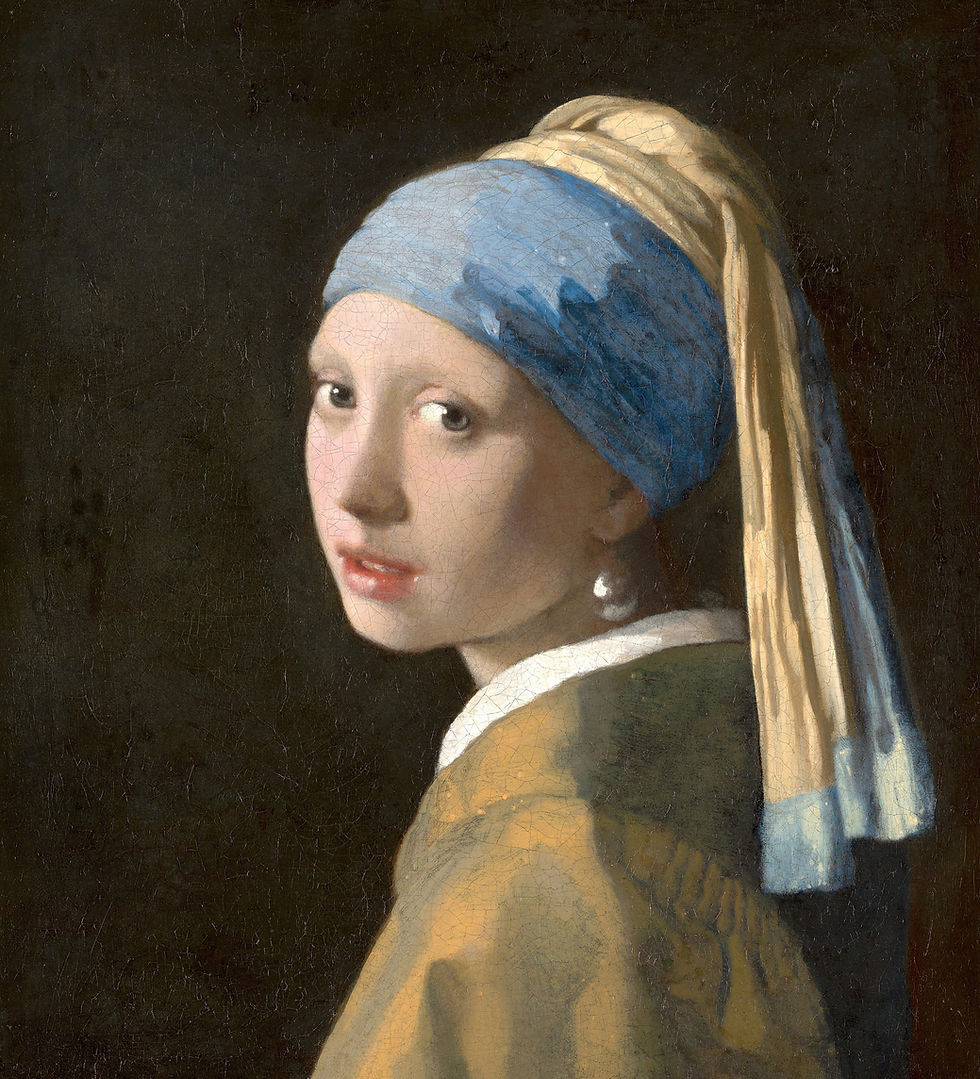
Look at the light. It comes from the upper left through a leaded-glass window we cannot quite see. It hits the astronomer's right shoulder, slides down the blue and gold of the robe, picks out the edge of the chest of drawers, lands on the globe, and dies in the shadowed corner at the lower right. Vermeer is painting one of his quiet diagonals — the same compositional move he used in Girl with a Pearl Earring and The Milkmaid — a single shaft of cool daylight crossing a still room and giving the subject its weight.
The colour palette is restrained. Blue and gold for the robe; warm umber for the table cloth; pale wall; the globe's parchment yellows. There is no red anywhere in the picture, which is unusual in Vermeer. The result is a tonal harmony that reads as deeply masculine without being austere — a register the painter rarely worked in.
Where the painting fits in Vermeer's career
Vermeer painted slowly. In a thirty-year career he completed about thirty-six surviving works — perhaps three or four a year, sometimes fewer. He died in debt in 1675 at the age of forty-three, leaving a wife and eleven children. His patron Pieter Claesz van Ruijven had died first; the great economic crisis of 1672 (the Year of Disaster, when France invaded the Netherlands) had collapsed the Delft art market.
The Astronomer and Geographer pair belongs to Vermeer's late middle period — the years just before that economic collapse, when he was working at the peak of his technical confidence. After 1670 his palette darkens and his subjects become smaller and more inward. The Astronomer is the painter still at the height of his powers, still finding new ways to make a still room into a stage for the human mind.
How to hang it
The painting is upright, almost square, and rewards proximity. A writing desk, a study, a bookshelf wall, a small library nook — these are where the picture belongs. Frame it in dark walnut or oxidised brass, with a narrow cream mat. The robe's blue and gold sit best against warm wood, not painted white. Light it with a single warm directional fixture from upper left, matching the painted light source.
The painting pairs well with another Vermeer interior — The Geographer is the obvious choice and gives the pair the cosmological symmetry Vermeer intended — or with a Rembrandt scholar portrait. Avoid hanging it next to anything noisy or colourful; the painting requires its own quiet.
Available as a fine print: zocineartdesign.etsy.com/listing/1089389806
Key takeaways
Vermeer painted The Astronomer in 1668; it is one of only two paintings he signed with a date and one of only two male portraits he ever made.
The likely model is Antoni van Leeuwenhoek, Vermeer's contemporary in Delft, the inventor of the microscope, and the executor of Vermeer's estate.
The celestial globe is a Jodocus Hondius from 1600; the open book is a specific 1621 Dutch astronomical treatise; the picture-within-the-picture above the scholar is Moses Saved from the Nile.
The Astronomer is the sister of The Geographer (1669); they share the model, the room, and the light, and were sold as a pair until 1797.
The painting belongs above a writing desk or in a small library, framed in dark walnut, lit from upper left to match the painted source of light.
Browse the full archive at zocineartdesign.etsy.com.


Comments