Vermeer's View of Delft: The Painting Marcel Proust Said Was the Most Beautiful in the World
Johannes Vermeer (1632-1675) painted his hometown of Delft from the south bank of the river Schie at some point between the spring of 1660 and the autumn of 1661, when he was twenty-eight or twenty-nine years old. The resulting picture, View of Delft, oil on canvas, ninety-eight by one hundred and seventeen and a half centimetres, is the only major townscape Vermeer ever produced. (He made one other small townscape, The Little Street, at about the same time; everything else in his thirty-five surviving paintings is interior, single-figure, or domestic.) The picture shows Delft seen from across the harbour where the Schie enters the city through the Schiedam and Rotterdam water-gates — the two tall brick towers at the centre of the composition, with the Nieuwe Kerk's spire visible above the rooftops at the right and the smaller spires of the Oude Kerk and the city's other parish churches scattered across the skyline. A handful of figures stand on the near bank in the foreground, three of them grouped at the left, four at the right beside two moored fishing boats. The sky occupies more than half the picture. A heavy band of grey cloud crosses the upper third; sunlight strikes through the gap below the cloud and lights up the red-tile rooftops at the right while leaving the water-gates at the centre in shadow. The painting is a five-second moment of weather over the city just after a rainstorm.

The composition: how Vermeer organised a town on a flat horizon
Almost the entire interest of the picture is in its weather. The composition is, in technical terms, extremely simple. The horizon line sits at about thirty-seven per cent of the way up the canvas, slightly below the centre — low enough that the sky dominates the picture but high enough that the city is fully readable. The town occupies a single horizontal band running from the left edge to the right edge of the canvas, with the two water-gates at the geometric centre. The river fills the lower portion of the picture, reflecting the city in horizontal streaks of pale blue, brown, and grey. A small group of figures in the foreground anchors the lower-left and lower-right corners of the composition. There is no diagonal recession, no central vanishing point, no theatrical perspective. The picture is built almost entirely on horizontals, and the only verticals — the church spires, the towers, the ships' masts — are kept thin and far apart.
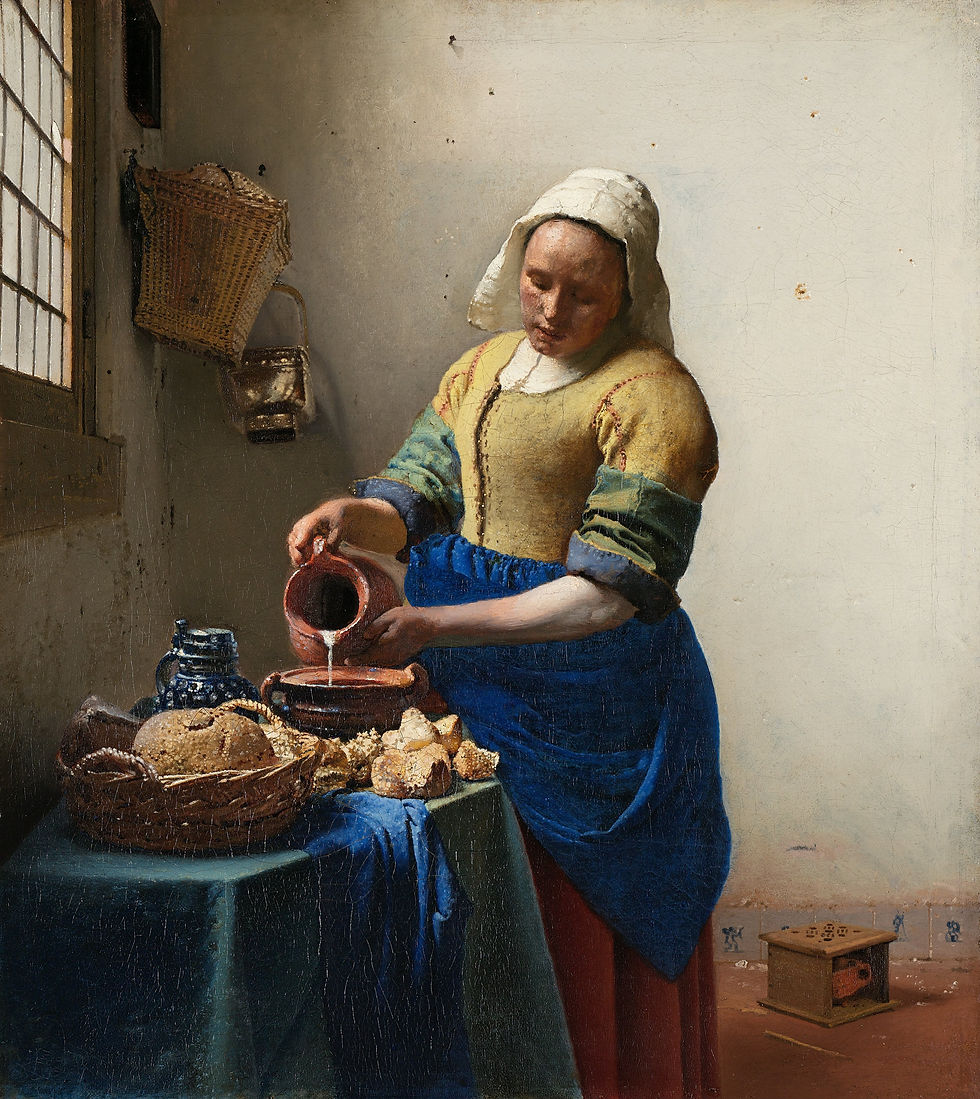
What makes the picture not simple is how Vermeer painted the surfaces. The brickwork of the water-gates is built up in small slow glazed layers of paint, the individual bricks barely separated from each other but distinct enough that you can read the masonry pattern at close inspection. The red roof-tiles in the right-hand cluster of houses are modelled in a stippled, granular impasto with tiny white highlights placed exactly where the wet tiles catch the post-rain sun. The water in the foreground is built up in horizontal sweeps of broken colour — pale blue for the reflected sky, dark grey for the reflected shadow, brown for the silt of the harbour bottom — that are then crossed with vertical streaks of vermilion and white where the masts and rigging of the boats reflect. The same technique that Vermeer had developed at small scale in interiors like The Milkmaid and Woman Holding a Balance — slow careful glazed paint, with small white highlights placed exactly where light catches the curve of an object — is here applied at the scale of an entire town across a stretch of open water.
Delft 1654: the disaster behind the calm
Six years before Vermeer painted the View of Delft, on the morning of Monday 12 October 1654 at about ten-thirty, the central gunpowder magazine of the Dutch Republic, stored in a converted Clarissan convent at the eastern end of the city centre between the Geer canal and the present Doelenstraat, exploded. The detonation killed an estimated one hundred and twenty Delft residents in the immediate blast, levelled approximately two hundred houses across the central and northern quarters of the city, and broke glass and tiles across most of the lower town. Among the killed was the painter Carel Fabritius, then thirty-two, Rembrandt's most gifted former student and the painter who had moved to Delft in 1650 to develop a new style of trompe-l'œil close-attention painting (the small Goldfinch of 1654, which Donna Tartt later borrowed for the title of her 2013 novel, was painted in the four months before the explosion).

Vermeer was twenty-two in October 1654 and had been registered as a master painter in the Delft Guild of Saint Luke for less than a year. He was newly married, had a one-year-old child, and was living in his mother-in-law Maria Thins's house on the Oude Langendijk in the south-east quarter — a part of the town largely spared by the blast, but close enough that the windows of the Vermeer-Thins house broke and the family spent the rest of the day searching the rubble for friends. (Carel Fabritius's body was recovered the following morning from the ruins of his rented room on the Doelensteeg.) The View of Delft was painted six or seven years later, when the city had largely been rebuilt and the new gunpowder magazine relocated to the safer countryside south of the walls. The painting shows Delft as it looked in approximately 1660-61: substantially the post-disaster city, with the rebuilt houses immediately behind the water-gates and the slightly modified skyline of churches. The picture is, in this sense, a portrait of a town that had just survived something.
Proust 1902-21: the little patch of yellow wall
Marcel Proust saw the View of Delft for the first time on a visit to the Mauritshuis in The Hague in October 1902. He was thirty-one. He returned to the museum at intervals over the next nineteen years and saw the painting again, for what would be the last time, in May 1921 — by then severely ill with the bronchitis and asthma that would kill him eighteen months later. The May 1921 visit was the occasion of one of the most-quoted passages in Proust's À la recherche du temps perdu (In Search of Lost Time). In the fifth volume, La Prisonnière, the novelist Bergotte, modelled in part on the critic Anatole France and in part on Proust himself, reads in a Paris newspaper that a Vermeer exhibition has opened at the Jeu de Paume in the Tuileries. He goes despite a fever, climbs the gallery stairs, finds the View of Delft, and notices something he had never seen on his previous visits: a small patch of yellow wall lit by the post-rain sun on the right-hand side of the painting, just below the red rooftops, that the critic Vaudoyer had pointed out in a recent newspaper article. Bergotte looks at the patch for a long time. "That's how I ought to have written," he says. "My last books are too dry, I ought to have gone over them with several coats of paint, made my language precious in itself, like this little patch of yellow wall." Then he sits down on a circular settee in the middle of the room, has a stroke, and dies.
Proust's own May 1921 visit was almost exactly Bergotte's. He climbed the same stairs of the same Jeu de Paume exhibition, was already ill, looked for a long time at the same patch of yellow wall, and walked back to his apartment on the Boulevard Haussmann afterwards. He worked the experience into the novel within months. The passage was published posthumously in the first edition of La Prisonnière in 1923; the volume was edited by Proust's brother Robert from the manuscripts on Proust's desk at the time of his death in November 1922. The "little patch of yellow wall" — le petit pan de mur jaune in the French — has since become one of the most-cited details in twentieth-century literary criticism and one of the most-discussed passages in any reading of Proust on the subject of art, time, and the immortality of made objects. Bergotte's death in front of the View of Delft is the central scene of the entire Recherche on the question of why anyone, knowing they are about to die, would still want to write a book or paint a picture.
Vermeer in Delft: a small archive of a quiet career
Vermeer was a small-market local painter for almost his entire working life. He never travelled outside the Dutch Republic, never visited Italy or France, never sold a painting outside the Delft-Hague-Amsterdam corridor, and (so far as the surviving records show) never received a commission for an altarpiece, a portrait of a foreign sitter, or a history painting from a court patron. His total output across his twenty-three working years (1652-1675) was probably forty-five to fifty paintings, of which thirty-five survive. His patrons were a small group of Delft and Hague merchants — primarily the Catholic textile dealer Pieter van Ruijven and his daughter Magdalena, who together commissioned or first-acquired more than half of all the Vermeers known to art history. Vermeer was elected to the headship of the Delft Guild of Saint Luke twice (in 1662 and again in 1670) but never built a workshop and never trained an identified pupil.

The View of Delft was, at the time of Vermeer's death in 1675, owned by Pieter van Ruijven; it passed through Van Ruijven's daughter Magdalena and her husband Jacob Dissius to a 1696 Amsterdam auction at which it was sold (with twenty other Vermeers from the Van Ruijven-Dissius inheritance) for two hundred Dutch guilders — at the time about the price of a good farm horse. It passed through a series of private Dutch and German collections through the eighteenth and nineteenth centuries; in 1822 it was acquired by the newly-founded Mauritshuis in The Hague as part of a larger purchase of Dutch Golden Age paintings from a Brussels dealer. It has been on permanent display in The Hague since. The painting was the first Vermeer to enter a Dutch national collection by purchase rather than bequest, and it remains the picture by which Vermeer is most often first encountered by visitors to the Mauritshuis today.
Why the painting still matters
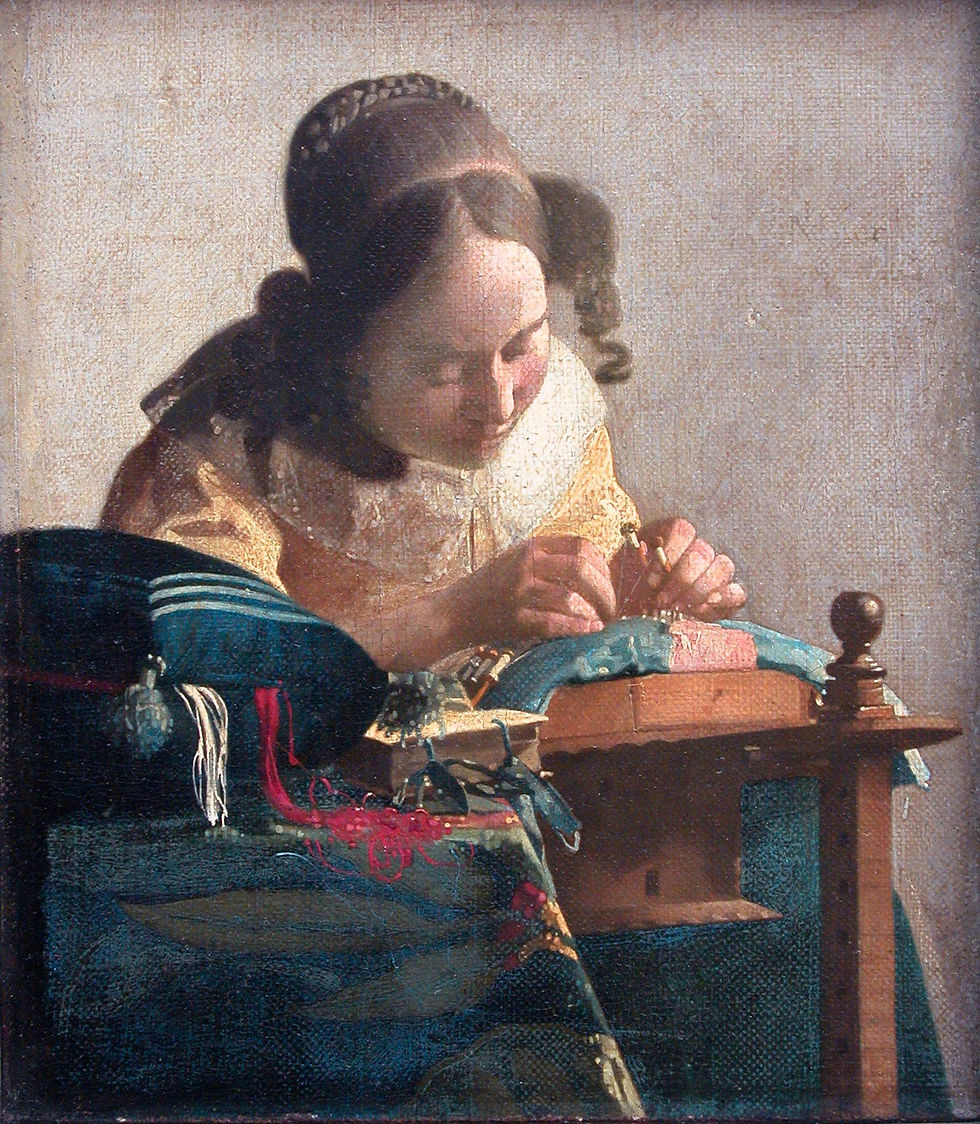
The View of Delft is the only fully outdoor painting Vermeer ever made. The 35-painting Vermeer corpus is dominated by the interior single-figure pictures that the Mauritshuis sister institution, the Rijksmuseum in Amsterdam, and the National Gallery in Washington have between them assembled into the canon — the Milkmaid, the Girl with a Pearl Earring, the Woman Holding a Balance, the Lacemaker, the Geographer, the Astronomer, the Music Lesson, the Officer and Laughing Girl. The View of Delft is the structural outlier. It is the only painting in which Vermeer's slow careful glazed surface-attention is applied not to a domestic object or a portrait sitter but to weather and light and brick and water at the scale of a town. The picture is now considered, by collective art-historical consensus and by survey-after-survey of Dutch art critics, the most consequential single Dutch Golden Age painting after Rembrandt's Night Watch.

In the four hundred years since Vermeer painted it, the View of Delft has been borrowed for every major reading of Dutch seventeenth-century art and for almost every twentieth-century essay on the philosophy of looking at painting. The art historian Lawrence Gowing's 1952 monograph Vermeer devoted a chapter to the picture; Svetlana Alpers's 1983 The Art of Describing used it as the central case of what she called the "descriptive" mode in seventeenth-century Dutch art (against the "narrative" Italian-Renaissance tradition); the philosopher Michael Fried's 1980 Absorption and Theatricality took it as the boundary case of his argument about how eighteenth-century painting tried to keep the viewer out of the picture. Bergotte's last sentence — "That's how I ought to have written" — is the simplest summary of the picture's grip on every painter, novelist, and philosopher who has looked at it carefully since 1675.
Key takeaways
Johannes Vermeer (1632-1675) painted his hometown of Delft from the south bank of the river Schie in about 1660-61. The picture, oil on canvas 98 × 117.5 cm, is the only major townscape Vermeer ever produced; everything else in his thirty-five surviving paintings is interior, single-figure, or domestic.
The composition is built almost entirely on horizontals. The horizon line sits at about 37% up the canvas; the town occupies a single horizontal band; the two Schiedam and Rotterdam water-gates are at the geometric centre; the river fills the lower portion. The picture is a five-second moment of weather over the city just after a rainstorm — heavy grey cloud across the upper third, sunlight striking through the gap below it onto the red-tile rooftops on the right.
Delft had been catastrophically damaged six years before Vermeer painted the picture. The central Dutch gunpowder magazine exploded on the morning of 12 October 1654, killed approximately 120 Delft residents, levelled 200 houses, and killed Carel Fabritius — Rembrandt's most gifted former student. The View of Delft shows the city substantially rebuilt by 1660-61.
Marcel Proust saw the View of Delft in The Hague in October 1902 and at the Jeu de Paume Vermeer exhibition in Paris in May 1921, eighteen months before his death. The novelist Bergotte's death in front of the painting in front of a "little patch of yellow wall" (le petit pan de mur jaune) in the fifth volume of À la recherche du temps perdu (La Prisonnière, 1923) is one of the most-cited passages in twentieth-century literary criticism and the central scene of the entire Recherche on art, time, and mortality.
Vermeer was a small-market local painter for almost his entire career. He never travelled outside the Dutch Republic, never sold a painting outside the Delft-Hague-Amsterdam corridor, and produced a total of probably 45-50 paintings (35 survive) across 23 working years. His main patron was the Catholic textile dealer Pieter van Ruijven, who with his daughter commissioned or first-acquired more than half of all known Vermeers.
The View of Delft was sold from the Van Ruijven-Dissius inheritance at a 1696 Amsterdam auction for 200 Dutch guilders (about the price of a good farm horse) and acquired by the Mauritshuis in 1822 from a Brussels dealer. It has been on permanent display in The Hague since and is the first Vermeer to enter a Dutch national collection by purchase rather than bequest.
The picture is the only fully outdoor work in Vermeer's surviving corpus and the structural outlier of the canon. Lawrence Gowing's 1952 Vermeer, Svetlana Alpers's 1983 The Art of Describing, and Michael Fried's 1980 Absorption and Theatricality have all taken the painting as a central case. The View of Delft is now considered the most consequential single Dutch Golden Age painting after Rembrandt's Night Watch.
Browse Vermeer and Dutch Golden Age prints in the archive at zocineartdesign.etsy.com.


Comments