Whistler's Mother (1871): The Painting That Refused to Be a Portrait of Its Sitter
James Abbott McNeill Whistler (1834-1903) painted Arrangement in Grey and Black No. 1 in his London Chelsea studio in approximately three weeks in autumn 1871. The 144.3 × 162.4 centimetre oil-on-canvas shows the artist's 67-year-old mother Anna Matilda McNeill Whistler (1804-1881) seated in profile in a high-backed wooden chair against a flat grey wall, wearing a black mourning dress and a white lace bonnet, her hands folded in her lap holding a small white handkerchief. The painting hung at the Royal Academy of Arts spring exhibition in 1872 — the only one of three Whistler submissions accepted by the conservative academy jury — was poorly received by the Royal Academy public, returned to Whistler's possession unsold, and was acquired for the French state in 1891 by the Paris collection where it has hung continuously since. Whistler titled the painting NOT as a portrait of his mother but as an arrangement — a formal composition of two non-pictorial elements (the colours grey and black). The titling decision was the inaugural statement of late-nineteenth-century European aestheticism and the 'art for art's sake' position that the painting's primary subject is its own formal qualities rather than the persons or things it depicts.

Anna McNeill Whistler, the three-week sitting, and the Chelsea studio
Anna Matilda McNeill Whistler was born in 1804 in North Carolina, daughter of a Wilmington physician; she married George Washington Whistler (a US Army Major and later civil engineer who built the St Petersburg-Moscow railway for Tsar Nicholas I) in 1831 and had four sons, of whom James was the eldest survivor. She had been widowed since George Whistler's 1849 death from cholera in St Petersburg and had lived with James in his various European studios since approximately 1863. In autumn 1871 she was sixty-seven years old, living with James in his Cheyne Walk studio house in Chelsea on the north bank of the Thames, in conservative widow's mourning that she had not removed since George's death twenty-two years earlier. The sitting was an accident: Whistler had been working on a different commissioned portrait that autumn that fell through when the original sitter cancelled; Anna was visiting the studio that afternoon and offered to take the original sitter's place at the chair Whistler had already set up. Whistler painted her for approximately fifteen sittings over three weeks, working in his preferred slow controlled brushwork from a single fixed studio position. The painting was therefore not a commissioned portrait — Whistler had no patron paying for it — and was painted entirely for his own use.
The Chelsea studio context is important. Whistler had moved from Paris to London in 1859 and had spent the 1860s gradually breaking from his Parisian Realist training (he had studied at Charles Gleyre's academic studio in 1855-58 alongside Monet, Renoir, and Bazille) toward the new aestheticist position that would define his mature work. The 1860s London Whistler — the Nocturne series of dark Thames-river paintings, the 1865 Symphony in White No. 1 portrait of his Irish lover Joanna Hiffernan — had been steadily refusing the academic-Salon convention that paintings must depict identifiable subjects in identifiable narrative situations. The 1871 Arrangement in Grey and Black extended the position to its logical limit: a painting whose entire titular content is two colours, with the depicted human subject (the artist's own mother) reduced to a secondary descriptive note added in smaller type below the title.
The titling decision and the aestheticist position
The painting's title is the painting's argument. Whistler's full 1872 Royal Academy submission title was "Arrangement in Grey and Black, No. 1: Portrait of the Painter's Mother" — with the colour-arrangement as the primary title and the mother-identification as the parenthetical subtitle. The Royal Academy printed the title in their 1872 catalogue but the press reception almost universally dropped the colour-arrangement portion and referred to the painting simply as "Whistler's Mother". Whistler protested in print repeatedly across the next decade — most famously in the 1878 article in the London World magazine where he wrote: "To me it is interesting as a picture of my mother; but what can or ought the public to care about the identity of the portrait? My picture is an arrangement in colour. The likeness is a private matter." The argument was not received calmly. The conservative London art-press attacked Whistler for refusing to honour the depicted subject (his own widowed mother); the progressive press defended the position as the inaugural statement of an aesthetic that would become known by approximately 1882 as 'art for art's sake' (the phrase had been coined in French — l'art pour l'art — by the philosopher Victor Cousin in 1820 but was reactivated by the 1860s-80s English aestheticist movement around Whistler and his ally Oscar Wilde). The 1878 World article is the canonical primary source for late-19th-century aestheticism in English-language painting and was reprinted continuously across the 1880s-90s in aesthetic-movement publications.
Why the painting matters now
Whistler's Mother is now the second-most-recognised American painting worldwide after Grant Wood's 1930 American Gothic and the most-recognised single image of nineteenth-century American art. The reception history that produced this position has three phases. The first (1871-1891) was the Royal Academy and post-Academy private-collection period — the painting was poorly received in London, returned to Whistler unsold, and was kept by Whistler in storage and occasional private exhibition for the next twenty years. The second phase (1891-1934) was the painting's French state acquisition for the Paris collection in 1891 (the first American painting purchased by the French state) and its consolidation as the canonical international Whistler image. The third phase (1934-present) was American popular consolidation: the 1934 United States Postal Service issued a 3-cent stamp commemorating the painting on Mother's Day, and the stamp's mass distribution across the next forty years (approximately 193 million stamps printed and used between 1934 and the stamp's 1974 retirement) made the painting the visual reference for the American Mother's Day holiday. The Mother's Day association — which Whistler would have detested as the worst possible misreading of his deliberately mother-as-arrangement-component composition — is the single most-cited driver of the painting's twentieth-century American visibility. The painting's continuing twenty-first-century visibility on social media is the function of the Mother's Day association: every year's first weekend of May produces an annual wave of Whistler's Mother reproductions across American social media, almost all of which return to the conventional reading Whistler refused.
Key takeaways
James Abbott McNeill Whistler (1834-1903) painted Arrangement in Grey and Black No. 1 in approximately 3 weeks in autumn 1871 in his London Chelsea Cheyne Walk studio. Model = his 67-year-old widowed mother Anna Matilda McNeill Whistler (1804-1881). 144.3 × 162.4 cm oil on canvas. Held in a Paris collection since 1891 acquisition by the French state — the first American painting purchased by France.
The sitting was an accident: Whistler had been working on a different commissioned portrait that fell through when the original sitter cancelled; Anna was visiting the studio and offered to replace the cancelled sitter at the already-prepared chair. Approximately 15 sittings, three weeks. Not commissioned, no patron paying — painted entirely for Whistler's own use.
The full Royal Academy 1872 submission title: "Arrangement in Grey and Black, No. 1: Portrait of the Painter's Mother" — colour-arrangement as primary title, mother-identification as parenthetical subtitle. Press reception almost universally dropped the colour-arrangement portion and referred to the painting simply as "Whistler's Mother." Whistler protested in print continuously for the next decade.
Whistler's canonical 1878 World magazine statement: "To me it is interesting as a picture of my mother; but what can or ought the public to care about the identity of the portrait? My picture is an arrangement in colour. The likeness is a private matter." This is the inaugural late-19th-century English-language aestheticist statement — 'art for art's sake' (l'art pour l'art) position.
Three reception phases: (1) 1871-1891 — Royal Academy rejection + 20-year private-collection storage. (2) 1891-1934 — French state acquisition + international consolidation as canonical Whistler image. (3) 1934-present — US Postal Service 1934 Mother's Day 3-cent stamp + 193M stamps distributed 1934-1974 → Mother's Day association as American visual reference.
The Mother's Day association — which Whistler would have detested as the worst possible misreading of his deliberately mother-as-arrangement-component composition — is the single most-cited driver of the painting's 20th-century American visibility. Annual May Mother's Day social-media reproduction wave continues to reverse the painting's original 1871 aestheticist argument.
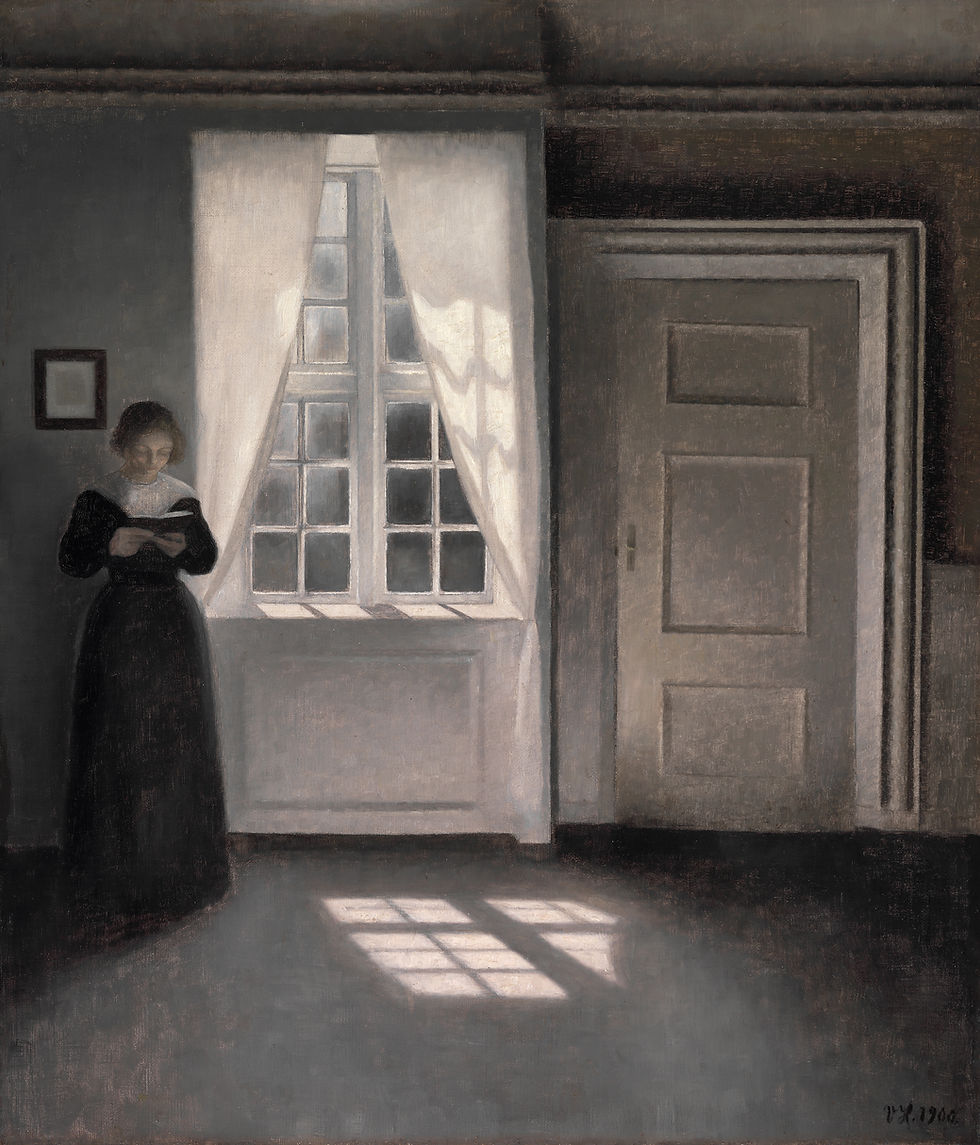
Direct lineage to Hammershoi quiet-modernism: Hammershøi (1864-1916) visited Whistler's London studio twice (1894 + 1898), corresponded with Whistler 1899 until Whistler's 1903 death, and inherits the controlled cool palette + flat compositional ground + reduction-of-figure-to-formal-element directly. Whistler→Hammershoi is the cleanest English aestheticism → Northern European quiet-modernism transmission.
Browse 19th-century American + Aestheticist prints in the archive at zocineartdesign.etsy.com.


Comments