Bedroom Wall Art for Couples: Six Paintings That Don't Argue With Each Other
Updated: 1 day ago
A shared bedroom is the rare interior where wall art has to satisfy two people whose visual preferences may not perfectly overlap. Couples who decorate together usually agree on the room's structural elements — the bed frame, the floor finish, the lamp shades — but disagree on the painted image that hangs above the bed. The six paintings below are chosen for that constraint. Each carries a quiet emotional register that neither partner reads as imposed on them by the other. Each carries a controlled palette that survives both morning sun from an east window and warm evening lamp-light. Each carries subject matter that is intimate without being romantic in any sentimental sense — none of the six shows a kiss, a wedding, a heart, or any direct depiction of a couple. The paintings are intimate because they depict moments of private interior life that the room itself is also meant to contain.
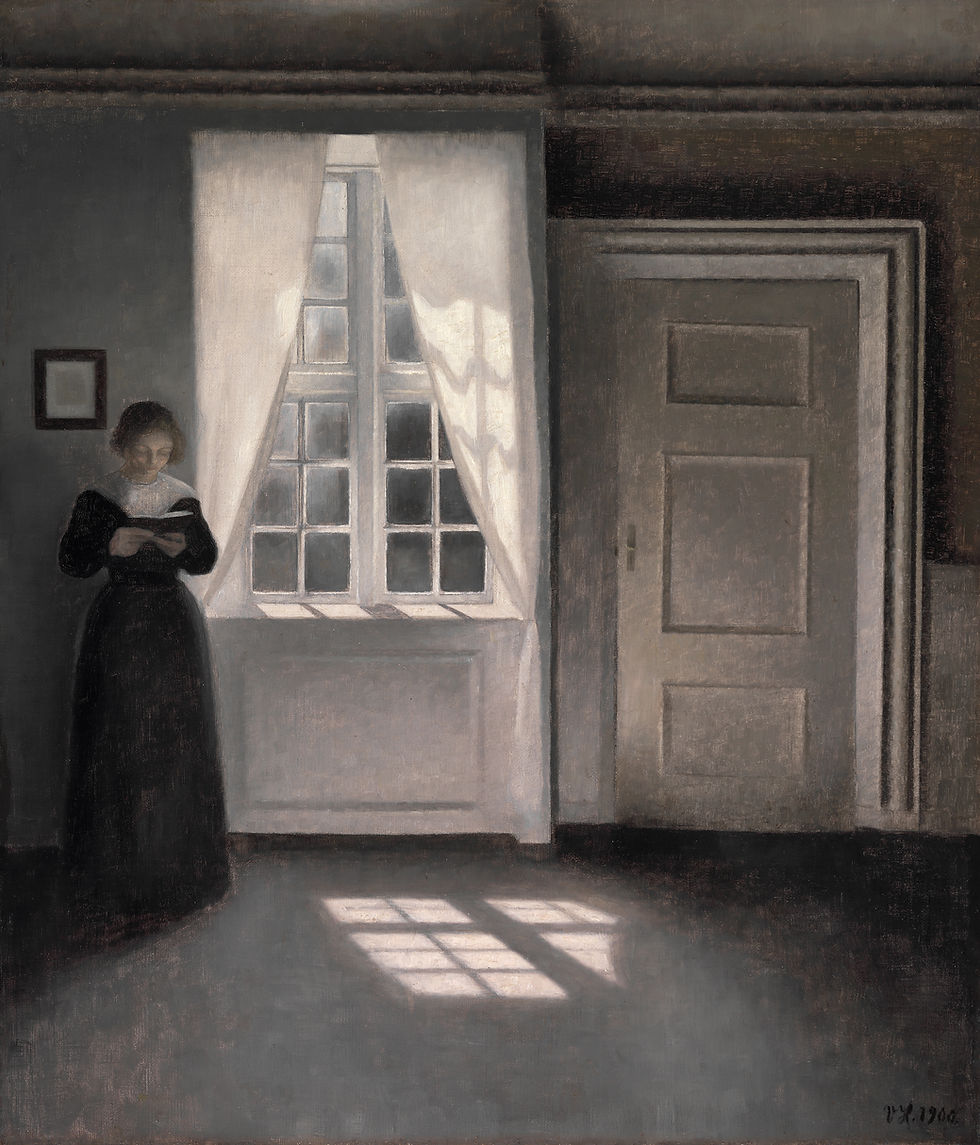
1. Hammershoi, Interior, Strandgade 30 (1900) — the above-bed centrepiece
The Hammershøi is the cleanest possible above-bed painting because it depicts no one's specific position. A single back-turned female figure walks through an empty room toward an open doorway; the room is cool grey and dove white with a splash of yellow afternoon sun on the floor. The painting argues with no one because it argues for nothing. Print at 80 × 70 cm — the larger Hammershøi size, scaled for above-bed placement — and frame in unstained European oak with a wide flat profile. Mount centred above the bed at approximately 150 centimetres from the floor to the centre of the canvas (the painting's lower edge will be approximately 30 centimetres above a standard 130-centimetre-tall padded headboard, leaving a comfortable visual breath between bed and painting). The Hammershøi is the structural piece around which the rest of the bedroom's wall programme can be designed.
2. Cassatt, Tea (c. 1890) — the dresser wall
Cassatt's Tea is the painting that hangs on the dresser wall opposite the bed. Two women in pale cream and dove grey are seated side-by-side at a low table with a silver tea-service; the viewer is positioned at conversational distance, close enough to share the visit but not to participate in it. The painting fits the dresser wall because it operates at the same emotional register as the bedroom itself — a private interior moment observed without interruption. Print at 60 × 90 cm horizontal and frame in black-stained European ash; mount centred on the wall above the dresser at approximately 145 centimetres from the floor (so the painting reads at standing eye-level when the wearer is dressing in the morning). The Cassatt and the Hammershøi work as a paired conversation across the room — the same domestic-interior subject in two different national traditions twenty years apart, the two paintings echoing each other across the bed.

3. Monet, Camille on the Beach at Trouville (1870) — the morning side
Monet's Camille on the Beach at Trouville was painted in summer 1870 during the brief honeymoon Monet and his first wife Camille Doncieux took on the Norman coast in the weeks immediately after their 28 June 1870 marriage. The 38 × 46 centimetre canvas is small for a Monet — about the size of a dinner-plate — and depicts Camille seated on the sand under a black parasol in a striped dress, reading a small book. The brushwork is loose and visible and the sand of the beach contains real Trouville grains pressed into the wet paint (the analysis of the canvas surface conducted in 2007 found multiple grains of beach sand embedded in the original 1870 paint surface). The painting belongs on the morning side of the bed (the wall the partner waking earliest faces) because it carries the same emotional register as the first quiet hour of a shared morning. Print at 50 × 60 cm and frame in dark walnut. Mount above a small side-table or chest of drawers on the side of the bed nearer to the window.

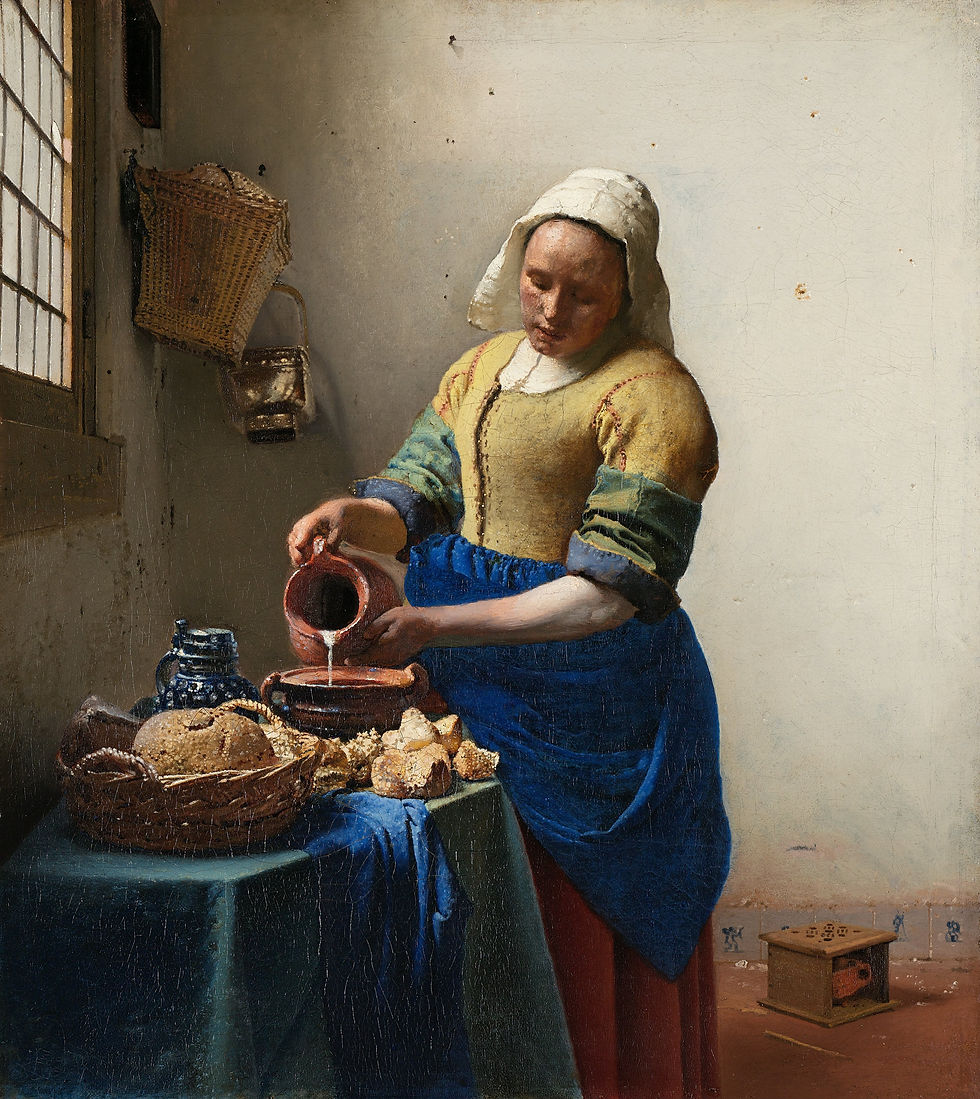
4. Vermeer, The Milkmaid (c. 1660) — the evening side
The Vermeer is the painting on the opposite side of the bed from the Monet. A single female servant pours milk from a brown earthenware jug into a low ceramic bowl, the morning sun coming through a leaded window from the upper left and producing the famous Vermeer light on the milk-stream's white arc. The painting is small (45.5 × 41 cm) and rewards close-range viewing — the partner who reads in bed before sleep registers the painting's specific quiet competence at the end of the day. The Vermeer + Monet pairing on the two sides of the bed is the strongest possible thematic balance: the Monet is a single figure outdoors in cool morning light, the Vermeer is a single figure indoors in steady warm light. Print at 40 × 35 cm and frame in dark walnut. Mount on the wall at seated-eye-level (approximately 100 centimetres from the floor) above the bedside table so the painting reads at exactly the height a reader in bed sees it.
5. Renoir, Young Girl Reading (c. 1890s) — the reading-chair corner
Most shared bedrooms have a single reading-chair tucked into a corner near the window or beside the dresser. The Renoir is the painting that hangs above the reading chair. A single figure in profile, head tilted slightly down to the page, the warm pink-and-cream palette typical of Renoir's late-1880s Provence period — the painting is a compositional rhyme between the depicted figure's absorbed posture and the chair's actual reader. Print at 50 × 70 cm and frame in slim dark-walnut moulding. Mount at standing-eye-level (approximately 155 centimetres from the floor) so the painting reads at full scale when the partner walks past the corner during the day, and at seated-side-eye-level when the partner is actually in the chair reading. The Renoir is the only painting in the six-painting bedroom programme that does any direct work of representing the room's actual use — but the representation is gentle enough that the painting does not feel literal.

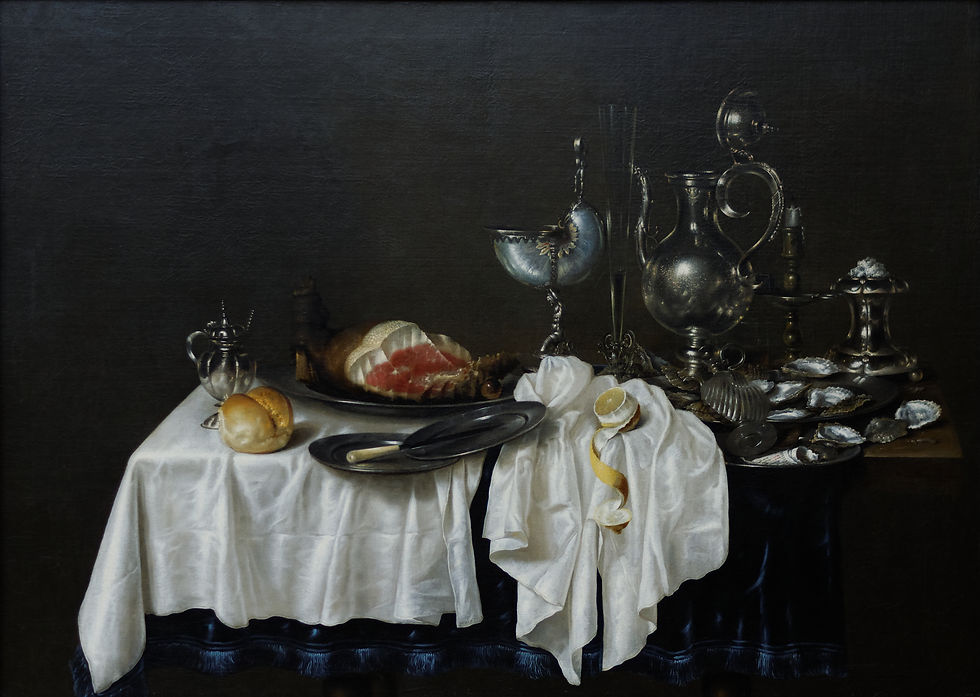
6. Heda, Still Life with Nautilus Cup (c. 1640) — the en-suite or walk-in entry
The Heda is the painting that hangs at the entry to the en-suite bathroom or the walk-in closet — the threshold between the bedroom and the daily routines that begin and end there. A half-eaten meal on a polished wooden table: an overturned silver tazza, a lemon with its peel coiled, a green-glass römer wine glass, a polished pewter plate, the nautilus-shell cup of the title. The painting is bookless and figureless and carries no narrative; it is the still-life version of a bedroom's argument — careful observation of a small number of beautiful objects, lit from one side, registered carefully. The painting works as the threshold image because it does not depict either bedroom or bathroom and therefore does not impose its meaning on the room a partner is walking into or out of. Print at 60 × 90 cm horizontal and frame in dark walnut. Mount above the en-suite door-frame or on the wall opposite the walk-in closet entry at standing-eye-level.
Placement, framing, lighting — the practical rules for couples
Three rules govern all six bedroom placements. First: SCALE matches function. The above-bed painting is the largest (80 × 70 cm Hammershøi); the bedside paintings are smaller (40 × 35 cm Vermeer, 50 × 60 cm Monet); the dresser and reading-chair paintings are middle-scale (60 × 90 cm Cassatt and Heda, 50 × 70 cm Renoir). The scale hierarchy produces a calm visual rhythm rather than a competing salon-wall. Second: FRAMING — pick ONE frame material for the entire room. Dark walnut, black-stained European ash, or unstained European oak. Mixing frame materials in a bedroom creates a visual restlessness that interferes with sleep; the single-frame-material rule matters more here than in any other room. Third: LIGHTING — the above-bed painting needs a dedicated picture-light at 2700 Kelvin warm-white temperature, dimmable from the bedside switch. An unlit painting above the bed at evening reads as a dark rectangle and contributes nothing to the room's settle-down register. The picture-light should be dim enough at lowest setting to leave on as a night-light without disturbing sleep.
Key takeaways
A shared bedroom needs paintings that don't impose either partner's specific preference. The six selected canvases all carry quiet emotional registers, controlled palettes that survive both morning sun and warm evening lamp-light, and subject matter that is intimate without being sentimentally romantic.
Six paintings + placements: Hammershøi Strandgade Interior (above bed, 80×70 cm), Cassatt Tea (dresser wall, 60×90 cm), Monet Camille at Trouville (morning side of bed, 50×60 cm), Vermeer Milkmaid (evening side of bed, 40×35 cm), Renoir Young Girl Reading (reading-chair corner, 50×70 cm), Heda Still Life Nautilus (en-suite or walk-in threshold, 60×90 cm).
The strongest paired conversations: Hammershøi + Cassatt (echoing across the bed, same domestic-interior subject 20 years apart). Monet + Vermeer (morning side / evening side, outdoor cool light / indoor warm light, mirror-balance across the bed).
Three universal rules: (1) SCALE matches function — above-bed largest, bedside smallest, dresser/reading-chair middle. The hierarchy produces calm visual rhythm rather than competing salon-wall. (2) FRAMING — ONE material for the whole room (dark walnut OR black-stained ash OR unstained oak); single-material rule matters more in bedroom than in any other room. (3) LIGHTING — dedicated 2700K picture-light above the bed, dimmable from bedside switch, low enough to leave on as night-light.
Mounting heights: above-bed 150 cm floor-to-canvas-centre (~30 cm above standard 130 cm padded headboard), dresser 145 cm (standing eye-level for dressing), bedside seated 100 cm (reading-in-bed eye-level), reading-chair 155 cm (standing-pass eye-level + seated-side eye-level when reading).
The selection rule for couples: NO direct depiction of a couple. None of the six paintings shows a kiss, a wedding, a heart, or any romantic-genre subject. The paintings are intimate because they depict moments of private interior life that the room itself is also meant to contain — not because they describe the relationship the couple shares.
Browse fine prints for the bedroom in the archive at zocineartdesign.etsy.com.
Comments