Cassatt's Child's Bath: The Tenderness of Modern Motherhood
Updated: Sep 6
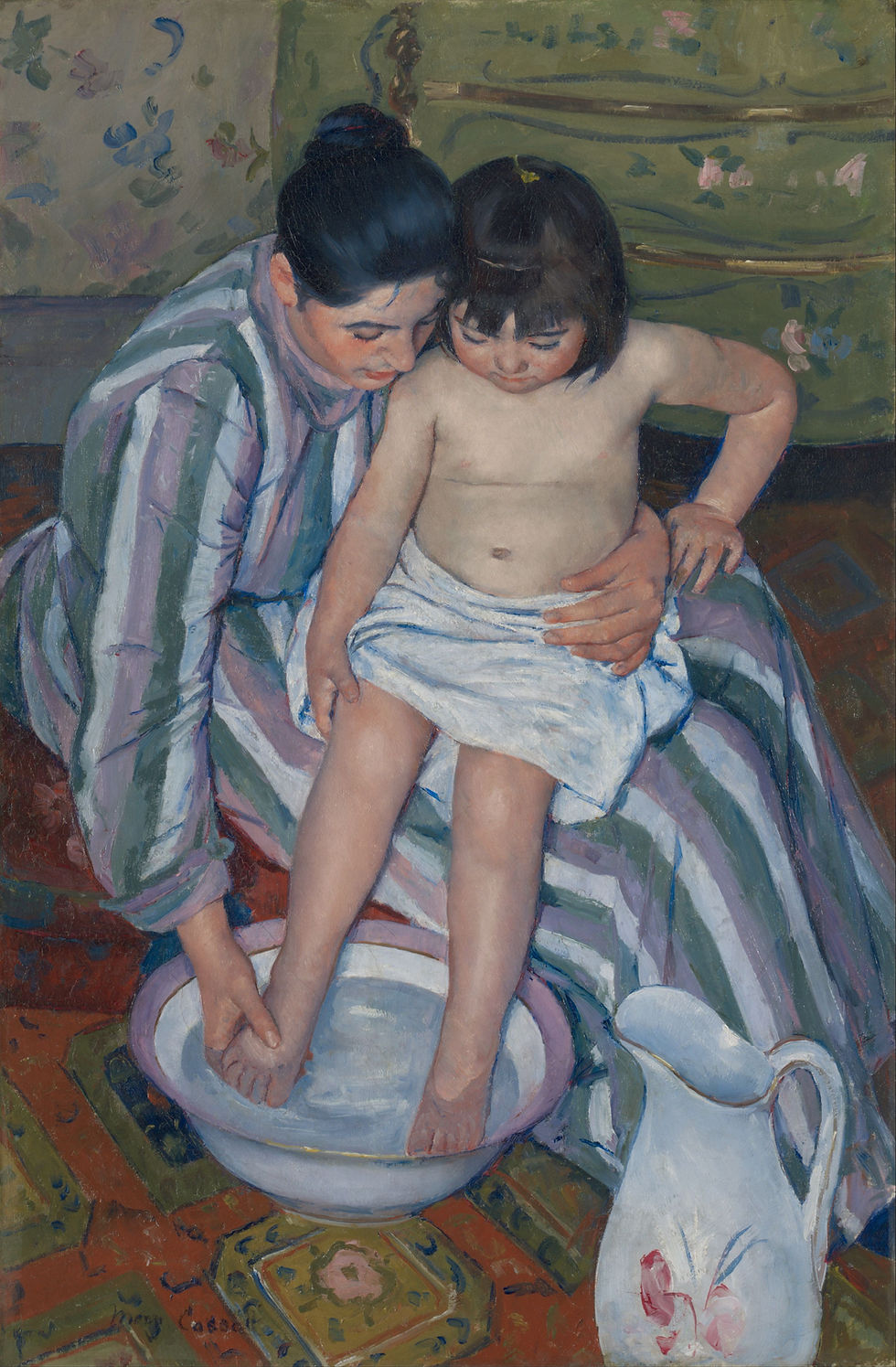
Mary Cassatt painted The Child's Bath in 1893, the year she had returned from a long study of Japanese woodblock prints in Paris. The painting is small — about four feet tall — and the subject is the oldest one in domestic life. A woman holds a child on her lap, washes one of the child's feet in a basin, and looks down. Nothing happens. That is the point.
What makes the picture remarkable is everything it refuses. There is no story, no allegory, no Madonna pose lifted from Renaissance precedent, no sentimental glow. Cassatt cropped the figures from above, flattened the patterns, and let the act of washing carry the full weight of the picture. The result is one of the quietest and most radical paintings of nineteenth-century American art.
What follows is a reading of the painting at four levels: what Cassatt borrowed from ukiyo-e, what she invented from the bathing scene itself, how the picture sits inside her larger mother-and-child series, and where to place a print of it in a contemporary room.
What Cassatt borrowed from Japanese woodblock prints
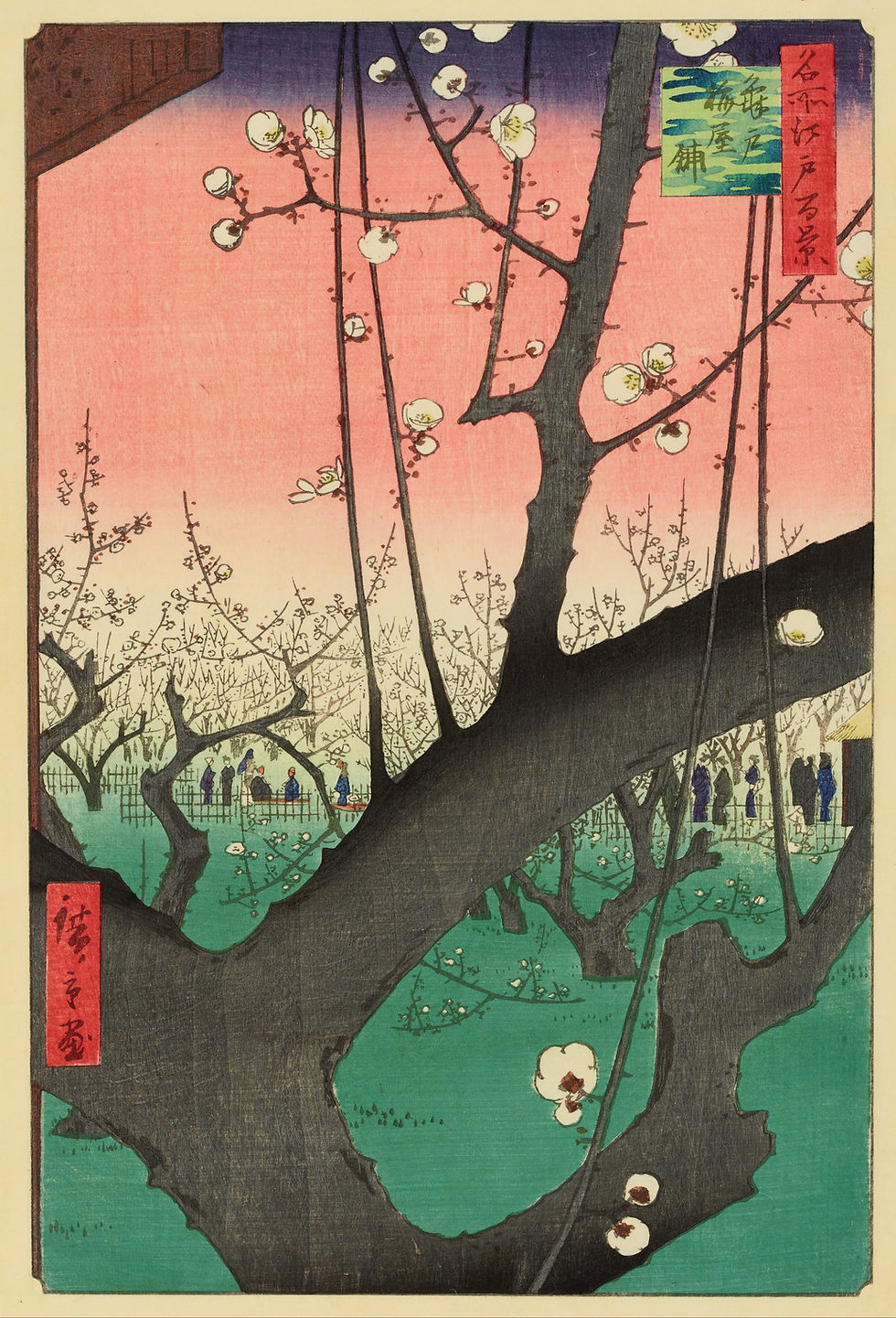
In April 1890 Cassatt visited an exhibition of Japanese prints — more than seven hundred sheets by Utamaro, Hokusai, Hiroshige and others — held at the École des Beaux-Arts. She went back several times. She wrote to Berthe Morisot that you cannot dream of anything more beautiful. Within a year she had produced ten color drypoints of her own, modeled directly on Utamaro's bathing women and toilette scenes.
Three Japanese conventions sit visibly inside The Child's Bath. The first is the high vantage point: Cassatt looked down on her figures from above the way Utamaro looked down on his courtesans, collapsing depth and forcing the viewer into the role of intimate observer. The second is flat patterning — the striped dress, the floral wallpaper, the patterned rug — pressed up to the picture plane in defiance of European tonal recession. The third is the decisive crop, cutting the chest of drawers at the right edge and the rug at the bottom edge in the way a woodblock cuts a kimono or a screen.
European painters had been borrowing from ukiyo-e for two decades by 1893 — Manet, Whistler, Degas, Van Gogh all owned prints — but Cassatt was the painter who absorbed the lesson into a domestic American subject. The bath scene is hers entirely; the language is borrowed and rebuilt.
What the bathing scene actually does
Look at the geometry. Two heads lean together at the top of the canvas; two pairs of hands meet at the center. The mother's right hand cups the child's foot in the basin. Her left hand braces the child's waist. The child's left hand rests on the mother's knee. The composition is held together by a quiet pyramid of contact — head to head, hand to foot, lap to body — and the whole pyramid tilts gently toward the basin.
Cassatt was painting a single repeated gesture — the lowering of a small foot into warm water — and she stopped time inside it. The child looks at her foot. The mother looks at her hand. No one looks at us. The act is private and continuous; the painting frames it without interrupting it.
The color does the rest. The mother's dress is striped pink and green; the wallpaper is patterned green and gold; the basin is a clean band of cream. Cassatt mixed her tones from a small palette and built the painting in distinct flat zones, each separated from its neighbor by a clear contour. This was technique borrowed from Japan and from the Italian primitives Cassatt had studied as a younger painter — outlines first, washes later. Nothing in the picture is rendered in the conventional academic round.
Where it sits in Cassatt's motherhood series
Cassatt painted mothers and children for nearly thirty years. The series begins in the early 1880s with looser, brushier Impressionist family scenes and ends around 1910 with monumental compositions that read almost as secular icons. The Child's Bath falls in the middle and is the pivot — the picture where she stops painting like a French Impressionist and starts painting like a printmaker who happens to use oils.
Cassatt herself never married and had no children. Her models were her relatives, her servants' children, and the children of friends — borrowed bodies in real interiors. She rejected the long tradition of religious motherhood subjects (the Madonna and Child of the canon) and replaced them with what she called the modern woman — clothed, urban, middle-class, attentive to her own child as an individual rather than as a symbol. The Child's Bath is one of the founding statements of that program.
She is also painting work. The bath is labor — small, daily, unromantic, performed by a real woman with a wet sleeve and an awkward angle. Cassatt does not pretend otherwise. The painting honors the work by looking at it carefully, without dramatizing it.

Reading the details
Three small details reward a slow look:
The water in the basin — a cream-grey-pink mix, painted thin so the canvas weave shows through. The water is not transparent; it is opaque, held inside the basin's rim like a flat dish. Cassatt does not give us a reflection. The basin functions as a quiet center of stillness around which the entire composition pivots.
The chest of drawers at the right edge — cropped, with a flat pitcher and a glass on top. The pitcher is the source of the bathwater, the glass implies a drink for the child afterward; nothing else of the room is shown. Cassatt is editing the way a Japanese woodblock editor would edit, keeping only the props the act requires.
The wallpaper — a green and gold floral pattern that fills the upper half of the picture. It refuses to recede. It sits flat against the figures, as patterned as the dress, as patterned as the rug, with no shadow to root anyone in space. Cassatt is announcing that depth is a convention she has chosen to set aside.
Why the painting still works
Many late nineteenth-century pictures of children are unbearable now — too sweet, too sentimental, too obviously coded for a Victorian living-room. The Child's Bath is not one of them. The reason is that Cassatt was painting a structure, not a mood. The composition holds whether the viewer brings tenderness to it or not. The pyramid of touch, the flat colour, the high vantage, the cropped frame — these would still be a great painting if the figures were anonymous adults at any other small daily task.
What the subject adds is recognition. Anyone who has ever bathed a child, or been a child being bathed, recognizes the geometry. The painting tells the truth about what the gesture looks like from inside it. That recognition is the source of the picture's long emotional life.
How to live with this painting
The print works best where it can be looked at slowly and from close in — at sitting distance, not from across a room. It is a private picture in a public format. A reading-nook wall, a small bedroom, a quiet corner of a nursery, the wall behind a writing desk, the stair landing where the eye lands on the way up — all suit the painting better than a long sofa wall or an entryway.
Frame it in a narrow oak or unstained ash, with a generous cream mat that picks up the basin and the bath water. Avoid black; it fights the painting's pinks and greens. Avoid gilt; the painting was made in conscious revolt against the gilded frames of academic salon painting and looks ironic inside one. Hang it at seated eye-level — slightly lower than you would hang a landscape, because the picture rewards being looked down into.
It pairs well with another Cassatt — The Boating Party makes a strong horizontal counterweight if the room can take both — or with a single Hiroshige bird-and-flower print, which carries the same Japanese vocabulary into a different subject. Avoid hanging it next to anything Victorian or sentimental; the painting is too quietly modern to share a wall with imitations.
→ Available as a fine print: zocineartdesign.etsy.com
Key takeaways
Cassatt painted The Child's Bath in 1893, three years after the Paris ukiyo-e exhibition that changed her direction.
The composition borrows three Japanese conventions: high vantage, flat patterning, and decisive cropping.
A quiet pyramid of touch — head to head, hand to foot — holds the painting together; the basin is its still center.
The picture is one of the founding statements of Cassatt's lifelong modern woman subject — clothed, urban, attentive, painted as a structure rather than as a sentiment.
The painting belongs at sitting distance in a quiet room, framed in pale wood with a cream mat, ideally near a Hiroshige or another Cassatt for company.
Browse the full archive at zocineartdesign.etsy.com.


Comments