Cassatt's Tea Paintings (1880-1891): How an American Painter in Paris Made the Drawing-Room the Subject of Modern Art
Mary Cassatt painted the same domestic ritual — two women at afternoon tea in a respectable upper-middle-class drawing-room — three separate times across the decade 1880-1891. The first was an oil-on-canvas of approximately 64.77 by 92.07 centimetres now held in a Boston collection, painted in Paris during the autumn of 1880 when Cassatt was thirty-six years old; the model was her older sister Lydia Simpson Cassatt (then thirty-three) seated with an unidentified visitor in the Cassatt family's rented Boulevard Haussmann apartment. The second was a tonally cooler version completed in 1890, currently held in a Washington collection. The third was the 1891 color drypoint-and-aquatint print Afternoon Tea Party, the seventh in Cassatt's ten-plate Japonisme series of 1890-91 that translated Hokusai and Utamaro woodblock principles into a Western printmaking technique. Across the three versions the question Cassatt asks is the same: does the private afternoon between two women deserve the compositional seriousness that French Impressionism had reserved, before 1880, for cafés, opera-houses, and Boulogne weekends?

Cassatt arrived in Paris in 1866 and stayed forty years
Mary Stevenson Cassatt was born on the 22nd of May 1844 in Allegheny City, Pennsylvania (now part of Pittsburgh), the fifth child of the investment banker Robert Simpson Cassatt and Katherine Kelso Johnston. Robert Cassatt was prosperous enough that the family travelled extensively in Europe across the 1850s — Cassatt spent her ages seven through eleven (1851-1855) in Paris, Heidelberg, and Darmstadt — and the seven-year-old Cassatt encountered French academic painting at first hand in the Louvre and the Paris Salon during these years. She enrolled at the Pennsylvania Academy of the Fine Arts in 1860 at age sixteen, studied there for four years until 1864, and returned to Paris in 1866 at age twenty-two to begin a private studio apprenticeship with the academic painter Jean-Léon Gérôme. The 1866 Paris arrival was decisive: Cassatt never permanently returned to live in the United States, although she visited Pennsylvania for extended periods (1870-71, 1898-99, and 1908). Her forty-year French residency ended only in 1915 when severe diabetes made transatlantic travel impossible, and she died in her Château de Beaufresne country house outside Beauvais on the 14th of June 1926, age eighty-two.

Cassatt's first decade in Paris (1866-1876) was a sequence of academic submissions to the Paris Salon, four of which were accepted between 1868 and 1876. The work from this period is conventional — competent academic portraiture and genre painting in the Salon-acceptable French mode of the 1870s, deliberately constructed to win institutional approval. The shift came in 1877. Edgar Degas (1834-1917, ten years older than Cassatt) saw Cassatt's Little Girl in a Blue Armchair at the Paris Salon's annual exhibition that summer; Degas attended the show, was struck by the unconventional perspective and the child's bored slouch in the chair, asked his dealer for an introduction, and walked into Cassatt's Rue de Laval studio in late autumn 1877. Cassatt's own account of the meeting survives in her 1894 letter to the dealer Ambroise Vollard: "He looked at the pictures and said 'Most of these are right. You have a sense of feeling — you are one of us.' He asked me to exhibit with them." The "us" was the Impressionist group — and the invitation was the turning point in Cassatt's working life. She exhibited in the Fourth Impressionist Exhibition of April 1879, the Fifth in 1880, the Sixth in 1881, and the Eighth (the last) in 1886, and was the only American — male or female — invited to join the group across its twelve-year exhibiting history.
The 1880 Boston Tea: a painting about Lydia Cassatt's last good year
The 1880 Boston oil that initiated the Tea series was painted during what would prove to be Lydia Cassatt's last functionally healthy year. Lydia Simpson Cassatt was born in 1837 (six years before Mary), had been Cassatt's closest companion since their shared 1850s European travels, and had been formally diagnosed with Bright's disease — the nineteenth-century umbrella term for chronic kidney inflammation — in late 1879. The disease was progressive and untreatable in the pre-dialysis era; the Cassatt family had been told to expect three to five years of declining health before death. The 1880 Boston Tea was therefore composed with a specific biographical horizon. Lydia is the seated figure on the left of the canvas, in a pale rose afternoon dress with her right hand on the silver tea-service handle. The visitor on the right (identity uncertain — possibly the Cassatt cousin Anne Dickinson or a Boulevard Haussmann neighbour) is in a deeper red. The compositional argument is intimacy without sentiment: the two figures are physically close (their knees almost touching, Cassatt's brushwork emphasises the small distance) but psychologically separate (Lydia looks down at the tea-tray, the visitor looks at Lydia). The viewer is positioned at conversational distance — perhaps three feet from the corner of the table — close enough to share the visit but not to participate in it.

Cassatt completed approximately twenty-two canvases of Lydia between 1879 and Lydia's death in November 1882 — by some margin the largest single-sitter body of work in Cassatt's career. The sequence includes Lydia in a Loge Wearing a Pearl Necklace (1879, Philadelphia collection), Lydia Crocheting in the Garden at Marly (1880, NYC collection), Lydia Reading the Morning Paper (1880, private collection), and the 1880 Boston Tea. Lydia died in Paris on the 7th of November 1882, age forty-five, after a six-month decline. Cassatt did not paint a finished canvas for almost two years afterward; the next major work is Susan on a Balcony Holding a Dog of 1883, a transitional canvas with the wider tonal range and looser brushwork that would characterise Cassatt's post-Lydia decade. The 1880 Boston Tea therefore reads in retrospect as the last canvas in Cassatt's most stable working period — the late stage of a five-year stretch (1877-82) when she had a beloved primary model in regular health, a powerful institutional ally (Degas), a productive painting routine, and a stable Paris household. Everything that follows is composed in the absence of all four conditions.
Why Degas mattered to Cassatt and Cassatt mattered to Degas
The Cassatt-Degas working relationship was the most productive and the most volatile artistic friendship of either painter's career. The two met in late 1877 and worked closely until 1912 — thirty-five years — although they were never romantically involved (Degas never married, Cassatt never married, both insisted on the platonic terms publicly and privately) and the relationship broke down repeatedly. The most-cited rupture was the Dreyfus Affair of 1894-99: Degas was a public anti-Dreyfusard and an open anti-Semite, Cassatt was a Dreyfusard, and the disagreement effectively ended close studio contact between 1898 and 1903. They reconciled but never fully re-established the 1877-94 working rhythm. The technical influence flowed in both directions. From Degas, Cassatt absorbed the unconventional cropping (figures cut off by picture edges, as in the 1880 Boston Tea where the visitor's right shoulder is sheared by the canvas), the asymmetric composition (heavily weighted lower-left, lighter upper-right — diagonals rather than the symmetric centres of academic Salon painting), and the willingness to put unglamorous everyday subjects at the centre of the picture. From Cassatt, Degas absorbed the maternal-and-domestic subject matter — Degas's late pastels of women bathing and combing hair (c.1885-1900) draw directly on Cassatt's 1879-85 sequence — and the colour-print technical knowledge that Cassatt developed in her 1890-91 Japonisme series. Degas's 1879 caustic-line dry-point technique was Cassatt's technical starting-point; her 1891 series taught Degas what could be done with the technique at full development.
Degas's most-quoted statement about Cassatt is the remark transcribed by the dealer Paul Durand-Ruel in a March 1894 letter to the American collector Louisine Havemeyer: "I will not admit that a woman can draw like that." The remark is usually cited as evidence of Degas's misogyny — and on a flat reading it is misogynistic — but Durand-Ruel's full transcription continues: "… and yet Mary Cassatt draws better than most of the men in our group. It is intolerable. It is unfair. It is also true." The remark is a Degas inversion: the contradiction between his expressed prejudice and his actual professional respect for Cassatt is the point. Cassatt herself never publicly responded to the line — by 1894 she had been working in Paris for twenty-eight years and had long since stopped engaging with male-painter commentary on her gender — but she continued the working relationship with Degas without alteration. Her private letters from the period, especially the 1894-95 correspondence with Louisine Havemeyer, describe Degas as "the most difficult and the most necessary friend I have ever had," a formulation that captures both the productivity and the cost of the thirty-five-year working partnership.
Why the Tea paintings matter now
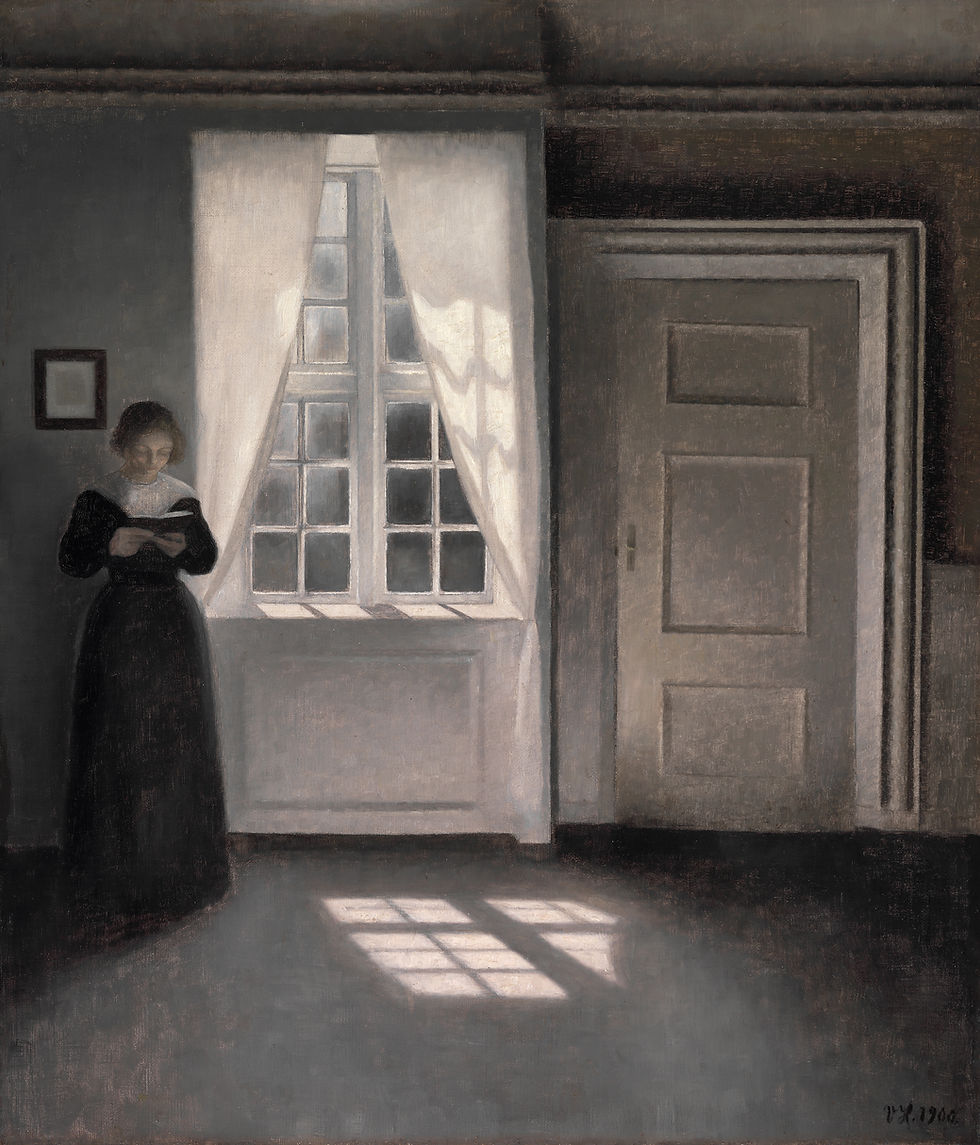
Cassatt's reception across the second half of the twentieth century and into the 2010s-2020s has gone through three distinct phases. The first phase (1926-1965) was institutional underrepresentation: Cassatt was treated by mid-century American and French art-historical writing as a minor Impressionist, the standard adjective being "charming" — a category that effectively excluded her from the serious-modernist canon. The second phase (1965-1995) was feminist art-historical recovery: Linda Nochlin's 1971 ARTnews essay "Why Have There Been No Great Women Artists?" and the subsequent Nochlin-Sutherland-Garb scholarship through the 1970s-80s re-positioned Cassatt as a major rather than minor figure, and the 1970 Philadelphia Museum of Art Cassatt retrospective (the first comprehensive American Cassatt exhibition since her 1926 death) made the case institutionally. The third phase (1995-present) is the Cassatt-as-canonical-modernist phase: the 1998-99 Chicago/Boston/Washington touring retrospective drew approximately seven hundred thousand visitors across its three venues, and Cassatt's 1891 color print series is now consistently included in graduate art-history syllabi as a foundational document of Western Japonisme. The Boston 1880 Tea, the Washington c.1890 Tea, and the 1891 color print are now read together as a single ten-year working investigation of how French Impressionism could be extended to subjects French Impressionism had not previously considered worthy of compositional attention. The investigation succeeded. The domestic-pair-at-tea has been a legitimate Western-painting subject from 1880 onward — Hammershøi, Hopper (1882-1967, the American direct descendant of Cassatt), Lucian Freud, and the contemporary American painter Anna Weyant all work in the compositional vocabulary Cassatt established in those eleven years.
The Tea sequence is also a clean example of what Cassatt's late-twentieth-century recovery actually did to the writing of nineteenth-century European art history. Before 1965, the standard narrative of 1870s-90s French painting treated the public-life subjects of Manet, Monet, Renoir, and Degas as the central modernist concern and the domestic-interior subjects of Cassatt and Berthe Morisot as a feminine sub-current. After 1995, the standard narrative treats both as equally central — and the Tea paintings are one of the load-bearing exhibits for the revised view. "Cassatt extended French Impressionism into the rooms that French Impressionism had previously walked past," the Boston curator Anna Bishop wrote in the 2014 catalogue essay for the museum's permanent-collection rehang. "The 1880 Tea is the painting in which the extension first proves itself." The catalogue essay is now the standard short-form citation for Cassatt's compositional contribution; the 1880 Boston canvas is the painting most often illustrated to make the argument.
Key takeaways
Mary Cassatt (1844-1926, born Allegheny City Pennsylvania, died Beauvais France) returned to the afternoon-tea subject THREE times across the decade 1880-1891: an oil canvas (Boston collection, c.1880, 64.77×92.07 cm), a cooler-palette version (Washington collection, c.1890), and the seventh plate of her 1891 ten-print color drypoint-and-aquatint Japonisme series. The three together argue that the domestic afternoon deserves the same compositional seriousness French Impressionism had previously reserved for cafés, opera-houses, and weekend leisure.
Cassatt arrived in Paris in 1866 at age 22 to study with Jean-Léon Gérôme and stayed forty years; she never permanently returned to the US. Edgar Degas saw her Little Girl in a Blue Armchair at the 1877 Paris Salon, introduced himself, and invited her to exhibit with the Impressionists — she joined the Fourth (1879), Fifth (1880), Sixth (1881), and Eighth (1886) Impressionist Exhibitions and was the ONLY American (male or female) invited across the group's twelve-year exhibiting history.
The 1880 Boston Tea was painted during Cassatt's older sister Lydia Simpson Cassatt's (1837-1882) last functionally healthy year — Lydia had been diagnosed with progressive Bright's disease (chronic kidney inflammation) in late 1879 and died in Paris November 1882, age 45. The Boston Tea is the last canvas in Cassatt's most stable working period (1877-82) and the last finished canvas before her two-year painting hiatus after Lydia's death.
Cassatt painted ~22 canvases of Lydia between 1879-1882 — by some margin the largest single-sitter body of work in her career. Other Lydia canvases: Lydia in a Loge Wearing a Pearl Necklace (1879, Philadelphia), Lydia Crocheting in the Garden at Marly (1880, NYC), Lydia Reading the Morning Paper (1880, private). The Lydia sequence ends with the 1880 Boston Tea.
The Cassatt-Degas working relationship lasted 35 years (1877-1912), platonic throughout. Cassatt absorbed unconventional cropping + asymmetric composition + unglamorous everyday subjects from Degas; Degas absorbed maternal-and-domestic subject matter + colour-print technical knowledge from Cassatt. Relationship ruptured 1898-1903 over the Dreyfus Affair (Degas anti-Dreyfusard, Cassatt Dreyfusard) but resumed cordially after 1903.
The 1891 color drypoint-and-aquatint series (ten plates, 1890-91, edition of approximately 25 of each) was Cassatt's direct response to the April 1890 Paris exhibition of Japanese ukiyo-e prints at the École des Beaux-Arts — she saw Hokusai and Utamaro at scale for the first time. The seventh plate, Afternoon Tea Party, is the Tea-subject's third return. The series is now consistently included in graduate art-history syllabi as a foundational document of Western Japonisme.
Reception phases: (1) 1926-1965 institutional underrepresentation — "charming minor Impressionist." (2) 1965-1995 feminist recovery — Linda Nochlin's 1971 ARTnews "Why Have There Been No Great Women Artists?" essay + 1970 Philadelphia retrospective. (3) 1995-present canonical-modernist phase — 1998-99 Chicago/Boston/Washington touring retrospective drew ~700K visitors across three venues; standard graduate syllabus inclusion.
Direct lineage: Cassatt's 1880-91 Tea period seeded the next generation of European and American interior painting. Vilhelm Hammershøi (1864-1916) saw Cassatt's 1891 color print series in Copenhagen autumn 1892 via Galerie Bing's touring exhibition and adopted the back-turned female figure + cool palette in his mature 1898-1916 interiors. Edward Hopper (1882-1967), Cassatt's most direct American descendant, inherits the "observed-but-not-interrupted private moment" compositional ethics.
Browse Impressionist and American painter prints in the archive at zocineartdesign.etsy.com. Further reading: National Gallery of Art Cassatt Open Access collection — the Washington Tea (NGA 52898) plus the full 1890-91 ten-print Japonisme series are downloadable in high resolution.


Comments