Vermeer's The Art of Painting (c. 1666-68): Meaning, the Muse, the Map and the Painter's Back
Johannes Vermeer's The Art of Painting (c. 1666-68) shows a painter in an old-fashioned costume, seen from behind, painting a model dressed as Clio, the muse of history. It is less a studio view than an allegory: Vermeer is arguing that painting deserves the same dignity as history and poetry.

What are we looking at in The Art of Painting?
We stand in a large room with a black-and-white chequered floor, looking past a heavy tapestry curtain that has been pulled aside as if to reveal a stage. A painter sits at an easel with his back toward us. He wears a black jacket with slashed sleeves, a style that was already out of date in the 1660s, and a soft beret. On the canvas in front of him he has begun with the blue laurel wreath of a young woman who poses by the window.
She holds a trumpet and a thick book, and her wreath is a classical sign. These are the attributes of Clio, the muse of history, as an Italian handbook of the time described her. On the table lie a plaster mask, some fabric and an open folio. A large map of the Netherlands covers the back wall, and a chandelier with a double-headed eagle hangs over the scene.
What is the meaning of The Art of Painting?
The picture works as an argument. Painting is shown to be a learned craft with a noble subject, because the model is the muse of history, not an ordinary sitter. The mask on the table is a traditional emblem of imitation, the idea that painting copies life. The trumpet suggests fame, which a good painter earns for his subject and for himself.
The map is the richest clue. It shows the Seventeen Provinces of the Low Countries as one territory, though the north and south had been divided since the late sixteenth century. The crease down its middle follows the border. Many scholars read it as a look back at a lost unity, but it could also be read as a proud record of Dutch cartography. The chandelier is an empty Habsburg eagle with no candles, a reminder of the old rulers. Together they place a quiet, domestic scene inside Dutch history.
What is the least known fact about it?
Vermeer never sold it. He kept it in his studio until his death in 1675, and it appears to have been for him a showpiece rather than a commission. After his death, his widow, Catharina Bolnes, tried to protect it from creditors by transferring it to her mother, Maria Thins. It later passed through several owners, and for a long time it was thought to be by Pieter de Hooch, until it was recognised as a Vermeer in the nineteenth century.
Its twentieth-century story is even stranger. In 1940 it was bought for Adolf Hitler, who admired Vermeer, and at the end of the Second World War it was found with other looted art in an Austrian salt mine and returned to Vienna.
How does it fit with Vermeer's other work?
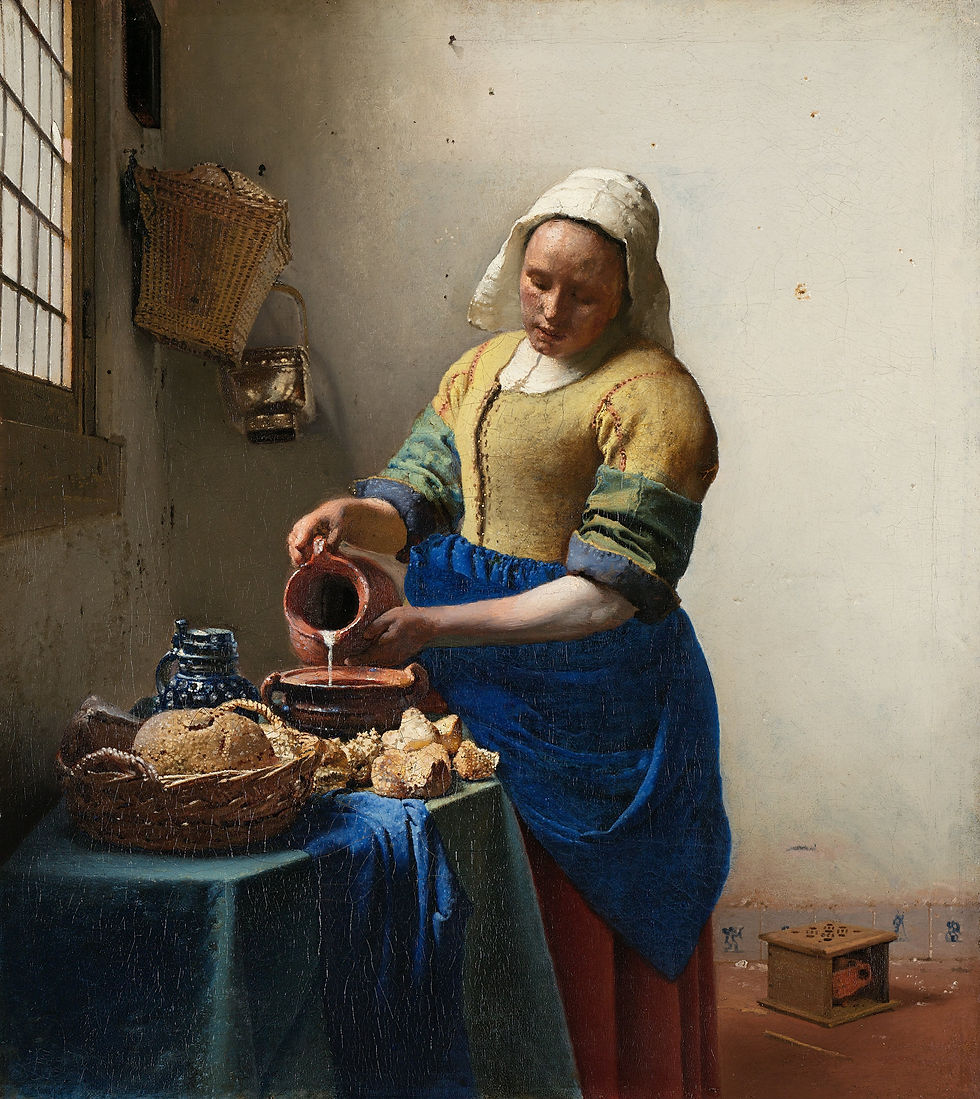
Most of Vermeer's pictures show one or two people doing a small thing: reading a letter, pouring milk, weighing pearls. This one is larger and more theatrical, and it is the only one of his paintings that shows a painter at work. To see his best-known pictures in order, read Vermeer Paintings Explained. For his city view, see Vermeer's View of Delft, and for a shorter list of favourites, try Best Vermeer Paintings.
Where is The Art of Painting today?
It is held in a Vienna collection, where it is among the best-known Dutch paintings. Because it is a large, detailed picture, it rewards a long look: the light on the map, the shine of the brass chandelier and the pattern on the curtain are all painted with care.
Zocine Art Design is an independent studio that prints classic paintings as wall art.
Frequently asked questions
Who is the painter in Vermeer's The Art of Painting?
Nobody knows for certain. He is seen from behind, and many viewers assume he is Vermeer himself, but the picture does not confirm it.
Who is the woman in The Art of Painting?
She is a model dressed as Clio, the muse of history, with a laurel wreath, a trumpet and a book.
What does the map in The Art of Painting mean?
It shows the Low Countries as they were before the north and south split. Scholars read it as a reference to Dutch history and to the art of map-making.
Why is it also called Allegory of Painting?
Because it uses symbols instead of showing a real studio scene. The muse, the mask and the map all point to the meaning of art.
Browse Johannes Vermeer and other classic art prints in the archive at Zocine.
New in the Journal: Vermeer Paintings Explained
New in the Journal: Vermeer's View of Delft


Comments