Best Vermeer Paintings: Nine Works That Define a Quiet Master
Johannes Vermeer of Delft painted somewhere between thirty-four and thirty-six pictures across a working life that lasted twenty-two years. He died in 1675 at the age of forty-three, deep in debt, with eight surviving children and a wife who had to sell two paintings to pay the baker. For two centuries after his death he was almost forgotten — Dutch art history of the eighteenth century considered him a competent local painter and not much more. He was recovered by the French critic Théophile Thoré-Bürger in 1866 and has, since then, become one of the most studied painters in Western art. Almost every picture he made is now considered a small masterpiece of light, glass, paint, and unhurried looking. Nine of them, in the order he made them.
Officer and Laughing Girl, c. 1657 — the first interior with the map
Vermeer's early genre pictures — those he made in his late twenties — are formally close to the work of Pieter de Hooch and Gerard ter Borch, the two Dutch painters whose domestic interiors he was studying. The Officer and Laughing Girl, painted around 1657, is the picture in which Vermeer first arrives at the kind of room he would paint for the rest of his life. The canvas is fifty by forty-six centimetres, oil on linen, now in a private American collection. A young soldier in a wide-brimmed black hat sits at the picture's left edge, his back almost turned to the viewer, his red coat catching the morning light. Across the table from him a young woman in a yellow bodice leans toward him, laughing.

Two things in this picture become Vermeer's signature for the next eighteen years. The first is the wall map at the back of the room — Balthasar Florisz van Berckenrode's map of Holland and West Friesland, published in 1620, hanging in the same orientation in three later Vermeer pictures. The second is the device by which one figure is treated almost as a silhouette and the other as the receiver of the picture's full light. The soldier is the largest single object in the painting and we can barely see his face. The laughing girl is half his size and we see her in complete clarity. Vermeer is teaching himself, here, that scale and light are independent variables — that a picture can use one figure to frame the optical conditions for another.
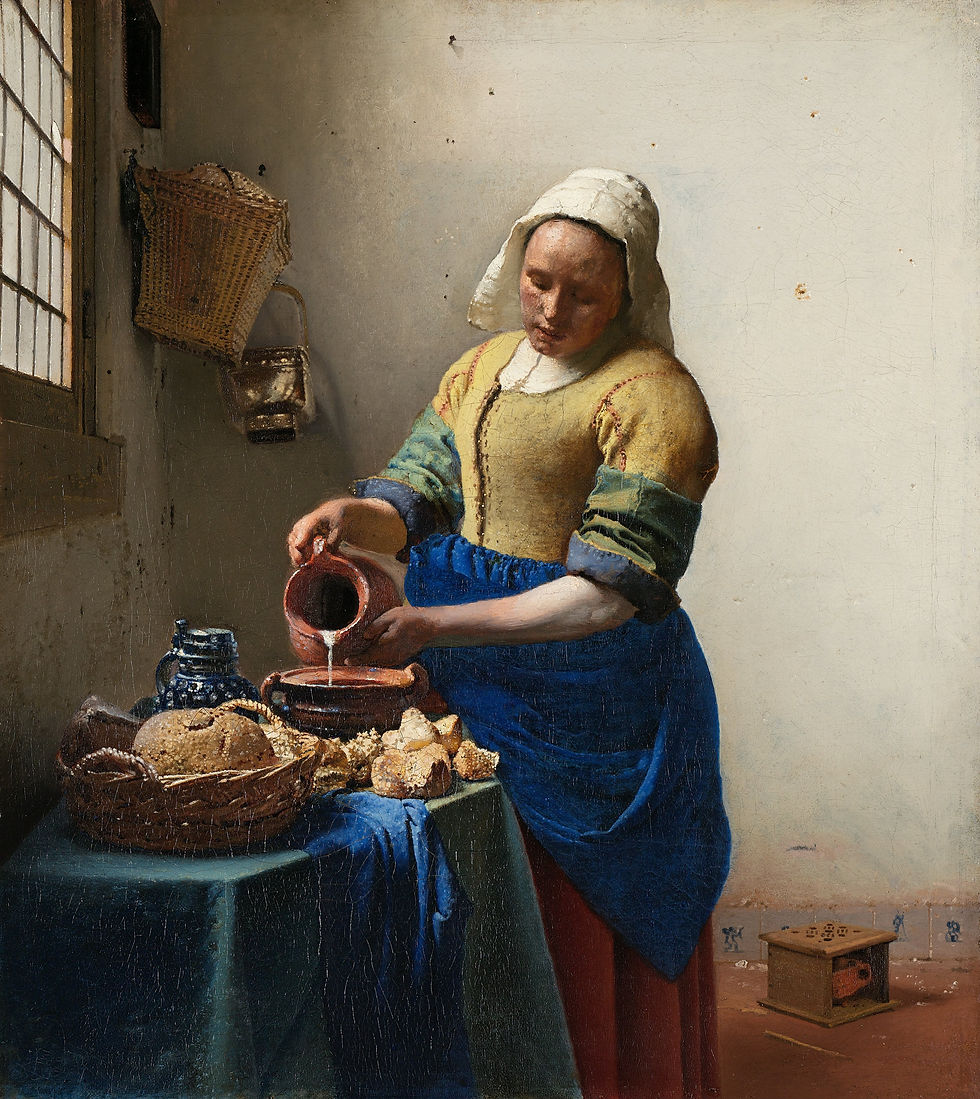
The Milkmaid, c. 1658 — the painting that turned a kitchen into an icon
The Milkmaid was painted around 1658, on a canvas forty-five and a half by forty-one centimetres, oil on linen, now in an Amsterdam collection. A kitchen-maid in a yellow bodice, blue apron, and white cap stands at a wooden table near a window. She is pouring milk in a continuous thin stream from a brown stoneware pitcher into a low earthenware bowl. On the table in front of her: a wicker bread basket holding the broken end of a loaf, three or four smaller pieces of crust, a small blue jug. Behind her: a whitewashed wall with one nail, one wicker-wrapped basket hanging from a hook, one pierced metal foot-warmer at floor level. The light comes from a single high window on the left, lead-glazed, with one pane visibly broken.
The picture has, since the late nineteenth century, become probably the most reproduced single domestic figure in Dutch painting. Most of the reasons are formal. Vermeer has built the maid as a sequence of three colour blocks — yellow, blue, the white of her cap — set against the warm earth tones of the bread, the cool grey of the wall, the dark of the foot-warmer. The thin stream of milk pouring from the pitcher is painted with such patience that one can see, near the bowl, the way the stream begins to break into separate drops. The bread crusts have a slightly granular surface built up from thousands of tiny dots of lead-tin yellow and lead white — the technique sometimes called pointillé, a way of suggesting the optical sparkle of light hitting an uneven surface. The picture takes a moment that should be one second long and treats it as if it could be held forever.
View of Delft, c. 1660-61 — the cityscape as portrait
Vermeer made only two known townscape pictures in his life. The View of Delft, painted around 1660-61, is the larger and more famous of the two. The canvas is ninety-six by one hundred and fifteen centimetres, oil on linen, in a collection at The Hague. The picture shows Delft from across the harbour on the Kolk, looking north toward the city walls — the Schiedam Gate on the left with its small turret, the Rotterdam Gate on the right with its drawbridge, the brick towers of the Old Church in the middle distance, the spire of the New Church catching the late-morning sun behind the Rotterdam Gate. Boats are moored at the harbour wall. Two small groups of figures stand on the foreground sandbank. A horse and cart wait near the boats. The clouds above are very large and unhurried.

Marcel Proust, who saw the View of Delft at a Paris exhibition in May 1921, used the painting in In Search of Lost Time as the picture his character Bergotte goes to see in the last hours of his life. Bergotte stands in front of the canvas and notices, for the first time, a little patch of yellow wall — petit pan de mur jaune — and recognises that this small detail is more carefully made than anything he himself has written. He dies in the gallery. The patch of yellow wall Proust meant is on the right side of the painting, on the south-facing flank of the Rotterdam Gate, where the morning sun has just begun to catch the wall and turn it from grey to lemon. It is about two centimetres wide on the canvas. It is one of the most carefully made small areas of paint in any seventeenth-century European picture.
The Music Lesson, c. 1662-65 — the room as optical instrument
The picture officially titled Lady at the Virginal with a Gentleman — and conventionally called The Music Lesson — was painted between 1662 and 1665. The canvas is seventy-three and a half by sixty-four and a half centimetres, oil on linen, in a Royal collection in London. The picture shows a long, deep room seen from the doorway. In the foreground, a black-and-white marble-tiled floor recedes sharply toward the back wall. Halfway down the room a heavy oriental carpet covers a small wooden table; on top of the carpet, a white porcelain jug and a glass. At the back of the room, a woman in a blue dress stands at a virginal — the small Dutch keyboard instrument painted on the wall in front of her — her back to the viewer. To her right, a gentleman in a black cloak listens. On the wall behind them: a large mirror that reflects the woman's face and the easel that Vermeer himself is presumably standing at to paint the picture.

The picture is the densest study of perspective and reflection Vermeer ever made. The marble floor is a perspective ruler — the diagonals of the tiles converge on a single vanishing point behind the woman's left shoulder. The carpet is treated as a low table-cloth so that we can see the underlying table edge at its left, which functions as a depth gauge. The mirror on the back wall is the painting's secret centre: it shows the woman's face from the front, which we cannot see directly, and shows the easel that the picture is presumably being made from. Vermeer is announcing, inside the painting, the fact that the painting is a constructed view from a specific point in the room. The viewer is invited to occupy the easel's position.
Woman Holding a Balance, c. 1664 — the moral mechanism
Woman Holding a Balance, painted around 1664, is the most quietly programmatic of Vermeer's mature pictures. The canvas is forty by thirty-five and a half centimetres, oil on linen, in a Washington collection. A young pregnant woman in a blue jacket trimmed with white fur stands at a table in front of a window, holding a small jeweller's balance between her thumb and forefinger. On the table: a pearl necklace, gold coins, two open jewel-cases, a piece of blue cloth. On the wall behind her: a painting of the Last Judgment — Christ in the centre, the souls being weighed on either side. The light from the window falls across her face and onto her hand.

The balance the woman holds is empty. The pans are level. She is not weighing the pearls or the gold; she is testing the instrument. The composition aligns her right hand with the figure of Christ in the painted Last Judgment behind her, and the empty balance with the cosmic scales by which souls are weighed in Christian iconography. The picture is therefore a small mechanical argument: ordinary domestic weighing, the picture suggests, is part of the same activity as ultimate judgement. The pregnancy in the foreground anchors the moral mechanism in human biology. Vermeer is using a thirty-by-forty centimetre genre painting to make a theological claim about attention.
Girl with a Pearl Earring, c. 1665 — the head that became a logo
The Girl with a Pearl Earring was painted around 1665, on a small canvas forty-four and a half by thirty-nine centimetres, oil on linen, in a Hague collection. The picture shows a young woman in a brown jacket, turbaned in heavy ultramarine-and-lemon cloth, looking back at the viewer over her left shoulder. Her face is in three-quarter view, her mouth slightly open, her eyes catching the picture's only direct highlight. From her left earlobe hangs a single large pearl. The background behind her is a uniform dark warm black — no room, no window, no map, no chair.

The picture is not a portrait. The genre name for it in seventeenth-century Dutch art is tronie — a study of a face, often in fancy costume, made not as a likeness of a specific person but as a study of expression and light. The girl was almost certainly not a real sitter; she is a model used to demonstrate a specific optical problem — the rendering of the human face turning back into a black void with one pearl as the picture's external object. The pearl itself is painted in two strokes: a curving highlight at the top and a smaller bright crescent of reflected window light at the bottom-left. Neither stroke is on a physical pearl; they describe a pearl by describing what light does on its surface. The picture is sometimes called the Mona Lisa of the North, which is a marketing description, but the structural reason the picture has acquired so much fame is that it is one of the most efficient images of a human face ever made. Almost everything is held back so that one expression and one piece of jewellery can occupy the whole canvas.
The Astronomer, 1668 — the scholar at the window
The Astronomer, dated and signed 1668, is fifty by forty-five centimetres, oil on canvas, in a Paris collection. A young man in a long robe leans toward a celestial globe placed on a carpet-covered table near a window. His right hand rests on the globe; his left hand holds the table edge. In front of him on the table: an open book, an astrolabe, a folded sheet of paper, a small wooden box. On the wall above the table: a framed painting of the finding of Moses — Moses among the bullrushes — which is sometimes read as a parable of divine providence guiding the scholar. The light from the lead-glazed window falls across the astronomer's hair, the globe, the book.

The open book on the table has been identified: it is Adriaan Metius's Institutiones Astronomicae & Geographicae, a Dutch astronomy and geography textbook published in 1621. The page open in the painting is the section on the use of the celestial globe — the page Vermeer needed to make the painting precise. The astronomer's pose is conventional for late-seventeenth-century scholar portraits; the globe and the astrolabe identify the profession. What makes the picture Vermeer's is the level of attention paid to the way the window light falls across the table edge. The carpet, the book, the brass of the astrolabe, the wooden table — each is rendered as a specific optical event.
The Geographer, 1669 — the scholar standing
The Geographer was painted in 1669, the year after the Astronomer, on a canvas fifty-one and a half by forty-five centimetres, oil on linen, in a Frankfurt collection. The picture is the companion piece to the Astronomer. The same room, the same window, the same carpet-covered table, the same young man — almost certainly the same sitter, possibly the lens-maker and microscopist Antonie van Leeuwenhoek, Vermeer's near-neighbour in Delft. Where the Astronomer sat at his celestial globe, the Geographer stands at his table with a pair of dividers in his right hand, a chart open in front of him, a rolled map on the floor at his feet. A terrestrial globe sits on the cabinet behind him. His head is turned toward the window light as if he has just looked up from his work.

The two pictures were almost certainly conceived as a pair — celestial science and terrestrial science, sitting and standing, the scholar inside his work and the scholar caught looking up from it. The pose of the Geographer is the more dramatic of the two. The man's body is half-turned toward the window. His weight is on his right leg. The dividers in his hand are held as if he has been measuring a distance on the chart and has paused to think about what the measurement means. Vermeer has done something unusual for him: he has caught a figure in the middle of a thought rather than in the middle of a fixed pose. The Geographer is the most action-filled picture in Vermeer's later work, and action-filled in Vermeer means a man looking up from a desk.
The Lacemaker, c. 1669-70 — Vermeer's smallest masterpiece
The Lacemaker is the smallest surviving Vermeer painting. The canvas is twenty-four and a half by twenty-one centimetres — about the size of a paperback book. It was painted around 1669-70, oil on linen mounted on panel, in a Paris collection. A young woman in a yellow bodice and white cap sits at a small wooden table, bent in close concentration over a lace-pillow — the wooden block on which Dutch women made bobbin lace in the seventeenth century. Bobbins of thread hang in tiny groups from the pillow. The girl's hands move in the foreground, blurred by their proximity to the picture plane. A blue cushion at the front of the picture spills threads of red and white across the table.
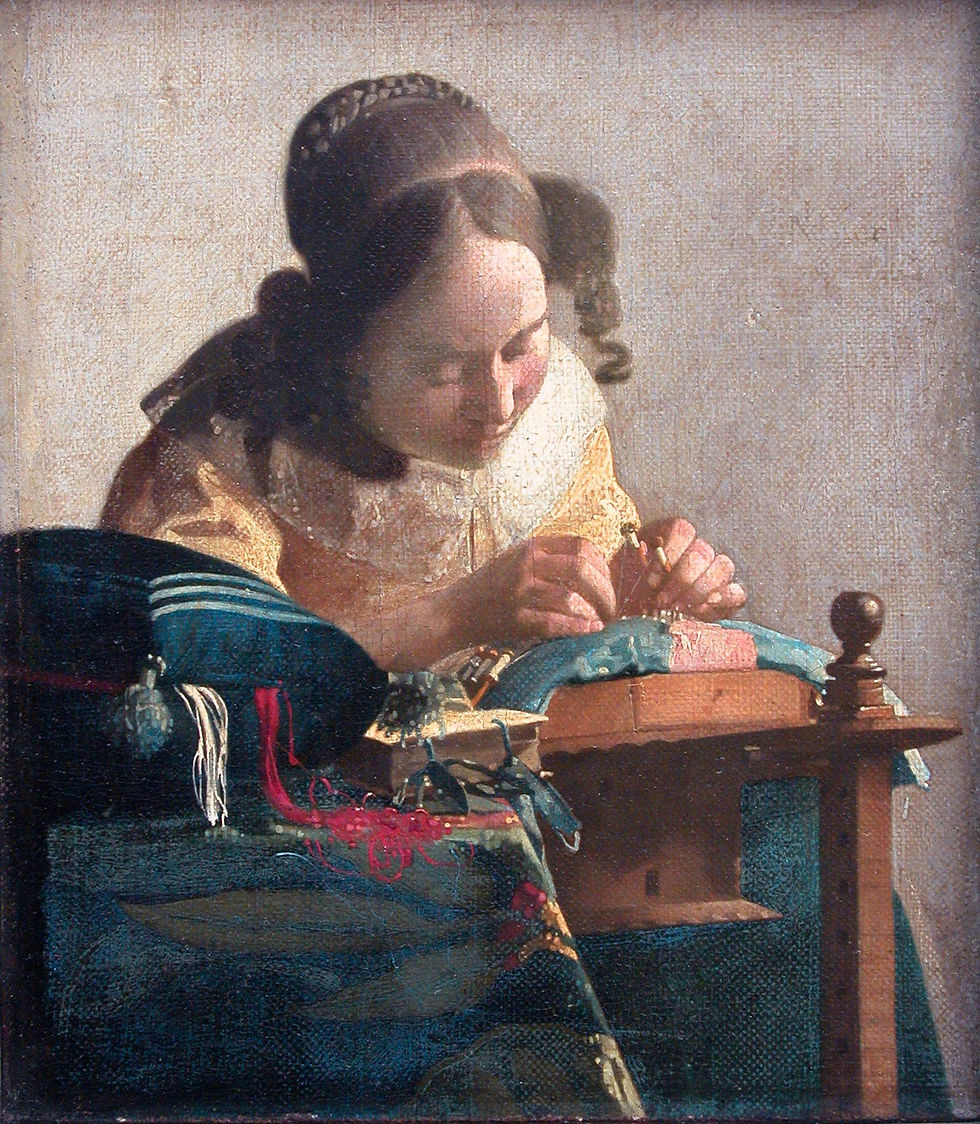
Salvador Dalí, who saw the Lacemaker as a young man in 1929, became obsessed with the painting and returned to copy it more than thirty times over his life. What Dalí responded to is what is unusual about the picture in Vermeer's oeuvre: the foreground is deliberately out of focus. The red and white threads spilling out of the blue cushion in the front of the picture are painted with a soft optical blur that suggests the way an unfocused area of a camera obscura would look. The girl's face and hands in the middle of the picture are in sharp focus. The picture is a tiny demonstration of what happens to a scene when an optical instrument with shallow depth of field is pointed at it. Vermeer is, almost certainly, painting from a camera obscura projection, and he is making the picture about the experience of that projection.
Key takeaways
Johannes Vermeer of Delft (1632-1675) painted about thirty-five pictures in twenty-two years. He died in debt at forty-three and was almost forgotten for two centuries before his rediscovery by the French critic Théophile Thoré-Bürger in 1866.
The Milkmaid (c. 1658) is the most reproduced single domestic figure in Dutch painting — a kitchen-maid pouring a thin stream of milk from a stoneware pitcher, the surface of the bread crusts built up from thousands of tiny dots of lead-tin yellow and lead white.
The View of Delft (c. 1660-61) is the painting Marcel Proust used in In Search of Lost Time as the picture his character Bergotte goes to see in his last hours; the small patch of yellow wall on the Rotterdam Gate is the detail Proust meant.
The Music Lesson (c. 1662-65) is Vermeer's densest study of perspective and reflection — the mirror on the back wall shows the woman's face and what is presumably Vermeer's own easel, announcing the picture as a constructed view from a specific standpoint.
Woman Holding a Balance (c. 1664) is a thirty-by-forty centimetre genre painting that makes a theological claim about attention — the empty balance aligns with the cosmic scales of the Last Judgment painted on the back wall.
Girl with a Pearl Earring (c. 1665) is a tronie — a study of a face in fancy costume, not a portrait of a specific person — but is now one of the most efficient images of a human face ever made; the pearl is two strokes of paint describing what light does on a surface.
The Astronomer (1668) and The Geographer (1669) are a pair of scholar portraits in the same room with the same young man — possibly the lens-maker Antonie van Leeuwenhoek, Vermeer's near-neighbour in Delft. The two pictures are celestial science and terrestrial science, sitting and standing.
The Lacemaker (c. 1669-70) is Vermeer's smallest painting — twenty-four by twenty-one centimetres — and the one in which the foreground is deliberately out of focus. The painting is almost certainly made from a camera obscura projection and is the picture Dalí returned to copy more than thirty times.
Browse Johannes Vermeer and Dutch Golden Age prints in the archive at zocineartdesign.etsy.com.


Comments