Delacroix's Liberty Leading the People (1830): The Painting Made During the Three-Day July Revolution It Depicts
Updated: 1 day ago
Eugène Delacroix (1798-1863) painted Liberty Leading the People (La Liberté guidant le peuple) between October and December 1830 — approximately three months after the Three Glorious Days of the July Revolution (27, 28, and 29 July 1830) that overthrew King Charles X of France and installed the constitutional monarchy of King Louis-Philippe of the House of Orléans. The 260 × 325 centimetre oil-on-canvas — Delacroix's largest single composition and one of the largest history paintings of the nineteenth century — was completed in Delacroix's Paris studio in early December 1830, was exhibited at the Salon of May 1831, and was purchased the same May by the new Louis-Philippe government for 3,000 francs. The painting hangs in a Paris collection where it has been continuously since 1874. The figure of Liberty herself — a bare-breasted barefoot young woman in a torn yellow dress wearing the Phrygian cap of Republican Rome, holding the tricolour flag of the French Republic in her right hand and a Charleville Model 1816 musket with bayonet in her left — became, almost immediately after the 1831 Salon, the visual reference for every subsequent depiction of Marianne as the personified figure of the French Republic.

The Three Glorious Days of 27-29 July 1830
The July Revolution of 1830 was the second French revolutionary uprising of the nineteenth century, forty-one years after the 1789 French Revolution and eighteen years before the 1848 revolution. The proximate cause was Charles X's 25 July 1830 ordinances, which dissolved the recently-elected Chamber of Deputies, suspended press freedom, and reduced the eligible electorate by approximately 75 per cent — an attempt to entrench the conservative Bourbon-Restoration government that had held power since 1814. The Paris public response was the uprising of 27-29 July, conducted primarily by the working-class population of central Paris (printers, typesetters, journeymen, students), who built barricades across the narrow streets of central Paris with paving stones, overturned carts, and dismantled cabarets. Approximately 1,800 people were killed across the three days (the official figure from the 1830 government's casualty count) and Charles X abdicated on 2 August, fleeing to British exile. The constitutional-monarchy government of Louis-Philippe was installed on 9 August. Delacroix had been a personal observer of the uprising from his Quai Voltaire apartment on the Paris Left Bank and recorded the events in real-time letters to his sister Henriette during the three days — the letters survive and document Delacroix's specific compositional sources for the painting. The figure of Liberty is composite (no single Paris model) but the bare-headed bourgeois man in the dark top-hat to Liberty's immediate right is widely identified as Delacroix's self-portrait — Delacroix has inserted himself into the painting as one of the revolutionaries he was not literally one of.
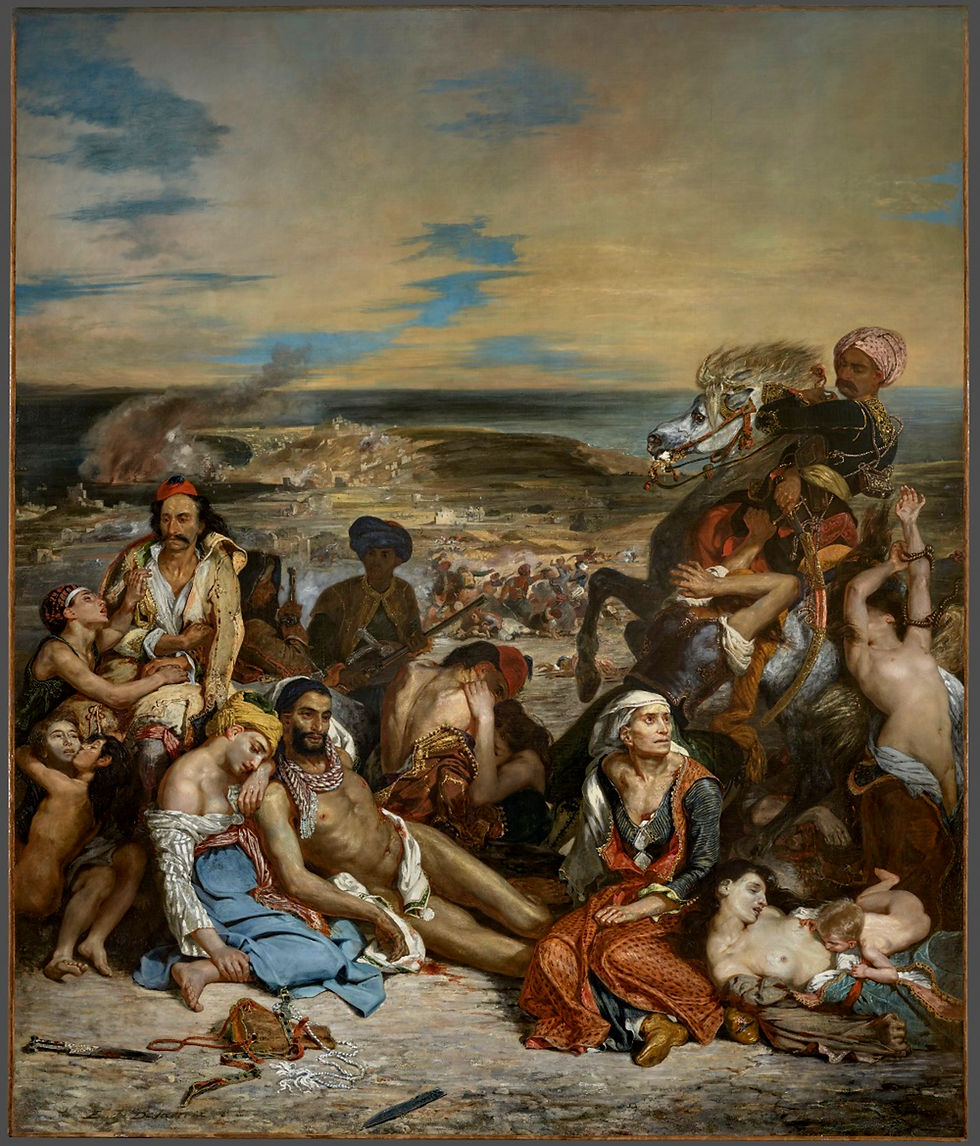
How the painting both inherits from David and breaks with him
Liberty Leading the People is the most-cited Romantic-era response to David's Neoclassical political-painting tradition and is the painting in which French nineteenth-century political painting visibly turned from David's Neoclassicism toward the new Romantic vocabulary. The inheritance from David is immediate. Delacroix had been technically trained in the Neoclassical tradition — his teacher Pierre-Narcisse Guérin had been a David student in the 1790s, and Delacroix's pre-1820 work is recognisably late-Davidian in its smooth surface, controlled palette, and clearly-bounded figure-drawing. The Liberty inherits David's specific compositional decision from The Death of Marat (1793) and The Oath of the Horatii (1784) to use a single allegorical figure as the organising centre of a politically-charged composition (Marat's body, the three Horatii brothers, Liberty's bare torso). The Liberty also inherits David's removed-political-context approach — the painting strips away the specific Paris street geography of the uprising (the central-Paris quartiers where the actual fighting happened are not identifiable), the specific military uniforms of the Royal Guard, the specific government buildings, the specific casualty positions. The Liberty therefore reads as a generic-revolutionary scene rather than a documentary-accurate Paris July 1830 scene. But the Liberty also breaks with David in three specific ways. First: BRUSHWORK. Where David's surface is smooth and academic, Delacroix's surface carries visible brushstrokes, broken colour, and a deliberate Rubens-derived chromatic luminosity that David had explicitly rejected. Second: SUBJECT-NUDITY. David's Liberty would have been clothed or mythologically-draped; Delacroix's Liberty is bare-breasted and identifiable as a contemporary Paris working-class woman rather than a Roman goddess. Third: VIOLENCE. David's Marat is post-violence (the body, the absent assassin, the still room); Delacroix's Liberty is mid-violence (the smoke, the dead bodies in the foreground, the musket-firing boy, the advancing column of revolutionaries). The Liberty is the canonical exhibit for the move from Neoclassical static-aftermath to Romantic dynamic-uprising in early-nineteenth-century French political painting.
Suppression, Marianne, and the painting's nineteenth-century afterlife
Liberty Leading the People had a complicated relationship to the government that bought it. The Louis-Philippe regime purchased the painting for 3,000 francs from the 1831 Salon but became immediately uncomfortable with the canvas: the figure of Liberty was read by 1830s Paris viewers as a specifically revolutionary image rather than a generic-allegorical one, and the new July Monarchy government did not want a visible state endorsement of street-uprising iconography. The painting was hung briefly in the Musée du Luxembourg in 1832 but was removed from public view in 1833 — kept in government storage for the next twenty-two years. The 1848 February Revolution that overthrew Louis-Philippe and installed the Second Republic produced a brief reactivation: the painting was returned to public view from May 1848 to December 1851, then was again removed when Louis-Napoleon's December 1851 coup d'état installed the Second Empire. The Liberty was finally returned to permanent public exhibition only in 1874 after the Third Republic government re-acquired it for the current Paris collection. The painting therefore spent approximately 42 of its first 45 years (1831-1874) in government storage. The 1880s-1890s mass reproduction of the Liberty image was the period in which the figure of Liberty became consolidated as the canonical visual reference for the personified French Republic Marianne. The Marianne tradition — the female allegorical figure of the Republic in the Phrygian cap, used continuously on French postage stamps, coins, government documents, and town-hall busts from approximately 1870 to the present — has Liberty Leading the People as its single most-cited source image. Every nineteenth- and twentieth-century French Marianne descends visually from the central figure of Delacroix's 1830 canvas.
Why the painting matters now
Liberty Leading the People is the most-circulated nineteenth-century French painting in twenty-first-century online visual culture and has held that position approximately since 2015. The reception drivers are political. The Liberty has been the visual lingua franca of post-2010 political uprising for both left-leaning and centrist political movements globally — the painting was used as the visual reference for the 2011 Egyptian Tahrir Square uprising (Cairo street-stencils of the Liberty figure with the Phrygian cap reading "BREAD, FREEDOM, SOCIAL JUSTICE"), the 2014 Hong Kong Umbrella Movement (Liberty-figure umbrellas distributed at the Central district occupation), the 2019 Sudan Revolution (Liberty-figure murals in Khartoum), and the 2019 Hong Kong protests. The painting also appears repeatedly in twenty-first-century popular culture — the cover of Coldplay's 2008 Viva la Vida album is the Liberty with the original Latin lyrics painted across it; the figure appears as a recurring motif in the 2012 film of Les Misérables (which was based on Victor Hugo's 1862 novel that itself drew on the 1830 uprising the Delacroix depicts); the Liberty appears as the central image in the post-2017 #MeToo-era reproductions on protest signs across European feminist demonstrations. The painting's continuing visibility is the function of its specific compositional design: a single advancing allegorical figure carrying a flag, set against a clearly-defined backdrop of conflict, easily reproducible in single-image meme format. Delacroix made the Liberty in three months in late 1830 for an audience he could not have imagined; the painting's twenty-first-century online life is the continuation of a reception arc that has been operating continuously since the 1880s.
Key takeaways
Eugène Delacroix (1798-1863) painted Liberty Leading the People October-December 1830 in approximately 3 months, immediately after the Three Glorious Days of 27-29 July 1830 (the July Revolution that overthrew King Charles X and installed Louis-Philippe). 260 × 325 cm — Delacroix's largest single composition. Held in a Paris collection continuously since 1874.
The Three Glorious Days: triggered by Charles X's 25 July 1830 ordinances dissolving the Chamber and suspending press freedom + reducing electorate by ~75%. Paris working-class uprising built barricades from paving stones, overturned carts, dismantled cabarets across central Paris quartiers. ~1,800 killed across three days. Charles X abdicated 2 August. Louis-Philippe installed 9 August.
Delacroix observed the uprising from his Quai Voltaire apartment, recorded events in real-time letters to his sister Henriette during the three days (letters survive). The Liberty figure is composite, no single Paris model. The bare-headed bourgeois man in dark top-hat to Liberty's immediate right is widely identified as Delacroix's self-portrait — he inserted himself as one of the revolutionaries he was not literally one of.
Lineage from David's Neoclassical political painting: inherits the single-allegorical-figure-as-organising-centre + removed-specific-political-context (no identifiable Paris streets / Royal Guard uniforms / government buildings). BREAKS with David in three specific ways: (1) BRUSHWORK visible vs David's academic-smooth, (2) Liberty bare-breasted contemporary Paris working-class vs David's Roman-goddess drape, (3) Liberty mid-violence vs David's Marat post-violence aftermath.
Suppression: Louis-Philippe government purchased the painting from 1831 Salon for 3,000 francs but became immediately uncomfortable. Hung briefly in Musée du Luxembourg 1832, removed from view 1833 → 22 years in government storage. Brief reactivation under Second Republic May 1848 - December 1851. Removed again under Second Empire. Returned to permanent public view only 1874 under Third Republic. Painting spent ~42 of its first 45 years in government storage.
Marianne tradition: the figure of Liberty in the Phrygian cap became the canonical visual reference for the personified French Republic Marianne — used continuously on French stamps, coins, government documents, town-hall busts from ~1870 to present. Every 19th and 20th century French Marianne descends visually from the central figure of Delacroix's 1830 canvas.
21st-century political uses: Cairo 2011 Tahrir Square stencils ("BREAD, FREEDOM, SOCIAL JUSTICE"), Hong Kong 2014 Umbrella Movement, Sudan 2019 Khartoum murals, Hong Kong 2019 protests. Popular culture: Coldplay Viva la Vida (2008) album cover, Les Misérables (2012) film, post-2017 #MeToo protest signs. Most-circulated 19th-century French painting in online visual culture ~since 2015.
Browse Romantic and 19th-century French paintings in the archive at zocineartdesign.etsy.com.
New in the Journal: Courbet's The Stone Breakers (1849): The Lost Painting That Invented French Realism and Was Destroyed by an Allied Bomb in 1945


Comments