Romanticism: Friedrich, Gericault, Delacroix and the Painters of Feeling
Updated: Aug 18
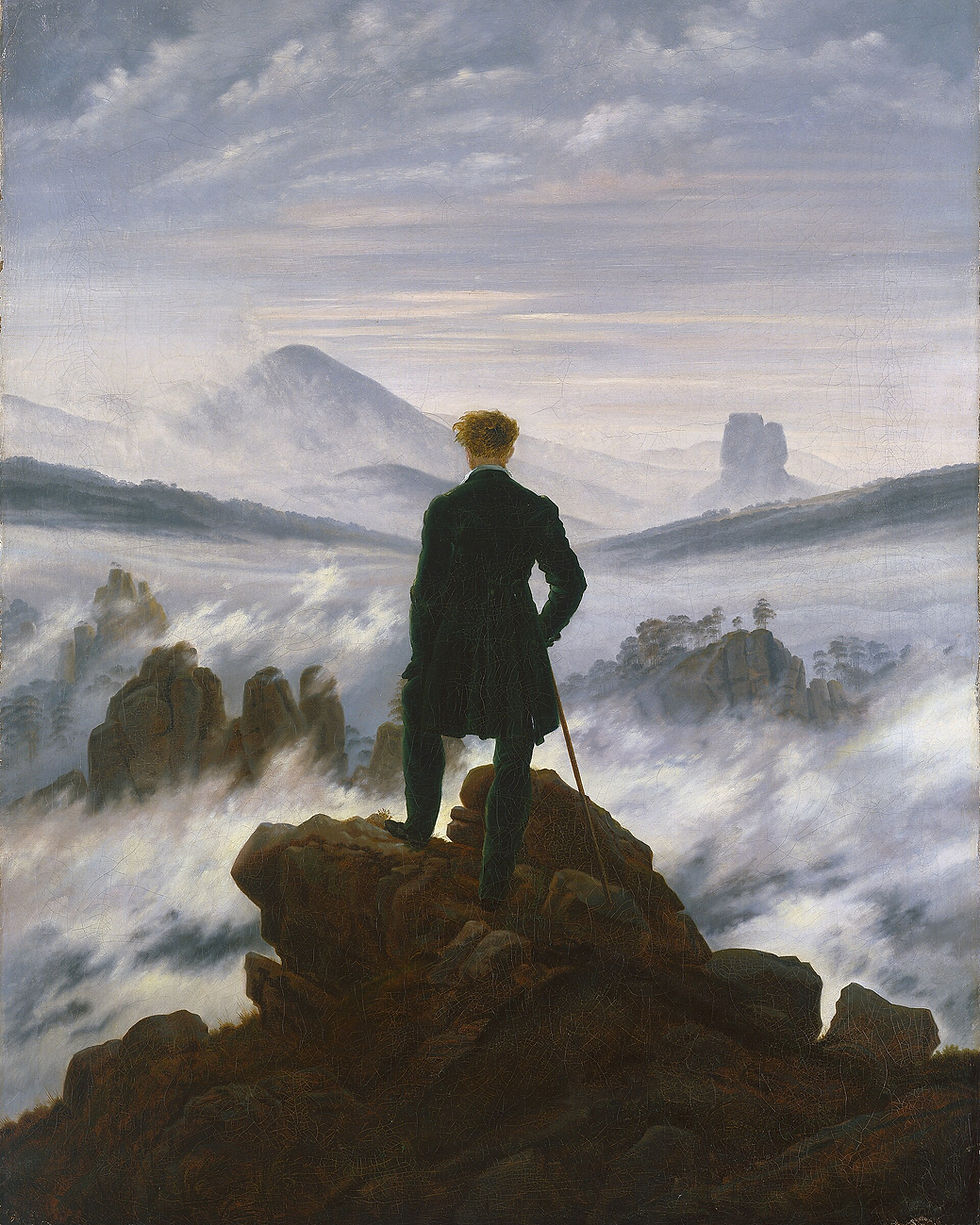
Between roughly 1800 and 1850, European painters turned away from order, reason, and the antique line. They turned toward weather, ruin, revolution, solitude, illness, the sublime landscape, the half-light, the wreck, the lone figure on the cliff. The movement is now called Romanticism. It is the period that gave us most of the images you would still call “mood paintings” today: the solitary wanderer above a sea of fog, the shipwreck on a raft, the barricade-mounted figure with the tricolour, the burning ship at sunset.
Five painters did most of the work. Caspar David Friedrich in Dresden gave Romanticism its solitude. Theodore Gericault and Eugene Delacroix in Paris gave it its politics and its disasters. J.M.W. Turner in London gave it its weather. Francisco Goya in Madrid gave it its violence. None of them met. They corresponded with their own contemporaries (Goya barely; Friedrich rarely; Delacroix constantly), they read each other's reviews, and they built four versions of the same revolution in painting more or less simultaneously.
What Romanticism was reacting against
The decade before 1800 had been Neoclassical. Jacques-Louis David in Paris had built the dominant visual language of the French Revolution and the early Napoleonic state out of antique sculpture, tight line, frieze-like composition, and didactic moral subjects. The Death of Marat, the Oath of the Horatii, the Coronation of Napoleon. Order, reason, civic virtue, the antique.
Romanticism was, in part, a generational rejection of all of that. The Romantic painters were born in the 1770s, 1780s, and 1790s. They had grown up through the French Revolution, the Terror, the Napoleonic Wars, and the post-1815 European restoration. By the time they were painters, they were tired of the idea that the antique was the answer to anything. They wanted weather, feeling, history-as-it-was-actually-happening. Geometry was less interesting to them than dread.
Caspar David Friedrich — the solitary figure

Caspar David Friedrich painted in Dresden between roughly 1800 and his death in 1840. He painted landscape almost exclusively — mountains, forests, the Baltic coast, the chalk cliffs of Rugen, monasteries in moonlight, oak trees in winter snow. He painted them small, with thin transparent layers of oil, and almost always with a single small figure placed somewhere in the middle distance, back to the viewer, looking out at the same thing the viewer is looking at.
The figure is the Romantic invention. Friedrich gave landscape an inhabitant who was both inside and outside the picture — someone the viewer could stand behind and look out with. The Wanderer above the Sea of Fog, painted around 1818, is the cleanest demonstration. The Monk by the Sea, painted in 1810, is the most radical: a single tiny figure on an empty beach under a vast empty sky, almost no horizon, almost no incident. The reviewer Heinrich von Kleist wrote that it was “as if one's eyelids had been cut off.”
Theodore Gericault — the disaster

Theodore Gericault painted for only about fifteen years before he died in 1824, aged thirty-two, from injuries sustained in a fall from a horse. His one enormous painting is the Raft of the Medusa, finished in 1819. The painting shows the survivors of a French naval shipwreck — the Medusa, run aground off the coast of Senegal in 1816 — on the makeshift raft they had built and drifted on for thirteen days. Of the 147 people who started the journey, fifteen reached land. The raft, in Gericault's painting, is the moment they sighted the ship that would rescue them.
The painting is enormous. Twenty-three feet across. Geometric in composition (the figures form a strict triangle climbing toward the upper right). But its subject is not antique heroism. It is contemporary scandal: the French naval captain had been incompetent and politically appointed; the lifeboats had been cut loose with the survivors abandoned to die; the government had tried to suppress the story. Geometry-trained line is used to paint a political indictment. That gap between the technique (Davidian) and the subject (modern, journalistic, scandalous) is where Romanticism sits.
Eugene Delacroix — the revolution

Eugene Delacroix was Geriacult's friend and the inheritor of his ambition. He painted Liberty Leading the People in 1830 to commemorate the July Revolution, which had toppled Charles X in three days of street fighting. The painting shows Marianne — the personification of the French Republic — bare-breasted, holding the tricolour in one hand and a musket in the other, leading a mixed crowd (a worker, a top-hatted bourgeois, a young boy with pistols, a peasant) over the bodies of dead soldiers. The painting was bought by the new government, hung once in the Luxembourg, and then quickly put into storage. It was considered too inflammatory to display.
Delacroix is the painter who imported colour as the carrier of feeling. He had studied the Venetian Renaissance painters (Titian, Veronese) and the Flemish baroque (Rubens), and he had absorbed the lesson that warm colour and broken brushwork can do work that line cannot. His Death of Sardanapalus (1827) and Women of Algiers (1834) are paintings built on red, gold, deep green, dark blue, and a deliberately loose surface. He is the painter Cezanne would later study most carefully — the painter who, more than anyone in the nineteenth century, taught later painters how colour could organise a picture.
J.M.W. Turner — the weather
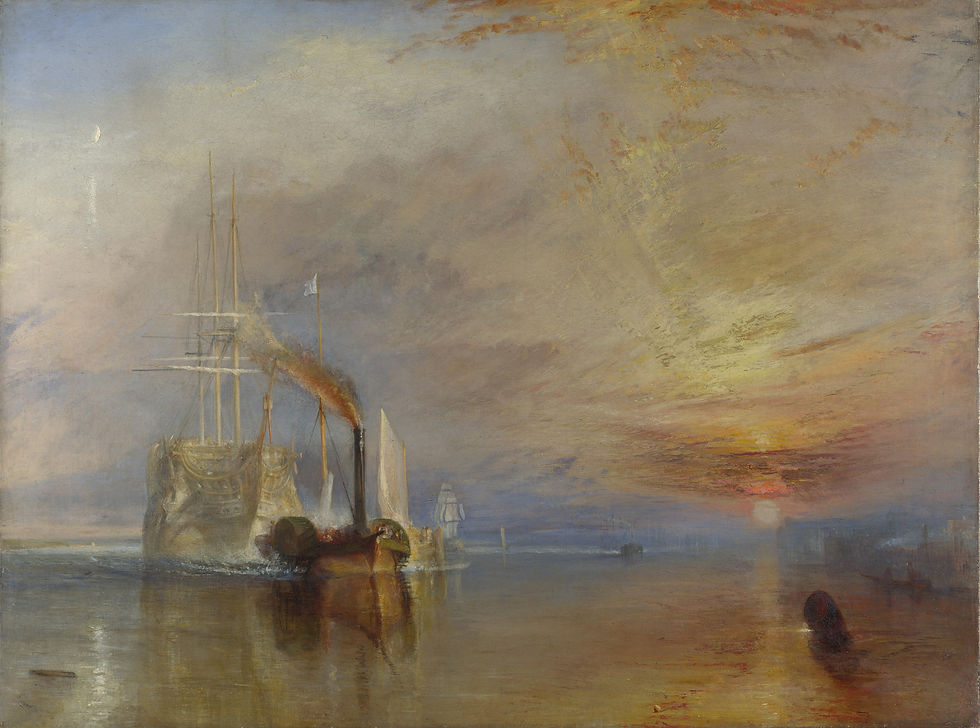
J.M.W. Turner painted in London for fifty years. Trained as a topographical watercolourist (he was making a living drawing buildings and landscapes for printsellers by age fourteen), he ended his life painting near-abstract canvases of light, mist, fire, storm at sea, and steam railways. The Fighting Temeraire (1838), Rain Steam and Speed (1844), Snow Storm – Steam-Boat off a Harbour's Mouth (1842) are landmarks. The last is famous for Turner's claim (which he later denied) that he had himself lashed to the mast of a ship during a storm so he could paint the sea from inside it.
Turner is the Romantic painter who pushed furthest into pure painterly effect. His late canvases dissolve the distinction between sky, water, smoke, fire, and snow into a single luminous atmospheric envelope. Almost no Romantic painter influenced the late nineteenth century more directly — Monet went to London specifically to look at Turner. Impressionism's atmospheric paintings (Rouen Cathedrals, water lily ponds) are partly Turner's grandchildren.
Francisco Goya — the violence

Goya stands slightly to the side of the others. He was older (born 1746, so a generation earlier), he was Spanish (so working outside the Paris-London-Dresden circuit), and he had spent most of his career as the chief court painter to the Spanish Bourbons — not the obvious posting for a future Romantic. But the late Goya is the most violent painter of the Romantic period. The Third of May 1808, his great history painting of the French execution of Madrid civilians, was painted in 1814. The Black Paintings, the murals he painted directly onto the walls of his own house between 1819 and 1823, contain Saturn Devouring His Son, the Witches' Sabbath, and the Dog — some of the darkest images in European art.
Goya is the painter who took the political subject Geriacult had introduced in the Raft of the Medusa and pushed it past indignation into nightmare. The Third of May does not ask the viewer to feel outraged. It asks the viewer to feel the bullet entering the body. The Black Paintings were not made for any audience — Goya painted them on his own walls, in oil straight on plaster, presumably for himself. They are the most private Romantic paintings anyone made.
Where Romanticism ends
By 1850 the movement is essentially over. The painters die (Geriacult in 1824, Goya in 1828, Friedrich in 1840, Turner in 1851, Delacroix continuing until 1863 but in a kind of late chamber-music register). The generation that replaces them — Courbet, Manet, Daumier, Millet — takes the Romantic interest in contemporary subject and political indignation but rejects the Romantic interest in feeling, the sublime landscape, and the medieval or oriental setting. They want what the streets actually look like. That movement is called Realism. It is the post-Romantic answer to the question Romanticism left open.
Romanticism's images, however, are the ones that still organise how the broad public imagines nineteenth-century painting. The lone wanderer above the fog, the shipwrecked raft, the woman with the flag, the burning ship, the firing squad — these are the Romantic inheritance, and they are still doing the work of carrying “seriousness” in painting almost two hundred years after they were made.
Key takeaways
Romanticism in painting ran roughly 1800 to 1850, across Germany, France, England, and Spain.
It was a generational rejection of Neoclassicism — a turn from antique order toward weather, ruin, revolution, and solitude.
Five painters did most of the work: Friedrich (solitude), Geriacult (disaster), Delacroix (revolution and colour), Turner (weather), Goya (violence).
The Romantic invention is the small back-turned figure inside the landscape — someone the viewer stands behind to look out.
Realism (Courbet, Manet, Millet) replaced it after 1850. Impressionism's atmospheric painting is partly Turner's late grandchild.
Browse Romantic and nineteenth-century prints in the archive at zocineartdesign.etsy.com.
New in the Journal: Caspar David Friedrich: Eight Paintings of Solitude
New in the Journal: Friedrich's Sea of Ice: The 1824 Painting Where the Arctic Crushes a Ship and a Hope
New in the Journal: How Painters Captured the Sea: Storm, Survival, and the Blue Hour


Comments