Caspar David Friedrich: Eight Paintings of Solitude
Updated: Aug 24
Caspar David Friedrich painted one subject for the whole of his working life. A figure stands in a landscape. The figure is small. The landscape is large. The figure is usually seen from behind — the German art-historical term is Rückenfigur, the back-figure — so that the viewer is invited to stand where the figure stands and see what the figure sees. The landscape is treated as an interior. The figure is treated as the empty seat the viewer is being asked to take.
Friedrich was born in 1774 in Greifswald, on the Baltic coast of what was then Swedish Pomerania and is now north-eastern Germany. He trained at the Copenhagen Academy from 1794 to 1798 and settled in Dresden in 1798, where he worked until his death in 1840. He was, depending on the decade, either the most admired or the most ignored painter in German Romanticism — celebrated in his thirties, dismissed by the 1830s as a melancholic relic of an earlier century, recovered in the early twentieth century as the most important German landscape painter of the modern period. His paintings have been on more book covers, postcards, and album sleeves in the last fifty years than the work of any other German painter before the twentieth century. They have become shorthand for solitude as a visual category. Eight of them, in the order he painted them.
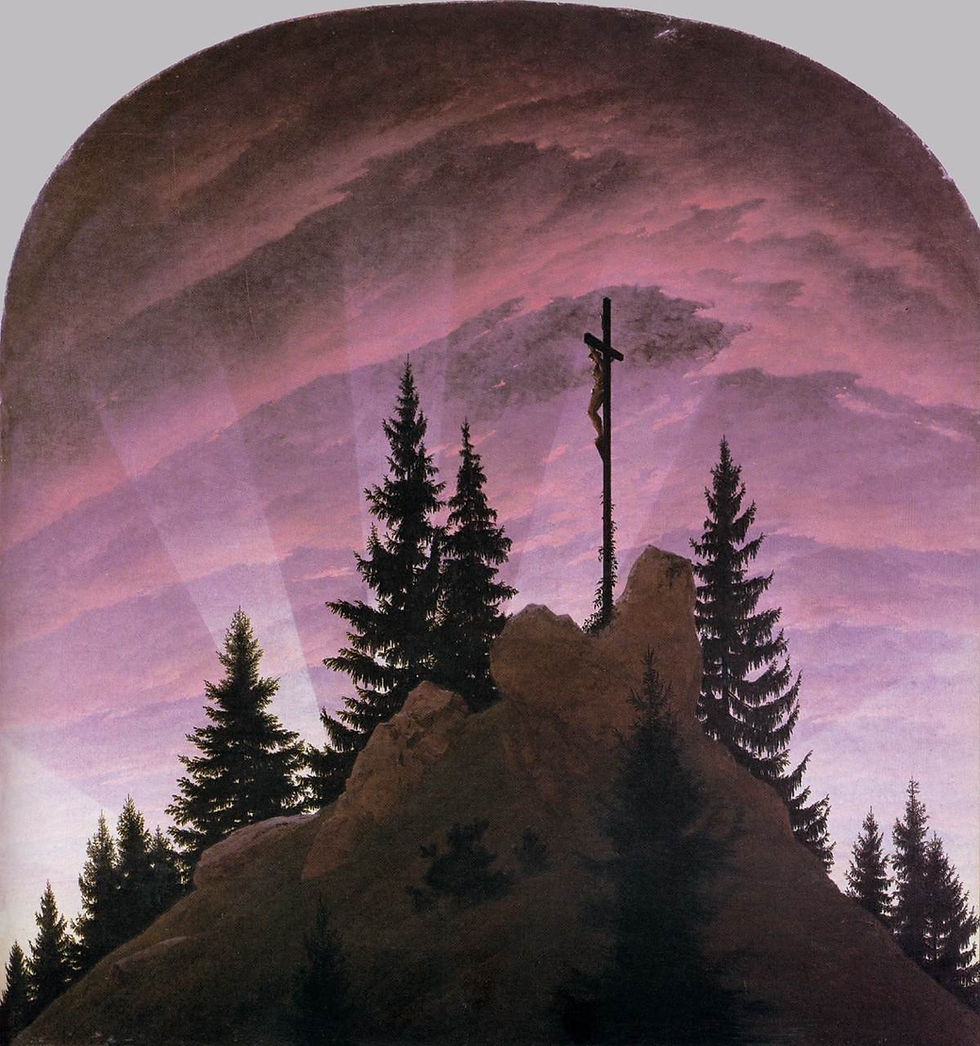
The Cross in the Mountains, 1808 — the painting that announced the project
Friedrich's first major painting, the so-called Tetschen Altar, was commissioned in 1807 by a Bohemian aristocrat named Anton Graf von Thun-Hohenstein as an altar painting for his castle chapel at Tetschen in northern Bohemia. The picture is one hundred and fifteen by one hundred and ten centimetres, painted on canvas, framed in carved gilt wood designed by the sculptor Karl Gottlob Kühn to Friedrich's instructions. A cross stands on a rocky summit silhouetted against a sky that holds the last rays of a sunset behind it. Fir trees climb the rock toward the cross. Beams of light radiate from behind the summit.
The painting was attacked in print as soon as it was shown in Dresden in 1808. The Berlin critic Friedrich Wilhelm Basilius von Ramdohr wrote a six-thousand-word denunciation in the Zeitung für die elegante Welt arguing that Friedrich had committed a category error: landscape was the wrong genre for religious painting, the cross was a small accident of the picture rather than its centre, and the whole composition was a presumption against three centuries of Christian altar tradition. Friedrich answered in print. Goethe — who was sympathetic to Friedrich but found the Tetschen extreme — described the painting privately as the world turned upside down. The argument the Tetschen Altar made — that a landscape could carry the full weight of religious painting, that a small natural detail could function as the centre of a devotional image — was the argument Friedrich would extend for the next thirty-two years.
Abbey in the Oakwood, 1809-10 — the ruin as devotional centre
The Abbey in the Oakwood was painted between 1809 and 1810 as part of a pair with the Monk by the Sea — the two pictures hung together at the Berlin Academy exhibition of 1810 and were bought immediately by the seventeen-year-old Crown Prince Friedrich Wilhelm of Prussia, for what would have been a substantial sum. The Abbey shows the ruined Gothic façade of a monastery — modelled on the Eldena Abbey near Greifswald that Friedrich knew from childhood — standing in a winter graveyard at twilight. Tombstones tilt at the bottom of the picture. Bare oaks twist into the sky. A small funeral procession of monks carries a coffin toward the abbey door. The light is the last cold light of a winter afternoon.

The picture is one hundred and ten by one hundred and seventy-one centimetres — substantially wider than the Tetschen Altar and laid out as a horizontal landscape. The figures are too small to read individually; the monks are dark accents at the picture's geometric centre, lit by the candles they carry. The ruin replaces the cross. The funeral procession replaces the Christ figure. What does not change is the structural decision: the landscape is the surface on which the meaning of the picture is made, and the human element is a small punctuation inside it.
Monk by the Sea, 1808-10 — the picture that turned the figure into an emblem
The Monk by the Sea, the Abbey's pair, is the most radically reduced picture Friedrich ever painted. The canvas is again one hundred and ten by one hundred and seventy-one centimetres. The composition is three bands: a low strip of pale sand at the bottom, a darker band of grey-green sea in the middle, and an enormous overcast sky filling the top two-thirds of the picture. Near the lower-left edge of the picture, a single black-robed figure stands on the sand looking out to sea. The figure is about three centimetres tall in a canvas almost two metres wide.

Heinrich von Kleist, reviewing the picture in the Berliner Abendblätter in 1810, wrote that looking at the Monk was "as if one's eyelids had been cut off." Kleist meant that the picture refused the viewer the conventional consolations of landscape painting — there were no trees, no boats, no distance markers, no narrative incident. The picture was a confrontation. The figure was less a person than a measuring instrument: the only object inside the picture that could give the viewer a sense of scale for the void it was facing. Everything Friedrich would do for the next thirty years is already in this picture in compressed form. The figure as emblem. The landscape as confrontation. The viewer pulled into the figure's standpoint and offered nothing else to look at.
Wanderer above the Sea of Fog, c. 1818 — the most reproduced solitude in painting
The Wanderer above the Sea of Fog is, by an enormous margin, the most reproduced painting Friedrich ever made. It was painted around 1818, on a panel ninety-five by seventy-five centimetres, and is now in a Hamburg collection. A man in a green coat stands on a dark rocky outcrop at the top of the picture, his back to the viewer, his weight on a walking stick, his hair caught by the wind. Below him a sea of cloud fills the middle of the picture. Beyond the cloud, distant mountain peaks rise and fade. The man is on a summit but the summit itself is not visible — there is no path up to where he stands and no path down. He is the only human element in the picture, and his face is hidden.

The painting has become so completely a visual cliché — book covers, motivational posters, advertising — that it is easy to forget how strange a picture it actually is. The wanderer's position on the rock is geometrically unstable; the rock pitches forward toward the viewer. The fog below him is rendered with a precision that no actual mountain fog has. The distant peaks belong to no single Friedrich knew personally — they are an assembly of granite outcrops from the Elbsandsteingebirge south of Dresden, rearranged into a continuous receding chain. The picture is not a record of a place. It is a constructed landscape designed to make the act of standing on a summit alone visible as a category. The man's face is hidden because the picture is not about him; it is about the standpoint he occupies, into which the viewer is invited.
Chalk Cliffs on Rügen, c. 1818 — the figure multiplied
The same year as the Wanderer, Friedrich painted the Chalk Cliffs on Rügen — a smaller picture, ninety by seventy centimetres, on canvas, painted around 1818 after his honeymoon trip to the Baltic island of Rügen with his wife Caroline. Two figures kneel at the edge of a sheer white chalk cliff in the foreground. A third figure, a man in a top hat, stands behind them, looking out to the sea. Below the cliff, the Baltic stretches to the horizon. Two small sailing ships are just visible in the distance. The cliff face drops away to nothing under the foreground figures.

The three figures are sometimes read biographically — the kneeling woman as Caroline, the standing man as Friedrich, the kneeling man behind as his brother Christian. The biographical reading is plausible but secondary. What matters formally is that Friedrich, who had spent ten years reducing his pictures to a single figure plus a landscape, here multiplies the figure into three and rearranges the cliff into a frame around them. The dark birch trees on either side form a Gothic arch. The chalk drops vertically. The sea fills the bottom of the arch. The picture is a portal: the viewer looks through the trees, over the cliff, into the open sea. The figures, paradoxically, hold the viewer inside the picture — they are markers of where the viewer is, not where the viewer is going.
Woman before the Setting Sun, c. 1818 — Friedrich's altarpiece for the body
A small picture, around twenty-two by thirty centimetres on canvas, painted around 1818 and now in a Folkwang collection in Essen. A woman in a long blue-violet dress stands at the centre of a low gorse-covered hill, her back to the viewer, her arms raised slightly outward from her sides, the setting sun directly in front of her. The light hits her shoulders, the back of her head, the outline of her dress. Her face is invisible because the picture's structure does not permit it.

The pose is what makes the picture. The woman's arms are not raised in surprise or in worship; they are raised in the small ambiguous gesture of someone receiving something. Friedrich, who had built his career from the Rückenfigur, here pushes the formal device to its limit: the woman is treated as a vertical altar between the viewer and the sun. Her body is the picture's centre line. The horizon passes through her waist. The sun's last light passes through her head. The picture organises the landscape around her in the way a Gothic altarpiece organises the architecture of a chapel. The figure is no longer just the viewer's emblem; it is also, in this small picture, the picture's own object of devotion.
Two Men Contemplating the Moon, 1819-20 — the figure paired
Two Men Contemplating the Moon was painted between 1819 and 1820, on a small canvas thirty-five by forty-four centimetres. Two figures in old German costume stand in a clearing at the edge of a forest, their backs to the viewer, looking at a thin crescent moon hanging in a darkening sky between two leaning pine trees. A bare oak in the foreground tilts diagonally across the picture. The ground is broken stone and bramble. The figures lean slightly toward each other; one rests his hand on the other's shoulder.

The two figures are usually identified as Friedrich and his student August Heinrich. The old-German costume — the so-called altdeutsche Tracht — was politically loaded. It had been adopted by the Burschenschaften, the student fraternities pushing for German unification and constitutional reform, and was banned in the Carlsbad Decrees of September 1819, the same months Friedrich was painting the picture. The two men contemplating the moon are, among other things, two men wearing the costume of a political movement that had just been outlawed. The moon is the only safe thing in the picture to look at; the picture is not just about contemplation but about what kinds of contemplation are still permitted.
Samuel Beckett, who saw the picture in Dresden in 1937 and wrote about it in his diaries, used it as the visual source for the staging of Waiting for Godot — two men, a single bare tree, an undefined dusk. The image had to travel through a hundred and twenty years and one Irish playwright to find its second life, but the line is direct.
The Sea of Ice, 1823-24 — solitude without the figure
The last picture in this set is the bleakest. The Sea of Ice was painted between 1823 and 1824, on a canvas just under one hundred by one hundred and thirty centimetres, and is now in a Hamburg collection. The picture shows a shattered ice floe at the centre of a frozen sea. Slabs of ice tilt up at sharp angles to form a fractured pyramid in the middle of the canvas. Buried in the ice at the lower right, the splintered wreckage of a small ship is just visible — masts broken, hull crushed, name not legible. There is no human figure anywhere in the picture.

The painting was inspired in part by the loss of William Edward Parry's Arctic expedition of 1819-20 — the British attempt to find the Northwest Passage that had been trapped in pack ice for a winter — and by Friedrich's experience of watching the river Elbe break up after a hard freeze in 1820. The composition does what no other Friedrich picture quite does: it removes the figure entirely. The ship — the human presence — is no longer a witness in the landscape; it has been destroyed by the landscape and the wreckage is now part of the geological texture. The Sea of Ice is solitude rendered as terminal. It is the picture in which the Rückenfigur project arrives at its endpoint: the viewer is the only consciousness left in the room with the picture, and the picture has used up its figures.
Friedrich's reputation collapsed within ten years of the Sea of Ice. The German art establishment turned to the Düsseldorf school of realist genre painting in the 1830s and 1840s. Friedrich suffered a stroke in 1835 that left him unable to paint full oils. He died in Dresden in 1840, sixty-five years old, and was buried in the Trinitatisfriedhof there. For the next sixty years he was a footnote in German art history. The recovery began in the 1890s with the rediscovery of his work by the Norwegian painter Edvard Munch and the German art historian Andreas Aubert. By 1906, when the Berlin Centennial Exhibition included Friedrich in its survey of nineteenth-century German art, the case was made. The painters who built modernism from the 1900s onward — Munch, the Brücke painters, Rothko in the 1950s, the American colour-field generation — were all looking back at the eight paintings above and others like them.
Key takeaways
Caspar David Friedrich (1774-1840) painted human figures alone or in small groups inside large landscapes for the entire forty years of his working life. The figures are usually seen from behind — the Rückenfigur or back-figure — so that the viewer is invited to stand where the figure stands and see what the figure sees.
The Cross in the Mountains (Tetschen Altar, 1808) announced the programme: a landscape used as religious surface, a single small natural detail treated as the centre of a devotional picture. The painting was attacked at the time as a category error and is now read as the founding statement of nineteenth-century landscape painting as a serious genre.
The Monk by the Sea and Abbey in the Oakwood (1808-10) were Friedrich's first major public success — bought as a pair by the future King Friedrich Wilhelm IV of Prussia. Heinrich von Kleist's review of the Monk described looking at it as "as if one's eyelids had been cut off."
The Wanderer above the Sea of Fog (c. 1818) is the most reproduced Rückenfigur in painting — book covers, posters, advertising — and has become shorthand for solitude as a visual category. The figure's face is hidden because the picture is not about him; it is about the standpoint he occupies.
The Two Men Contemplating the Moon (1819-20) was painted in the months the Carlsbad Decrees banned the German student fraternities; the figures wear the outlawed altdeutsche Tracht costume. Samuel Beckett used the picture as the visual source for the staging of Waiting for Godot.
The Sea of Ice (1823-24) is the only major Friedrich painting with no human figure at all — a shattered ice floe with the wreckage of a small ship buried in it. The Rückenfigur project's endpoint: the viewer is the only consciousness left in the room with the picture, and the picture has used up its figures.
Friedrich's reputation collapsed in the 1830s and stayed buried for sixty years. The recovery began with Munch and Aubert in the 1890s. By the 1950s the line from Friedrich's empty landscapes to Mark Rothko's colour-field paintings was already being drawn, and Friedrich was being read as the German painter who invented the visual grammar of modern solitude.
Browse Caspar David Friedrich and German Romantic landscape prints in the archive at zocineartdesign.etsy.com.
New in the Journal: Friedrich's Sea of Ice: The 1824 Painting Where the Arctic Crushes a Ship and a Hope


Comments