The Most Unsettling Paintings in Art History: Eight Works for Halloween
The most unsettling paintings in art history include Goya's Saturn Devouring His Son, the Hell panel of Bosch's Garden of Earthly Delights, Caravaggio's Medusa and Artemisia Gentileschi's Judith Slaying Holofernes. They disturb not through shock alone but because each shows something real: madness, violence, death.
Horror in painting is older than the horror story. Long before the Gothic novel, painters were putting monsters, severed heads and the dead on canvas, and not always to frighten. Some wanted to warn, some to mourn, some to show off what paint could do. The eight works below span four centuries, from a Netherlandish altarpiece to a Finnish watercolour. Here is what they show, and why they work.
1. Goya, Saturn Devouring His Son (c. 1819-23)
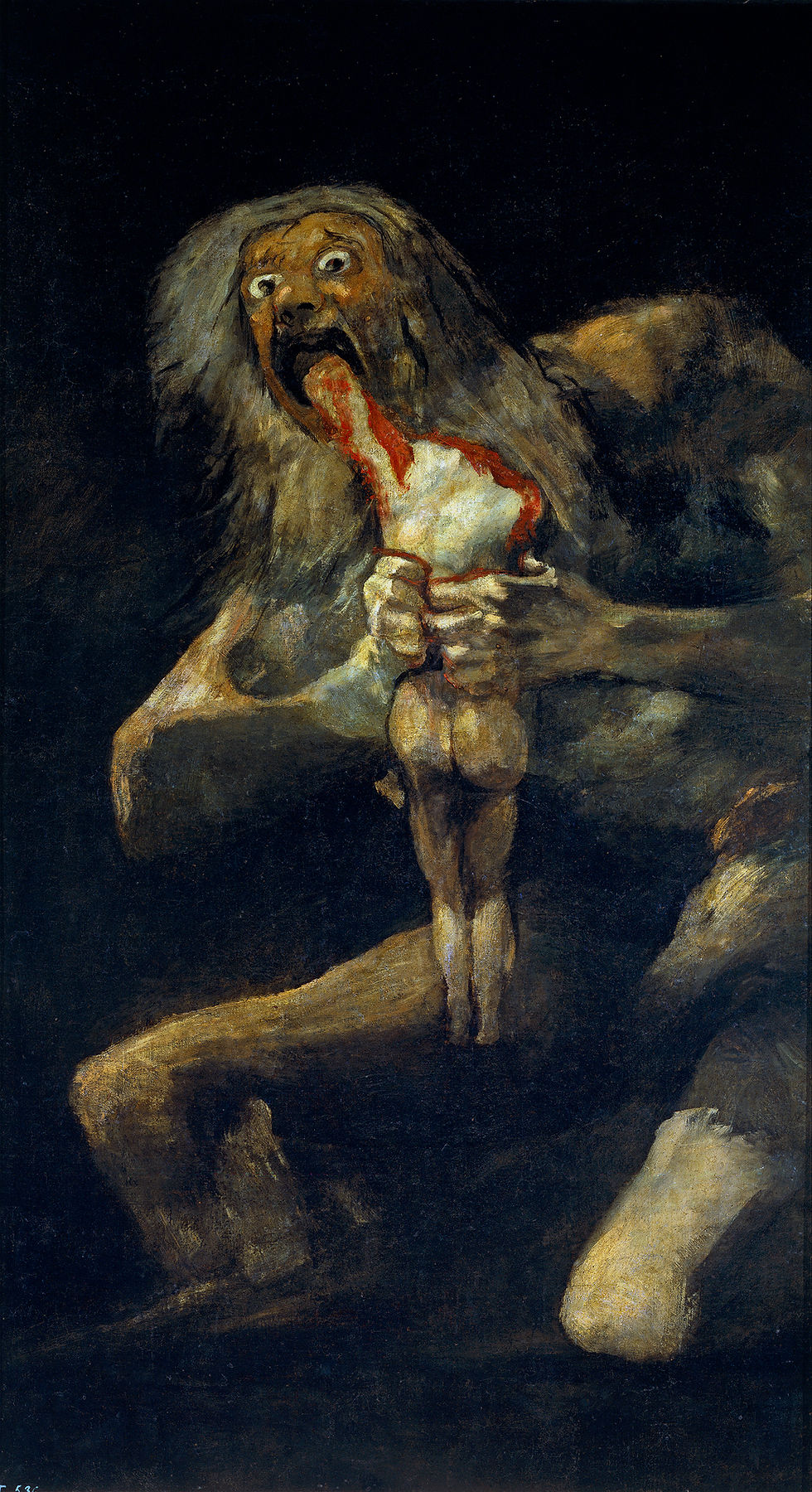
Goya never meant anyone to see this picture. He painted it directly on the plaster wall of his own house outside Madrid, the Quinta del Sordo, as one of the fourteen murals now called the Black Paintings. He gave it no title and left no explanation. The god Saturn, who in the myth ate his children to stop them taking his throne, stares out with white, terrified eyes while he bites into a headless body. He does not look powerful. He looks mad, and afraid of what he is doing.
The murals were cut from the walls and transferred to canvas in the 1870s, half a century after Goya left Spain. That is the only reason they survive.
2. Bosch, the Hell panel of The Garden of Earthly Delights (c. 1490-1510)

Open the triptych and the left wing shows Eden, the centre a garden of naked pleasure-seekers. The right wing is where it ends. In Bosch's Hell a bird-headed monster sits on a high chair swallowing sinners whole, giant musical instruments have become instruments of torture, and a hollow man with tree-trunk legs looks back over his shoulder at the viewer. Nothing is lit by the sun. The only light is fire.
3. Caravaggio, Medusa (c. 1597-98)

Caravaggio painted the Gorgon at the instant of her death: the head has just been cut off, blood spurts from the neck, the snakes still writhe, and the mouth is open in a scream. He painted it on a round, convex parade shield, a gift from Cardinal del Monte to the Grand Duke of Tuscany. The curve plays a trick on the eye. The head seems to stand out from the surface, as if it were hanging in front of the shield. The face is often said to be the painter's own.
Read more: Caravaggio's Medusa: The Shield That Screams
4. Artemisia Gentileschi, Judith Slaying Holofernes

Many painters showed the biblical widow Judith beheading the Assyrian general Holofernes. Few made it look like work. In Artemisia's version two women hold a grown man down on a bed, and the sword goes through his neck with effort. Blood runs down the white sheets. Her Judith is not elegant or hesitant; she is doing something hard and doing it properly. The painting is more disturbing than most horror because it looks entirely real.
Several of these paintings are available as classic art prints at Zocine on Etsy.
5. Friedrich, The Abbey in the Oakwood (1809-10)

Not every unsettling painting needs blood. Friedrich's picture is quiet: a ruined Gothic church in the snow, dead oak trees, a graveyard, and a small line of monks carrying a coffin toward the broken doorway at dusk. It is the stillness that disturbs. The figures are almost lost in the dark, and the sky above them is brighter than anything on the ground. It is the most Gothic picture of the Romantic age, painted before the word meant horror films.
6. Gustave Doré, the Inferno engravings (1861)

When Doré illustrated Dante's Inferno, he gave the nineteenth century its picture of Hell. His engravings are all black ink and white light: endless crowds of the damned, cliffs that fall away into darkness, demons and storms. They were printed in huge numbers and copied for a century afterwards, and much of what films and games still show as the underworld comes from him.
7. Edvard Munch, Vampire (1895)

Munch first called this picture Love and Pain. A woman with long red hair bends over a man and presses her face into his neck. It could be an embrace. It was a friend, the writer Stanisław Przybyszewski, who described it as a vampire, and the name stuck. The ambiguity is the point: Munch painted love as something that comforts and drains at the same time.
8. Hugo Simberg, The Garden of Death (1896)

The strangest picture on this list is also the gentlest. In the Finnish painter Hugo Simberg's garden, Death is not one skeleton but several, dressed in black robes, and they are gardeners. They water small plants and carry flowers with great care. The flowers are often read as the souls of the dead. It is a frightening idea painted tenderly, and Simberg returned to it a decade later in a fresco for Tampere Cathedral.
Read more: Hugo Simberg's Garden of Death (1896)
Why these pictures still work
None of these painters was trying to make a Halloween decoration. Goya painted his private fears on his own walls. Bosch was preaching. Caravaggio and Artemisia were showing what paint could do with a body. Friedrich and Simberg were thinking about death in the way their age thought about it, with ruins, gardens and quiet. What they share is that each one shows something we would rather not look at, and makes it impossible to look away.
Frequently asked questions
What is the most disturbing painting in art history?
Goya's Saturn Devouring His Son (c. 1819-23) is the painting most often named. Goya painted it on the wall of his own house as one of the Black Paintings and never meant it to be seen.
Why did Goya paint Saturn Devouring His Son?
Goya left no explanation. The mural belongs to the fourteen Black Paintings he made privately in his seventies, and it is usually read as an image of madness, fear and old age rather than a straight illustration of the myth.
Why is Caravaggio's Medusa painted on a shield?
It was a parade shield, a gift from Cardinal del Monte to the Grand Duke of Tuscany. In the myth Perseus used a polished shield to defeat Medusa, and the convex surface makes the severed head seem to float in front of it.
What is The Garden of Death by Hugo Simberg about?
Painted in 1896, it shows skeletal figures in black robes tending plants and flowers, often read as the souls of the dead. Death appears as a careful gardener rather than a threat.
Browse dark and Gothic classic art prints in the archive at Zocine on Etsy.
Zocine Art Design is an independent studio that prints classic paintings as wall art.
New in the Journal: Friedrich's The Abbey in the Oakwood: The Monk's Dark Companion
New in the Journal: Dark Academia Wall Art: 12 Paintings
Comments