Edvard Munch Beyond The Scream: Eight Paintings That Map a Haunted Life
Updated: Aug 1
Edvard Munch spent more than half a century turning private grief into pictures the rest of the world would come to recognise as its own. He was born in 1863 and died in 1944 at the age of eighty, and he built almost his entire reputation on a small set of rooms, shorelines, and faces that he returned to for decades. The eight paintings below trace that life from a childhood sickbed to a sanatorium ward, and every one of them was finished before 1925.
Most people meet Munch through a single screaming figure on a bridge. That painting has its own place in the story and its own essay. This tour steps around it to show the works that made it possible: the deathbed portrait he called his breakthrough, the shoreline where he painted love turning to ash, and the desire and dread he set side by side in Vampire and Madonna.
Munch wrote almost as much as he painted. In one much quoted diary passage he described his inheritance plainly. "Illness, insanity and death were the black angels that kept watch over my cradle and accompanied me all my life," he wrote. The pictures that follow are what he did with those three visitors.
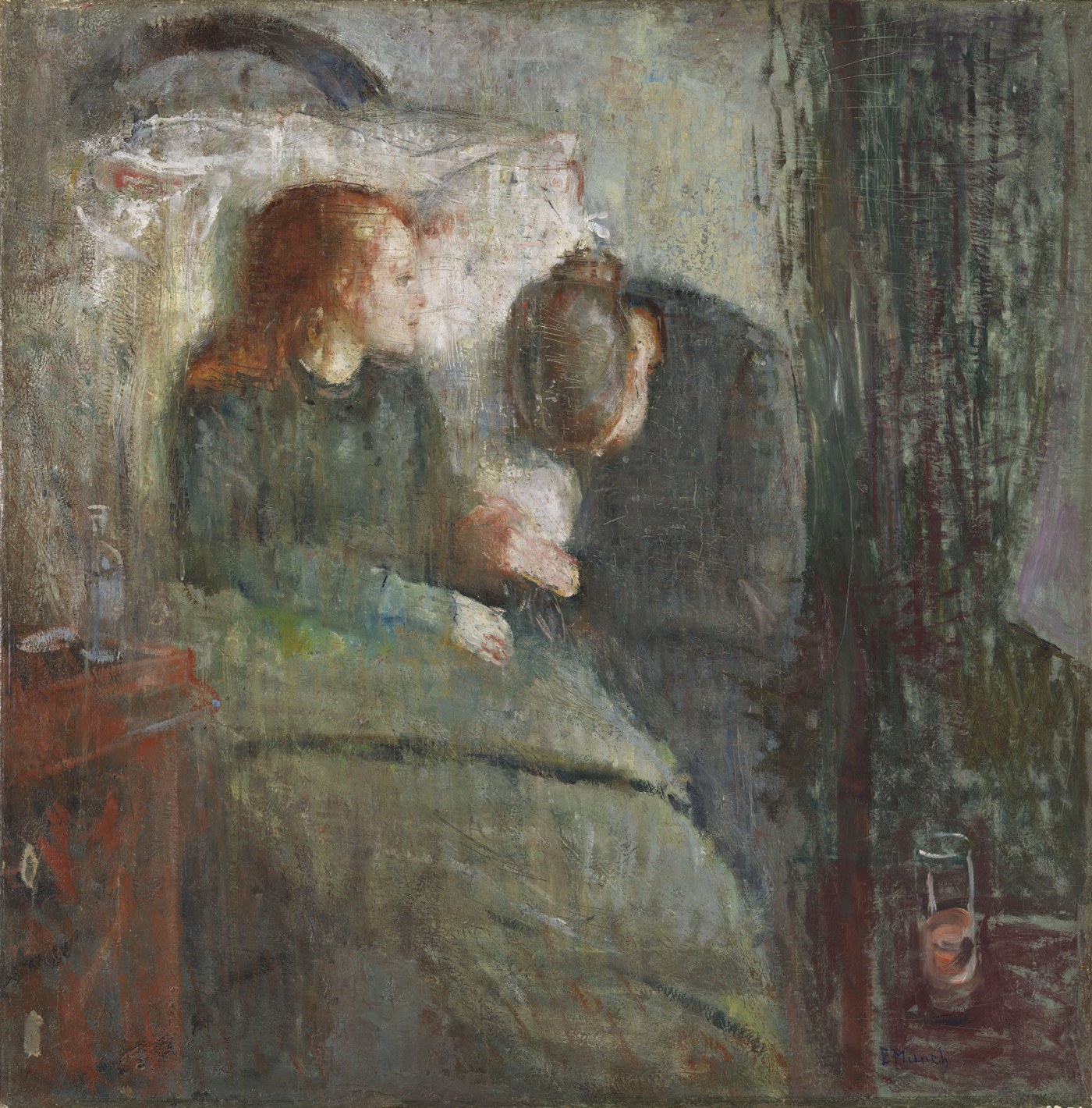
1. The Sick Child (1885)
When Munch was five his mother died of tuberculosis. Eight years later, in 1877, the same disease took his older sister Johanne Sophie at the age of fifteen. Munch was thirteen. The Sick Child, painted between 1885 and 1886 on a canvas of roughly 120 by 118.5 centimetres, is his return to that sickroom: a pale girl propped against a white pillow, turning toward a grieving woman who cannot lift her head to meet her.
Munch scraped and repainted the surface again and again until the paint itself looked worn thin, as though it had been handled too much. Critics attacked the picture as unfinished. He disagreed for the rest of his life. In his own notes he wrote that with The Sick Child he broke new ground, and that most of what he did afterward had its birth in this one picture. He believed it so firmly that he painted the subject six separate times between 1885 and 1927, across more than forty years.
The Sick Child is available as an archival fine print in the ZocineArtDesign shop. View the listing here.
2. Evening. Melancholy (1891)
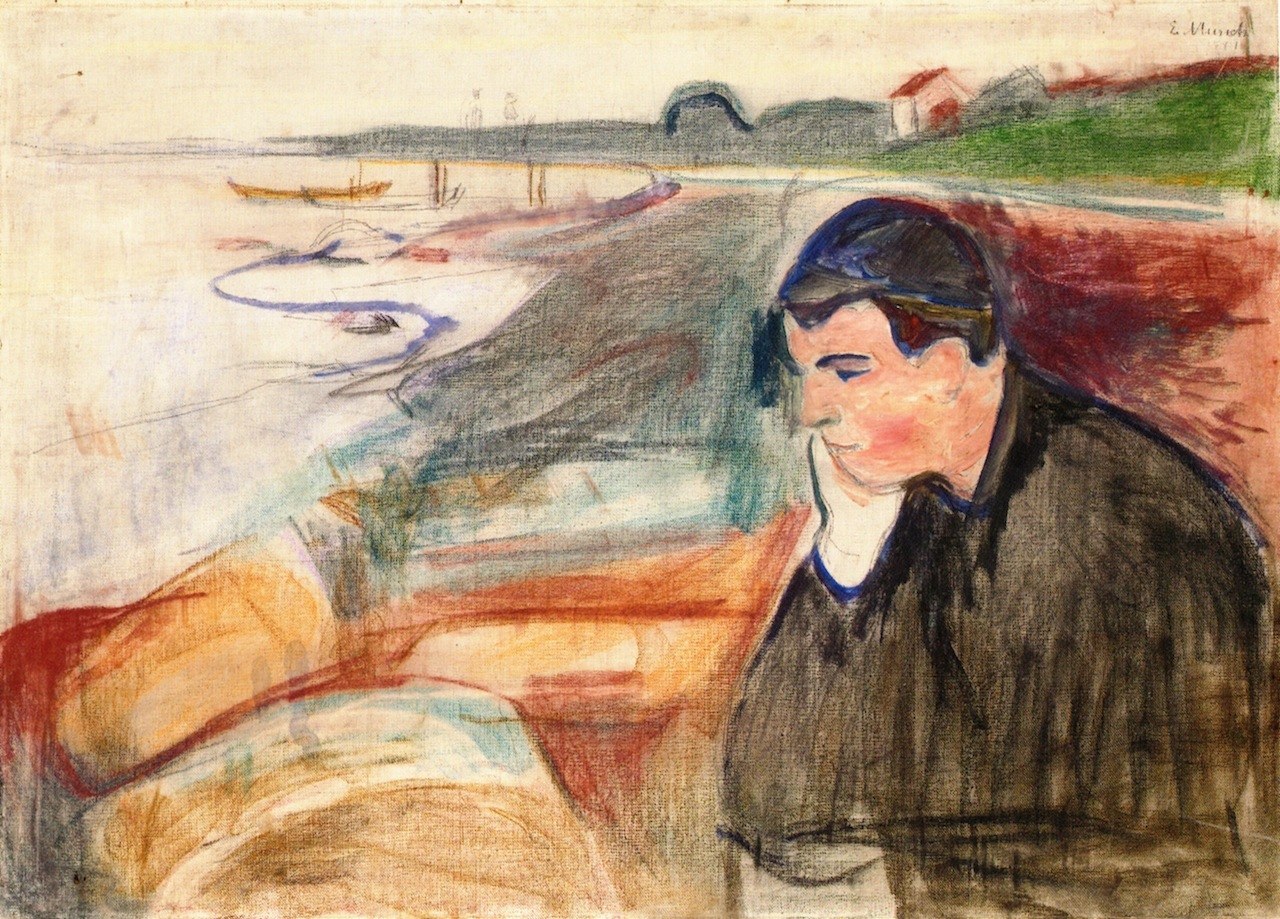
By 1891 Munch had spent time in Paris and absorbed the flat colour and hard contours of the newest French painting. He carried them home to the small coastal town of Asgardstrand, where he would summer for years. Evening. Melancholy, about 72 by 98 centimetres, shows a man slumped at the front of a long curving shoreline while a tiny couple boards a boat far behind him. The man was his friend Jappe Nilssen, brooding over an unhappy love affair.
Munch reduced the whole scene to a few sweeping bands of yellow shore and blue water and let the heavy tilt of the man’s head carry the mood. Norwegian critics later treated this quiet shoreline as the first fully Symbolist painting made in the country, a picture built from feeling rather than description.
Melancholy is available as an archival fine print in the ZocineArtDesign shop. View the listing here.
3. Vampire (1895)
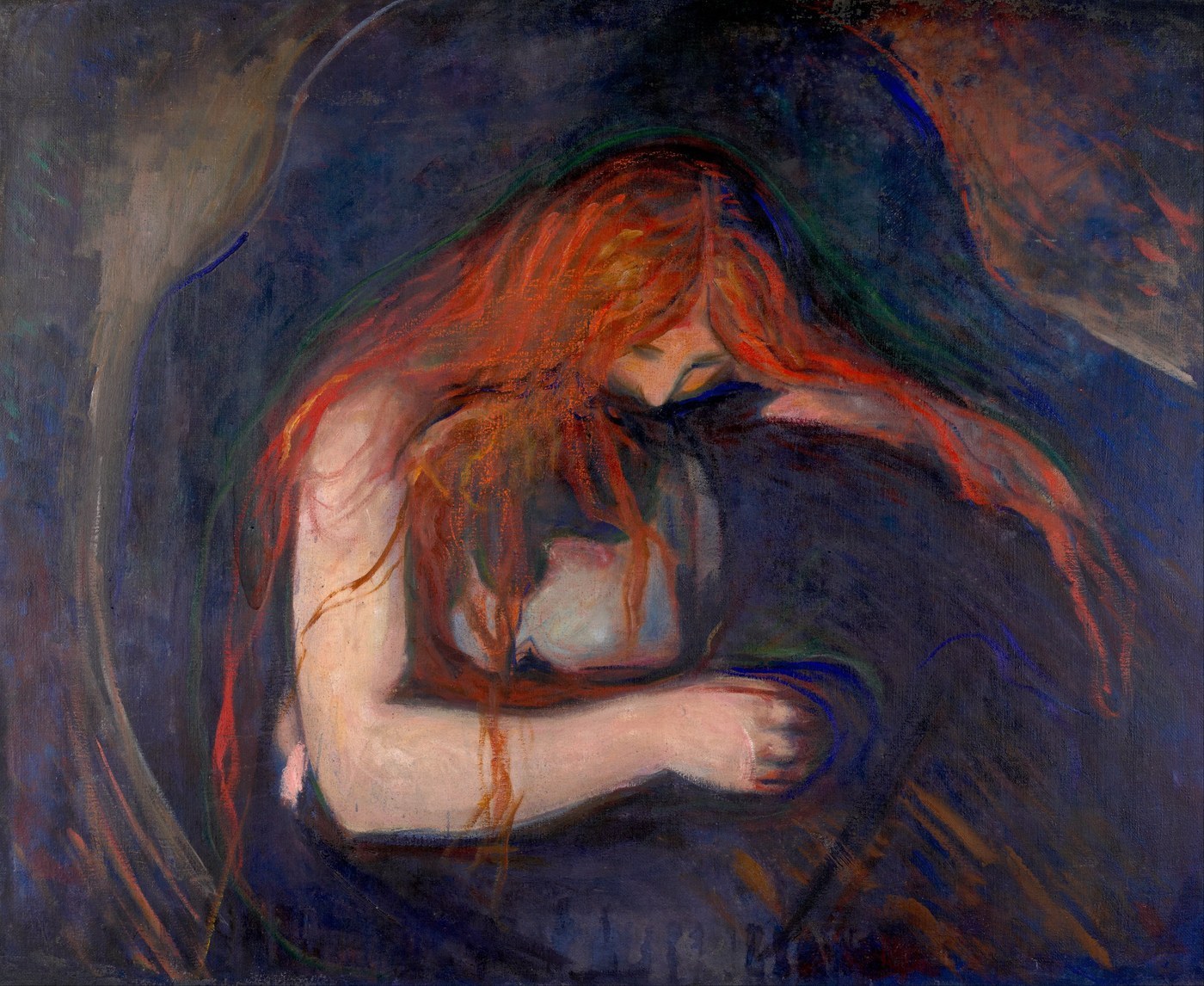
Munch first called this picture Love and Pain. A woman bends over a man, her red hair spilling across his neck as he collapses into her lap. The writer Stanislaw Przybyszewski, part of Munch’s Berlin circle, renamed it Vampire, and the darker title stuck. Munch always insisted it showed nothing more sinister than a woman kissing a man on the neck. The version reproduced here, roughly 91 by 109 centimetres, dates from the mid 1890s, one of several painted variants he made alongside a printed edition.
It belongs to the same current of desire shading into fear that runs through all his Berlin work. Munch’s Vampire, and what it can bring to a room today, is explored in full in a separate essay.
Vampire is available as an archival fine print in the ZocineArtDesign shop. View the listing here.
4. Madonna (1894)
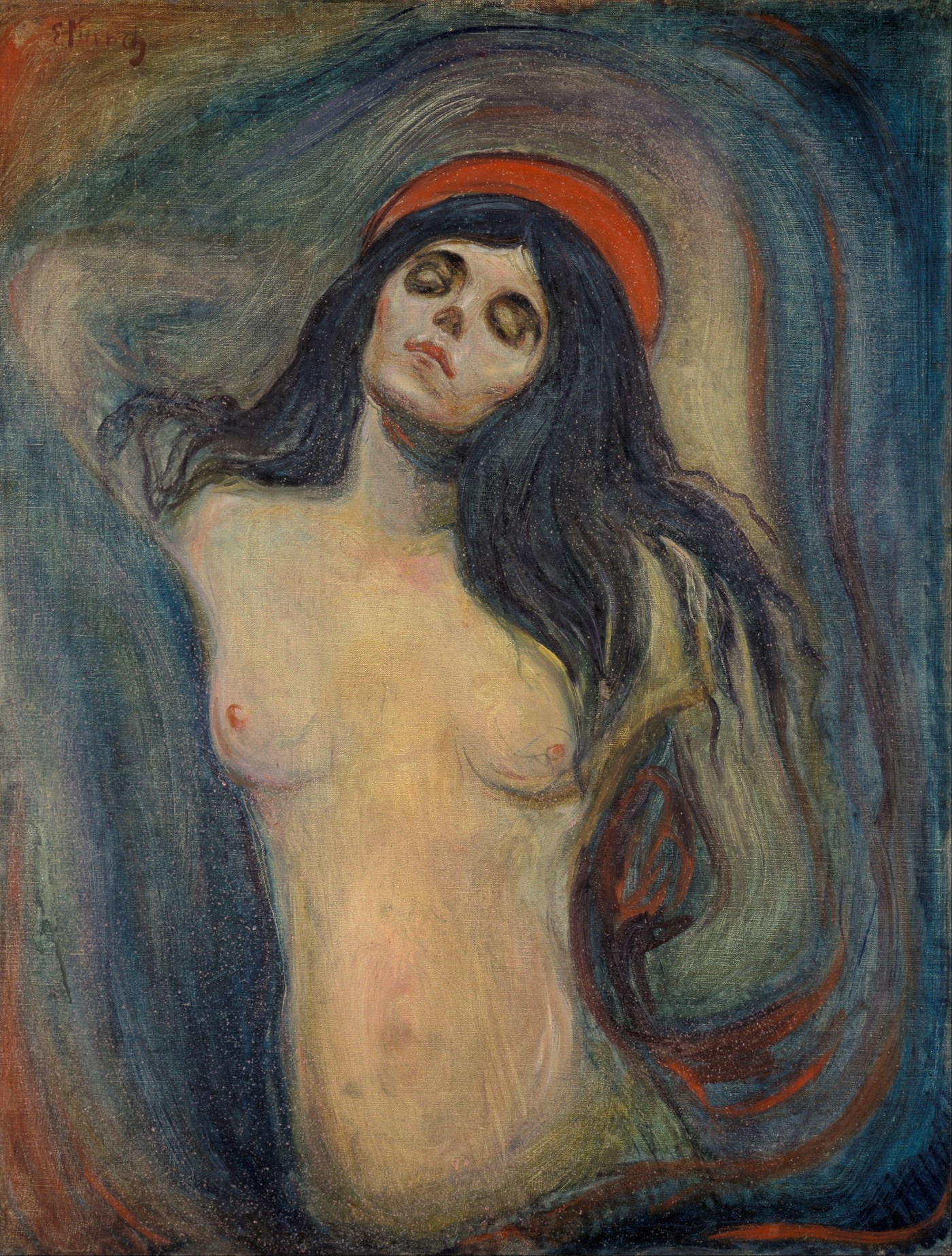
Madonna sets the same charged mood inside a single figure. A woman leans back with her eyes closed and one arm behind her head, ringed by a red halo, caught at what Munch described as the moment when life and death touch. He painted several versions between 1894 and 1895 and cut a lithograph of the subject that framed the figure with swimming sperm cells and a small foetus in the border. The painted canvas measures about 90 by 70 centimetres.
It is a religious title placed on an unmistakably earthly body, and that collision is the whole point. For Munch, love, birth, and death were one continuous event rather than three separate ones, and Madonna is his attempt to hold all three in a single face.
Madonna is available as an archival fine print in the ZocineArtDesign shop. View the listing here.
5. Ashes (1894)
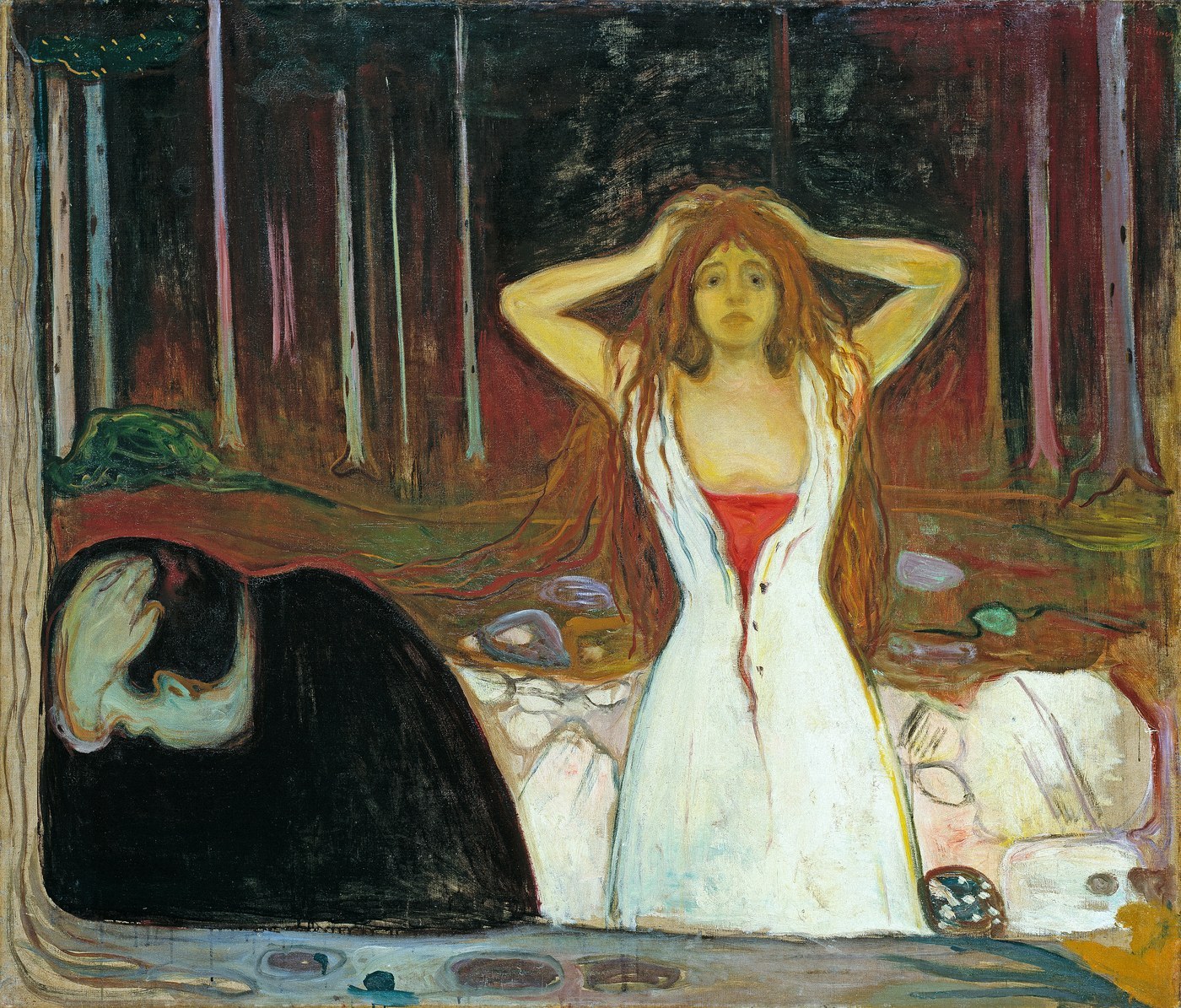
If Vampire and Madonna show desire at its height, Ashes shows the morning after. A woman stands upright in a white shift pulled open, hands raised to her head, while the man crumples at the edge of the frame with his face turned away. The painting, about 120 by 141 centimetres, sets them in the same Asgardstrand woods where Munch staged so many of his encounters.
Nothing dramatic is happening, and that is exactly what makes it bleak. The title says everything the two figures will not. The fire is out, and what is left is cold.
6. Anxiety (1894)
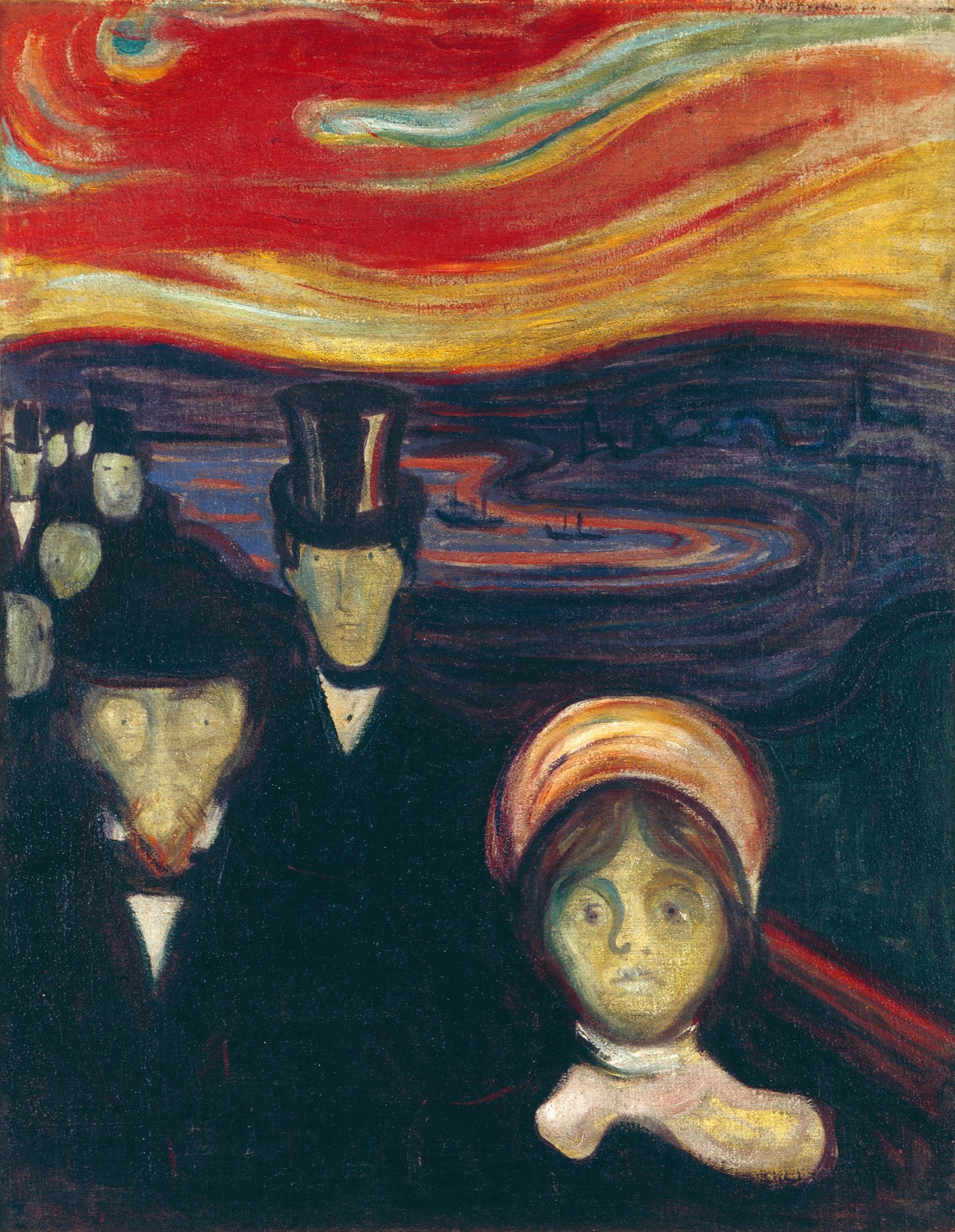
Anxiety takes the blood-red sky and the plunging wooden walkway of Munch’s most famous image and fills the foreground with a crowd instead of one figure. A line of pale, hollow-eyed townspeople in dark coats and hats presses toward the viewer along a road above a fjord, their faces frozen into near-identical masks. The canvas runs about 94 by 74 centimetres.
Where the single screaming figure feels like private panic, this procession feels like a whole society sleepwalking under the same poisoned sunset. The bridge, the burning sky, and the sense of dread are shared with The Scream, which is discussed in detail in this essay.
7. The Dance of Life (1899-1900)
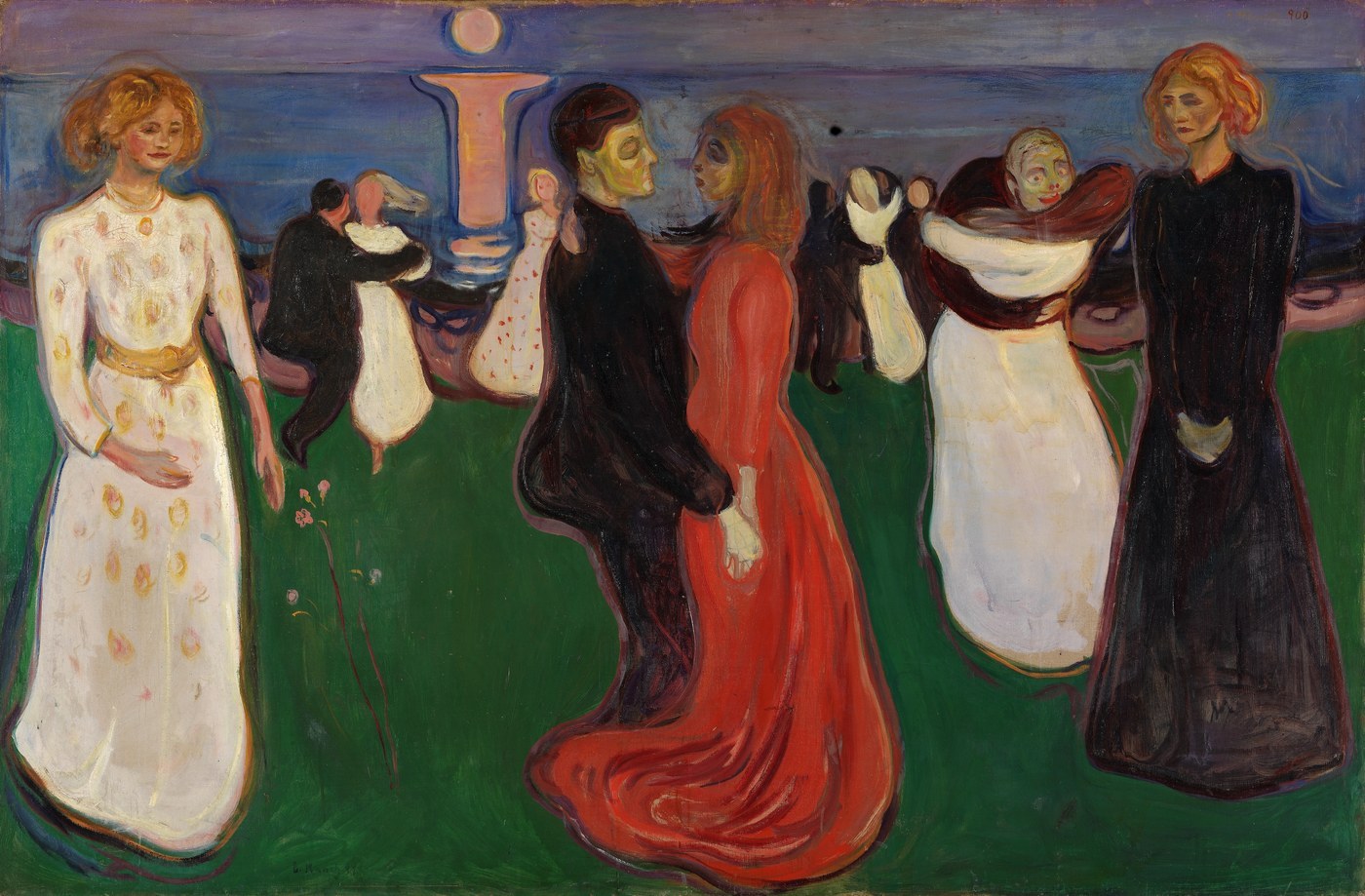
The Dance of Life gathers the whole cycle into one wide canvas of roughly 125 by 191 centimetres. On a midsummer night at Asgardstrand, couples turn on the grass under a low moon that lays a golden pillar across the water. At the centre a man dances with a woman in red.
To the left a woman in white reaches toward the dance, hopeful and untouched. To the right a woman in black stands rigid, arms closed, already past it. Munch has painted the same woman three times, as innocence, as desire, and as grief, and set the three ages of a single life around one dance.
8. Golgotha (1900)
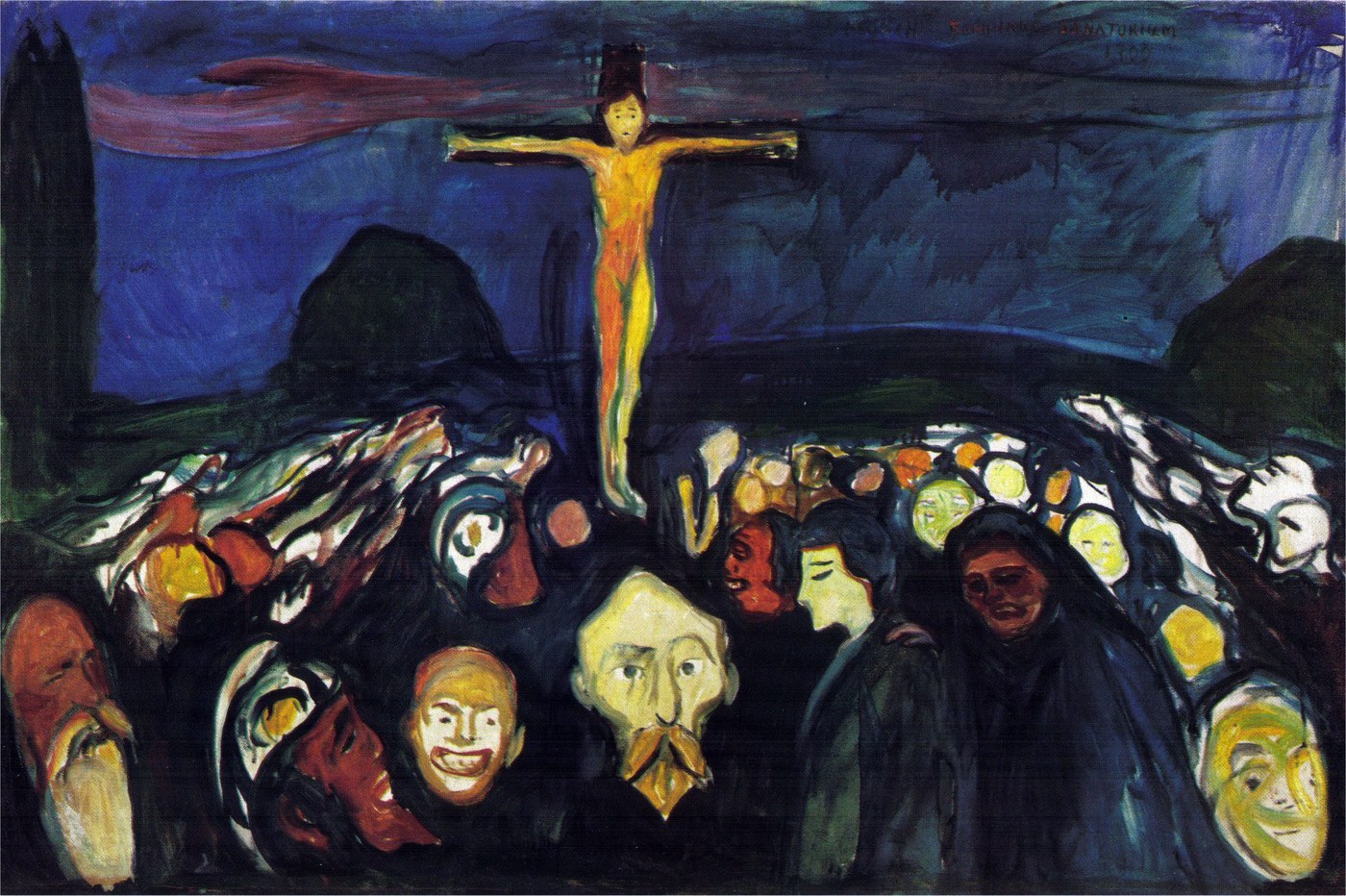
Munch painted Golgotha in 1900 while he was a patient at a sanatorium at Kornhaug, in a Norwegian mountain valley, recovering from the drinking and nervous strain that would eventually break his health. It is his most openly autobiographical religious picture. A gaunt figure hangs on a cross while a crowd of contorted faces surges below, and the crucified man carries Munch’s own features. At about 80 by 120 centimetres, it turns the private feeling of being watched and judged into a New Testament scene.
Eight years later, in 1908, that strain finally caught up with him and he spent months in a clinic in Copenhagen. The work that came after was calmer and more colourful, but the eight pictures on this page are the ones that first named the fear.
A Nordic Contemporary
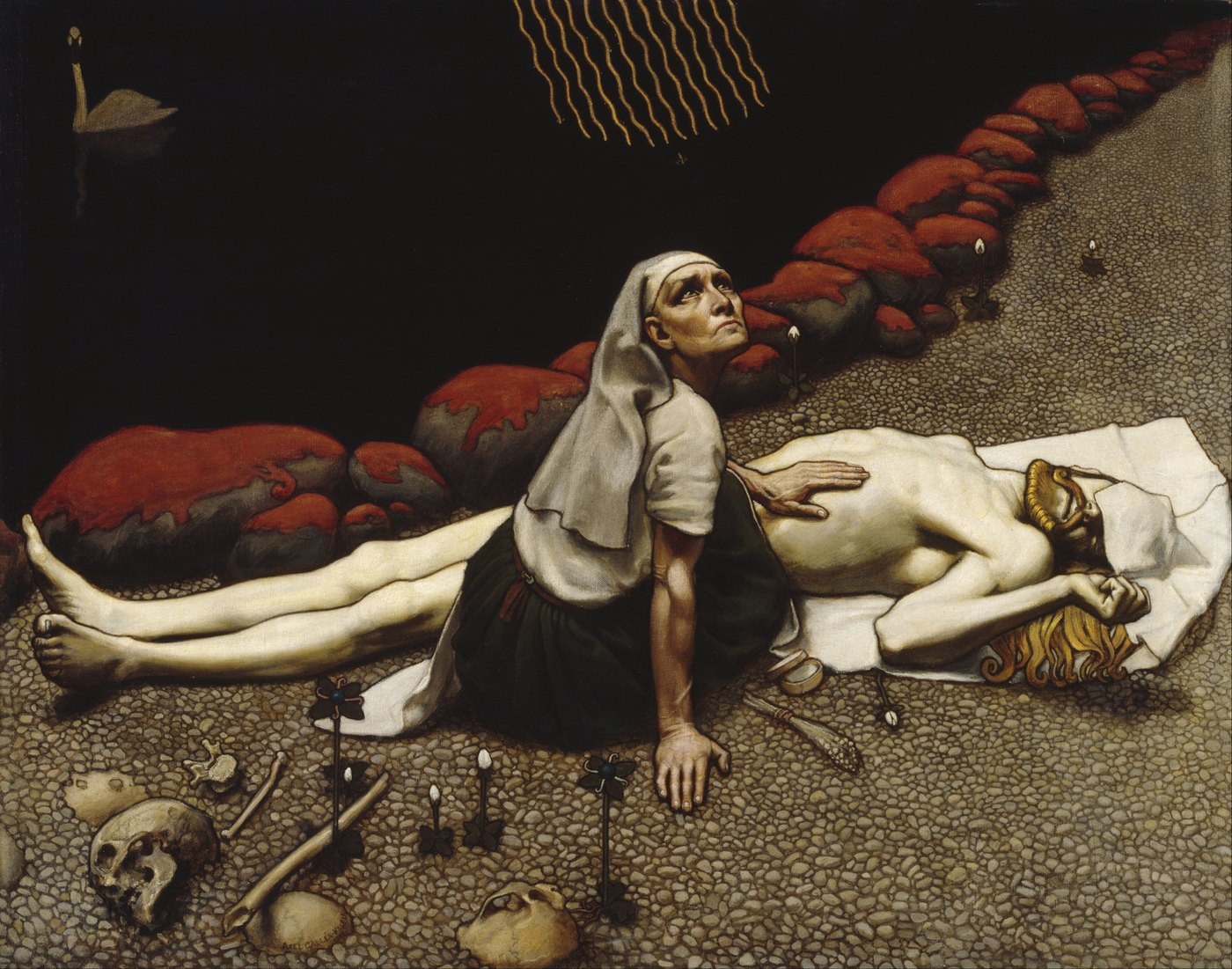
Munch did not paint his death pictures in isolation. In the mid-1890s he showed his work in Berlin beside a loose circle of northern Symbolists who were drawing the same feelings out of their own countries. One of them was the Finnish painter Akseli Gallen-Kallela, born in 1865 and two years younger than Munch. His Lemminkäinen’s Mother of 1897, a tempera panel of about 85 by 108 centimetres, takes a scene from the Finnish epic the Kalevala: a mother kneels on the black shore of the river of the dead and gathers the broken body of her son, willing him back to life. Set beside The Sick Child, it shows how widely this subject was shared across the north at the turn of the century, one grieving woman bent over a body she refuses to give up.
One Sentence Behind Every Picture
A single decision runs through all eight canvases. In a notebook he kept at Saint-Cloud outside Paris around 1889, later known as his Saint-Cloud manifesto, Munch set down the programme he would follow for the rest of his life. "No longer shall I paint interiors with men reading and women knitting," he wrote. "I shall paint living people who breathe and feel and suffer and love." Every painting in this tour is that one sentence carried out.
Frequently Asked Questions
Which came first, The Scream or The Sick Child?
The Sick Child came first, painted in 1885 and 1886, eight years before The Scream of 1893. Munch called The Sick Child his artistic breakthrough and returned to the subject six times over roughly forty years, so the sickroom, not the bridge, is where his mature style began.
Why did Munch paint the same subjects so many times?
He treated his motifs as parts of a larger cycle he called the Frieze of Life, first shown together in Berlin in 1902 with more than twenty paintings. Repainting a subject let him revisit the same feeling with new colour and technique, and in practical terms it also let him sell one version while keeping another on the wall.
Are these Munch paintings free to reproduce?
Munch died in 1944, and these late nineteenth-century paintings have long since passed out of copyright, which is why they can be studied, reproduced, and printed freely today. The images on this page are faithful reproductions of the original canvases.
How do these early Munch works look on a wall?
Munch’s early canvases work best as single strong statements on a quiet wall rather than in a dense cluster. Several of the paintings in this tour, among them The Sick Child, Melancholy, Vampire, and Madonna, are available as archival fine prints in the ZocineArtDesign shop.
New in the Journal: Paintings of Paintings: How Antwerp Invented the Gallery Picture


Comments