Paintings of Paintings: How Antwerp Invented the Gallery Picture
The gallery picture, a painting whose entire subject is a room crowded with other paintings, was invented in one city inside a single generation. It appeared in Antwerp in the years around 1615, and within four decades it had produced some of the most detailed images of collecting ever made. A gallery picture is not a portrait of a person or a landscape. It is a portrait of a collection.
The idea sounds narrow. In practice it let painters show off everything at once: their command of miniature copies after famous works, their fluency in perspective, their eye for shells and coins and marble busts, and their argument about what art was for. These rooms are dense, quiet, and strange. They reward slow looking, because almost every framed rectangle on the wall is a recognisable picture reduced to the size of a playing card.
Below is how the genre began, who built it, and why a court painter eventually turned one of these rooms into the earliest printed catalogue of a picture collection.
The city that sold pictures by the thousand
Antwerp in the early seventeenth century was the busiest art market in northern Europe. Its painters worked in guild workshops that turned out pictures for export the way other trades turned out cloth or sugar, and its dealers shipped panels across the continent by the crate. A collector could walk into a dealer room and see landscapes, still lifes, saints and battle scenes stacked frame against frame. That experience, a wall of unrelated pictures seen all together, is the raw material of the gallery painting.
Contemporaries had a word for the room these pictures ended up in. A Dutch and Flemish collector called it a "constkamer," an art chamber, the same idea the German lands recorded as a Kunstkammer. The word covered both the physical room and the collection inside it, and it is the direct ancestor of the modern word for a museum gallery. When Antwerp painters began picturing the constkamer, they were painting a subject their own buyers already lived with.
Frans Francken and the first painted collections
The painter usually credited with fixing the format is Frans Francken the Younger, who lived from 1581 to 1642. From the late 1610s he produced small, jewel like panels showing a table and a wall loaded with treasures: framed landscapes, a garland of flowers around a small holy image, drawings, ancient coins laid out in rows, a nautilus cup, a dried seahorse pinned to the wall. Nothing is random. Each object is a category of collecting, and the picture as a whole is a claim that the person who owns these things owns the world in miniature.
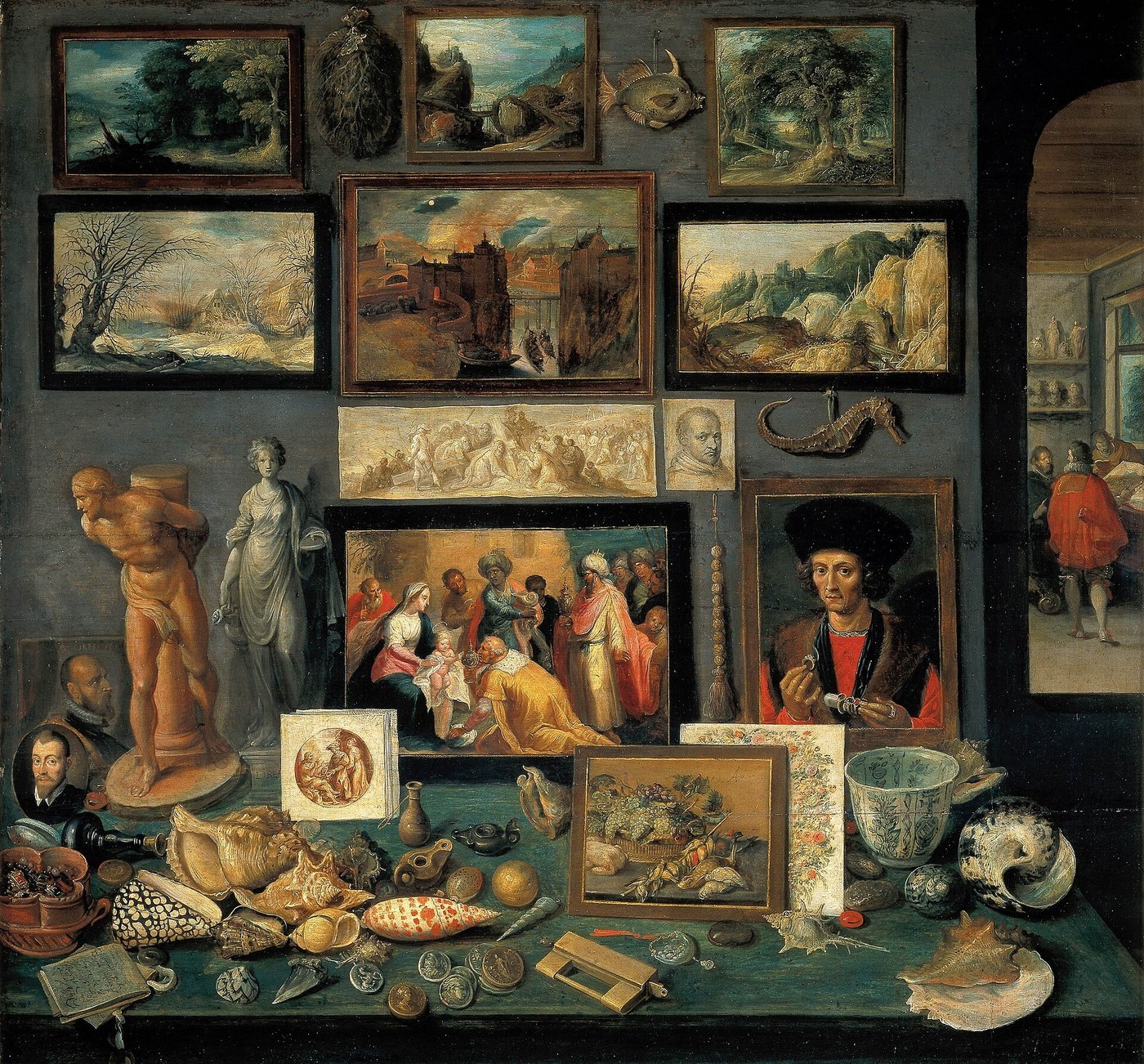
The panel above, dated 1636, is a mature example. Seven or eight small landscapes hang in a tight grid, a night fire glows in the picture at the centre, and below them the table carries shells, medals, a Chinese porcelain bowl and a portrait of a money changer weighing coins. The reference is pointed. A collection is also a form of wealth, and the picture is honest about it. Francken painted variations on this design for decades, and in doing so he taught a whole city of painters how to compose a room out of nothing but other art.
Willem van Haecht turns the room into an argument
If Francken made the format, Willem van Haecht, who lived from 1593 to 1637, gave it ambition. Van Haecht managed the celebrated collection of the Antwerp merchant Cornelis van der Geest, and he painted gallery interiors that read like essays on the dignity of art. His best known composition, made around 1630, sets the ancient painter Apelles at his easel inside a Flemish gallery, surrounded by marble sculpture, connoisseurs in conversation, and a wall of pictures.
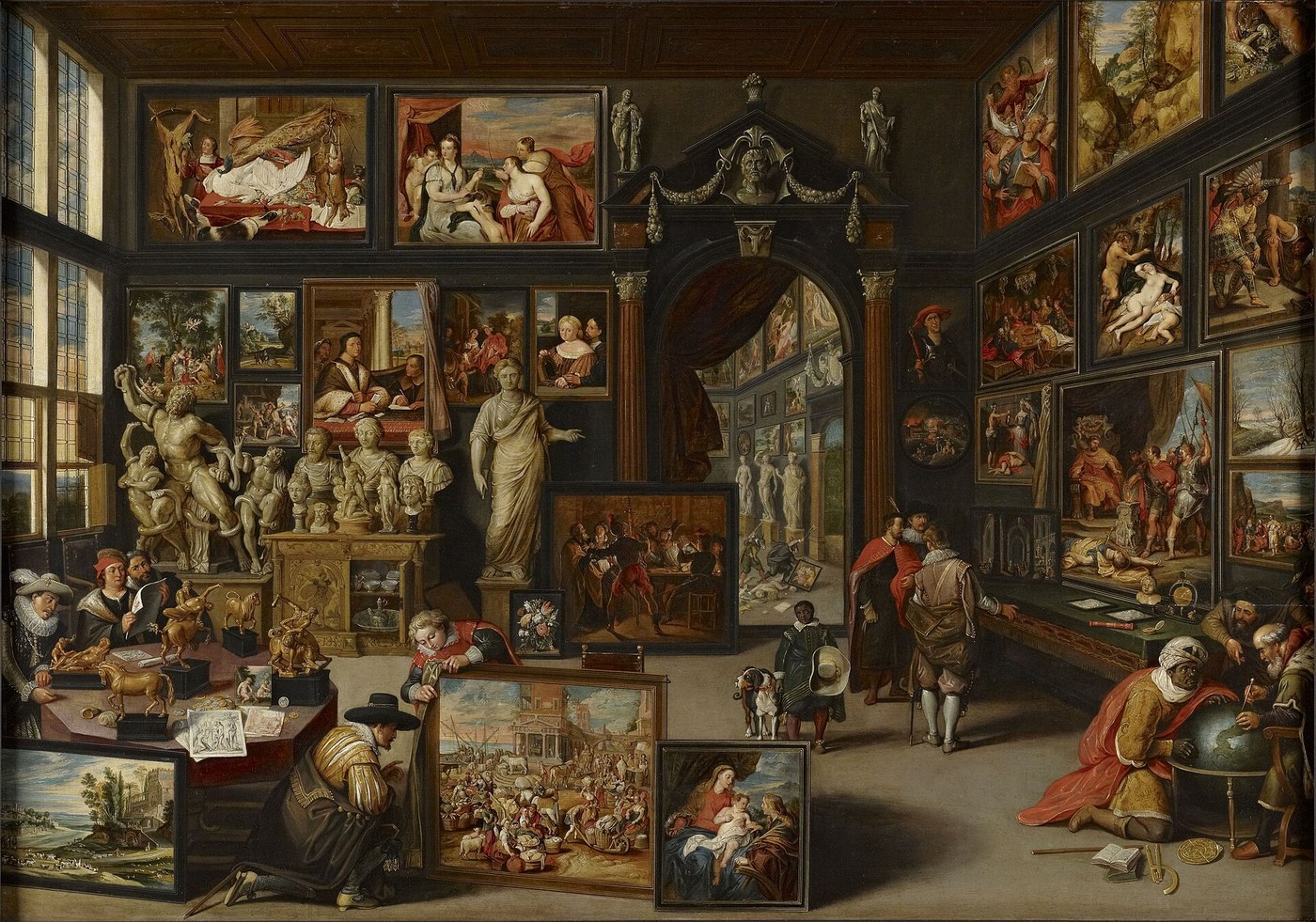
The panel, a little over a metre and a half across, is a manifesto disguised as an inventory. By placing a legendary painter of antiquity in a modern Flemish room, van Haecht argues that the painters of his own city belong in the same story as the masters of Greece and Rome. The marble Laocoon group on the left, the classical busts, the drawings passed hand to hand, all say the same thing: painting is a liberal art, not a trade, and the collector who assembles it is a kind of scholar. The genre was never only about showing off objects. It was about status, and about what looking is worth.
When one of the five senses became a gallery
The gallery picture also crossed into allegory. In 1617 two of the most admired painters in the city, Jan Brueghel the Elder and Peter Paul Rubens, collaborated on a series of the five senses, and their picture of Sight is a gallery painting in everything but name. Brueghel painted the setting and the objects, Rubens painted the figures, and together they filled a palace room with paintings, sculptures, a globe, an armillary sphere, an early telescope, jewels and scientific instruments.
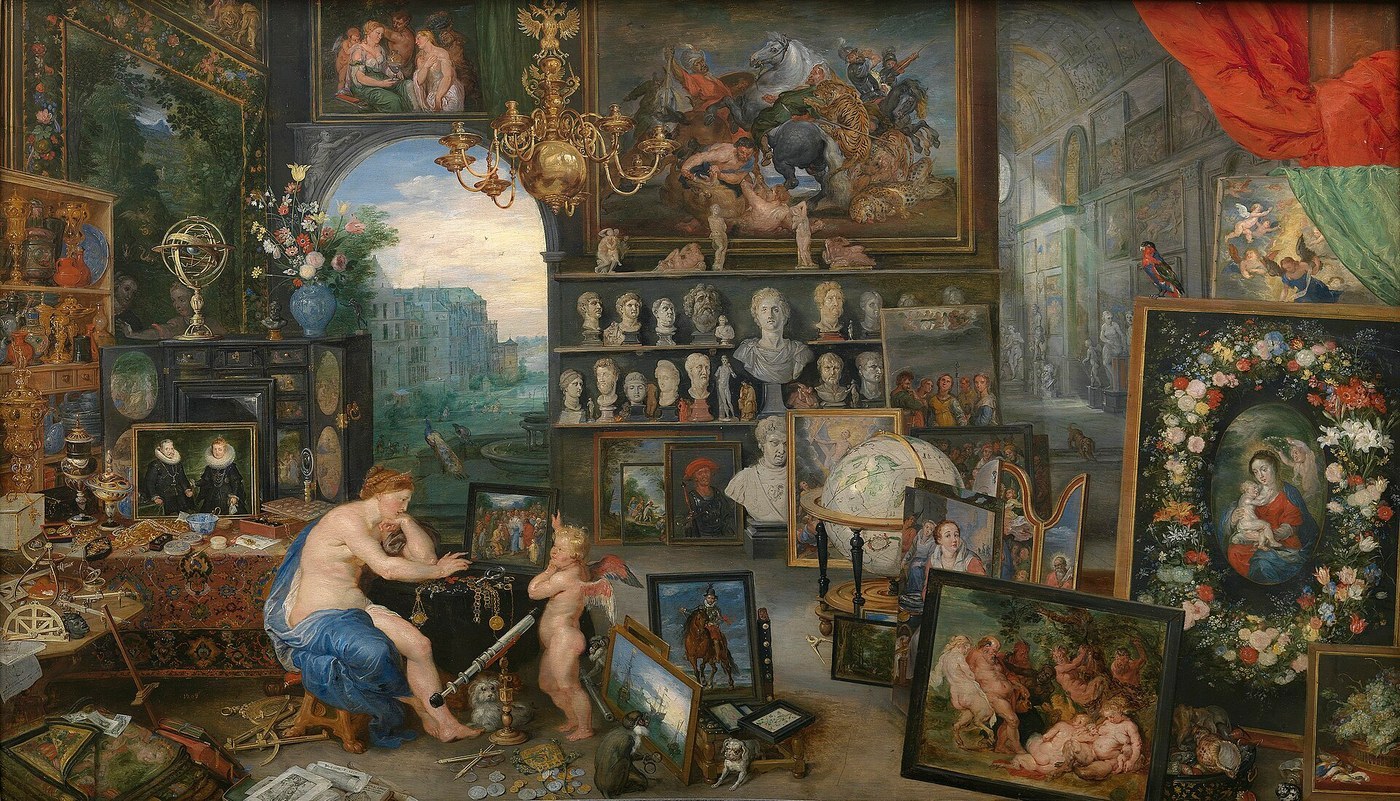
At the centre Venus turns a painting toward the light while Cupid holds it for her. The message is direct. Of all the senses, sight is the one that takes in art and knowledge, and the room built to celebrate it is, inevitably, a picture gallery. The painting was made for the ruling court of the region, which means the genre had climbed in a single decade from the dealer back room to the walls of a palace. It is one of the clearest demonstrations that in Antwerp, the collection and the artwork had become the same subject.
The collection as a still life
Not every gallery picture shows people. A whole branch of the genre removed the collectors entirely and simply arranged the treasures for inspection, closer to a still life than a scene. The panel below, painted in 1619, is exactly this: a wall of small landscapes and a flower ringed holy image above a table strewn with shells, gold and silver coins, a commemorative medal, a book of figure drawings and a vase of tulips.
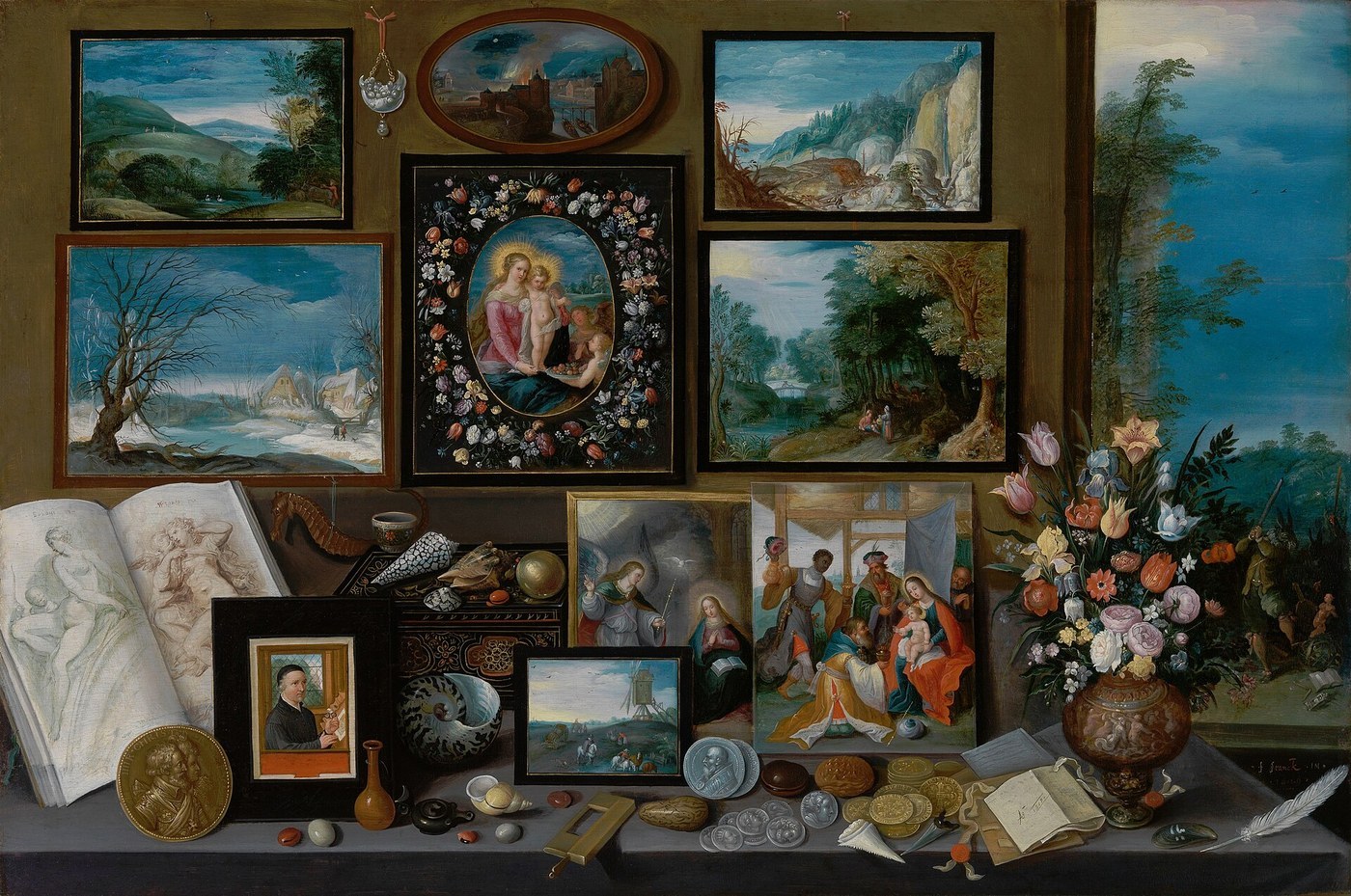
Read slowly, the table is a lecture. Coins stand for history, shells for the far reaches of the natural world, drawings for the discipline of the hand, the flower garland for the passing of time. Painters such as Cornelis de Baellieur and members of the wider Francken workshop turned out dozens of these arrangements, and buyers across Europe collected the paintings of collections almost as eagerly as they collected the objects inside them. The picture is a catalogue you could hang on a wall.
Teniers, the archduke, and the first picture catalogue
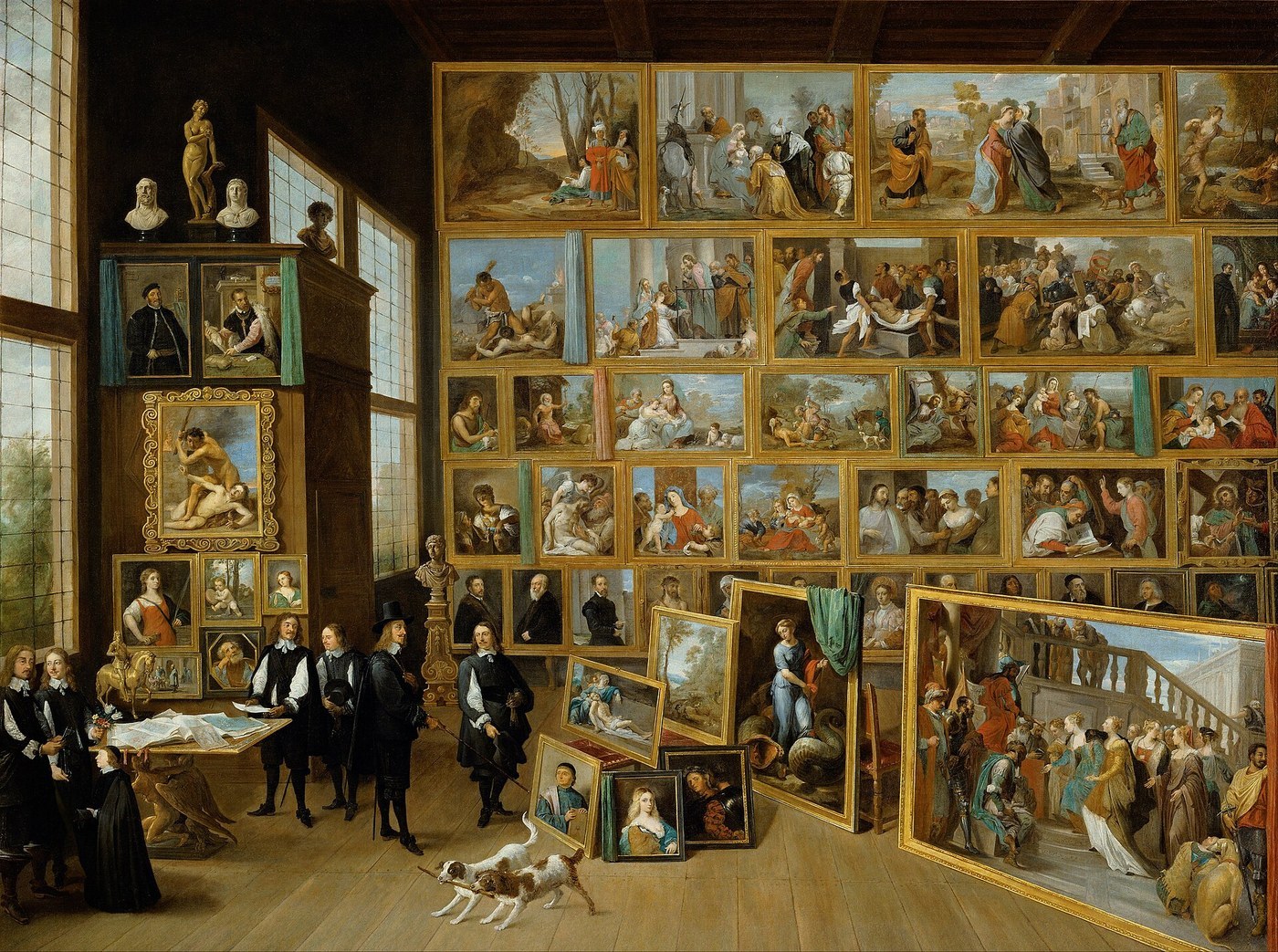
The genre reached its most consequential form with David Teniers the Younger, who lived from 1610 to 1690. In 1651 he entered the service of Archduke Leopold Wilhelm, the governor of the Southern Netherlands, whose court sat in Brussels. Leopold Wilhelm had assembled one of the largest picture collections in Europe, around 1,400 paintings, close to 900 of them by Italian masters, and an inventory of the holdings was drawn up in 1659. Teniers was made keeper of that collection, and he painted the archduke walking his own gallery, the pictures hung frame to frame from floor to ceiling, exactly as the opening image of this essay shows.
Then Teniers did something new. He made small painted copies of the finest Italian pictures, had them engraved, and gathered the results in 1660 into a printed book he titled the "Theatrum Pictorium," a theatre of painting. It reproduced more than 240 of the archduke’s Italian pictures as prints, and it is the earliest illustrated catalogue of a private picture gallery ever published. A collection that lived behind palace walls could now be studied by anyone who owned the volume. The gallery painting, which began as a way to picture a room, ended by inventing the idea that a collection could be published, shared, and known at a distance. Every illustrated museum catalogue since descends from that book.
Key takeaways
The gallery picture, a painting of a room full of other paintings, was invented in Antwerp around 1615 and grew directly out of the city’s vast art market.
Frans Francken the Younger (1581 to 1642) fixed the small cabinet format from the late 1610s, painting collections as dense arrangements of pictures, shells, coins and sculpture.
Willem van Haecht (1593 to 1637) raised the genre into an argument that painting is a liberal art, placing the ancient master Apelles inside a Flemish gallery around 1630.
In 1617 Jan Brueghel the Elder and Peter Paul Rubens turned the allegory of Sight into a full gallery interior, carrying the format from the dealer room to the palace.
David Teniers the Younger catalogued Archduke Leopold Wilhelm’s collection of roughly 1,400 paintings and published the "Theatrum Pictorium" in 1660, the first illustrated catalogue of a picture gallery.
Questions readers ask
What is a gallery painting?
A gallery painting, sometimes called a cabinet picture or a constkamer painting, is a work whose subject is a collection of art. It shows a room hung with many smaller pictures, often together with sculpture, coins, shells and scientific instruments. The genre began in Antwerp around 1615 and treats the act of collecting itself as a worthy subject.
Who invented the gallery picture?
No single artist owns the invention, but Frans Francken the Younger is usually credited with fixing the format in the late 1610s, and Willem van Haecht gave it its highest ambition around 1630. Jan Brueghel the Elder, Peter Paul Rubens, Cornelis de Baellieur and David Teniers the Younger all developed it further across the following decades.
What was the Theatrum Pictorium?
The "Theatrum Pictorium," published by David Teniers the Younger in 1660, was a book of engravings reproducing more than 240 of the Italian paintings in Archduke Leopold Wilhelm’s collection. It is regarded as the earliest illustrated catalogue of a private picture gallery, and it made a collection that lived behind palace walls available to anyone who owned the volume.
Why did collectors buy paintings of other paintings?
Because the gallery picture was a statement of taste and learning as much as a decoration. Owning a painted collection signalled that its owner valued art, understood it, and could recognise the famous works reduced to miniature on its walls. For a merchant city that lived on the picture trade, a painting of a collection was also a quiet portrait of the buyer.
Further reading in the archive
For more journeys through the deep history of European painting, see Dark Academia Wall Art: 12 Paintings That Define the Aesthetic.
The full archive of vintage paintings, printed to order as fine prints, is at zocineartdesign.etsy.com.


Comments