The Most Famous Muses in Art History
Updated: Aug 7
A muse is not a model. A model sits for one painting and goes home. A muse sits for thirty paintings — sometimes hundreds — across years or decades, and slowly the painter's whole way of seeing rearranges itself around her face. The muse appears in the early career and the late career; in the famous pictures and the failed ones; in the official portraits commissioned by patrons and the private drawings the painter made on the back of an envelope at three in the morning. By the end, the painter and the muse are difficult to separate. You cannot describe the painter's work without describing her.
The women below are the most famous European muses of the last hundred and fifty years. Some of them painted, some did not. Some had their own work overshadowed by the work of the men they sat for. Some were married to those men, some were lovers, some were both. All of them were the load-bearing figures inside the careers of the painters they are most often discussed alongside.
Camille Doncieux — Monet's first wife
Camille Doncieux (1847-1879) was nineteen when Claude Monet found her, working as a model in Paris in the autumn of 1865. He was twenty-five, unknown, and the son of a Le Havre grocer who had cut off his allowance because he was painting instead of selling provisions. They fell in love within weeks and moved in together within months. Camille became, almost immediately, the figure inside every important painting of Monet's twenties and thirties.

Camille appears in roughly thirty-two surviving Monet canvases between 1865 and her death in 1879. She is the woman in white in Women in the Garden, the woman in green in Camille (the painting that briefly made Monet a national name in 1866), the dark-clad mother on the beach at Trouville the summer after their wedding, the figure under the parasol in the Argenteuil garden, the woman in a Japanese kimono in the late 1870s when the marriage was failing and money had become impossible. She bore him two sons and died of pelvic cancer at thirty-two — Monet painted her on her deathbed the morning she died, in a small picture he kept private for the rest of his life.

Monet remarried after Camille's death — to Alice Hoschedé, who had been the wife of Monet's bankrupt patron — but he never again painted a model the way he had painted Camille. The late Monet, the painter of the water lilies at Giverny, did landscape almost exclusively. The figure had gone out of his pictures with her.
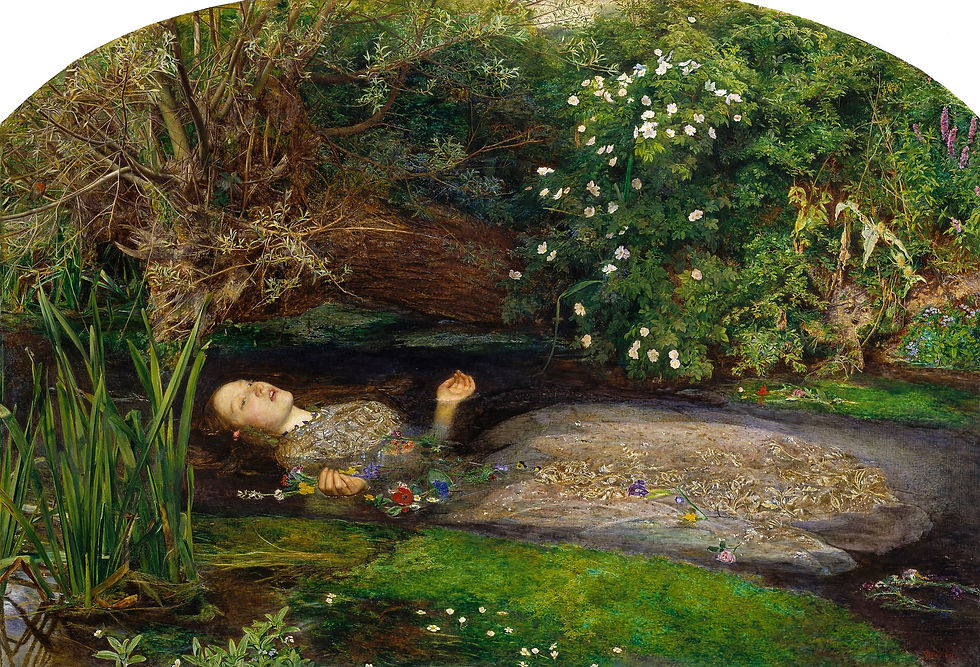
Elizabeth Siddal — the Pre-Raphaelite Ophelia
Elizabeth Siddal (1829-1862), called Lizzie, was the muse of the entire Pre-Raphaelite circle. She had been a hat-shop assistant in Holborn when one of the Pre-Raphaelites, Walter Deverell, asked her to sit for a painting in 1849. Within a year she was the figure inside half a dozen Pre-Raphaelite canvases. John Everett Millais painted her as the drowning Ophelia in 1851-52, lying for hours in a bath of water that was kept warm by candles underneath. The candles eventually went out, the water turned cold, and Lizzie caught a severe chill that she never fully recovered from. The picture became one of the most reproduced images of nineteenth-century English painting.
Lizzie's main painter was Dante Gabriel Rossetti, with whom she lived from the early 1850s and whom she married in 1860. She was the figure in dozens of his drawings and paintings. She was also a painter and poet in her own right — her drawings survive in modest numbers, and Christina Rossetti and Algernon Swinburne both praised her writing. She died of laudanum overdose in 1862 at thirty-two, possibly intentionally; Rossetti buried his only manuscript of unpublished poetry in her coffin and seven years later, in a documented and well-known act, had the coffin exhumed to retrieve it.

Rossetti's Beata Beatrix (c. 1864-1870), painted in the years after Lizzie's death, is the most famous memorial painting in nineteenth-century English art. He fused Lizzie's face with Dante Alighieri's Beatrice — the literary lover who died young — and produced a picture that is half portrait and half elegy. The painting hangs in a London collection and is still the image most people think of when they think of Pre-Raphaelite painting at all.
Jeanne Hébuterne — Modigliani's last love
Jeanne Hébuterne (1898-1920) met Amedeo Modigliani in Paris in the spring of 1917, when she was nineteen and he was thirty-two. She was a painting student at the Académie Colarossi. Within months she had moved in with him, against the violent objection of her conservative Catholic parents. She became the model for almost every major portrait Modigliani painted in the last three years of his life — roughly twenty-six canvases — and the figure to whom his late style is most clearly addressed.

Modigliani's portraits of Jeanne are the most distinctive single-sitter sequence in early-twentieth-century European painting. The figure is always elongated; the face is almost always tilted slightly to one side; the eyes are often shown as almond-shaped blanks with no visible pupil. The technique is the result of Modigliani's long interest in African sculpture and Italian Mannerism, applied unrelentingly to one face. Jeanne survives in the paintings as a particular cast of feature — the same cast each time, rendered with patient unsentimental love over thirty months of work.
Modigliani died of tubercular meningitis in January 1920 at thirty-five. Jeanne, eight months pregnant with their second child, threw herself from her parents' fifth-floor window two days later. She was twenty-one. The combined deaths fixed the relationship permanently in the mythology of bohemian Paris. Modigliani's paintings of her are now among the most expensive twentieth-century pictures at auction.
Gala — Dalí's organising force
Gala Diakonova (1894-1982) is the most argued-over muse of the twentieth century. She was Russian, ten years older than Salvador Dalí, and was already married to the French Surrealist poet Paul Éluard when she met Dalí in 1929 at the Catalonia village of Cadaqués. She left Éluard for Dalí within a year and remained Dalí's wife, model, business manager, and creative organiser for the next fifty-two years. Dalí signed many of his paintings Gala-Salvador Dalí. His own account, repeated in interviews for decades, was that she had organised his entire career and that he could not have produced any of the major work without her.
Gala appears in dozens of Dalí canvases, often in the role of a religious figure — the Virgin in the late religious series, Leda in the mythological pictures, the seated central figure in The Madonna of Port Lligat. Critics of Dalí have spent decades arguing about whether Gala was a genuine creative collaborator or a controlling presence who pushed his work toward the commercial register. The argument is unresolved. What is clear is that the Dalí style as the world knows it — the polished hyper-real surface, the mythological grandeur, the public showmanship — fully consolidated only after Gala arrived, and Dalí's painting visibly weakened in the few years she was geographically distant from him.
Dora Maar — Picasso's photographer
Dora Maar (1907-1997) — born Henriette Theodora Markovitch — was a French photographer and painter who became Pablo Picasso's lover and primary model from 1936 to 1944. She was the muse of the Guernica period. The photographs she took of Picasso painting Guernica in his Paris studio in 1937 are the most detailed visual record of the making of any twentieth-century painting and were taken because Dora suggested the project and persuaded Picasso to allow it.
Picasso painted Dora more than thirty times in eight years. The series is famously brutal — Picasso called her the weeping woman and produced a sequence of canvases in 1937 (the most famous is The Weeping Woman) in which her face is fractured into Cubist planes and saturated with tears. The pictures sit somewhere between portraiture and torture and have been read both ways: as Dora's emotional collapse during a difficult relationship and as Picasso's instrumental use of his lover's face as a vehicle for a public political grief about the Spanish Civil War. Dora was herself a major photographer and painter — her work has been seriously rehabilitated since the 1990s — and her own pictures, surrealist photomontages from the early 1930s, are now in major collections. The relationship with Picasso ended in 1944; she lived another fifty-three years in Paris and worked steadily, mostly in painting.
Camille Claudel — Rodin's collaborator and equal
Camille Claudel (1864-1943) was a French sculptor who entered Auguste Rodin's studio in 1884 as an apprentice and became, within a year, his lover, his model, and his collaborator on the largest sculptural commissions of his career. She was nineteen; he was forty-four and already with the woman who would later become his wife. The relationship lasted fifteen years. During that time Rodin produced — sometimes with Claudel's direct sculptural hand on the work — the major figures of his middle career: The Kiss, The Burghers of Calais, the Gates of Hell. Claudel's own independent sculpture from the same period is now understood as among the strongest French sculpture of the late nineteenth century.
The relationship ended badly. Claudel left Rodin in the late 1890s, after fifteen years of unresolvable conflict over his refusal to marry her and over the question of whose hand had made which sculpture. She continued sculpting on her own for the next two decades and produced an independent body of work — La Valse, The Mature Age, The Wave — that is now read as the work of a major sculptor and as a sustained meditation on the relationship with Rodin. In 1913 her brother Paul Claudel, the famous Catholic poet, committed her to a mental asylum on family pressure; she remained institutionalised for the last thirty years of her life and was buried in an unmarked grave. Her sculpture has been seriously rehabilitated since the 1980s. She is now read as Rodin's full intellectual equal.
Suzanne Valadon — the model who became the painter
Suzanne Valadon (1865-1938) is the most interesting case in the history of European muses because she crossed the line between sitter and painter and worked at the level of the men she had previously sat for. She was an illegitimate seamstress's daughter, raised in Montmartre, who began modelling in her teens. She sat for Pierre-Auguste Renoir's Dance at Bougival and Dance in the City, both 1883; she sat for Henri de Toulouse-Lautrec from 1885 onward (he gave her the name Suzanne — she had been Marie before); she sat for Pierre Puvis de Chavannes for nearly all the major figure compositions of his mature career.
In 1893, at twenty-eight, she stopped modelling and started painting. She had been drawing privately for over a decade under Lautrec's quiet encouragement, and the work she produced in her thirties is sustained, sharp, and built on what she had learned by watching the men she had sat for. Her female nudes — painted without the standard nineteenth-century gloss of idealisation — are now read as some of the most direct figure paintings of the period. She became the first woman ever admitted to the Société Nationale des Beaux-Arts in Paris and produced steadily for forty years. Her son, Maurice Utrillo, was a celebrated Montmartre landscape painter; she taught him. The trajectory from Renoir's model to Renoir's peer is the cleanest single example in the history of European art of a muse who became the painter herself.
What the muses were doing
The muse-relationship is not a separate genre of nineteenth- and twentieth-century European painting; it is the structural condition of large parts of it. The painters did not invent their styles in a vacuum. The styles consolidated around faces — the same face, painted again and again, until the painter knew it well enough that the painting of it stopped being description and started being commentary. The muse was the painter's working surface. The painter could not have produced the work without her.
Several of these women — Siddal, Claudel, Valadon — were artists in their own right. Their work has been steadily rehabilitated since the 1970s as the project of correcting the male-only twentieth-century art canon has continued. The current understanding of the muse-relationship is no longer the romantic one of a quiet inspirational presence; it is the more accurate one of an active intellectual and visual collaborator, frequently a maker herself, whose work was systematically absorbed into the credit of the man she sat for. Recovering that work is one of the ongoing projects of contemporary art history. It is most of the way done for Claudel, Valadon, and Maar. It is still mostly in progress for Siddal. It has barely begun for the dozens of women, most of them anonymous, who modelled for the lesser-known nineteenth-century painters whose names have not survived at all.
Key takeaways
A muse is structurally different from a model: she appears in dozens or hundreds of paintings across years, and the painter's style consolidates around her face. The muse is the painter's working surface.
Camille Doncieux (1847-1879) was Claude Monet's first wife and the figure in roughly thirty-two of his paintings before her death at thirty-two. After her, Monet stopped painting figures and turned to landscape.
Elizabeth Siddal (1829-1862) was the muse of the entire Pre-Raphaelite circle — Millais painted her drowning Ophelia, Rossetti married her and continued painting her face for years after her death. She was also a poet and painter herself.
Jeanne Hébuterne (1898-1920) was Modigliani's last muse, the figure in roughly twenty-six paintings in the final three years of his life. She killed herself two days after his death.
Gala (1894-1982) was Salvador Dalí's wife, model, and business manager for fifty-two years. Dalí signed his paintings Gala-Salvador Dalí. The argument over whether Gala was a creative collaborator or a controlling commercial influence is unresolved.
Dora Maar (1907-1997) was Pablo Picasso's lover and primary model during the Guernica years. She was herself a major photographer and painter; her work has been seriously rehabilitated since the 1990s.
Camille Claudel (1864-1943) was Rodin's collaborator and lover for fifteen years and produced an independent body of sculpture now read as work of the first rank. She spent the last thirty years of her life institutionalised.
Suzanne Valadon (1865-1938) crossed the line from model to painter — having sat for Renoir, Lautrec, and Puvis de Chavannes, she stopped modelling at twenty-eight and produced forty years of figure painting that is now read as among the strongest of the period.
Browse Pre-Raphaelite and Impressionist prints in the archive at zocineartdesign.etsy.com.
New in the Journal: Edvard Munch Beyond The Scream: Eight Paintings That Map a Haunted Life
New in the Journal: Paintings of Paintings: How Antwerp Invented the Gallery Picture
New in the Journal: Rossetti's Lady Lilith: The Pre-Raphaelite Stunner as Adam's First Wife
New in the Journal: Ten Portraits That Taught Europe How to Look: From Arnolfini to Madame X
New in the Journal: William Blake in 8 Visions: God, Newton, and the Red Dragon


Comments