William Blake in 8 Visions: God, Newton, and the Red Dragon
Updated: Aug 8
In the summer of 1827, a dying engraver sat up in bed in a two-room lodging off the Strand and coloured a print of an old man leaning out of the sun, measuring the darkness below with a pair of golden compasses. He had first made the image thirty-three years earlier. He worked at it until his hands gave out, looked at the sheet, and pronounced it done.
The engraver was William Blake, born in London in 1757, dead that August at sixty-nine. In his own lifetime he sold almost nothing, exhibited once to a single mocking review, and was written off by most of respectable London as a gifted madman. He claimed, calmly and consistently, that he saw visions: a tree full of angels at Peckham Rye as a boy, his dead brother teaching him a new way to print, the ghost of a flea walking into his workroom after midnight.
Two centuries later the verdict has reversed completely. The eight images below are the shortest path into his private mythology: who Urizen is, why Newton crouches naked on the ocean floor, and how a seven-headed dragon painted for a quiet Bible commission became one of the most recognisable images of evil ever made.

1. The Ancient of Days (1794)
This is the image Blake was colouring on his deathbed. It opens Europe a Prophecy, one of the illuminated books he wrote, etched, printed and coloured himself, so that no two copies are alike. The kneeling figure with the white beard is not God the Father, or not exactly. Blake called him Urizen, his invented deity of reason, law and measurement, the great architect who builds the world and then fences it in.
The compasses come from the Book of Proverbs, where wisdom describes the creator setting "a compass upon the face of the deep." In Blake’s hands the instrument is not praise. Reason, for him, was a necessary power that becomes a tyrant the moment it works alone, and the incomplete circle of light around the figure is the tell: a world drawn by measurement only is a world missing half of itself. The colossal anatomy is his lifelong debt to Michelangelo, an artist he knew entirely through engravings and never saw in the original.
The Ancient of Days is available as an archival fine print in the ZocineArtDesign shop. View the listing here.
2. The First Book of Urizen, Title Page (1794)
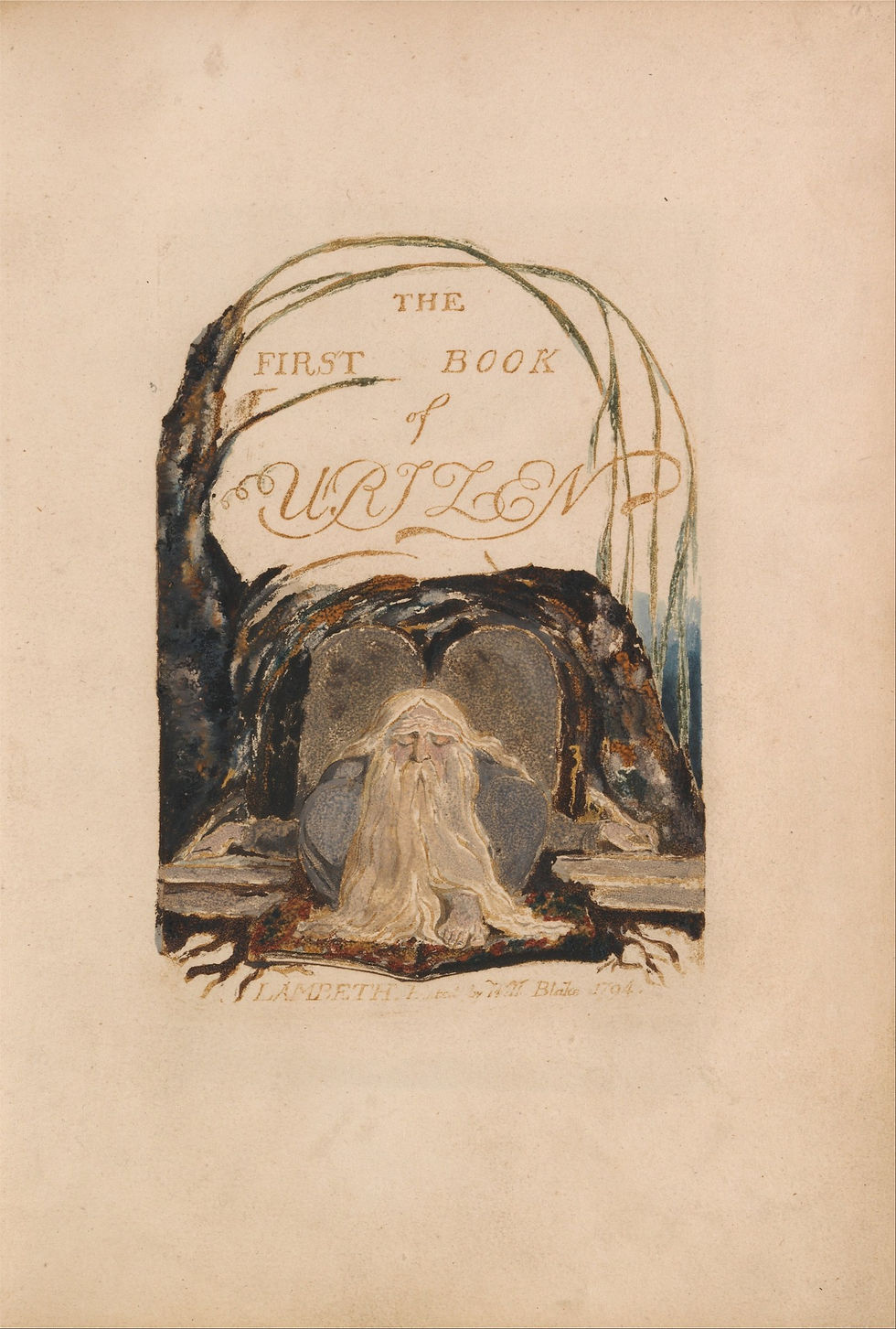
The same god, at home. On the title page of the book that bears his name, Urizen crouches behind twin stone tablets, eyes closed, writing with both hands at once into books of law. Roots crawl over the tablets. The composition is a deliberate parody of Genesis: a "first book" written not by Moses but by the spirit of legislation itself, blind to everything except its own text.
The page also shows off Blake’s trade secret. Around 1788 he began writing his poems mirror-reversed in acid-resistant varnish directly onto copper, biting the plate so that text and image stood up in relief and could be printed together. He said the method came to him in a dream from his dead brother Robert. Whatever its origin, it gave him total control: author, illustrator, engraver, printer and colourist in one pair of hands.
The Urizen plate is available as an archival fine print in the ZocineArtDesign shop. View the listing here.
3. Newton (1795)
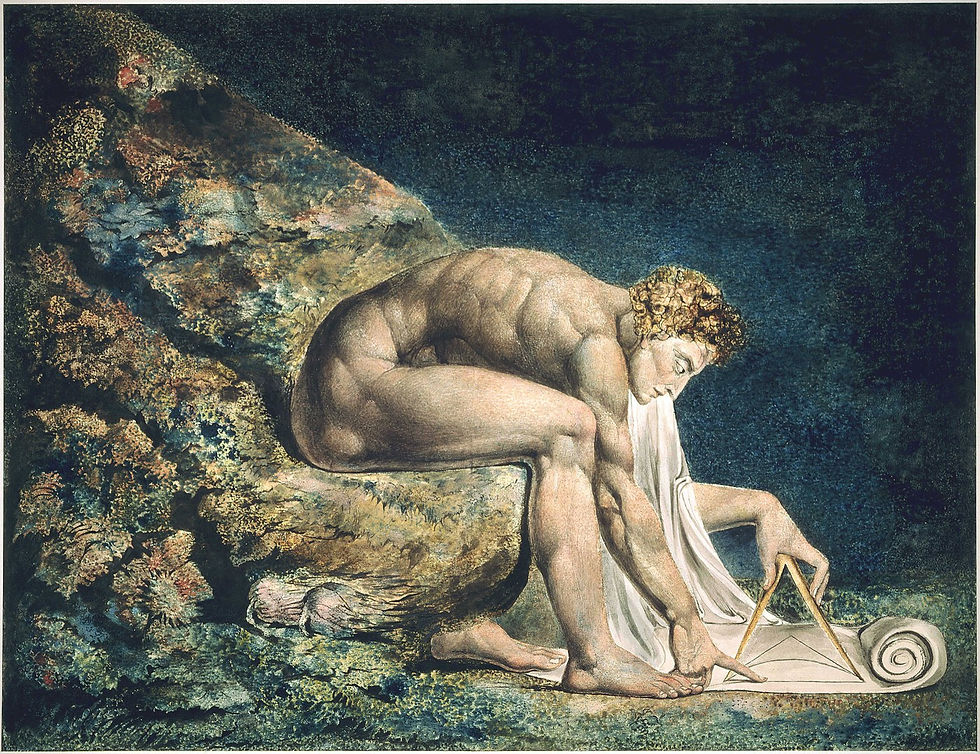
A heroic nude with the body of a river god sits on a lichen-covered rock that reads less like a shore than the floor of the sea. He folds himself into a perfect geometric wedge, eyes locked on the diagram at his feet, compasses echoing the ones held by Urizen the year before. The rock behind him blooms with colour and texture; he sees none of it.
This is not a tribute to the great physicist. It is an argument with him. "May God us keep from single vision and Newton’s sleep," Blake wrote in a letter of 1802, and this print is that sentence made visible: a mind of genuine beauty measuring a triangle while an entire universe glows unnoticed at its back. The technique is as unusual as the argument, a colour monotype pulled from painted millboard, then finished by hand, producing a mottled mineral surface no brush alone could reach.
Newton is available as an archival fine print in the ZocineArtDesign shop. View the listing here.
4. Jacob’s Ladder (c. 1805)

For most of two decades Blake’s steadiest income came from Thomas Butts, a clerk in the office of the muster-master general who quietly commissioned well over a hundred biblical watercolours and rarely argued about price. The arrangement kept Blake solvent and gave him a Bible-length canvas for his own theology.
Here the subject is Jacob’s dream at Bethel. Every illustrator before him had drawn what the text says, a ladder. Blake drew a spiral stair, sweeping up from the sleeper’s head through a sky of stars, crowded with angels carrying bread, scrolls and jugs, ordinary supplies for an ordinary night. The spiral is the whole point: dreams do not travel in straight lines, and neither, in Blake’s universe, does revelation.
Jacob’s Ladder is available as an archival fine print in the ZocineArtDesign shop. View the listing here.
5. The Great Red Dragon and the Woman Clothed with the Sun (c. 1803-1805)

Among the Butts watercolours are four scenes from the twelfth and thirteenth chapters of Revelation, and they contain some of the most alarming images in British art. Here the dragon is seen from behind, a human back monstrously muscled, horned head lowered, bat wings running clean past the edges of the sheet as if the paper itself could not hold him. Below, the woman clothed with the sun throws her arms wide in a mandorla of light.
Blake read Revelation the way he read everything, as psychology and politics as much as prophecy: empire and orthodoxy as beasts, imagination as the woman about to give birth. The composition has never loosened its grip. A hundred and seventy years later it was still frightening readers from the pages of a bestselling crime novel, which borrowed the dragon whole.
The Great Red Dragon is available as an archival fine print in the ZocineArtDesign shop. View the listing here.
6. The Number of the Beast is 666 (c. 1805)

The companion sheet moves one chapter on, to Revelation 13. The winged dragon now presides from a rock like a general reviewing troops, while below him the beast of the sea, seven-headed and pale as bone, raises its arms toward the horned beast of the earth. The palette is all smoke and ember, a restraint that makes the anatomy stranger.
What unsettles most is the composition’s calm. Nothing lunges. The three monsters simply confer, as institutions do. Blake, who lived through the state panic of the 1790s and was once tried for sedition after an argument with a soldier, knew exactly what a quiet meeting of powers could mean, and he was acquitted but never reassured.
The Number of the Beast is available as an archival fine print in the ZocineArtDesign shop. View the listing here.
7. The Ghost of a Flea (c. 1819-1820)

Late in life Blake fell in with the astrologer John Varley, who would sit with him after midnight while Blake sketched what he called visionary heads, drawing spirits as matter-of-factly as a portraitist draws a sitter. On one of those nights, he reported, the ghost of a flea walked into the room. It told him that fleas were inhabited by the souls of men who had been "by nature bloodthirsty to excess."
The panel he made from that sitting is scarcely larger than a paperback, tempera heightened with real gold on mahogany. The creature struts between stage curtains under a falling star, tongue flicking, one hand clutching an acorn cup for blood, its scaled skin glinting where the gold catches. It is grotesque, theatrical and completely sincere, painted with the same care another artist would spend on an altarpiece.
The Ghost of a Flea is available as an archival fine print in the ZocineArtDesign shop. View the listing here.
8. God Blessing the Seventh Day (1805)

After the dragons, the rest. In this Butts watercolour the creator sits at the close of the sixth chapter of creation, folded inside a mandorla of six winged figures whose wings meet in a single flame-shaped envelope of light. Yellow and rose radiate outward in painted rays. It is one of the gentlest sheets Blake ever produced, and it runs on exactly the same engine as the Red Dragon: a body of light, a frame of wings, a universe organised around a single central figure.
Look twice at the face. It is the face of Urizen, the same white beard from the frontispiece of 1794. In Blake’s system creation and limitation were never separate acts, and rest itself is a made thing, drawn, like everything else in his world, by hand.
God Blessing the Seventh Day is available as an archival fine print in the ZocineArtDesign shop. View the listing here.
Key takeaways
Blake was an engraver by trade who invented his own printing method, relief etching, and used it to publish his poems and images as a single handmade object.
The Ancient of Days and Newton both centre on compasses: in Blake’s mythology measurement without imagination is the root error of the modern mind.
The steadiest patron of his life was Thomas Butts, whose quiet commissions produced the great Revelation watercolours and Jacob’s Ladder.
The Ghost of a Flea came from late-night visionary sittings with the astrologer John Varley and is painted in tempera and gold on a panel the size of a paperback.
Almost unknown as a painter in his lifetime, Blake now sits at the source of everything from graphic novels to gothic design.
Questions readers ask
Was William Blake a painter or a printmaker?
Both, but a printmaker first. He trained for seven years as a reproductive engraver and earned his bread with the burin all his life. He worked almost never in oil, preferring watercolour, tempera on panel, colour monotype and his own relief-etched illuminated printing.
What does The Ancient of Days actually show?
Not a straightforward portrait of God. The figure is Urizen, Blake’s personification of reason and law, drawing the boundary of the created world with compasses. The image is a warning about what a universe looks like when measurement rules alone, which is why Blake kept the darkness pressing in around the light.
Why do Blake’s images look so modern?
Because they illustrate an internal system rather than an external scene. Blake invented his own mythology, cast his own gods, and drew what he claimed to see with documentary seriousness. Images built that way, from the inside out, do not date the way fashionable painting dates.
Further reading in the archive
For more of the canon’s darker rooms, see Goya Painted the Devil to Mock Those Who Believed, the aesthetics survey Dark Academia Wall Art: 12 Paintings That Define the Aesthetic, and the lone figure at the centre of Romanticism in Friedrich’s Wanderer above the Sea of Fog.
Every image in this essay is printed to order as an archival fine print. Browse the full Blake shelf and the rest of the archive at zocineartdesign.etsy.com.
New in the Journal: The Great Red Dragon: How William Blake Turned Prophecy into Terror


Comments