The Great Red Dragon: How William Blake Turned Prophecy into Terror
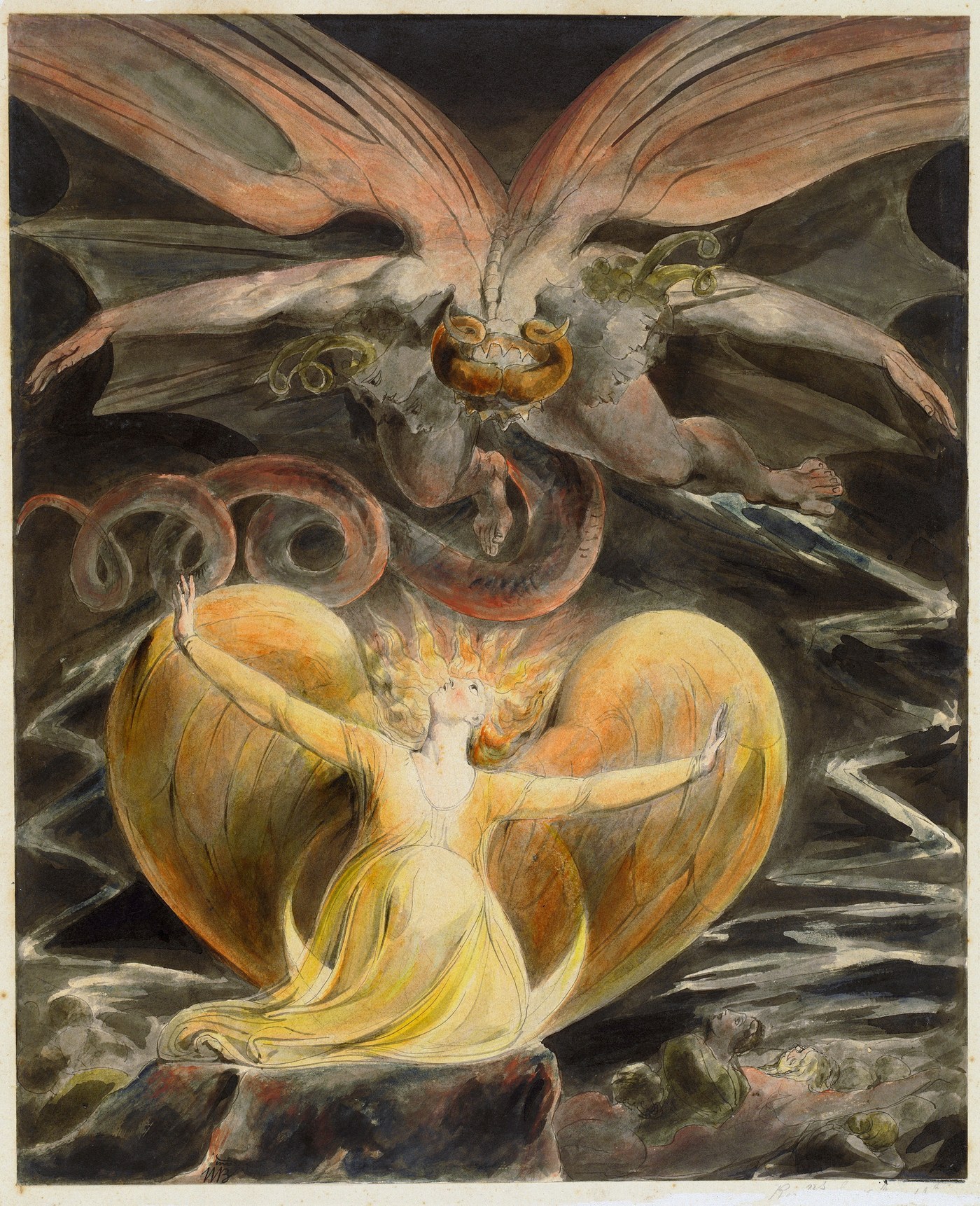
The Great Red Dragon is the name of a group of watercolours that William Blake painted between 1803 and 1805, and they remain among the most frightening images the age of Romanticism produced. Blake took a passage from the Book of Revelation and turned prophecy into a picture, giving the reader of scripture a monster with a body, a posture, and a will. This is the story of what those watercolours show, how Blake built their terror out of colour and pose, and why a private commission of Bible illustrations became one of the strangest achievements in British art.
Blake was born in 1757 and died in 1827, and he claimed to have seen visions from the age of four. He read the Bible as a living text rather than a settled one, and when he came to the twelfth chapter of Revelation he found a scene made for him. The result is a set of four dragon subjects that treat evil not as an idea but as a presence looming at the top of the sheet.
Available as a fine print: The Great Red Dragon
The Vision Blake Read
The source is Revelation, chapter 12, verses 3 and 4. In the King James Bible that Blake knew, the text reads, "And behold a great red dragon, having seven heads and ten horns, and seven crowns upon his heads." The same chapter opens with a woman clothed with the sun, the moon under her feet, and on her head a crown of twelve stars. Blake set the two figures against each other, and the arithmetic of the passage, seven heads, ten horns, seven crowns, twelve stars, became the scaffolding of the design.
In the most famous of the watercolours the dragon fills the upper half of the sheet with its back turned to the viewer, wings spread from edge to edge, its scaled tail coiling down toward the woman below. She kneels in a robe of gold with her arms flung wide and her hair rising like fire. Blake gives the monster the whole sky and leaves the woman a single stone above the water, so the threat is spatial before it is anything else.
The Painter of Visions
To understand the dragon it helps to understand the man who saw it. Blake trained as an engraver, a trade he entered as a boy of fourteen when he was apprenticed in 1772, and he spent his working life reproducing the designs of other artists to earn a living while pouring his own imagination into poetry and prints that few would buy. He wrote and illustrated his own prophetic books, inventing a private mythology of gods and giants, and he insisted the images came to him whole. He described conversing with angels and with the dead, and he treated these encounters as reporting rather than invention.
That conviction is the engine of the dragon watercolours. Blake did not approach Revelation as a difficult text to be decoded. He approached it as a scene he had already witnessed and only needed to record. The monsters are drawn with the same matter of fact clarity another artist would bring to a portrait sitter, and that steadiness is part of why they disturb. Nothing in the handling suggests the painter thought he was imagining.
A Commission of More Than a Hundred Watercolours
The dragon sheets were part of a much larger project. Between roughly 1805 and 1810 Blake produced over 100 watercolour illustrations of the Bible for Thomas Butts, a government clerk who became his most loyal patron and bought steadily when almost no one else would. Butts gave Blake something rarer than money, which was a reason to keep working through years of public neglect.
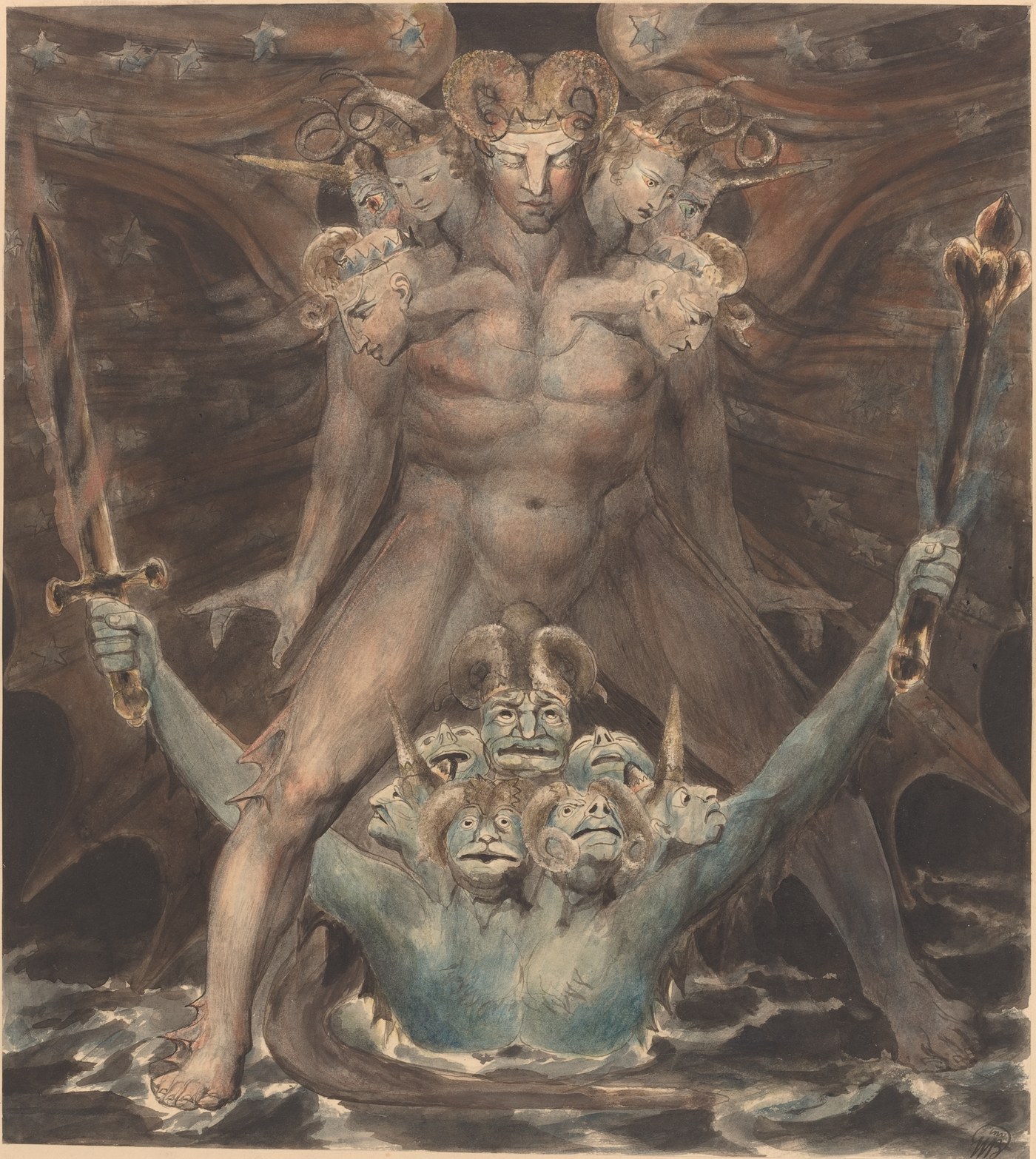
Within that series Blake returned to the dragon four separate times. One treatment of the woman clothed with the sun is held in a Brooklyn collection, and a second in a Washington collection. A third subject, the great red dragon standing over the beast that rises from the sea, is also in Washington. The fourth, known as The Number of the Beast is 666 and dated 1805, is kept in a Philadelphia collection. Together they form a small apocalypse in watercolour.
How Blake Built the Terror
Blake was not painting a story so much as a pressure. The terror of the dragon sheets comes from three decisions that repeat across the group. The first is scale. The monster is always larger than the frame can hold, so the eye reads it as unbounded, a body that continues past the paper. The second is the turned back. In the most celebrated version the dragon faces away, which denies the viewer a face to fix on and makes the creature feel busy with a purpose of its own. The third is colour. Blake reserves his warm reds and golds for the dragon and the woman and drowns everything else in a bruised grey and black, so that good and evil share the same fire while the world around them goes cold.
He worked in ink and watercolour over a firm outline, a method he trusted more than oil. The line does the drawing and the wash does the mood, and the muscles of the dragon are built from careful contour rather than shadow. This is why the figures read as sculpted and weightless at once. They have the definition of carved stone and the drift of a dream.
Look closely at the base of the most famous sheet and small human figures struggle in the dark water below the woman, easy to miss under the blaze of the two central forms. Blake often hid a second register of meaning at the edges of a design, and here the drowning bodies remind the viewer that the cosmic struggle overhead has a human cost underneath. The terror is not only the size of the dragon. It is the smallness of everyone who is not the dragon.
The Number of the Beast
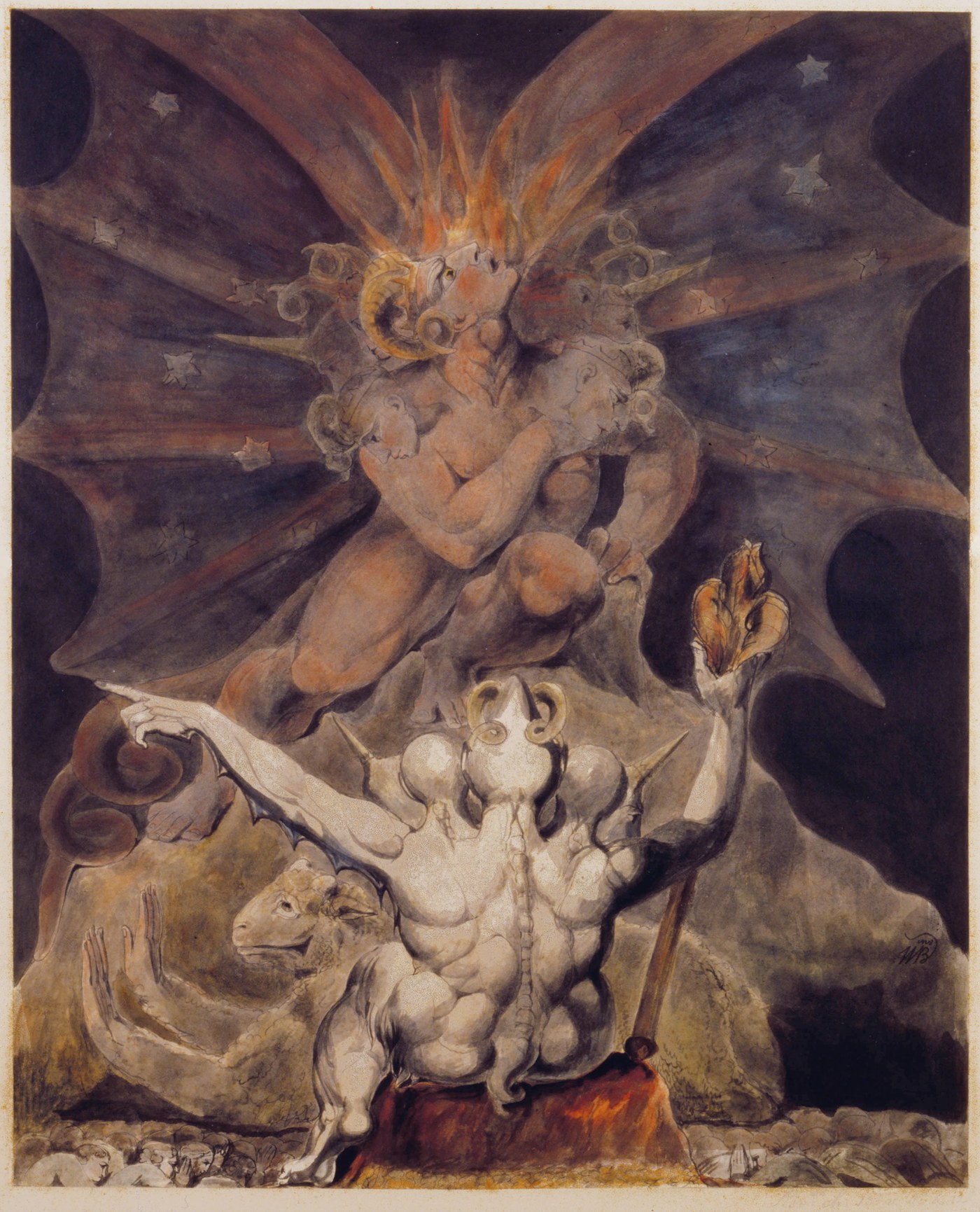
The most compressed of the four is The Number of the Beast is 666. Here Blake stacks his monsters vertically. A winged dragon with human limbs hovers above, and beneath it crouches the two horned beast that rises from the earth, its body pale and swollen, its arms thrown out to command the small crowd of worshippers at the foot of the sheet. Blake writes the number into the design rather than adding it as a label, so the famous cipher of Revelation becomes part of the anatomy of the scene.
Available as a fine print: The Number of the Beast is 666
Artist, Genius, Mystic, or Madman
Blake was not understood in his lifetime. The diarist Henry Crabb Robinson met him near the end and set the confusion down plainly. In his diary entry for 10 December 1825 Robinson wrote of Blake, "Shall I call him Artist or Genius or Mystic or Madman? Probably he is all." It is a fair summary of how the age received him, as a man whose visions were either revelation or illness and possibly both.
Recognition came long after his death in 1827. The dragon watercolours in particular have kept a strange afterlife. The novelist Thomas Harris borrowed the great red dragon for his 1981 thriller of the same name, in which a killer becomes obsessed with the image, and a 2002 film carried the painting to a mass audience that had never opened Blake. Two centuries on, the monster Blake drew from a page of scripture is still doing exactly what he built it to do, which is to frighten.
Frequently Asked Questions
What is The Great Red Dragon by William Blake?
It is a group of four watercolours Blake painted between about 1803 and 1805, illustrating the dragon of Revelation chapter 12. The best known shows the dragon towering over a woman clothed with the sun. Blake made them as part of a larger set of over 100 Bible illustrations for his patron Thomas Butts.
Which Bible passage does the painting illustrate?
Revelation, chapter 12, verses 3 and 4, which describes a great red dragon with seven heads, ten horns, and seven crowns. The same chapter opens with the woman clothed with the sun and crowned with twelve stars, and Blake set the two figures together in the design.
How many Great Red Dragon paintings did Blake make?
Four separate subjects. Two treat the woman clothed with the sun, one shows the dragon with the beast from the sea, and the fourth is titled The Number of the Beast is 666. All date to about 1805.
Where are the watercolours kept today?
They are divided among American collections. One woman clothed with the sun is in a Brooklyn collection, a second version and the beast from the sea are in a Washington collection, and The Number of the Beast is 666 is held in a Philadelphia collection.


Comments