Library Wall Art: Six Paintings That Belong on the Wall Beside a Bookshelf
Updated: Sep 9
A reading-room wall needs paintings that hold attention without competing with the book in the reader's hand. The six paintings below — drawn from Dutch seventeenth-century interior painting, French Impressionist portraiture, and the quieter end of Danish nineteenth-century modernism — share three qualities. Each has a single legible focal point that registers in the peripheral vision and rewards a second look. Each carries a controlled palette (no saturated primaries, no high-contrast graphic shapes) that survives the warm tungsten lamp-light most reading rooms use after dark. Each carries subject matter — a quiet figure, a domestic ritual, a still life with old books and a metal cup — that does not insist on being looked at but quietly thanks the reader for the eventual attention. Print sizes of approximately 50 × 70 cm or 60 × 90 cm fit standard shelving wall proportions; framed in dark walnut, black-stained ash, or unstained oak depending on the room's existing wood.
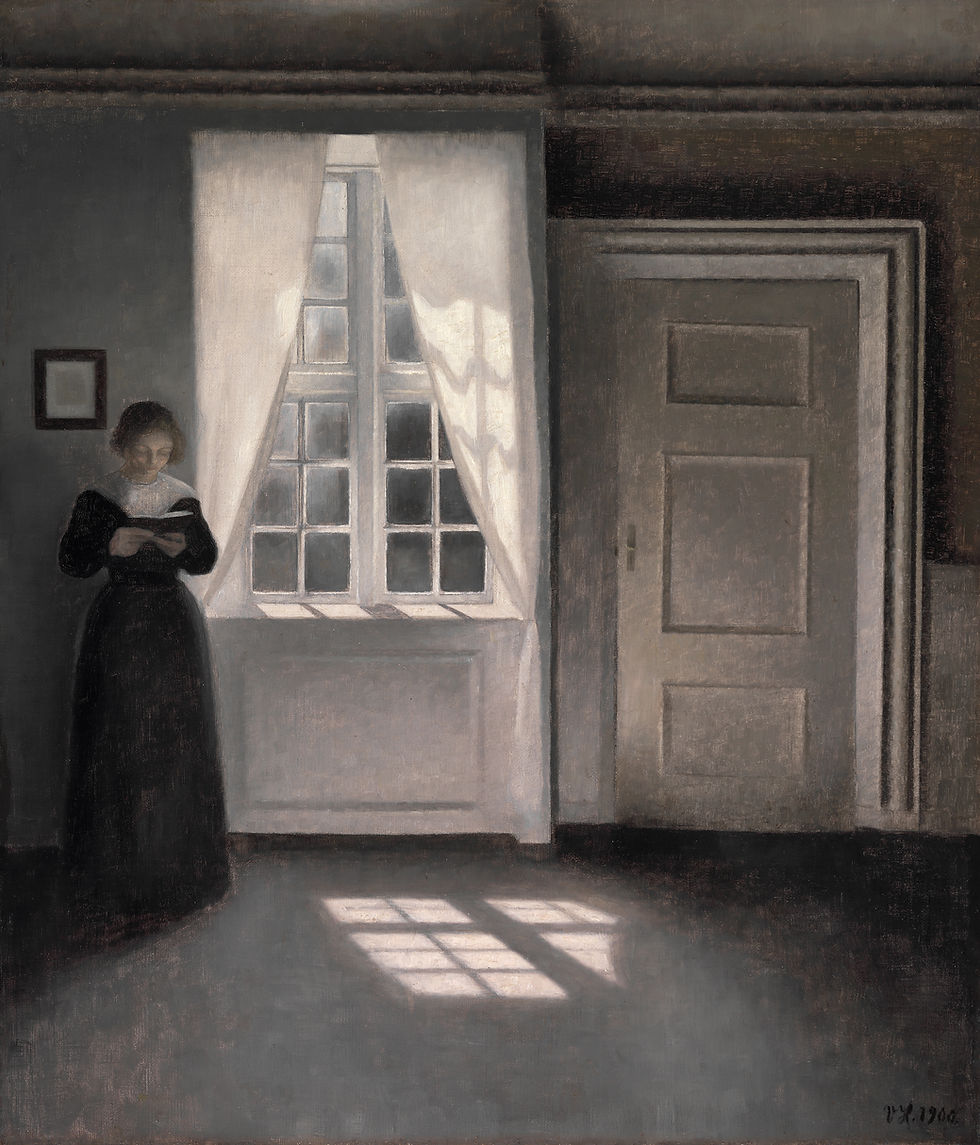
1. Hammershøi, Interior, Strandgade 30 (1900) — the quietest possible painting
Vilhelm Hammershøi (1864-1916) painted approximately sixty interiors of his Copenhagen apartment at Strandgade 30 between 1898 and 1909. The 1900 canvas is the cleanest single statement of the project: a back-turned female figure (Hammershøi's wife Ida) walking through an empty room toward an open doorway, the room cool grey and dove white with a single splash of yellow afternoon sun on the wooden floor. The painting's subject is not the figure or the doorway; the subject is the room itself, understood as a psychological environment. Mounted above a reading chair at eye-level — approximately one hundred and fifty centimetres from floor to centre of the canvas — framed in unstained European oak (the wood Hammershøi himself used in his Copenhagen frames), the painting reads as a window to a second room: a quiet, sunlit, slightly cooler version of the one the reader is sitting in.
2. Renoir, Young Girl Reading (c. 1890s) — the painting about reading itself
Pierre-Auguste Renoir (1841-1919) painted approximately seventeen separate canvases of women and girls reading between 1874 and 1898. The 60 × 47 cm version that survives in a US collection is the most-reproduced — a single figure in profile, head tilted slightly down to the page, the warm pink-and-cream palette typical of Renoir's late-1880s Aix-en-Provence period. The painting belongs on the wall directly behind a reader because it is a painting about reading itself: the figure's absorbed attention to the page mirrors the reader's own posture, and the painting therefore acts as a kind of compositional rhyme between the room and its subject. The recommended print size is 60 × 90 cm; the recommended frame is a slim dark-walnut or matte-black moulding that does not compete with the painting's own internal warmth. Hung on a shelving wall, the painting reads as a small window into a parallel reading session that has been quietly underway for over a century.

3. Cassatt, Tea, c. 1890 — the domestic ritual at conversational distance
Mary Cassatt's (1844-1926) Washington Tea is the second of her three returns to the afternoon-tea subject across the decade 1880-91. Two women in pale cream and dove grey are seated side-by-side at a low table with the silver tea-service; the viewer is positioned at approximately conversational distance — perhaps three feet from the corner of the table — close enough to share the visit but not to participate in it. The painting fits the reading-room wall because it operates at exactly the same emotional register as a quiet evening of reading: a private moment observed without interruption, an unselfconscious domestic interior that does not need narrative resolution. Print at 60 × 90 cm, framed in black-stained ash or dark walnut; mount above a low side-table or the back of a reading chair so the eye-line approximately matches the painting's own viewer-position. The Cassatt and the Hammershøi work especially well together when hung as a pair on opposing walls — the same domestic-interior subject in two different national traditions twenty years apart.

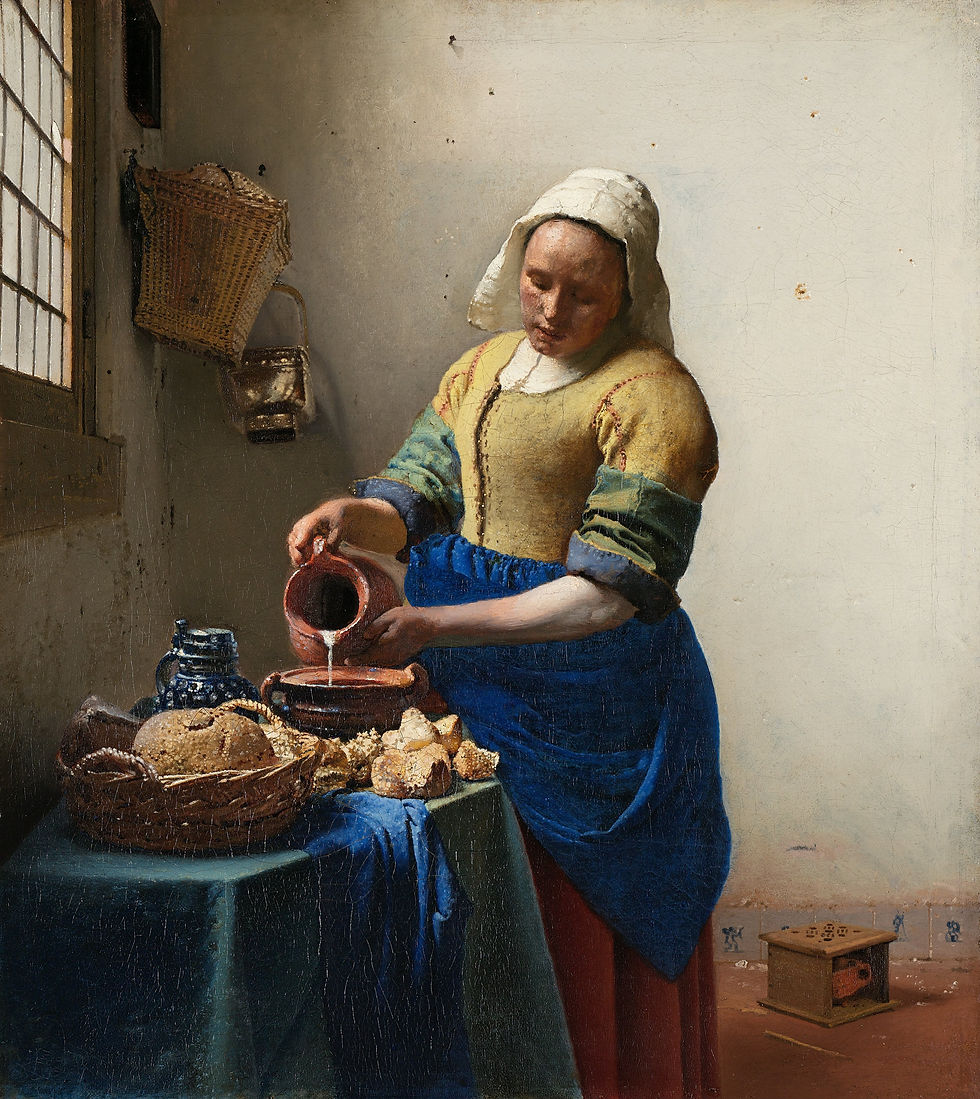
4. Vermeer, The Milkmaid (c. 1660) — the room reduced to its essentials
Johannes Vermeer's (1632-1675) Milkmaid is approximately 45.5 × 41 cm — small for a famous painting, the size of a standard reading-room single canvas. The painting shows a single female servant pouring milk from a brown earthenware jug into a low ceramic bowl, the morning sun coming through a leaded window from the upper left and producing the famous Vermeer light on the milk-stream's white arc. The painting belongs in a reading room for the same reason most Vermeers belong there: the composition has been reduced to its absolute essentials, the palette is controlled (warm ochres + white + the cool grey-blue of the wall), and the room is silent. The painting therefore does not interrupt reading; it deepens it. Print at 50 × 70 cm, framed in black-stained European oak with a wide flat profile (the heavy frame anchors the small canvas to a large library wall). The Milkmaid and a single Dutch still life make the cleanest possible two-painting library wall.
5. Rembrandt, Self-Portrait (late period) — the face of forty years of looking
Rembrandt van Rijn (1606-1669) produced approximately eighty self-portraits across his working life — the largest extended series of self-portraits in the history of Western painting. The late self-portraits (1659-1669) are the canonical reading-room paintings of the group: a single weathered face emerging from a near-black background, the brushwork loose and visible in the impasto highlights of the forehead and the bridge of the nose, the eyes steady and intelligent and tired. A late Rembrandt self-portrait on a library wall does what no other portrait in Western painting can do: it gives the reader a working companion who has spent forty years looking carefully at things. The face becomes a kind of room-mate. Print at 50 × 70 cm or 60 × 90 cm depending on wall scale; framed in dark walnut with a narrow inner gilt liner (the small gilt edge picks up the painting's own highlight tones without making the framing baroque). Mount the painting at eye-level when standing, not when seated, so the reader looks up to the face rather than across to it.

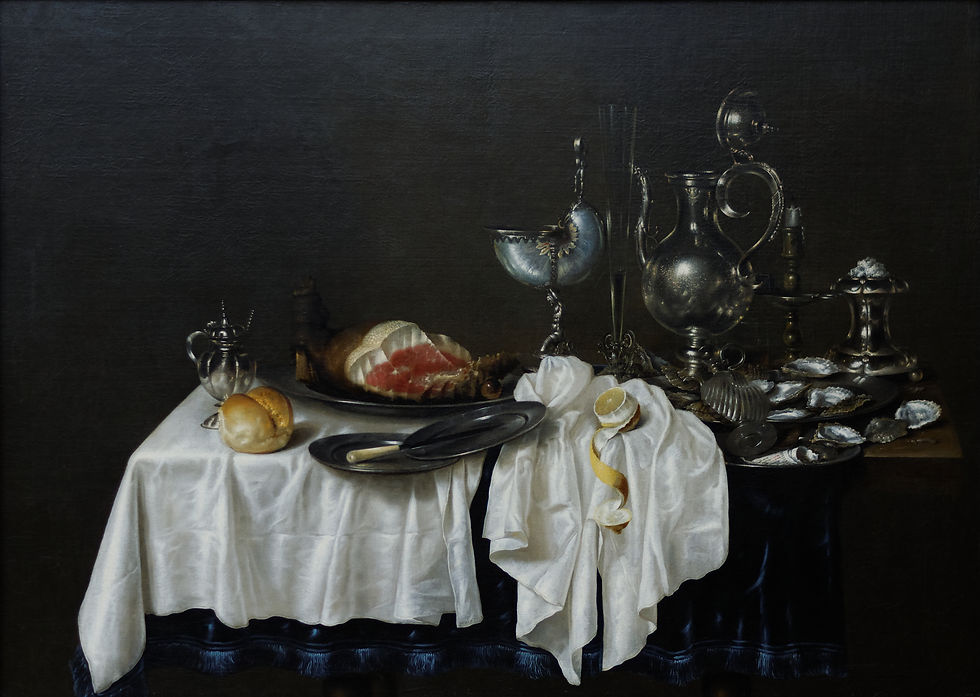
6. Heda, Still Life with Nautilus Cup (c. 1640) — the bookless still life that belongs with books
Willem Claesz Heda (1594-1680) was the leading Dutch monochromatic still-life painter of the seventeenth century — the wall-friendly counterpart to the more dramatic vanitas painters (Pieter Claesz, Jan Davidsz de Heem). His Nautilus Cup canvas of c. 1640 shows a half-eaten meal on a corner of a polished wooden table: an overturned silver tazza, a lemon with its peel coiled in the Northern European still-life convention, a green-glass römer wine glass, a polished pewter plate, the nautilus-shell cup of the title. The palette is the canonical Heda warm-monochrome — ivory + pewter-grey + ochre + the single bright lemon-yellow accent — and the painting reads as the still-life version of a library wall's argument: precise observation of a small number of beautiful objects, lit from one side, registered carefully. The painting is bookless but belongs entirely with books. Print at 60 × 90 cm, framed in dark walnut or black-stained ash; mount horizontally above a low shelving unit or a reading-chair side-table.
How to hang them together
Six paintings is two too many for most single library walls. The recommended combinations are: (a) Hammershøi alone on the long wall above the reading chair, the other five distributed across narrow vertical spaces between bookshelves at the room's perimeter; (b) Cassatt and Vermeer hung as a pair at fifteen-centimetre spacing on a single wall, the rest reserved for an adjacent space; (c) Rembrandt and Heda as a pair on a single wall, the remaining four held in storage and rotated seasonally. The general principle: leave at least sixty centimetres of empty wall around each painting so the eye has somewhere to rest. A reading-room wall over-hung with paintings makes the reader work too hard. The single most-important framing rule: pick ONE frame material (dark walnut, black-stained ash, or unstained oak) and use it for every painting on the wall — visual coherence between frames matters more than perfect fit to each individual painting.
Key takeaways
A library / reading-room wall needs paintings with (1) a single legible focal point that registers in peripheral vision, (2) a controlled palette that survives warm tungsten lamp-light, (3) subject matter that rewards a second look but does not demand the first.
The six paintings: Hammershøi Interior Strandgade 30 (1900), Renoir Young Girl Reading (c.1890s), Cassatt Tea (c.1890), Vermeer The Milkmaid (c.1660), Rembrandt late Self-Portrait (1659-69), Heda Still Life with Nautilus Cup (c.1640).
Recommended print sizes: 50 × 70 cm for single Vermeer-scale subjects, 60 × 90 cm for the larger figural canvases. Standard library-wall mounting height: ~150 cm from floor to centre of canvas for seated viewing; ~160 cm for standing-eye-level when mounting a face-forward portrait (Rembrandt).
Frame materials: dark walnut, black-stained ash, or unstained European oak — pick ONE for the whole room. Avoid white or gilt-only frames (compete with book-spines), avoid floating Plexi mounts (read as gallery rather than home).
Strongest two-painting pairings: Hammershøi + Cassatt (domestic interiors, twenty years apart, two national traditions); Vermeer + Heda (Dutch seventeenth-century, single small canvas + larger horizontal still life); Rembrandt + Heda (late painters of their generations, single face + single arrangement of objects).
Hanging principle: leave at least 60 cm of empty wall around each painting. An over-hung library wall reads as a gallery rather than a reading room and makes the eye work too hard to recover after looking up from the page.
Browse the full archive of fine prints at zocineartdesign.etsy.com.
Comments