The Light Academia Bedside Stack: Six Calm Paintings for the Reader of Rilke, Borges, Calvino, and Late Tolkien
Updated: Aug 29
Light Academia is the warmer half of the TikTok academic aesthetic — Rilke's Letters to a Young Poet on the bedside table, Borges's Labyrinths, Italo Calvino's Invisible Cities, late J. R. R. Tolkien's collected letters and On Fairy-Stories, the canon read for elegance and patient attention rather than for the Gothic-confrontation of the Dark Academia shelf. The six paintings below are chosen as wall-art for the Light Academia bedside register. The bedroom-reading shelf is shorter than the home-library shelf and the bedside reading-light is lower than the desk reading-light; the paintings on this wall need to operate at the same low-volume, high-attention level as the books on the table below them. The selection here is dominated by Vermeer (the strongest single bedside-painter in Western art), Hammershøi (Vermeer's Danish twentieth-century descendant), and three carefully-chosen Pre-Raphaelite-adjacent quiet pictures. Every painting in this series reads at distance as calm decoration and rewards close-looking with the specific attention the reader is using on the book in her hands.

1. Vermeer, The Geographer (1669) → Borges, Labyrinths + Calvino, Invisible Cities
Vermeer's Geographer is the wall painting for the Borges-and-Calvino reader. A solitary man in a teal-coloured house-coat stands at his sun-lit window-side table, dividers in his right hand, a rolled chart on the table, a globe behind on the cabinet. The painting reads as the canonical Light Academia bedside register — the man is alone with the chart, the chart maps something specific (probably the Strait of Magellan or the East Indies), the morning light fills the room at the exact temperature the bedside-reader's lamp wants to fill her own room. Borges's Labyrinths and Calvino's Invisible Cities operate in the same register — both books are about a single male attention mapping an impossible territory from a small quiet room. Print at 50 × 60 cm vertical, frame in unstained European oak, mount above the bedside table or above the small writing-desk in the bedroom. The Vermeer is the strongest single bedside painting in Western art history — every other painting in this series is downstream of it.
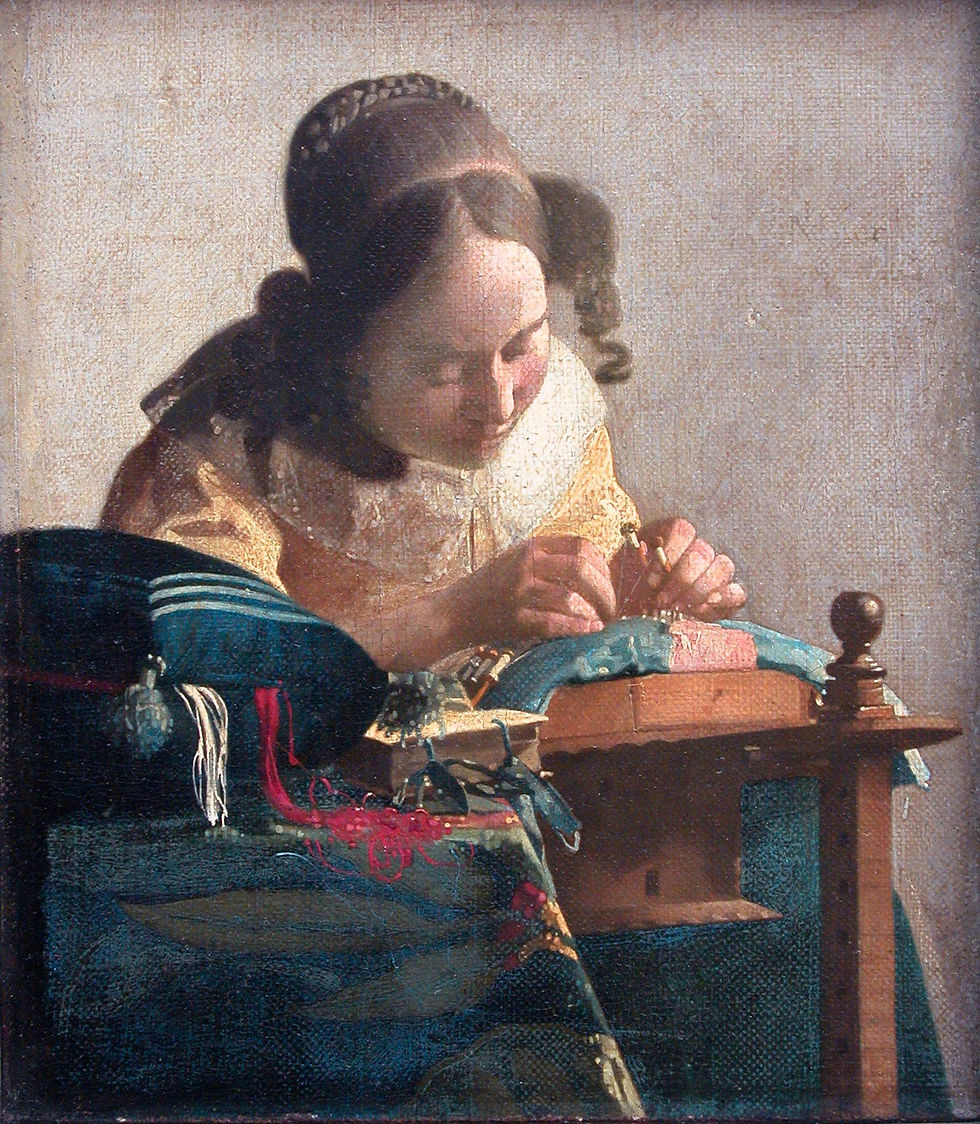
2. Vermeer, The Lacemaker (c. 1669-71) → late Calvino's narrative restraint
Vermeer's Lacemaker is the wall painting for the Calvino reader at the late-Calvino end of the shelf (If on a winter's night a traveller, Mr Palomar, Six Memos for the Next Millennium). The 24 × 21 cm canvas — Vermeer's smallest surviving painting — depicts a young woman bent in close concentration over her lace-pillow, fingers crossed in the act of binding two threads. The painting is the strongest Western statement of the high-concentration small-craft attention. Calvino's late essays argue for that exact attention as the writer's discipline — "lightness, quickness, exactitude, visibility, multiplicity, consistency" are Calvino's six memos and all six describe what the Vermeer lacemaker is doing with her hands. Print at 40 × 50 cm vertical (the small original allows a smaller print without aesthetic loss), frame in slim unstained European oak, mount above the bedside table at close-reading distance — the painting wants to be seen from within 1.5 metres. The Vermeer Lacemaker is the most quietly demanding painting in this series.
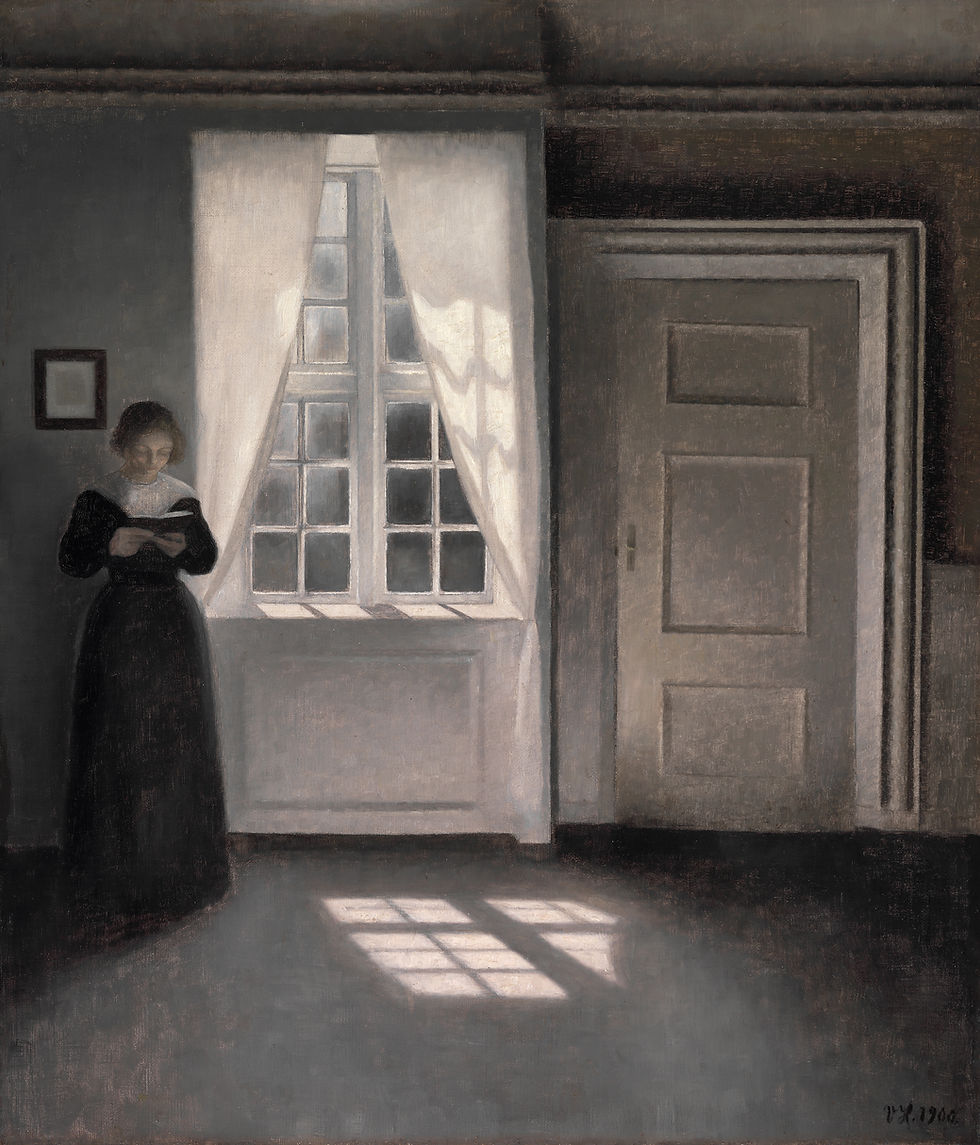
3. Hammershøi, Interior, Strandgade 30 (1900) → Rilke, Letters to a Young Poet
Hammershøi's Strandgade 30 interior is the wall painting for the Rilke reader. A single woman in a high-collared dark dress is seen from behind, standing at a door in a quiet Copenhagen apartment interior, surrounded by cool grey light, an empty parquet floor, an empty table, a closed second door. The painting is the strongest Northern-European visual statement of the Rilkean discipline of solitude — Rilke's Letters to a Young Poet argues that the young writer must be willing to be alone in the room with herself for long stretches of time, and that the loneliness is the work rather than the obstacle to the work. Hammershøi's painting and Rilke's letters are simultaneous statements of the same position from different countries (Denmark, Austria-Bohemia) in the same Northern-European 1900-decade. Print at 60 × 75 cm vertical, frame in unstained European oak, mount above the bedside table on the wall the bedside-reader looks at when she pauses between pages. The Hammershøi is the calmest wall companion for the Rilke bedside-reader.
4. Friedrich, Wanderer above the Sea of Fog (1818) → late Tolkien, Letters + On Fairy-Stories
Friedrich's Wanderer is the wall painting for the Tolkien reader at the late-Tolkien end of the shelf — the collected Letters, On Fairy-Stories, the marginalia and the maps. A single dark-coated male figure stands from behind on a rocky outcrop gazing across a sea of fog at the indistinct landscape beyond. The painting reads as the canonical Romantic image of the masculine interior facing the long landscape — and the Tolkien reader who has read the Letters knows that Tolkien's late position was exactly that: the elderly Oxford philologist on the small Oxford hill of his back garden, looking out across the imagined Shire-and-beyond he had spent his life mapping. Both works share a thesis: the long view is built out of patient walking. Print at 60 × 75 cm vertical, frame in unstained European oak, mount above the small writing-desk in the bedroom or above the bedside table on the wall facing the window. The Friedrich is the gift for the Tolkien reader whose secondary-world reading is finished and who is now reading the Letters for the man rather than for the mythology.

5. Cassatt, Tea (c. 1890) → the conversational-quiet Borges or Calvino re-read
Cassatt's Tea is the wall painting for the reader who returns to the Light Academia canon in conversation with a partner or a close friend — the bedroom or small living-room where two readers compare the Borges story they have both just finished. Two women in pale cream and dove grey sit side-by-side at a low table with a silver tea-service. The viewer is positioned at conversational distance. The painting is the visual statement of the specific Light Academia register of two readers comparing notes on a shared text — the conversation is not about the text exactly, the conversation orbits the text, the silver tea-service holds the room steady while the orbit happens. Print at 60 × 80 cm horizontal, frame in slim black-stained European ash, mount in the small bedroom-sitting-area or above the dressing-table that the room uses for evening conversation. The Cassatt is the warm-conversational wall in a series that is otherwise dominated by solitary-reading paintings.

6. Cézanne, Mont Sainte-Victoire (c. 1904) → the patient-returning bedside re-reader
Cézanne's late Mont Sainte-Victoire is the wall painting for the bedside-reader who returns to the same books year after year. Cézanne painted the limestone mountain east of his Provence studio more than sixty times between 1882 and his death in 1906; the late versions dissolve the mountain into structured colour-patches of ochre, sage-green, and lavender-violet. The painting is the strongest Western statement of patient-returning as a discipline — the same subject viewed from the same angle with the same paint, the small re-attention that finds new things each time. The Light Academia bedside-reader who keeps Letters to a Young Poet or Invisible Cities on the bedside table for two decades is doing the same thing in prose. Print at 60 × 80 cm horizontal, frame in slim unstained European oak, mount above the bedside table or above the small bedroom-armchair. The Cézanne is the painting that gets quieter and better the longer it is in the room.

How to mount the Light Academia bedside wall
Three rules govern the Light Academia bedside wall. First: HEIGHT IS LOWER THAN LIVING-ROOM. The bedside painting is viewed from a seated or supine reading-position; the centre of the canvas should sit at approximately 130-140 cm from the floor (lower than the 145-150 cm living-room default). Second: SMALLER FRAMES, CLOSER LOOKING. The bedside register is intimate — the prints in this series are 40-75 cm rather than 80-130 cm. The painting is being looked at from 1-1.5 m rather than from 3 m; smaller works at closer distance read more precisely. Third: WARM LAMPLIGHT, NEVER OVERHEAD. The bedside register is read in the bedside-lamp's 2700-3000K warm-white light only; overhead bedroom-light is wrong for this room. The painting should be lit by the same warm lamp the book is being read by — the bookshelf, the lamp, and the painting all agree on one warm-evening temperature.
Key takeaways
Light Academia is the warmer half of the TikTok academic aesthetic — Rilke, Borges, Calvino, late Tolkien, the canon read for elegance and patient attention rather than for the Gothic-confrontation of the Dark Academia shelf.
Six bedside-painting pairings: Borges + Calvino early → Vermeer Geographer. Late Calvino narrative restraint → Vermeer Lacemaker. Rilke Letters → Hammershøi Strandgade. Late Tolkien Letters + Fairy-Stories → Friedrich Wanderer. Conversational Light Academia re-read → Cassatt Tea. Patient-returning re-reader → Cézanne Mont Sainte-Victoire.
Three room rules: (1) LOWER HEIGHT — centre of canvas at 130-140 cm from the floor, viewed from a seated or supine reading-position. (2) SMALLER FRAMES, CLOSER LOOKING — 40-75 cm prints rather than 80-130 cm, viewed from 1-1.5 m. (3) BEDSIDE LAMP ONLY — 2700-3000K warm-white from the same lamp reading the book; never overhead bedroom-light.
Frame guidance: unstained European oak as the dominant default (matches the painting's quiet register). Slim black-stained ash for the Cassatt only (the painting's silver tea-service wants a darker frame). Dark walnut is wrong for this room — the heavy frame belongs to the Dark Academia library wall, not to the Light Academia bedside.
Print sizes by pairing: Vermeer Geographer 50 × 60. Vermeer Lacemaker 40 × 50 (the small original allows a smaller print). Hammershøi Strandgade 60 × 75. Friedrich Wanderer 60 × 75. Cassatt Tea 60 × 80 horizontal. Cézanne Mont Sainte-Victoire 60 × 80 horizontal.
Light Academia builds the bedroom around quiet attention. Every painting in this series rewards the bedside-reader who returns to the same books and the same wall year after year — the room gets calmer and better with time, the way a well-loved book does.
Browse fine prints for the Light Academia bedside wall in the archive at zocineartdesign.etsy.com.
New in the Journal: Why Scandinavian Paintings Glow: Nordic Light Explained in Six Masterpieces

Comments