Rembrandt's Self-Portraits: Forty Years of a Painter Watching Himself Grow Old
Rembrandt van Rijn — born in Leiden in 1606, died in Amsterdam in 1669 — painted, drew, and etched roughly eighty self-portraits across his forty-year working life. The exact number depends on how strictly the count is made: about forty oil paintings, roughly thirty-one etchings, and perhaps seven drawings survive that are securely attributable, with another twenty or thirty contested works depending on the scholar. By any count this is far more than any major European painter before him had attempted of themselves, and almost certainly more than any major painter since. The sequence is not a coincidence and not a vanity. Rembrandt returned to his own face roughly twice a year, every year, for four decades — through his early Leiden experiments, through the rich Amsterdam years of public commissions, through his bankruptcy and the death of his wife and the death of his son and the loss of his house, and into the last unflinching paintings of his final months. The self-portrait sequence is the most sustained autobiographical project in the history of European painting.

1628: the twenty-two-year-old etcher and the shadow
Rembrandt's earliest surviving self-portraits date from 1628, the year he turned twenty-two. He had just completed his apprenticeship under the history-painter Pieter Lastman in Amsterdam and was setting up an independent studio back in his home town of Leiden, sharing the space with his friend and slightly older colleague Jan Lievens. The Leiden self-portraits of 1628-31 — there are about a dozen of them across painting, etching, and drawing — are essentially studio experiments. Rembrandt is using his own face as the cheapest available model: a head he could move, light, and pose at will, without paying anyone, while he worked out the optical and tonal problems that would preoccupy his entire career.

The most striking of the 1628 panels — a small piece on oak, twenty-two by eighteen centimetres — is essentially a shadow study. The painter's face is half-thrown into deep darkness by a strong oblique light source from the upper left, the eye on the lit side picked out in detail and the eye on the shadowed side almost invisible. The fluffy curly hair is built up with rapid wet-on-wet brushwork, and Rembrandt has scratched into the wet paint with the wooden end of his brush handle to draw individual strands of hair back through the pigment — a technique he used throughout his life and that he was probably inventing at this exact moment. The picture is not flattering. It is not designed to attract a patron. It is the work of a young painter using his own face to learn how to paint shadow.
1640: the success-portrait at age thirty-four
Twelve years later, in 1640, Rembrandt painted a fundamentally different kind of self-portrait. He was thirty-four. He had moved permanently to Amsterdam in 1631 and had become, by the late 1630s, the most expensive portrait painter in the Dutch Republic. He had married the patrician Saskia van Uylenburgh in 1634; they had lost three infant children but were expecting a fourth (Titus, born 1641, the only one of their children to survive infancy). He had bought a large house in the prosperous Sint-Antoniesbreestraat — the same purchase that would, twenty years later, ruin him. He had been commissioned for a series of major Passion scenes by Prince Frederik Hendrik of Orange. He was at the unambiguous peak of his early career.
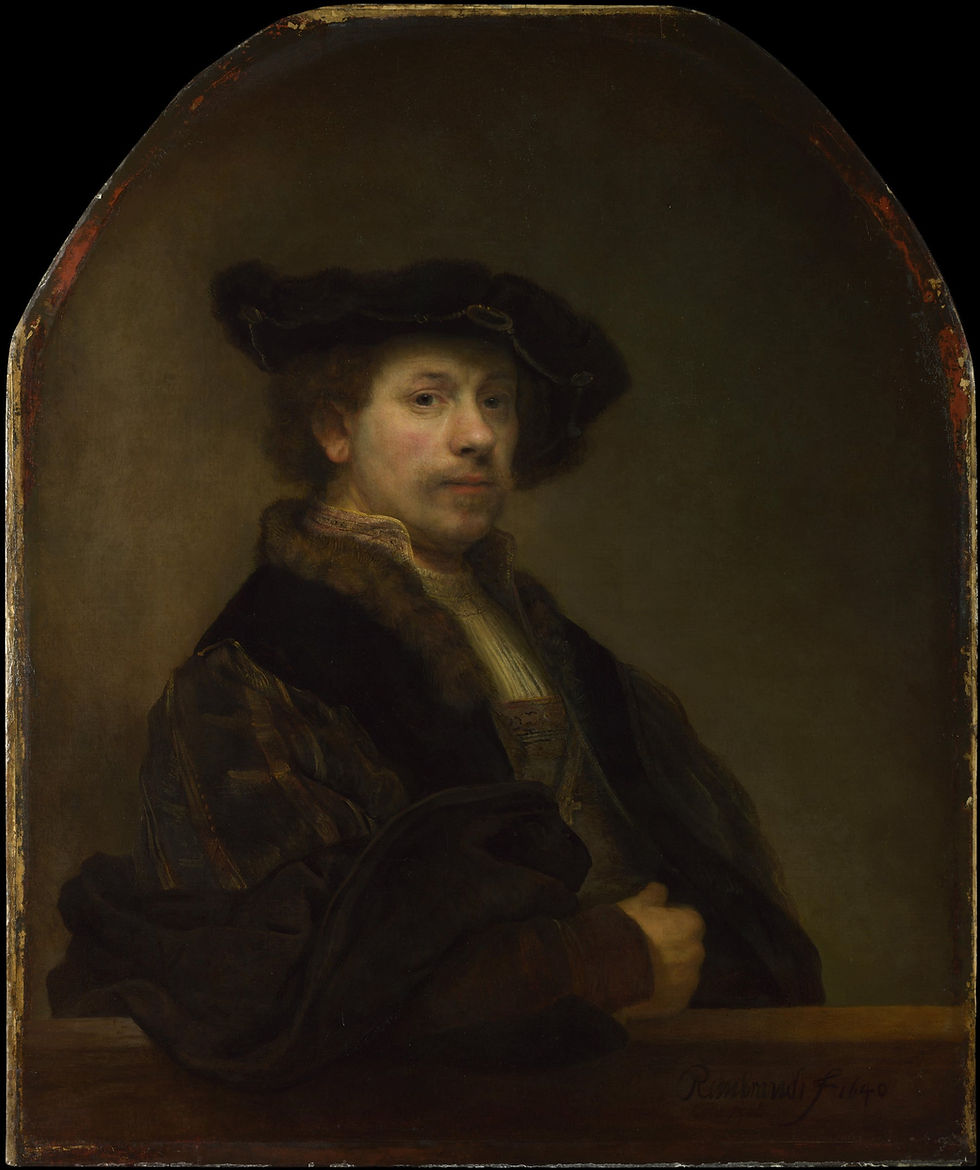
The 1640 picture is built on a direct compositional quotation. The pose — the body in three-quarter view turned to the viewer, the left arm resting along a ledge at the bottom of the canvas, the elaborate sleeve and dark cloak with a beret — is lifted almost identically from Titian's Portrait of a Man (c. 1510, the so-called "Ariosto" portrait, then in an English private collection) and Raphael's Portrait of Baldassare Castiglione (c. 1515, then in a French collection). Rembrandt had seen Lucas Vorsterman's etched copy of the Raphael at an Amsterdam auction in 1639 and made his own drawing of it; the 1640 self-portrait is a deliberate, visible quotation of the two most famous Italian Renaissance portraits he could cite. The picture says, unmistakably: I am of that European tradition. I belong in that company. It is one of the few openly ambitious public-statement self-portraits in the entire sequence — and it would be followed, in less than fifteen years, by the financial collapse that ended this part of Rembrandt's life forever.
The 1650s collapse: bankruptcy, Hendrickje, Titus
The financial decline began in the late 1640s and accelerated through the 1650s. Saskia died in 1642, the year after Titus's birth, probably from tuberculosis. Rembrandt's romantic life moved through two further partners: first Geertje Dircx, the family's nurse, with whom Rembrandt's relations ended catastrophically in a 1649 lawsuit and Geertje's eventual committal to a workhouse; then Hendrickje Stoffels, his housekeeper from around 1647, with whom he lived in a common-law relationship for the rest of her life (she was formally censured by the Dutch Reformed Church for living with him out of wedlock) and who gave birth to their daughter Cornelia in 1654. The house on the Breestraat — a too-expensive purchase that had required Rembrandt to take on a substantial mortgage — became unmanageable as Rembrandt's portrait commissions declined. By 1656 he was forced to declare a partial form of bankruptcy known as a cessio bonorum; in 1657 and 1658 the house and most of his collection of Italian, Dutch, and antique works of art were sold at auction. He moved to a rented house in the Jordaan district, where he lived for the rest of his life.

The self-portraits of the 1650s and 1660s register all of this. They are markedly different from the 1640 success picture. The clothing becomes plainer: a dark working robe rather than the elaborate cloak and beret of the Italianate self-presentation. The pose flattens out: the body is shown frontally, the head turned only slightly, no architectural elements, no ledge, no theatrical lighting. The face becomes the entire subject. The skin is heavier than in 1640, the cheeks more sunken, the hairline receded, the lines around the eyes and mouth deeper. The paint handling becomes thicker, more textural, more openly worked — the brushstrokes are visible as brushstrokes, not concealed in smooth modelling, and the texture of the face is built up with what Rembrandt's contemporaries called his rauwe (rough) manner, which had become a stylistic signature by the 1650s and was, by the 1660s, the way the entire Amsterdam art market identified a late Rembrandt at a glance.
Self-Portrait with Two Circles: the late masterpiece
The Self-Portrait with Two Circles — painted at some point in the last four or five years of Rembrandt's life, the dating disputed between 1665 and 1669 — is the largest of all the late self-portraits and is usually identified as the high point of the sequence. The picture shows Rembrandt at full half-length, standing in three-quarter view at the left of the canvas, holding his palette and a sheaf of brushes in his left hand. He is wearing the brown working-painter's robe and a high white turban-like cap that had become his standard studio costume. Behind him, against a flat earth-brown wall, two faint geometric circles are inscribed at upper right and centre — partial, unfinished, drawn or scratched into the wall surface rather than printed on it.
The two circles have been the picture's central iconographic puzzle for three hundred years. The most persistent reading connects them to the late-medieval anecdote of Giotto, recorded in Vasari, who demonstrated his skill to a papal messenger by drawing a perfect freehand circle on a sheet of paper; the circle in this reading is the symbol of the painter's perfect technical mastery, signed silently on the studio wall. Other readings connect the circles to Renaissance painting theory, to alchemy, to cabbalistic geometry, to cosmological diagrams, or to the simple practical fact that two large circles drawn on a studio wall were a standard sixteenth-century painters'-workshop accessory used for testing the accuracy of new pigments. What is not in dispute is that they signify something — they are a deliberate iconographic device that Rembrandt has placed behind himself in the picture's most monumental self-statement. The picture is Rembrandt's late, quiet, unconcealed claim to belong to the highest line of European painters.
Self-Portrait as Zeuxis Laughing: the painter who laughed himself to death
In 1662 or 1663 Rembrandt painted one of the strangest of all his self-portraits: a small picture, just under a metre tall, showing himself laughing — broadly, openly, mouth wide, head tilted, the entire face crinkled into amusement. He is shown in three-quarter view at a small easel, palette and brushes in his left hand, in the act of painting a second figure who appears at the lower right of the canvas: an old woman, almost a caricature, with a sharp wrinkled face and a pointed chin. The picture is now identified as Self-Portrait as Zeuxis Laughing, and its iconographic reference is the classical Greek painter Zeuxis of Heraclea, who according to the ancient sources (Festus, Pliny) died of laughter while painting an old woman who had insisted on being depicted as Aphrodite — the disjunction between her face and her ambition was too much, the painter laughed himself into a fatal stroke.

The picture is unique in the self-portrait sequence — Rembrandt almost never shows himself laughing or even smiling in any of the other eighty-odd images. The expression is also painted with extraordinary specificity, the crinkled cheeks and screwed-up eyes and open mouth modelled with the rough late brushwork that had become Rembrandt's signature. What the picture means is contested. The conventional reading is that Rembrandt — old, financially ruined, working in a rented house, increasingly unfashionable in the Amsterdam market — is identifying himself with the comic-pathetic figure of the painter who laughed at his subject and dropped dead in the studio. The picture is sometimes read as a gallows-humour self-acknowledgement; sometimes as a coded reflection on the absurdity of painting itself; sometimes as a moralising memento mori in the disguise of a laugh. The picture sat in a private collection for two and a half centuries before its identification as the Zeuxis subject was made definitive in the 1970s.
1669: the final year
Rembrandt died in Amsterdam on October 4, 1669, a year after the death of his only surviving son Titus (October 1668) and six years after the death of Hendrickje (1663). He was sixty-three. He left three self-portraits painted in the year of his death — one in a London collection (the so-called "Old Man" self-portrait), one in a museum in The Hague, and one in a smaller German collection — all of them painted with the heavy, openly textured late brushwork and all of them showing the painter at the same stage of physical decline: the face is soft, sagging, the eyes deeply set, the hair white at the edges of the cap. The London picture, painted in oil on canvas at roughly eighty-six by seventy centimetres, is conventionally identified as one of the last things Rembrandt painted before his death.

The 1669 picture closes the sequence. The painter is shown in three-quarter view, the same fundamental pose he had been using for forty years, but the face is unmistakably the face of a dying man. There is no flattery, no costume, no Italianate ambition, no laughing identification with a classical predecessor, no Giotto circle behind the head. The picture is just the painter looking at his own face in a mirror, painting what he sees, in the manner he had been refining since he was twenty-two. Across the sequence — from the 1628 shadow-study to the 1640 Italianate success-portrait to the 1659 post-bankruptcy face to the Two Circles monumental statement to the laughing Zeuxis to the 1669 final image — Rembrandt has produced the most complete autobiographical record any European painter has ever left of themselves: forty years of a face, painted with steadily increasing honesty, by a painter who was watching himself age.
Why the sequence matters
Rembrandt's eighty-odd self-portraits are not, taken individually, his greatest single works. The Night Watch (1642), the Jewish Bride (c. 1665-69), the Anatomy Lesson of Doctor Nicolaes Tulp (1632), the Sampling Officials of the Drapers' Guild (1662), and the late religious paintings are by most measures the more important pictures. But the self-portrait sequence, taken as a whole, is a different kind of object — a single forty-year project in which a painter has used his own face as the steady test surface on which to record both his stylistic development and his life. Before Rembrandt, painters had occasionally included themselves in larger works (Dürer's self-portraits from the late fifteenth century are the major precedent), but no one had ever sustained a self-portrait project across an entire working life. After Rembrandt the model was established. Van Gogh's roughly forty self-portraits in the late 1880s, Cézanne's twenty or so, Picasso's continual self-references through the twentieth century, and Lucian Freud's late nudes of himself are all in the Rembrandtian tradition — the self-portrait series as the painter's autobiographical project, made not for the public but for the steady accumulating record itself.

Key takeaways
Rembrandt van Rijn (1606-1669) painted, drew, and etched roughly eighty self-portraits across his forty-year career — about forty oil paintings, thirty-one etchings, and seven drawings — more than any major European painter before him and almost certainly more than any since.
The 1628 Leiden self-portrait, painted when Rembrandt was twenty-two, is a tonal experiment using his own face as the cheapest available model — the work of a young painter learning to paint shadow.
The 1640 Self-Portrait at the Age of 34, painted at the peak of his Amsterdam career, is a direct compositional quotation of Titian's Portrait of a Man and Raphael's Portrait of Baldassare Castiglione. Rembrandt is claiming his place in the European canon by lifting the pose of the two most famous Renaissance portraits he could cite.
The 1650s and 1660s self-portraits register the bankruptcy of 1656, the auction of his house and art collection in 1657-58, and the deaths of Hendrickje (1663) and Titus (1668). The clothing becomes plainer, the pose flattens, the face becomes the entire subject, and the brushwork becomes openly textured — the rauwe (rough) late manner.
The Self-Portrait with Two Circles (c. 1665-69) is the largest and most monumental of the late self-portraits. The two geometric circles inscribed on the wall behind the painter have been read as a reference to Giotto's perfect-circle demonstration, to Renaissance painting theory, or to the practical equipment of a sixteenth-century painter's studio.
The Self-Portrait as Zeuxis Laughing (c. 1662-63) is the only self-portrait in which Rembrandt shows himself laughing. The reference is to the classical Greek painter Zeuxis of Heraclea, who according to Pliny died of laughter while painting an old woman insisting on being depicted as Aphrodite.
Rembrandt left three self-portraits painted in the year of his death (1669). The London picture, conventionally identified as one of the last things he painted, shows the face of a dying man painted with the heavy openly textured late brushwork — no flattery, no costume, no iconographic device, just the painter looking at his own face in a mirror.
The sequence established the model of the painter's-life self-portrait series. Van Gogh's late self-portraits, Cézanne's, Picasso's, and Lucian Freud's are all in the Rembrandtian tradition — the self-portrait sequence as autobiographical project, made not for the public but for the steady accumulating record itself.
Browse Rembrandt, Dutch Golden Age, and portrait prints in the archive at zocineartdesign.etsy.com.


Comments