Dutch Golden Age: Vermeer, Rembrandt, and the Painters of Light
Updated: Aug 17
Between roughly 1620 and 1690 the seven United Provinces of the Netherlands — a small, wet republic on the North Sea, recently independent of Spain — produced more first-rank painters per square mile than any other place in history. Vermeer, Rembrandt, Frans Hals, Jan Steen, Pieter de Hooch, Gerard ter Borch, Willem Claesz. Heda, Pieter Saenredam, Jacob van Ruisdael, Meindert Hobbema, Aelbert Cuyp. Several hundred more working professionally. By one historian's count, the Republic produced as many paintings in seventy years as the whole of Italy produced in the entire Renaissance.
This is not because the Dutch were genetically more talented. It is because, for a brief window, the economic and political conditions of a single small country made painting an ordinary middle-class business. A guide to what was painted, by whom, and why almost everything you see in a serious survey of European art history is Dutch.
The economic argument
The Dutch Republic was the first modern bourgeois society. Power had shifted out of the church and the court and into a class of merchants, ship-owners, brewers, civic-guard captains, lawyers, and printers. These people had money, walls, and no inherited tradition of religious patronage. They wanted to buy paintings the way a London merchant a century later would buy books — for ordinary household use.
The art market that emerged to serve them was not commissioned. It was speculative. Painters made works on their own initiative and sold them through dealers, public auctions, fairs, or directly out of their studios. A modest interior or still life cost less than a piece of furniture. A merchant family of average prosperity might own ten to twenty paintings. The complete inventory of one Amsterdam draper in 1657 lists fifty-eight.
This is why Dutch painting has no Madonnas. There was no church paying for them. It has no royal allegories — no king to flatter. It has burghers, bakers, drunks, scholars, maids, sailors, accountants, mistresses, lutenists, mathematicians, dwarfs, dogs, oysters, lemons, herring, and tulips. The everyday world entered painting through the door the Republic left open.
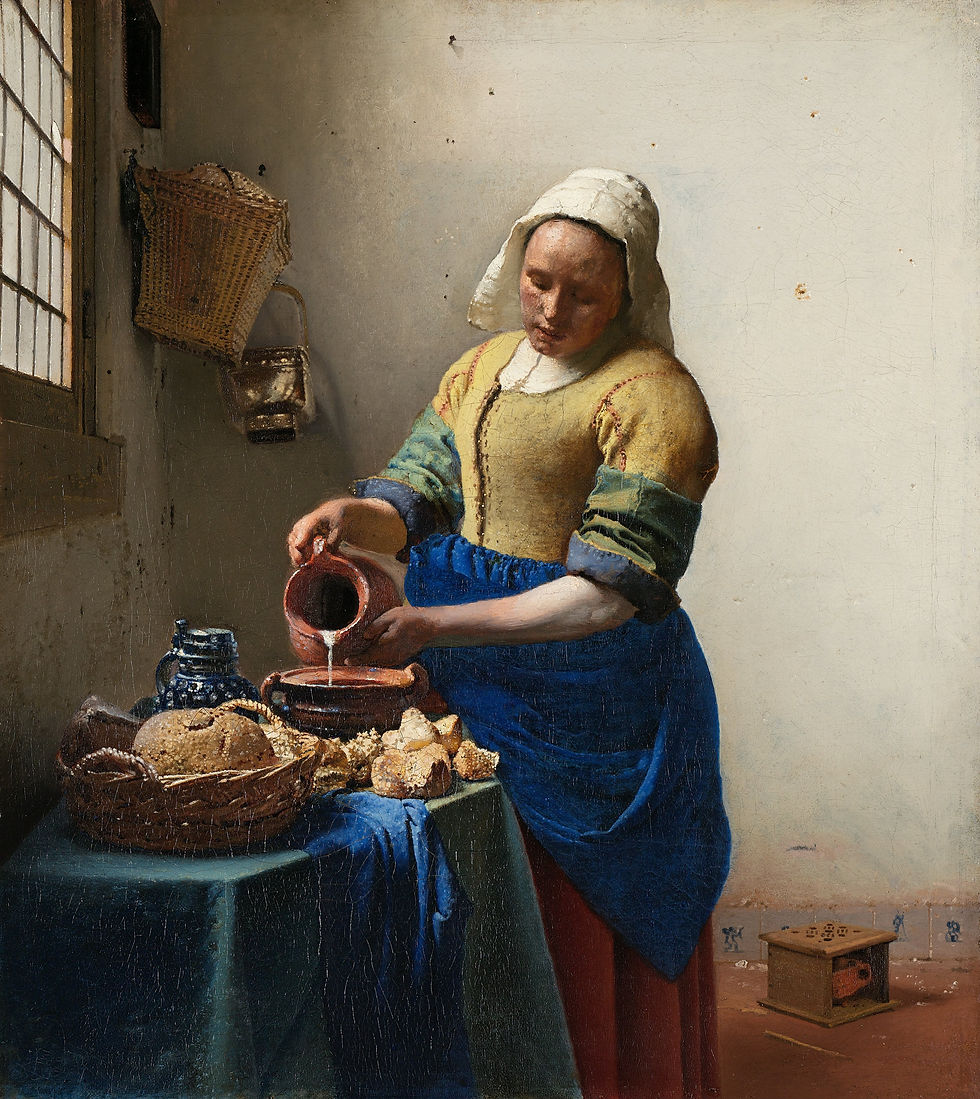
Vermeer — silence in north light
Johannes Vermeer (1632–1675) worked in Delft and produced, by the most generous count, thirty-six paintings in twenty-three years. Almost every one is an interior scene of one or two figures in north-window daylight, set against a back wall hung with maps, mirrors, or other paintings. The colour is composed around lead-tin yellow, ultramarine blue (very expensive — Vermeer went into debt for it), and a small palette of ochres and greys.

What Vermeer did that no other painter did is hold the moment. His subjects — a maid pouring milk, a girl reading a letter, an astronomer reaching toward a globe — are caught in the middle of small private actions. Nothing dramatic happens. The patience of the gaze does the work. Stand in front of a Vermeer for any length of time and you start to feel the room's quiet as physical pressure on your shoulders.
Rembrandt — light against the dark
Rembrandt van Rijn (1606–1669) worked in Leiden and Amsterdam, ran a large studio, and produced something like three hundred paintings, three hundred etchings, and two thousand drawings over four decades. His range is enormous — group portraits, history paintings, etchings of beggars, self-portraits at every age — but his single innovation is chiaroscuro pushed past the breaking point.

In a Rembrandt portrait the face is in the light and almost everything else is in deep shadow. The brushwork in the lit areas is thick, palpable, almost sculptural. The shadowed half of the canvas reads as space — a depth you can fall into, not a flat dark backdrop. The technical engine of The Night Watch (1642), of The Anatomy Lesson of Dr. Tulp, of the late self-portraits — all of it is the willingness to leave most of the canvas in shadow and let one carefully lit face do all the work.
Read the dedicated essay on Rembrandt's Night Watch for figure-by-figure analysis of his most famous composition.
Frans Hals — the working brushstroke

Frans Hals (c.1582–1666) painted the Haarlem militias, the regents of the city's old people's home, and dozens of single portraits of merchants and their wives. What separates Hals from the other Dutch portraitists is the brushwork. Where Vermeer hides every stroke and Rembrandt builds thick textured paint surfaces, Hals leaves the brushwork frankly visible — sleeves, lace collars, hair, embroidery all done in loose calligraphic strokes that resolve into form only at a distance.
Manet, Sargent, and the entire late-nineteenth-century revival of bravura brushwork took Hals as the founding example. The Laughing Cavalier is not actually laughing — the title is a Victorian nickname — but his moustache is the most-discussed three centimetres of paint in seventeenth-century art.
Still life — Heda, Claesz, Kalf
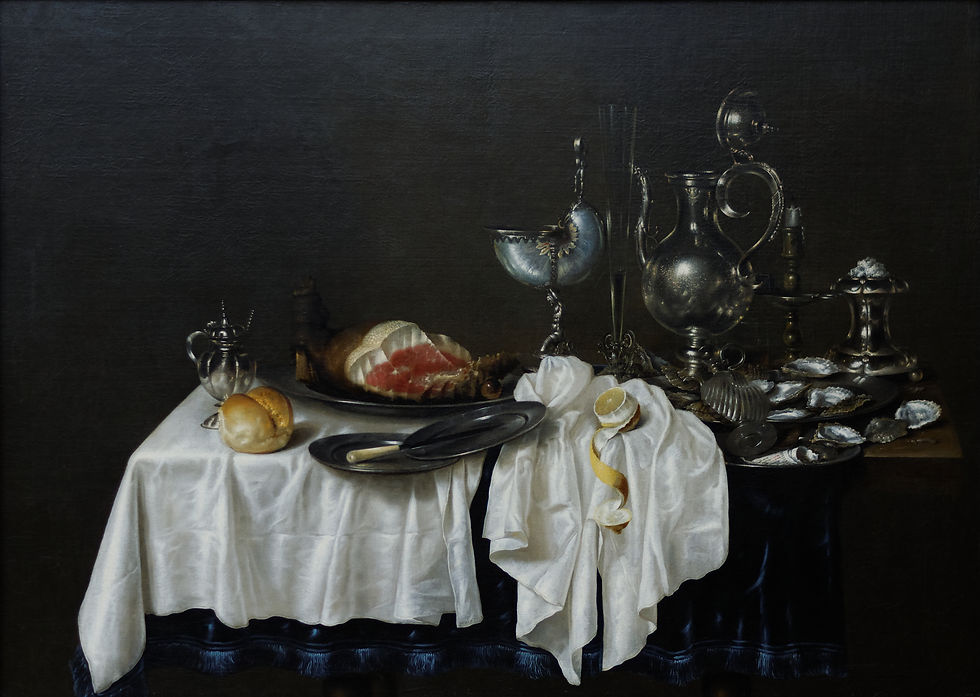
Dutch still life is its own deep tradition. Willem Claesz. Heda and Pieter Claesz pioneered the monochrome banquet piece — a half-eaten meal on a white tablecloth, painted almost entirely in pewter greys, butter yellows, and the cold blue-white of polished glass. Willem Kalf later added the heavy gilt and crimson of Eastern silks and Ming porcelain, turning the table into something closer to a Caravaggio side-altar.
The still life is never just objects. The peeled lemon refers to bitterness disguised in sweetness. The fly on the bread refers to corruption. The half-empty wine glass refers to a meal interrupted by death. The Dutch called this the vanitas — a reminder that everything pleasant is temporary. Even the most luxurious banquet still life is a small sermon on mortality, painted in oil for someone to hang in a dining room.
The genre painters — Steen, de Hooch, ter Borch
Below the major names sits a deep bench of genre painters — painters of everyday scenes. Jan Steen painted noisy tavern interiors and disorderly households (his name in Dutch still means a chaotic house). Pieter de Hooch painted courtyards and quiet domestic interiors in a slightly cooler key than Vermeer. Gerard ter Borch painted satin dresses and private conversations between men and women.
None of these painters tried to do what Rembrandt or Vermeer did. They were not after metaphysics. They were painting the actual texture of seventeenth-century Dutch life — the parties, the children, the lutes, the maps, the dogs, the courtships, the lessons being taught and the lessons being ignored. Two centuries later this material became the entire visual record of what middle-class life had looked like during the Republic.
Landscape — Ruisdael, Hobbema, Cuyp
The Dutch invented landscape painting as a major genre. Before them, landscape was background to a religious scene. After them, landscape was its own subject — the same way still life and genre had become their own subjects. Jacob van Ruisdael painted dark forests, broken windmills, and skies that took up two-thirds of the canvas. Meindert Hobbema painted bright avenues of trees in flat polder country. Aelbert Cuyp painted cows in golden afternoon light along the Maas.
Constable, Turner, and the entire English Romantic landscape school took the Dutch as their immediate ancestors. Cuyp's golden light in particular is the single most direct ancestor of Turner's late watercolours.
Why it ended
The Dutch Golden Age ended when the Republic lost its commercial dominance to England and France around 1700. The art market collapsed. Painters stopped being able to make a living. The next generation of Dutch painters — Cornelis Troost, the eighteenth-century portraitists — never approached the quality of what came before. By the time the painters of the Romantic era arrived in Amsterdam, the great seventeenth-century studios had been closed for a century, and the canvases were either in private hands or scattered across Europe.
What survived is the painting itself — and the conviction it left to every painter who came after that the everyday world, painted patiently, can carry the full weight of serious art.
Key takeaways
The Dutch Golden Age (c.1620–1690) produced more first-rank European painters per capita than any other period in history.
The cause is bourgeois economics, not genius: a wealthy merchant class buying paintings as ordinary household goods, with no church or court controlling the iconography.
Vermeer holds the moment in north light; Rembrandt builds emotion through chiaroscuro; Hals invents the modern bravura brushstroke; Heda turns the dinner table into philosophy.
Three new genres — landscape, still life, and everyday-life painting — emerged from the Dutch as serious art subjects in their own right.
The age ended around 1700 when Dutch commercial power moved to London and Paris. The paintings dispersed; the practice did not survive the economic shift.
Browse Dutch Golden Age prints in the archive at zocineartdesign.etsy.com.
Related Reading
New in the Journal: The Colour of Power: How Red Ruled the Old Master Portrait
New in the Journal: The Language of Light: How the Old Masters Painted Shadow
New in the Journal: The Spanish Golden Age in Ten Paintings
New in the Journal: How to Read a Crowded Painting: Slow Looking with Bruegel and Jan Steen
New in the Journal: How to Read a Painting Full of People: The Dutch and Flemish Crowd Scene
New in the Journal: Judith Leyster: The Lodestar of the Dutch Golden Age
New in the Journal: Rembrandt's Self-Portraits: Forty Years of a Painter Watching Himself Grow Old
New in the Journal: The Hierarchy of Genres: How Academies Ranked What Painters Could Paint


Comments