Rembrandt at the End: The Late Self-Portraits
Updated: Aug 10
By the end of his life Rembrandt could no longer afford to lie about his own face. The bankruptcy in 1656 had taken the great house on the Breestraat, the cabinet of curiosities, the print collection, almost everything except his brushes. His common-law wife Hendrickje had died in 1663. His son Titus, the one tender presence of his last years, died at twenty-seven in 1668. Rembrandt outlived him by eleven months.
In those final years he painted his own face again and again. Not as advertisement, not as performance, not as the costumed swagger of the early Amsterdam years. He painted himself the way an old man stands in front of a mirror at four in the morning, when the house is quiet and there is nothing left to perform.
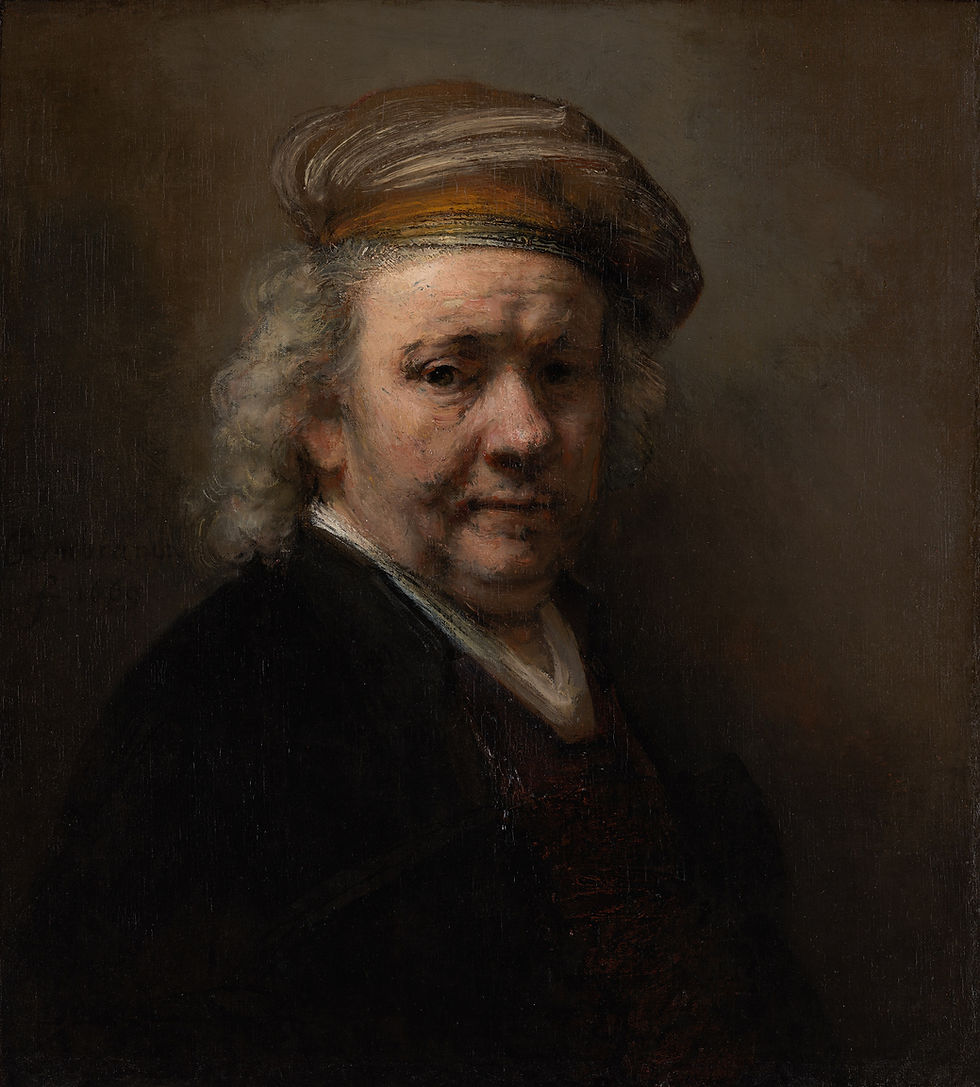
1. The Last Self-Portrait (1669) — Painted in the Year of His Death
Rembrandt died on 4 October 1669. He left this painting on his easel. The hands, originally folded one over the other, were never finished — you can still see, under the dark robe, the underdrawing of fingers that never received their final paint.
The face is the face of a man at sixty-three who has buried a wife, two daughters in infancy, a common-law wife, and a son. The hair under the simple cap has gone white. The eyes are red-rimmed. The mouth has the slight downturn of a man who has stopped expecting things to be otherwise.
And yet the painting refuses self-pity. There is no theatre, no costume, no allegorical prop. He has dressed in a plain robe — not the embroidered velvets of the 1630s self-portraits — and he looks straight out of the canvas, calmly, without asking anything of you. The brushwork around the head is thick, almost mortar-like, scumbled and scraped. The brushwork in the dark robe is so loose it dissolves. He had stopped polishing decades earlier.

2. The Year After the Bankruptcy (c. 1657) — A Face That Has Just Lost Everything
In July 1656 Rembrandt declared cessio bonorum — a kind of voluntary bankruptcy that protected him from debtors' prison at the cost of his house, his collections, and his social standing. The Amsterdam art market that had crowned him in the 1630s had moved on. Younger painters — Vermeer in Delft, Gerard ter Borch in Deventer — were producing the smooth, polished, brightly lit interiors that the new merchant class wanted.
Rembrandt painted this small self-portrait in the year following the loss. The broad black hat shadows the upper half of the face. The signature reads small, at the top left, in a hand that no longer requires emphasis. The expression is wary, withdrawn, but not defeated. The flesh has the late Rembrandt quality of paint laid like wet plaster — you can see the marks of the brush, even of the fingers, in the modelling of the cheek.
He is fifty-one years old. He has another thirteen years to paint, and he will paint himself for almost every one of them.

3. Self-Portrait at 53 (1659) — Signed Quietly, Top Left
A dark beret. A heavy dark coat. The hands clasped, almost prayerful, in the lower foreground. The signature, very small, at the left edge: Rembrandt f. 1659. The f. is for fecit — "made it."
This is the same year a great workshop assistant named Govert Flinck — a former Rembrandt student — won the prestigious public commission to decorate the new Amsterdam Town Hall. Rembrandt, the older master, was not invited. He had been displaced by his own pupils.
The painting does not record bitterness. The brushwork is at its slowest and most considered — every wrinkle around the eyes is built up of dozens of tiny modelled strokes. The light enters from upper left and falls on the forehead, the bridge of the nose, the tops of the cheeks. The rest of the face is in shadow. He is showing what a sixty-watt life looks like at three in the afternoon.

4. Titus, the Son (c. 1660) — Late Tenderness Painted on Another Face
Titus van Rijn was Rembrandt's fourth child and the only one to survive infancy. His mother Saskia had died when he was nine months old. Rembrandt raised him alongside Hendrickje. By twenty Titus was running what remained of the family art business; he had to, because his father's bankruptcy meant that any new earnings could be seized by creditors. Titus was the legal screen.
Rembrandt painted him many times. The red beret. The gold chain. The half-shadow that softens the cheekbone. The look that is somewhere between a son humouring his father and a young man too gentle for the world he has inherited.
Titus died in February 1668, aged twenty-seven, seven months after his marriage and seven months before his daughter was born. Rembrandt outlived him by twenty months. The 1669 self-portrait at the top of this essay was painted in that twenty-month window — a father painting his own old face in the silence after his son's funeral.
5. Why Did He Paint Himself Almost a Hundred Times?
Rembrandt produced about eighty self-portraits across his career — drawings, etchings, paintings. No painter before him had done this. Dürer had painted three self-portraits in a lifetime, considered eccentric. Rembrandt painted his own face like a daily ritual.
The early ones, in the 1630s, are partly self-advertising — the young Amsterdam master in costume, in armour, with feathered hat — paintings produced to be shown to potential portrait clients as evidence of versatility. The middle ones, in the 1640s and 1650s, are studies of light and expression — the model is free, available, and always there.
But the late ones, the bankruptcy onwards, are something else. They are a sustained moral practice — a refusal to look away from what time, loss, debt, and grief did to a face. They are not confessional in the modern sense. They do not announce feeling. They simply present, without apology, what an old painter saw in the mirror that morning, and they leave the viewer to do the rest of the looking.
6. What's Actually in the Late Brushwork
Look closely at the cheek in the 1669 portrait. The paint is not blended. The strokes sit on top of one another like courses of mortar. You can see — actually see, with the unaided eye, at gallery distance — the marks of a wide bristle brush dragged through wet pigment, and in places the impression of a thumb.
This was, in his own lifetime, the critique against him. A 1681 biographer wrote that Rembrandt's late paintings looked, on close inspection, as if they were "painted with a bricklayer's trowel." The critic meant it as condemnation. We read it now as description of a method.
The looseness is not casual. It is a calibrated decision about distance. At three feet, the late portrait looks like paint. At ten feet — gallery distance, the distance at which it was meant to be seen — it resolves into the most exact rendering of weathered human skin in seventeenth-century painting. The viewer's eye does the final mixing. Rembrandt, like Constable a century and a half later, had learned that the broken surface vibrates with a kind of life that the polished surface cannot.
7. The Late Period as a Decision, Not an Accident
It would be easy to read the late paintings as the work of a broken man making do with cheaper materials. They are not. The pigments are still the most expensive — lead-tin yellow, the costly umbers, real bone black. The canvases are properly prepared. He was not painting more loosely because he could no longer afford to paint tightly. He was painting more loosely because, by 1660, he had decided that tightness was a lie about how human flesh looked, and that loose paint told the truth.
This is the move that, two and a half centuries later, would be taken up by every painter who broke with academic finish — by Manet's sketchy edges, by Cézanne's unblended planes, by every Impressionist insistence that the truth of vision was in the gap between strokes rather than the smoothness of glaze. The late Rembrandt is the underground source for almost every honest painter of the modern era.
How to Live With a Late Rembrandt
On a wall, a late Rembrandt does what it did in the 1660s — it slows the room down. The browns are deeper than you remember. The light, when it falls, falls on the most fragile patch of flesh — a temple, a knuckle, the bridge of a nose. He rewards approach: walk towards it and the paint resolves itself into separate strokes; walk away and the face reassembles.
Give him north light, warm wood under the frame, a quiet wall. He is best on a smaller scale — the late self-portraits are not large paintings. Above a reading chair, beside a bookshelf, in a study with a desk lamp, he holds the room without dominating it.
Frequently Asked
Did Rembrandt actually paint eighty self-portraits?
The count varies by scholar between forty and ninety, depending on whether drawings, etchings, and disputed attributions are included. The conservative figure for paintings alone is around forty. The total — paintings, etchings, and drawings together — runs into the eighties.
Why are the late self-portraits darker than the early ones?
Two reasons. First, his palette genuinely darkened — he moved from the bright reds and yellows of the 1630s into the umber-and-bone-black register of the 1660s. Second, the varnishes used in the seventeenth century yellow and darken over centuries; the late paintings have suffered more from this than the early ones because they were painted with thinner ground layers.
How does the late Rembrandt relate to modern painting?
The looseness, the visible brushwork, the refusal to smooth the surface — every one of these became, two and a half centuries later, a foundational decision of modern painting. Cézanne kept a Rembrandt reproduction in his studio. Lucian Freud said that Rembrandt's late self-portraits were the only painter he returned to. The line runs straight from the 1669 portrait to almost every honest portrait of the twentieth century.
Browse the full archive at zocineartdesign.etsy.com
Related Reading
New in the Journal: Rembrandt's Self-Portraits: Forty Years of a Painter Watching Himself Grow Old


Comments