The Pre-Raphaelite Brotherhood Explained Through Seven Paintings
Updated: Aug 4
In September 1848, three young London art students gathered in Dante Gabriel Rossetti's bedroom in his parents' house in Charlotte Street, Bloomsbury, and founded a secret society. They called it the Pre-Raphaelite Brotherhood. There were three core members at the start — Rossetti himself, the twenty-year-old John Everett Millais, and the twenty-one-year-old William Holman Hunt — though four more sympathisers were brought in over the following weeks, bringing the total to seven. They agreed to sign their pictures with the initials PRB and to keep the meaning of the initials secret from the public. The name was a manifesto in three words. Italian painting before Raphael — the long Florentine, Sienese, and Flemish tradition that ran from Giotto in the 1300s to roughly the 1490s — had, the Brotherhood argued, been better than everything the Academy had made since. They wanted to paint as if the four hundred years between Giotto and themselves had not happened.
The Brotherhood's argument — what was wrong with Raphael
The name needs a moment of explanation. The Pre-Raphaelites were not, in any literal sense, hostile to Raphael himself. They had all spent hours copying Raphael at the Royal Academy schools, and Rossetti continued to admire Raphael's drawing throughout his life. What they were attacking was something they called the Raphaelite or Academic tradition — the doctrine, which had been taught in European art academies from roughly 1600 onward, that painting should be organised by certain idealising rules drawn from Raphael's late Vatican work: figures arranged in classically balanced compositions, faces idealised toward type rather than rendered as specific individuals, colour subordinated to overall tonal harmony, the painted surface smoothed to a uniform finish. The Pre-Raphaelites argued that all of this had been a wrong turn, and that European painting since 1500 had spent three centuries copying out a stale formula.
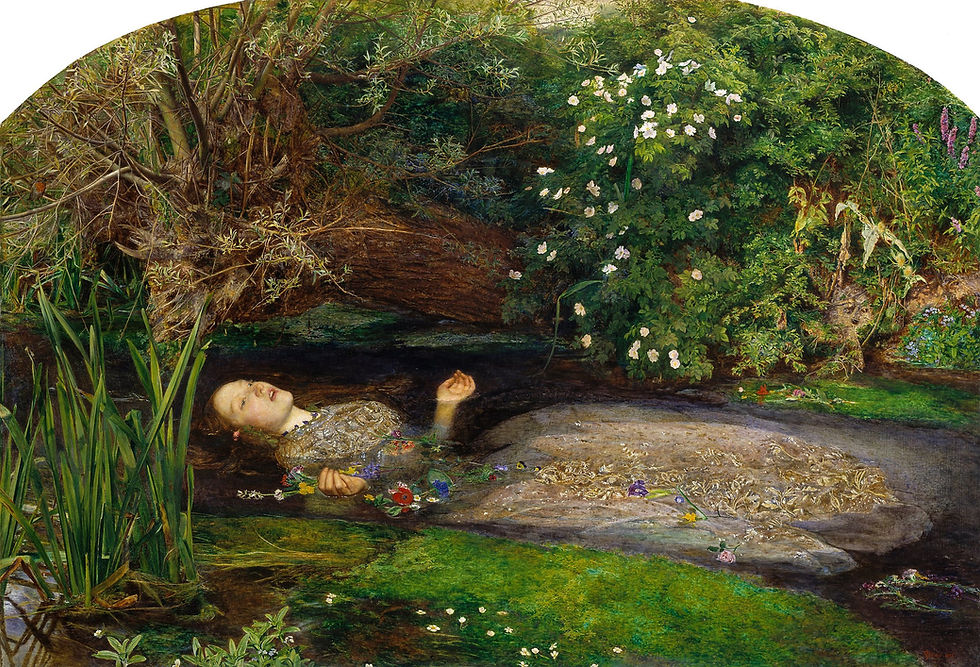
What they wanted instead, drawing on what they thought they could see in Italian painting before Raphael, was something that contained four distinct technical demands. First, brilliantly saturated colour applied to a pure white ground (rather than over the brown academic underpainting that desaturated everything on top of it). Second, sharp, almost photographic, naturalistic detail — every leaf on every tree, every blade of grass, every petal of every wildflower painted with the precision of botanical illustration. Third, outdoor, daylit landscape backgrounds painted on location in the open air rather than constructed in the studio from memory and imagination. Fourth, sincere emotional content drawn from contemporary literature, the Bible, and medieval romance, rather than the standard academic repertoire of classical mythology and military heroism. The first picture in which all four demands appear together is Millais's Ophelia.
Millais's Ophelia, 1851-52 — the Brotherhood's most famous painting
Ophelia, painted between July 1851 and December 1852, is the Pre-Raphaelite picture every viewer recognises. Millais painted the river background in the open air on the Hogsmill in Surrey over four months in 1851. He sat on the riverbank from eleven in the morning until dusk, six days a week, painting the foliage leaf by leaf. The botanical content of the picture — the roses, the daisies, the pansies, the loosestrife, the willow, the meadowsweet — is so precise that nineteenth-century botanists wrote articles identifying every plant species and arguing for what each one meant in the Victorian language of flowers.
The figure of Ophelia was painted separately, indoors, over four months in 1852. Millais's model was the nineteen-year-old Elizabeth Siddal — who would later become Rossetti's wife — and who lay in a bathtub of water heated from below by candles. The story of Siddal nearly catching her death after the candles went out and Millais kept painting without noticing has been told and retold; her father later billed Millais for the doctor's fees. The picture shows the moment in Hamlet Act IV, scene vii, when Gertrude reports Ophelia's drowning to Laertes — Ophelia falls into the river, her clothes spread out, briefly floating like a mermaid, singing fragments of old songs before being pulled under. The picture is the Brotherhood's manifesto in painted form: brilliant colour, photographic precision, outdoor light, sincere emotional content from Shakespeare.
Millais's Mariana, 1851 — the same year, the same method
Mariana, painted in the same year as the start of Ophelia, is the second great Millais Pre-Raphaelite picture. The canvas is 60 by 50 centimetres. A young woman in a heavy dark-blue medieval dress stands at an embroidery table, her hands pressed into the small of her back as if she has just stretched after long hours of work. Behind her, a leaded stained-glass window glows in afternoon light, scattered autumn leaves have blown in onto the floor of the room, and a small mouse runs at the lower right.
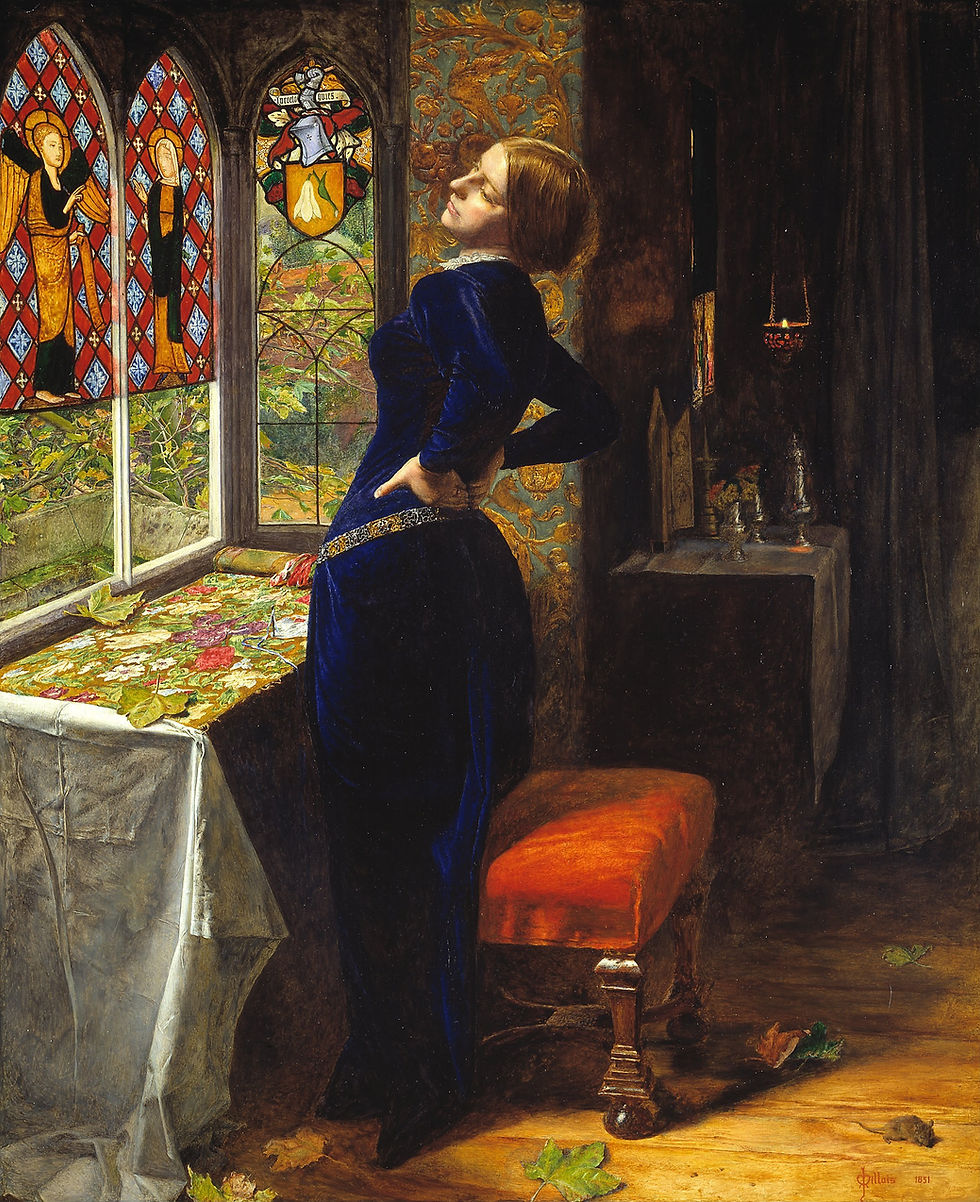
The picture illustrates a Tennyson poem, also called "Mariana," of 1830, which in turn illustrates a passage from Shakespeare's Measure for Measure — Mariana of the moated grange, betrothed to Angelo, abandoned by him when her dowry was lost in a shipwreck, waiting in the grange for the lover who never comes. The Tennyson poem's refrain — "My life is dreary, he cometh not" — is the picture's structural argument. Everything in the canvas is built around postponement. The autumn leaves on the floor mark seasons passing. The embroidery on the table is unfinished. The stained-glass window depicts the Annunciation — the moment Mary is told the messenger has arrived — placed in the room as the visual opposite of Mariana's situation. The mouse and the autumn leaves and the abandoned needlework all build the same image of suspended time. The picture is the Brotherhood's argument at its most distilled: a single figure, every detail charged with literary meaning, every surface painted with photographic specificity, the whole organised as a sustained metaphor.
Holman Hunt's Hireling Shepherd, 1851 — the Brotherhood as moral commentary
Hunt's The Hireling Shepherd, painted in 1851 at the same moment as Millais's Ophelia and Mariana, is the picture in which the Brotherhood's political and religious content becomes legible. A young shepherd in a red waistcoat sits in a meadow with a peasant girl on his knee. He shows her a death's-head moth he has caught. His sheep, unattended in the background, have wandered into a wheatfield, are eating the green grain, are bloating themselves on it (one lamb in the girl's lap is being given a green apple, which will kill it). The day is brilliant, the colour saturated, every blade of meadow grass painted with photographic precision in the foreground.

The picture is a moral allegory of an explicit kind. The shepherd has neglected his flock for trivial pleasures. The death's-head moth is the standard Victorian emblem of mortality. The wheatfield the sheep are destroying is, in Christian iconography, the field of the Lord. The lamb being given the green apple is a deliberate echo of Eve and the Fall. Hunt was writing the picture's symbolism, by his own account, as an attack on contemporary Anglican clergymen who in his view were neglecting their congregations for theological squabbles in pamphlet literature. The picture's allegorical density — every figure, every gesture, every prop loaded with religious meaning — would become the standard register of Hunt's mature work and one of the three main directions Pre-Raphaelite painting would take in the 1850s.
Rossetti's Beata Beatrix, c. 1864-70 — the Brotherhood as memorial
Rossetti married Elizabeth Siddal in 1860, eleven years after she had first modelled for Millais's Ophelia. Their marriage was unhappy. Siddal suffered from chronic ill health, miscarried a daughter in May 1861, became addicted to laudanum, and died in February 1862 of a laudanum overdose at the age of thirty-two. Rossetti, who blamed himself for her death, was so distraught at the funeral that he placed the only manuscript of his unpublished poems in her coffin and had her buried with them. (Seven years later he had the coffin exhumed and the poems recovered.) Beata Beatrix, painted between 1864 and 1870, is the picture Rossetti made to commemorate Siddal.

The picture stages Siddal as Beatrice — the figure from Dante's Vita Nuova, the medieval Italian romance Rossetti's family was named after and that Rossetti himself had translated into English in 1861. Beatrice is shown at the moment of her death, her head tilted back, her eyes closed, her hands resting open in her lap. A red dove (the messenger of death, in Rossetti's symbolism) drops a white poppy — the source of laudanum — into her hands. In the background, blurred behind Beatrice, Florence at twilight; a sundial reads nine o'clock; the Ponte Vecchio crosses the Arno. Dante himself stands in the right background looking toward an angel of love on the left. The picture is one of the most unguarded acts of mourning in nineteenth-century European painting, and one of the moments at which Pre-Raphaelite painting begins to slide from its early documentary mode into the dreamlike Symbolism that would dominate Rossetti's later work.
Waterhouse's Lady of Shalott, 1888 — the second generation
By the late 1880s the original Brotherhood was forty years old, three of its members were dead, and Pre-Raphaelite painting had become a national Victorian style with dozens of younger painters working in its visual language. John William Waterhouse's The Lady of Shalott, painted in 1888, is the picture in which the Pre-Raphaelite tradition arrives at its most popularly-loved late form.
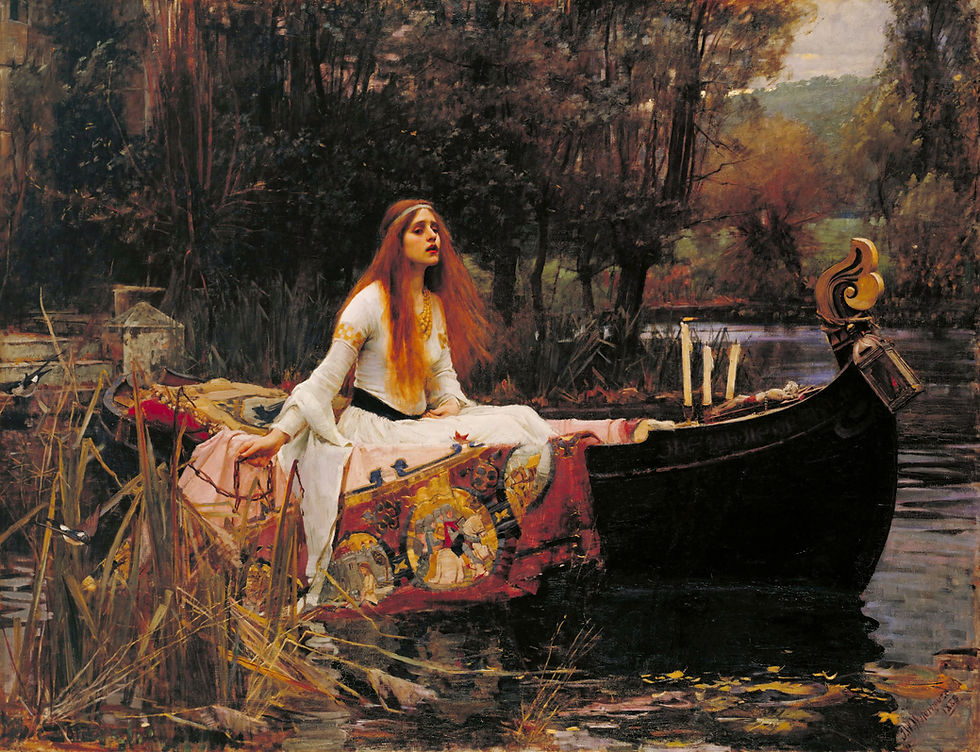
The picture illustrates Tennyson's poem of 1832, revised 1842, which the original Brotherhood had also drawn from. The Lady of Shalott has spent her life in a tower above the river, weaving a tapestry of the world she sees only as reflections in a mirror, forbidden to look out the window directly. When she sees Sir Lancelot in the mirror she breaks the prohibition, looks out, the mirror cracks, the tapestry unravels, she leaves the tower, finds a boat by the river, writes her name on it, lies down in it, and floats downstream toward Camelot, dying as the boat drifts. Waterhouse paints the last of these moments — the Lady on the funeral barge, the three candles in front of her two of which have already guttered out, the chain of her boat about to be released, the unraveled tapestry trailing into the water. The picture is a Victorian masterpiece in the Pre-Raphaelite tradition. The colour is saturated, the detail is photographic, the subject is medieval literature, the emotional register is unguarded melancholy.
Burne-Jones's Golden Stairs, 1880 — the Brotherhood's aesthetic endpoint
Edward Burne-Jones was not a founding member of the Brotherhood — he was eight years younger than Rossetti — but he was Rossetti's pupil at Oxford in the late 1850s and became, in the 1870s and 1880s, the painter through whom the Pre-Raphaelite tradition mutated into the Aesthetic Movement and the international Symbolism of the 1890s. The Golden Stairs, finished in 1880, is the picture in which the mutation is most visible.

The picture shows eighteen identical young women in pale white classical robes descending a curving golden staircase. They carry small musical instruments — flutes, pipes, viols, a tambourine, cymbals — but the instruments are not being played. The faces are uniform: the same elongated, melancholy, classicising oval Burne-Jones used in all his late work. The composition is a single vertical column of figures filling a canvas almost three metres tall by one metre wide. There is no setting beyond the staircase itself. There is no narrative. There is no Shakespeare or Tennyson or Dante. The picture is the Brotherhood's project mutated into pure rhythmic decoration — a procession of figures arranged for the visual pleasure of looking at them. The Brotherhood had begun in 1848 by attacking Raphaelite abstraction in favour of photographic realism. By 1880 it had arrived back, by a different route, at a kind of abstraction of its own — the painted body treated as decorative pattern. The Aesthetic Movement's slogan was art for art's sake, and the Golden Stairs is its visual manifesto.
Rossetti's Proserpine, 1874 — the cult of the femme fatale
The last of the seven pictures returns to Rossetti, and to the late visual obsession that came to dominate Pre-Raphaelite painting in its second and third decades: the cult of the half-length female portrait, the so-called stunner, with long unbound hair, parted lips, an exotic accessory, and a literary or mythological name. Rossetti's Proserpine, painted in 1874 and now in a London collection (with several variant versions in private hands), is one of the eight or nine such pictures Rossetti made in the last decade of his life.

The model is Jane Morris — Jane Burden Morris, the wife of Rossetti's friend William Morris (founder of the Arts and Crafts movement) — with whom Rossetti was having a long, semi-public affair. Jane Morris is shown as Proserpine, the Roman name for Persephone, the goddess captured by Pluto and condemned to spend six months of each year in the underworld because she had eaten six pomegranate seeds. The picture shows the seventh seed about to be eaten. Jane Morris holds the half-cut pomegranate in her left hand. Her dress is the dark green-blue of underworld water. A burner sends a thin trail of smoke up the left side of the canvas. A sonnet, written by Rossetti in Italian and English, is inscribed in a cartouche at the upper right. The picture is the Pre-Raphaelite stunner at its most concentrated. It is also a coded self-portrait of an adulterous affair: Jane Morris condemned to her marriage to William, allowed only fragments of time with Rossetti, eats the pomegranate seed as Rossetti's lover, returns to William as Persephone returns to the upper world.
Key takeaways
The Pre-Raphaelite Brotherhood was founded in September 1848 in Dante Gabriel Rossetti's bedroom in Bloomsbury by Rossetti, John Everett Millais, and William Holman Hunt — three core members, seven in total. They signed their pictures with the secret initials PRB and attacked three centuries of academic painting in the name of Italian painting before Raphael.
The Brotherhood's technical programme had four parts: saturated colour on white ground, photographic naturalistic detail, outdoor daylit landscape painted on location, and sincere emotional content drawn from literature and the Bible rather than classical mythology.
Millais's Ophelia (1851-52) is the most-reproduced single Pre-Raphaelite painting — Shakespeare's drowning Ophelia surrounded by botanically precise English wildflowers; Elizabeth Siddal modelled in a candle-heated bathtub and nearly died of the cold.
Millais's Mariana (1851), illustrating a Tennyson poem about Shakespeare's abandoned heroine, is the Brotherhood's argument at its most distilled — a single figure, every detail charged with literary meaning, the whole organised as a sustained visual metaphor for waiting.
Holman Hunt's Hireling Shepherd (1851) is the Brotherhood's didactic mode at its most direct — a shepherd flirting while his sheep eat themselves to death in the wheatfield, the picture loaded with Christian moral symbolism and aimed at contemporary Anglican clergy.
Rossetti's Beata Beatrix (c. 1864-70) is his memorial to his wife Elizabeth Siddal, who died in 1862 of a laudanum overdose — Siddal staged as Beatrice from Dante's Vita Nuova, the moment of death rendered as a transformation into the medieval Italian beloved.
Waterhouse's The Lady of Shalott (1888) is the second-generation Pre-Raphaelite picture par excellence — Tennyson's Lady on her funeral barge, the candles guttering, the tapestry of her own life trailing into the water — painted at the moment Pre-Raphaelite painting had become a national Victorian style.
Burne-Jones's Golden Stairs (1880) is the Brotherhood's late mutation into Aestheticism — eighteen identical young women descending a staircase carrying unplayed instruments, no narrative, no literary source, the painted body treated as pure rhythmic decoration.
Rossetti's Proserpine (1874), modelled by Jane Morris (William Morris's wife and Rossetti's mistress), is the Pre-Raphaelite stunner at its most concentrated — a coded self-portrait of an adulterous affair staged as classical mythology, with the pomegranate seed as the picture's central symbol.
Browse Pre-Raphaelite prints in the archive at zocineartdesign.etsy.com.
New in the Journal: Rossetti's Lady Lilith: The Pre-Raphaelite Stunner as Adam's First Wife


Comments