Waterhouse's Lady of Shalott: Tennyson, Tragedy, and Pre-Raphaelite Light
Updated: Aug 3
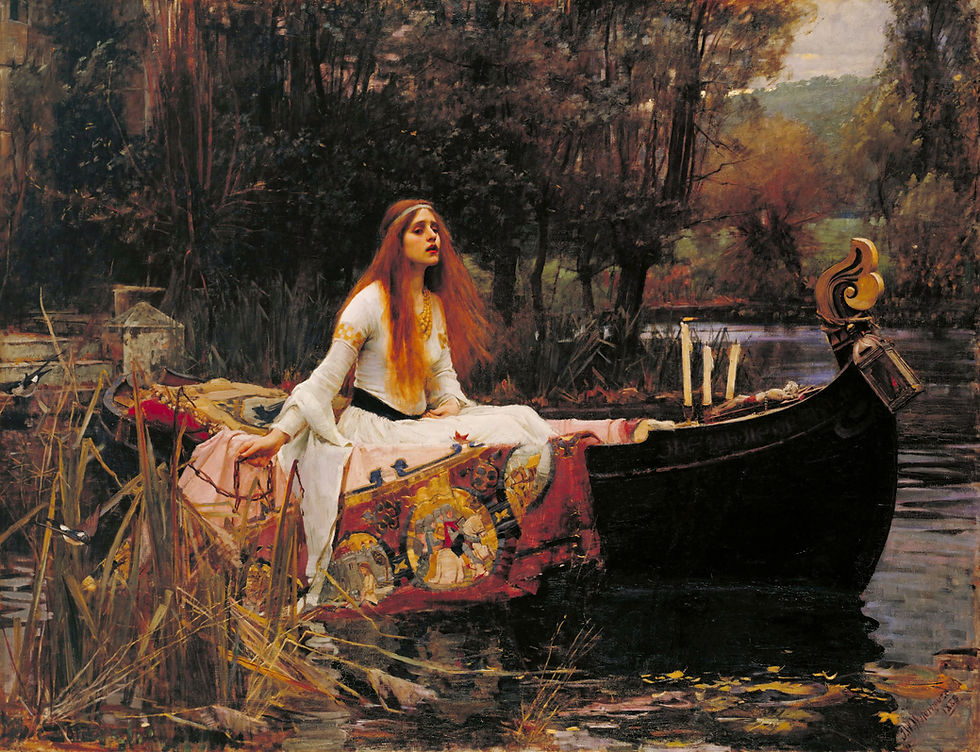
A young woman in a long white dress sits in a small wooden boat that has drifted out into a slow river at dusk. Three candles are mounted on the prow, two of them already blown out. She is loosening the chain that moored the boat to the bank. Her tapestry is bundled around her, hanging over the side. Her gaze is fixed on something we cannot see — somewhere downstream, on the towers of Camelot. The expression is between resignation and ecstasy.
This is John William Waterhouse's The Lady of Shalott, painted in 1888 when Waterhouse was thirty-nine. It is an illustration of Alfred Tennyson's 1832 poem of the same name, and the most famous single image ever made of that poem. It is also, by some readings, the painting that closed the long Pre-Raphaelite chapter in British art.
The poem
Tennyson's Lady is cursed. She lives alone in a tower on an island in the river above Camelot, weaving a tapestry of the world she sees only through a mirror on her wall. If she looks directly out the window she will die. For years she has been content to weave the mirror's reflections. One day Sir Lancelot rides past below her window in his armour, his image flashing in her mirror; she stops weaving, turns to the window, looks at him directly, and the curse takes hold. The mirror cracks from side to side. The tapestry flies away. She leaves the tower, descends to the river, finds a small boat, climbs in, and lets it drift downstream toward Camelot, singing as she goes. By the time the boat reaches the city she is dead.
Waterhouse paints the moment just before the boat drifts away from the bank. The candles on the prow (a funeral element from the poem) are still being lit. The tapestry is already escaping over the side. The Lady has stopped singing.
Reading the picture, detail by detail
The three candles are the painting's most loaded detail. In Tennyson's poem only one candle is named — the prow lantern. Waterhouse adds two more, and shows two of the three already extinguished. The remaining lit candle stands for the last minutes of the Lady's life. By the time the boat reaches Camelot all three will have gone out.
The tapestry along the boat's side shows scenes the Lady has woven from her mirror — Lancelot riding, knights at a tournament, a small wedding party. The viewer can read parts of it (Waterhouse's attention to textile detail is famous). It is the only record of the world she has not been allowed to enter, and it is escaping into the river even as she watches it go.
The chain in her hands is the boat's mooring. She has loosened it but not yet let go. The painting is staged on the half-second before the boat actually leaves the bank. Everything after this — the drift, the song, the death, the arrival in Camelot — is implied but not shown.
Why the Pre-Raphaelites took Tennyson seriously
The Pre-Raphaelite Brotherhood — Dante Gabriel Rossetti, John Everett Millais, William Holman Hunt, founded in 1848 — had treated Tennyson as a primary subject from the beginning. Tennyson's poetry of doomed women, medieval Britain, and Arthurian legend gave the Pre-Raphaelites the iconographic material they wanted: pre-Raphael (i.e., pre-1500) European subject matter, with the strict iconographic detail and high colour they had pulled from late medieval and early Renaissance painting.
Waterhouse, working a generation later (he was twenty when the original Brotherhood disbanded in 1854), is sometimes called a late Pre-Raphaelite or post-Pre-Raphaelite. He kept the iconographic density and the Tennysonian subject matter but loosened the brushwork — there is more visible paint, more atmospheric softness, more interest in light as light. The Lady of Shalott is the painting that most clearly sits on the boundary between the two phases.
The colour
The palette is built around three colours. The white of the Lady's dress is the brightest object on the canvas. The deep brown-green of the river surface dominates the lower two-thirds. The autumn russets of the riverbank trees — the painting is set in late autumn — fill the background. Small flares of red appear in the tapestry, the candles, and the embroidery on the boat. No other colour does substantial work.
The light is dusk, falling from a low angle behind the trees. The Lady's face is in soft fall-off rather than direct light. Waterhouse's contemporaries praised the painting specifically for the way the dusk reads on her face: simultaneously the calm light of a quiet evening and the cold light of an oncoming death.
After the painting
The Lady of Shalott was an immediate critical and commercial success. Waterhouse exhibited it at the Royal Academy in 1888 and it was bought for the British nation almost at once. It has been one of the most-reproduced Victorian paintings ever since — hung in countless university dormitories, used as a cover image for Tennyson editions, parodied in films and television. It is the rare Victorian narrative painting that has not aged into a curiosity.
Waterhouse continued to paint Tennyson and classical subjects for the next thirty years. None of his later paintings — and there are some technically more accomplished ones — quite holds the cultural weight of the 1888 Lady. The painting did for him what the Birth of Venus did for Botticelli or the Wanderer for Friedrich: it became the painting people meant when they said his name.
Key takeaways
Waterhouse's Lady of Shalott (1888) illustrates Tennyson's 1832 poem of the same name — the doomed woman in the tower above Camelot.
The painting shows the moment just before the Lady's boat drifts downstream toward her death. Three candles are mounted on the prow; two are already out.
The tapestry on the boat's side records the world the Lady has watched through her mirror but never been allowed to enter.
Waterhouse is sometimes called a late Pre-Raphaelite — he kept the iconographic density of Rossetti and Millais while softening the brushwork toward Victorian atmospheric painting.
The painting was a critical and commercial hit at the 1888 Royal Academy exhibition. It has been among the most-reproduced Victorian paintings ever since.
Browse Pre-Raphaelite prints in the archive at zocineartdesign.etsy.com.
New in the Journal: The Most Famous Muses in Art History
New in the Journal: The Pre-Raphaelite Brotherhood Explained Through Seven Paintings


Comments