Millais's Ophelia (1852): The Painting That Drowned Its Model
Updated: Jun 23
In the autumn of 1851, John Everett Millais set up his easel beside a slow tributary of the Hogsmill River in Surrey and began to paint a stretch of riverbank twelve feet wide. He worked there eleven hours a day, six days a week, through autumn rain and winter cold, for four months. He painted every plant in front of him from life: the dog rose, the loosestrife, the meadowsweet, the willow, the forget-me-nots, refusing to invent a single leaf.
There was no figure in the painting yet. He would add her later, in his London studio, working from a young woman named Elizabeth Siddal who lay in a tin bathtub of water heated from below by oil lamps. The lamps were not reliable. The water cooled. He kept painting.
Ophelia is now one of the most reproduced paintings in the British canon. Its strangeness (the singing drowning girl, the catalogue of botanically perfect flowers, the slightly upturned face) has the quiet force of a painting that knew exactly what it was doing while looking at nothing in particular. Here is what is in it, and what it cost the woman who let him paint her.
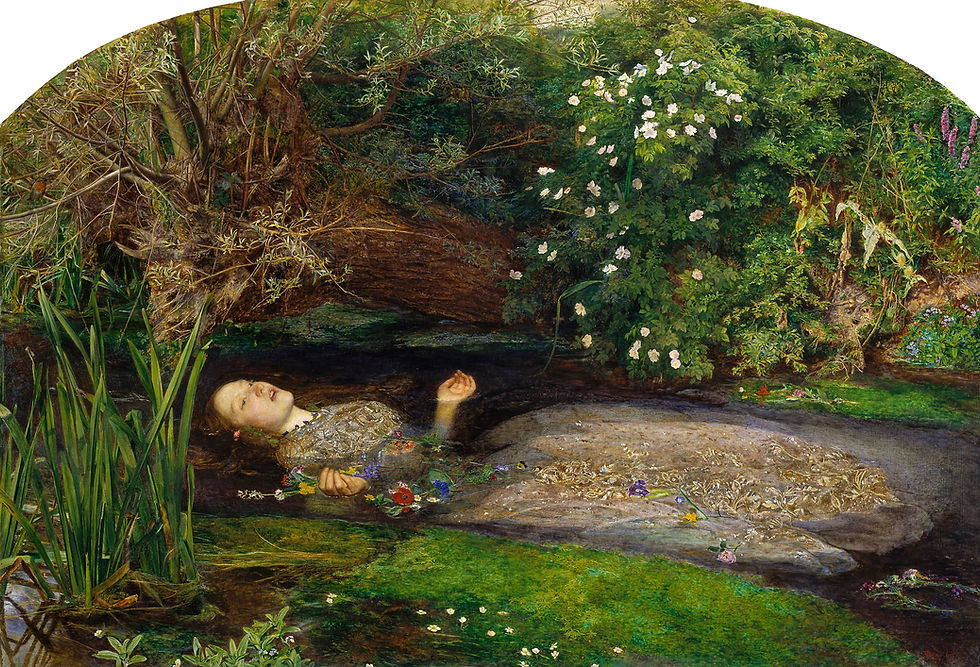
-> Available as a print: John Everett Millais, Ophelia (1852)
What the Painting Depicts
The scene is from Hamlet, Act IV, Scene 7. Queen Gertrude reports the death of Ophelia to her brother Laertes. Mad with grief at her father's killing and the rejection of her lover Hamlet, Ophelia has climbed onto a willow branch over a brook to hang her garlands of wildflowers. The branch breaks. She falls. Her clothes spread out around her in the water and hold her up for a little while. She sings snatches of old songs as she floats. The cold and the weight of her clothing eventually pull her under.
Millais paints the in-between moment: Ophelia still afloat, still singing, eyes open and looking past the viewer, hands raised. The water already has her. She has not yet drowned, but the painting is not interested in whether she might be rescued. It is a portrait of the seconds before the line is crossed.
Shakespeare gave the report to Gertrude in twenty-five lines of verse. Millais translated those lines into a wall of pictorial detail so dense that the eye cannot finish reading it. The dress, embroidered and silver-shot, weighs visibly heavier than the body wearing it. The water is clear at the surface and brown in depth. Every viewer can feel its temperature without being told. The willow leans in from the upper left exactly as Gertrude described, then disappears into the riot of summer plants along the bank.
The Flowers, Decoded
Every plant in Ophelia is botanically identifiable and almost every one carries a Victorian meaning. Millais chose them with the kind of attention a modern viewer would reserve for a piece of writing. The painting can be read flower by flower.
Floating beside her right hand is a string of violets, a flower the Victorians read as faithfulness and early death. Ophelia herself names them in the play: "I would give you some violets, but they withered all when my father died." The wreath also carries pansies, the flower whose name comes from the French pensée, for thought, and which in the language of flowers stood for love in vain.
Across the lower foreground are pink dog roses: youth, and pain. There is a small cluster of daisies near her right hand, which the Victorians read as innocence. There is fritillary, which carries sorrow. There is a poppy floating in the lower right, the long-standing emblem of sleep and, in this context, death. There is forget-me-not.
Above her head, just left of centre, is a small cluster of red flowers Millais painted only after he had returned from the riverbank. They are loosestrife. He read them as a private joke aimed at Tennyson, whose poem he had been reading that autumn, and who had used the same flower as a romantic motif. The Victorian audience could read the visual code the way we read a paragraph.
This is not decoration. It is an argument that a painting can carry the same kind of layered meaning a piece of literature carries. The Brotherhood Millais belonged to (the Pre-Raphaelite Brotherhood) had been making that argument since their first manifesto three years earlier.
The Pre-Raphaelite Brotherhood
In September 1848, seven young men (three painters, one sculptor, one critic, and two others on the periphery) met in the house at 83 Gower Street where Millais lived with his parents. They were nineteen, twenty, twenty-one. They were already exhibiting at the leading London annual exhibition. They had all decided, separately, that contemporary British painting was finished.
Their argument was specific. The painter Raphael, working in Rome around 1500, had taught the European tradition to compose pictures around a careful, idealised triangle, with light falling in conventional directions, figures in conventional postures, and colours subdued by a smoky brown undertone. By 1848, every important academy in Europe was still teaching that recipe. The Brotherhood believed that the recipe had killed the painters using it.
Their counter-proposal was to look backwards, before Raphael (at the Italian primitives, at early Northern Renaissance painters like van Eyck) for a way of seeing that paid attention to small things and refused to subordinate them to an overall scheme. They committed to four principles: to have genuine ideas to express, to study nature attentively so they might know how to express them, to sympathise with what is direct and serious and heartfelt in previous art (and to reject what was conventional and self-parading and learned by rote), and most indispensable, to produce thoroughly good pictures and statues.
Ophelia is one of the most complete statements of those principles. It was painted in three places (the riverbank, the studio, and the bathtub) over almost a year, with every blade of grass painted from the object itself rather than from memory. It refuses Raphaelite composition: the figure is not the structural centre, the eye has no clear path through the picture, and the light falls flat across everything in a high overcast English summer key. It is a painting that argues with three centuries of European training.
The Model in the Bathtub
Elizabeth Siddal was nineteen years old in 1852, working in a milliner's shop in Cranbourne Alley behind Leicester Square. The painter Walter Deverell had spotted her in the shop and recruited her as a model for his painting of Viola in Twelfth Night. Within a year she was modelling for several of the Brotherhood. She had red hair, a pale and unconventional face, and a kind of stillness that registered on canvas.
Millais asked her to model for the figure of Ophelia. He set up the tin bathtub in his studio at 7 Gower Street and asked her to lie in it fully dressed in the brocaded silver gown he had bought second-hand from a dealer. He arranged her hair and her hands. He lit the studio. And he heated the water from below with oil lamps placed under the tub.
She lay in the cooling water through hours-long sittings, day after day, for weeks in the winter of 1852. At one point the lamps under the tub went out. Millais did not notice. Siddal, lying with her hands raised and her face composed for the painter, did not say anything. The water grew slowly cold. By the time the sitting ended she was severely chilled. She developed a bad respiratory illness. The family doctor wrote to Millais demanding fifty pounds, which Millais paid.
Siddal's health never fully recovered from that winter. She had been already prone to weakness; the chill in the bath sharpened the underlying fragility. Over the next decade she would model for Dante Gabriel Rossetti, eventually marry him in 1860, write poetry of her own, and die in 1862 of an overdose of laudanum. She was thirty-two.

Rossetti spent years afterwards painting and re-painting her from memory. The most famous of those paintings, Beata Beatrix, shows her as Dante's Beatrice at the moment of her death, a red dove dropping a poppy into her hands. He never finished a single version of it without going back to it again.
Ophelia is the painting Siddal modelled for. Beata Beatrix is the painting Rossetti made for her. The two pictures hang in separate institutions, but they are part of the same story, and the body of work that follows nineteenth-century British painting forward into Symbolism (the Aestheticism of the 1870s, the Burne-Jones figures, Whistler's nocturnes) passes through both of them.
Why It Still Works
Ophelia is a painting that should not survive its own ingredients. A Victorian costume drama. A literary subject from a play almost everyone has either read or pretended to. A drowning girl. A profusion of symbolically-coded flowers in the language of a vanished social code. Most paintings carrying that much baggage feel exhausted in their first hour.
This one does not. The reason is partly technical (the surface holds up under any magnification) but mostly it is the strangeness of the actual image. The face is calm; the hands are open; the song is still being sung. The viewer is invited to watch the line being crossed without anyone in the painting registering that it is being crossed. There is no scream, no struggle. The water does the work.
Hamlet is full of language about delay, about not acting at the moment of action. Ophelia, in Millais's hands, is the inverse argument. She has stopped acting. She is letting the water do what the water does. The painting is a quiet portrait of acquiescence to a slow disaster.
Read that way, as a meditation on the moment between consent and consequence, the painting answers questions that nineteenth-century critics did not think to ask. It is also why, almost two centuries later, the picture still moves people who have never opened the play.
Where the Painting Is Now
Ophelia hangs in a London collection that is normally open to visitors free of charge. It is shown almost always at eye level, in a room of mid-nineteenth-century British paintings. There is glass over the surface. The painting is small (about thirty by forty-four inches) and a viewer underestimates that smallness in reproductions, where the density of detail expands the painting in the mind.
Many viewers come straight to Ophelia and leave. The rest of the room (Holman Hunt's Hireling Shepherd, Rossetti's early portraits, the smaller Millais pieces) is also worth standing in front of. Together they are the most complete public account of what the Brotherhood did between 1848 and 1855. Ophelia is the canonical statement; the others are the working notes.
Frequently Asked
Who was Ophelia's model?
Elizabeth Siddal, a nineteen-year-old shop assistant who had been spotted in a milliner's shop in central London and recruited as a model by several of the Pre-Raphaelite painters. She later became the wife of Dante Gabriel Rossetti and a poet in her own right. She died in 1862 at thirty-two.
Did Elizabeth Siddal really almost die during the painting?
The cooling-bathtub story is true. Millais was painting her lying in a tin bath of water warmed by oil lamps; the lamps went out during a sitting and the water grew very cold while she lay still for the pose. She developed a severe respiratory illness afterwards. Her father wrote to Millais demanding fifty pounds for the doctor's bill, which Millais paid. The chill is one of several factors usually named in accounts of her later poor health, though it is not the sole cause of her early death.
Why are the flowers so carefully painted?
The Pre-Raphaelite Brotherhood believed a painting should carry meaning the way a piece of literature carries meaning. The flowers in Ophelia are botanically identifiable and almost every one has a Victorian symbolic reading: violets for early death, pansies for thoughts of love in vain, poppies for sleep and death, forget-me-nots, fritillary for sorrow. The flowers are a layered code that a Victorian viewer would read the way a modern reader reads a paragraph.
How long did the painting take?
About eleven months total. Four of those months were spent on the riverbank in Surrey painting the background plants from life, eleven hours a day, six days a week. The figure was added in Millais's London studio over the winter, in much shorter sittings with Elizabeth Siddal in the bath.
Browse the full archive at zocineartdesign.etsy.com.


Comments