How to Read a Painting Full of People: The Dutch and Flemish Crowd Scene
TL;DR. A crowd scene is a painting built from many small stories at once, a whole community held in a single frame. Dutch and Flemish masters such as Pieter Bruegel the Elder, David Teniers the Younger, and Jan Steen made the crowded picture a serious art, and learned to compose it so the eye always finds a path.
To read a painting full of people, start with the whole and then follow its structure. A crowd scene shows dozens of figures at a feast, a fair, or a festival, and no single hero holds the center. The form flourished in the Low Countries between about 1550 and 1680, when painters turned the town square, the village fair, and the family holiday into pictures a viewer could study for an afternoon. What looks at first like happy chaos is in fact carefully ordered.
Why Painters Filled a Frame With People
For centuries the most respected paintings had shown sacred history, myth, or the powerful, arranged around a single commanding subject. The crowd scene turned that hierarchy on its head. It gave the leading role to a whole street or household and treated ordinary gestures, quarrels, and jokes with the same care a court painter spent on a monarch. The result was a picture that felt closer to lived experience than almost anything before it, and a buyer could return to it again and again without exhausting the detail.
A crowded scene hides its structure inside apparent disorder, and the painters who built it were exacting about tone. The way the Old Masters handled shadow is a study in itself, and it is exactly that control of light that keeps a busy picture legible instead of confusing.
Bruegel's Town Square: Carnival Against Lent

The Fight Between Carnival and Lent of 1559 crams an entire town into one square. On the left, spilling from a tavern, sits the world of Carnival, where a fat man rides a barrel and levels a spit of roast meat like a lance. On the right, in the cold shadow of the church, waits the world of Lent, a gaunt figure on a wooden cart who answers with a paddle of herrings. Between the two poles a hundred smaller scenes play out at once, children at games, beggars on the ground, a fishwife at her stall, a procession leaving the door of the church.
Bruegel steers the eye through this mass with colour. A run of red caps, hoods, and jackets appears again and again across the square, and the gaze hops from one to the next like stepping stones. Red does that work in painting after painting. It was the loudest pigment a workshop owned, and masters used it to command attention long before they used it to dress a queen.
Teniers and the Village Fair

David Teniers the Younger widened the crowd until it became a whole community at leisure. His Kermis on Saint George's Day of 1649 packs a village fair into a single view. A pink banner marks the saint's day above the tavern, a piper leads the dancers, and far to the right a church tower closes the distance. Dozens of separate incidents unfold at once, yet the composition never tips into confusion.
His method is simple to describe and hard to do. Teniers crowds the near ground with incident, keeps the middle distance active but calmer, and opens a window of pale light and open ground at the back to release the pressure. The eye enters at the busiest point, works through the tangle of dancers, and finally escapes into air. It is the same rhythm a good storyteller uses, a rush of event resolved by a pause.
Steen Brings the Crowd Indoors
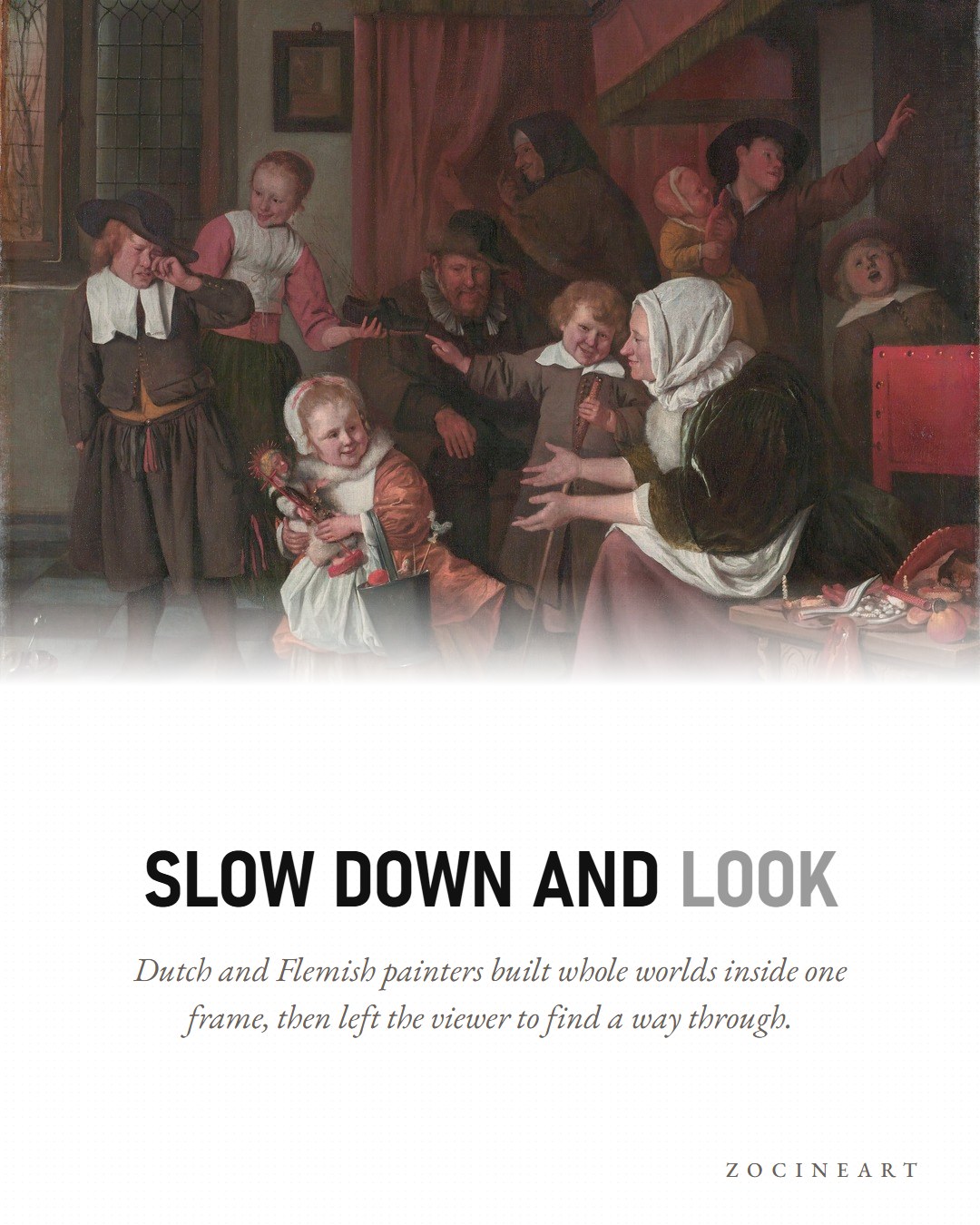
Jan Steen shrank the crowd to a single household and filled it with feeling. In The Feast of Saint Nicholas of around 1668 a family celebrates the winter holiday. One girl hugs a doll and a bucket of sweets, smug with her haul. A boy sobs in the corner because his shoe holds only a birch rod, the traditional punishment for a child who had misbehaved. A grandmother beckons from behind the bed, and the whole room turns on that small drama of reward and disappointment.
Reading the scene takes patience. Like the coded objects the Baroque painters tucked into their pictures, the meaning of a Steen sits in the small props scattered across the floor, the sweets, the discarded shoe, the songbook. The hidden language of these details is half the pleasure of looking.
How to Read a Crowded Painting
Start with the whole. Let the scene register as a mood before hunting for detail. Then find the anchor, usually a figure or object the painter has lit or coloured to hold the center. From there, follow the strongest colour through the crowd, and let it lead you from group to group. Finally, look for the odd note, the child under the table, the dog at the edge, the face turned toward you. In a crowd scene the smallest figure often carries the point.
None of these steps needs training in art history. The paintings were made for ordinary viewers, and they still work that way. The pleasure is in the counting, in the slow discovery that a picture you took in at a glance actually holds an afternoon of looking.
Questions Collectors Ask
What is a crowd scene in painting called?
Most crowd scenes belong to genre painting, the depiction of everyday life. Within that field, an intimate gathering of people eating, drinking, or making music is often called a merry company, while a village fair held on a saint's day is called a kermis. Both are crowd scenes at different scales, one a room and one a whole community.
Who were the great painters of crowded scenes?
Pieter Bruegel the Elder gave the crowd scene its weight in the sixteenth century with town festivals and peasant gatherings. In the seventeenth century David Teniers the Younger refined the outdoor fair, and Jan Steen brought the crowd indoors and gave it a moral edge. Together they define the Dutch and Flemish tradition of the picture full of people.
Why did Dutch and Flemish painters fill their pictures with so many figures?
A growing merchant class wanted paintings about its own life rather than only saints and rulers. Scenes of feasts, fairs, and family gatherings met that demand, and the crowded composition let a painter show wit, observation, and moral instruction all at once. The many figures were a feature, not clutter.
Seen together, these three painters describe a single ambition, to hold an entire gathering in one frame and trust the viewer to walk through it. The crowded picture remains one of the most generous subjects in the canon, an image that keeps giving up new detail every time it is looked at.


Comments