The Hierarchy of Genres: How Academies Ranked What Painters Could Paint
Updated: Aug 18
In short: for nearly two centuries, European academies ranked painting not by skill but by subject. This order was called the hierarchy of genres. History painting stood at the top, followed by portrait, everyday genre scenes, landscape, and still life at the base. The seven works below trace that ladder, from Benjamin West in 1770 to George Stubbs in 1762.
A Ladder of Subjects
The ranking was set down in 1667, when the critic André Félibien wrote a preface to the lectures of the French academy of painting. He arranged the kinds of painting into five clear ranks and placed the painter of the human figure far above the painter of fruit or flowers.
Félibien put the order plainly. The painter of the living human figure, he wrote in 1667, "is much more excellent than all the others." A picture that told a story from scripture or ancient history asked the most of an artist, so it earned the most respect. A bowl of fruit asked the least. These five ranks became the measure of ambition for generations of painters.
History at the Summit
History painting sat at the top because it demanded everything at once: many figures, strong feeling, and a subject drawn from great events. Benjamin West finished The Death of General Wolfe around 1770 and showed it in London in 1771. West broke one rule of the genre by dressing his figures in modern uniforms rather than classical robes, and the choice caused a quarrel that lasted for years. The picture still obeyed the deeper rule of the form. It gave a recent death the solemn weight once saved for religious scenes.
Portrait and the Everyday Middle
Below history came the portrait, the record of a single face and the standing it wished to claim. Thomas Gainsborough painted The Blue Boy in 1770, dressing his young sitter in shimmering blue satin that let him show off pure skill with cloth and light. For more on how the portrait taught Europe to look at itself, see our essay on ten portraits that shaped Western art.
One rung lower sat genre painting, the picture of ordinary life. Jan Steen filled The Merry Family of 1668 with song, drink, and cheerful disorder, and hid a small moral inside the noise. These crowded rooms reward slow looking, a habit we explore in our guide to reading a painting full of people.
Landscape, Marine, and Still Life
The lower ranks held the subjects that copied the world without inventing a story. Landscape gave the plain countryside its dignity. John Constable painted The Hay Wain in 1821, a canvas about 130 by 185 centimetres, and slowed a farm cart at a river crossing until the ordinary felt worth study. Marine painting, a close cousin, measured a nation by its water and its ships, as J.M.W. Turner did in The Fighting Temeraire of 1839. For the way northern painters turned bare land and cold light into a subject of their own, read why Scandinavian paintings glow.
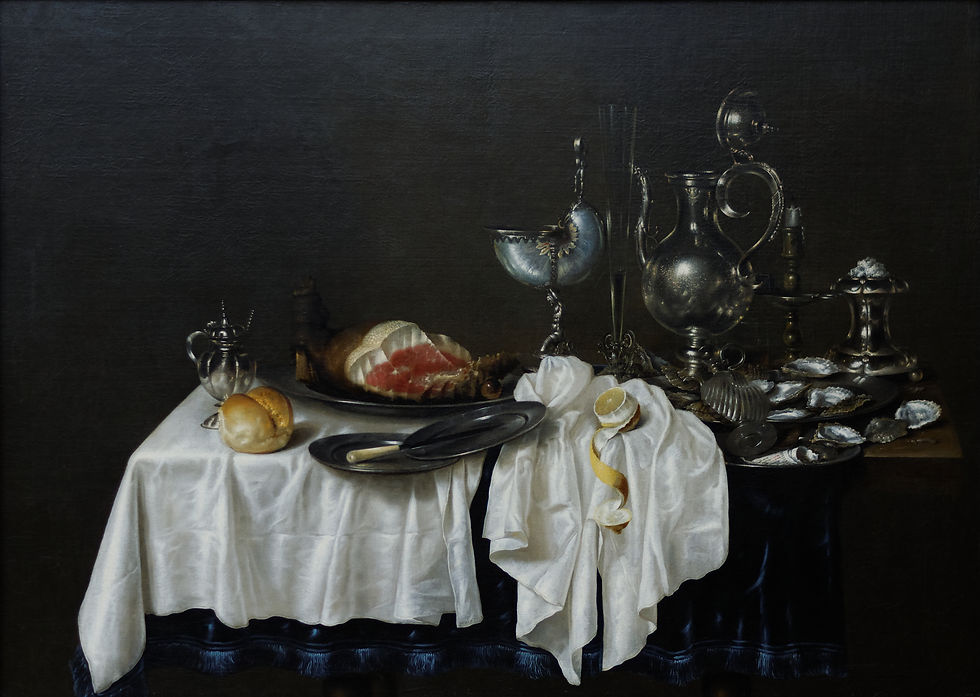
Still life rested at the base, yet it rewarded the closest attention. Jan Davidsz de Heem arranged fruit, glass, and a scarlet lobster on dark cloth around 1640, using ripeness and decay to hint at the passing of time. The academy also allowed a place for the animal picture, and George Stubbs pushed it to the edge of grandeur. His Whistlejacket of 1762 shows a rearing racehorse against bare ground, with no rider and no field, at nearly life size, about 292 by 246 centimetres.
Why the Ladder Fell
The hierarchy held firm for almost two hundred years, then loosened in the 1800s. As buyers grew fond of quiet rooms and open fields, landscape and still life climbed while grand history scenes lost their market. By the late nineteenth century the ranking that once ruled the academies had all but reversed. The genres survive today less as a ladder and more as a set of choices, and the wall in a home can hold any rung of it.
Questions Collectors Ask
What is the hierarchy of genres in painting?
It is the ranking of painting by subject that European academies used from the 1600s. History painting stood highest, then portrait, then genre scenes of daily life, then landscape, then still life. The order rewarded difficulty and moral weight over pure craft.
Who created the ranking of painting genres?
The critic André Félibien set the order down in 1667 in a preface for the French academy of painting. He divided painting into five ranks and placed the painter of the human figure far above the painter of flowers or fruit.
Which genre was considered the lowest?
Still life sat at the base, since it copied silent objects rather than living figures or great deeds. In practice the finest still life, such as the work of Jan Davidsz de Heem, demanded rare patience and skill, which is why collectors have prized it for centuries.
Seven pictures, seven kinds of looking. Each rung of the old ladder still hangs well, whether the subject is a battle, a face, a field, or a bowl of fruit.
New in the Journal: How Painters Captured the Sea: Storm, Survival, and the Blue Hour


Comments