The Painting Where Nothing Happens: Friedrich's Monk by the Sea
The most disquieting painting in the canon of Romanticism shows nothing happening. A figure stands on the edge of a beach. The sea is empty. The sky takes up most of the canvas. There is no boat, no companion, no shore on the horizon. The painting is large, and the silence is louder than the room.
This is The Monk by the Sea, painted by Caspar David Friedrich in 1810. It was a small scandal when first exhibited. It is still a quiet shock today.

Caspar David Friedrich, The Monk by the Sea, 1810.
A horizon. A figure. A void.
The composition is almost cruel in its restraint. A strip of pale sand. A band of dark sea. A vast, weather-blasted sky. And one man, no taller than a thumb, looking out into none of it.
Friedrich removed every prop a contemporary viewer would have expected. There is no ship to anchor the eye. There is no town on the cliff. The figure does not turn to face us. He is given no halo of meaning. He simply stands.
The German poet Heinrich von Kleist saw the painting that year and wrote that it felt like having his eyelids cut off. He meant it as praise. The painting refuses to let you blink.
The painting that scared a king
When the painting first appeared in public, it was hung beside its companion piece, painted in the same year. That second painting shows a winter ruin: a Gothic abbey crumbling into snow, with a tiny funeral procession winding through bare oaks.
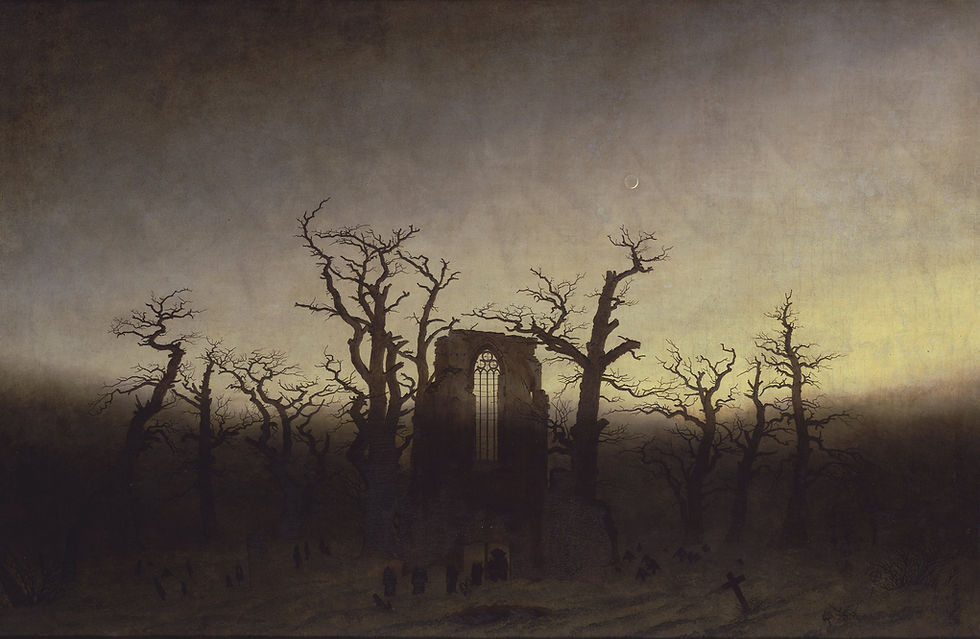
Caspar David Friedrich, Abbey in the Oakwood, 1810. The companion piece.
Together the two paintings form a single statement: the body ends, and behind it is the sea. Crown Prince Frederick William of Prussia bought them both on sight. The future king understood. Most viewers did not.
Friedrich was painting through the Napoleonic invasion of his country. Every German viewer in 1810 had recently buried someone. The vastness was personal.
How Friedrich invented the silence
Look at the proportions. The figure occupies maybe one fortieth of the picture height. The sky takes up four fifths of the surface. No painter before Friedrich had given so much canvas to nothing.
He achieved the silence with paint chemistry as much as composition. The dunes were layered with thin, transparent glazes so the underdrawing breathes through. The sea is a single tone of black green, brushed flat. The sky was reworked at least three times: x-rays show Friedrich painted out two sailing ships before settling on emptiness.
The figure is the smallest revision. Originally Friedrich painted himself there, slightly taller, in lay clothes. He scraped that version out and replaced it with the small monk in a dark robe. The replacement is not a portrait. It is a scale.
Why it still works today
Two centuries later, the painting is still doing what it did to Kleist. You stand in front of it (or scroll past a reproduction of it, which is not the same but is not nothing) and your chest goes quiet. The horizon line is at roughly the level of your heart. The figure stands where you stand.
This is the trick Friedrich left for us: he painted the place where a person ends and the world begins, and he refused to comfort you about it. The painting does not say what is on the other side of the sea. It does not say there is one.
It is the loneliest room ever painted. It is also one of the most often reproduced. Both facts are true at once.
A short note for collectors
The painting belongs to a Berlin collection and is not for sale. Its quiet, however, is portable. A well chosen Romantic print, framed with restraint and hung where the eye can rest, brings a little of that silence into a room. Friedrich believed paintings should be hung at heart level. We agree.
Browse the full archive of Romantic and Symbolist prints at zocineartdesign.etsy.com.
Reading this with morning coffee? The painting will outlast the coffee.


Comments