10 Cozy Bedroom Wall Decor Ideas (Calm, Layered, and Sleep-Friendly)
Updated: Jul 27
A bedroom wall should feel composed but never loud. The art above the bed sets the room's tone before any lamp turns on — it's the first thing the eye lands on at night and the last thing it leaves in the morning. Decorating it well is less about filling space and more about choosing what will sit quietly with you, year after year.
The instinct most bedrooms get wrong is treating the wall as decoration. The better approach is to treat it as atmosphere — work that calms rather than activates, with a palette and scale matched to rest rather than display.
Below are ten ways to compose a bedroom wall — arranged from the most reductive single piece to the most layered. Each is taken from how editorial bedrooms, hotel suites, and quiet collector homes solve the same problem. Pick the one that matches your bed's geometry first, then your palette.
1. Anchor with a single calm work above the bed
The strongest move and the easiest. One framed piece centered above the headboard, sized to roughly two-thirds the width of the bed, hung with the lower edge about 20 to 25 cm above the headboard top.
Choose something internally quiet — a moonlit landscape, an Art Nouveau silhouette, a soft botanical study. Avoid high-contrast battle scenes and dramatic figurative work above where you sleep. The frame should be muted: warm oak, limewashed timber, matte black — never glossy.
2. The moonlight pairing — two celestial works flanking
Two same-sized vertical pieces, one on each side of the bed at lamp height, identical framing. Works built around moonlight, dusk, or night gardens — the palette stays in the cool, low-luminance register that rooms for sleeping reward.
This is the most calming arrangement in the canon. Art Nouveau moon ladies, Whistler-style nocturnes, and Hiroshige's nighttime woodblocks were all made for exactly this slot.
3. Botanical serenity, scaled large
One large botanical study above the bed — Ernst Haeckel's orchidae plates, Pierre-Joseph Redouté's roses, Maria Sibylla Merian's specimens. The composition is calm by design and the palette stays in greens and soft creams that suit a sleeping room.
Botanicals work best when they're scaled bigger than instinct says. A 60 × 80 cm Haeckel study reads as a quiet presence, not a poster.
4. The reading-nook gallery cluster
The corner of a bedroom with a chair and a lamp deserves its own small composition — three or four framed works clustered loosely, sized smaller than the bed wall. Mix a landscape, a portrait, a botanical, a textile study. The cluster should feel collected, not curated, with one repeating tonal note across the four pieces.
This is where the more idiosyncratic prints live — the pieces that don't quite fit above the bed but do belong in the room.
5. A single sleeping-figure or quiet portrait
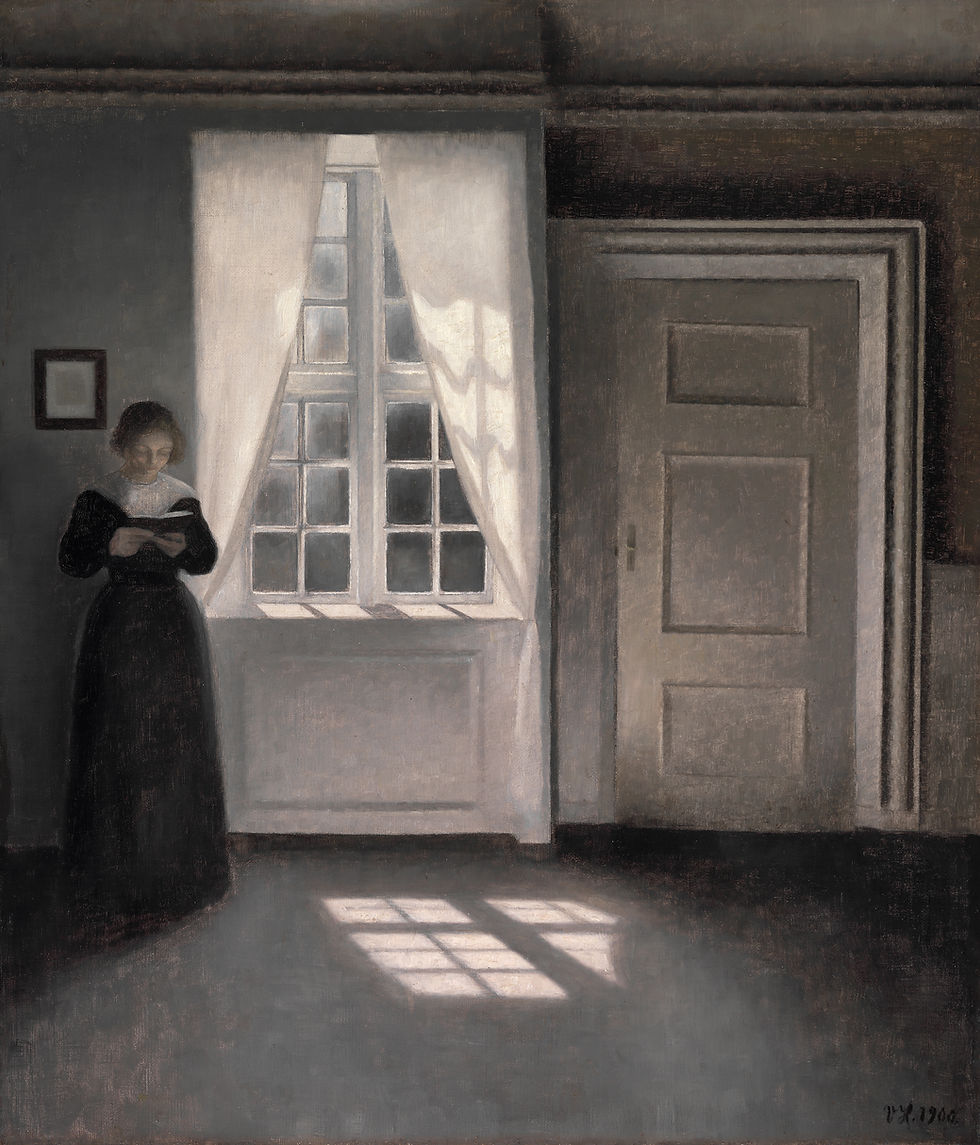
A figurative portrait above the bed is unusual but, done right, deeply atmospheric. The figure should be in repose — reading, dreaming, looking away. Egon Schiele's quieter portraits, Sargent's drawn studies, Hammershøi's interiors with a single figure — all work.
The rule: the figure must look down or sideways, never directly out. Eye contact above a bed is unsettling at 3am.
6. The dawn diptych — two warm landscapes
Two same-size horizontal landscape pieces hung side by side above the bed, 8 to 12 cm apart, in the warm dawn register — soft pinks, ochres, pale gold. The pairing reads as a single panoramic view of morning light, which is the most generous thing a bedroom wall can do.
Monet's haystack series, Bierstadt's western dawn studies, and Turner's pale mornings all anchor this layout.
7. Lean above the dresser, never over the bed
Place a slim console or low dresser against a side wall and lean — don't hang — two or three framed pieces of different heights against it. Add one ceramic vessel, one small lamp, a stack of vintage hardcover books.
This is where the more colourful or active pieces can live without overwhelming the sleep wall. The lean reads as confidence: the art is here for now, ready to rearrange.
8. The cool palette wall — a three-piece set
Three framed works in a coordinated cool palette — pale blues, soft grays, washed greens. Identical framing, even spacing, hung as a horizontal row above the bed or a vertical column beside it. The unified palette is what does the calming.
Hiroshige's Tōkaidō series in muted indigo, Whistler's nocturnes in slate, Hammershøi's quiet rooms in chalky grey — any of these makes a sleep-friendly trio.
9. The Hammershøi single — one quiet interior
A single painting of a quiet interior — empty doorway, sunlit chair, woman reading by a window — hung above a side wall or in the line of sight from bed to door. Vilhelm Hammershøi is the archetype, but any Dutch or Danish interior with restrained light works.
The painting acts as a second, smaller room within the bedroom. It expands the space psychologically without taking floor area.
10. The overlooked upper walls — above the door and wardrobe
The space above doorframes and the top edge of a tall wardrobe is the most underused wall surface in any bedroom. Add a single horizontal piece up there — a thin panoramic landscape, a Japanese horizontal woodblock, a long calligraphic banner.
It draws the eye upward and makes the ceiling feel taller than it is. The frame finish should match other framed pieces in the room — this is one room, not three.
Choosing what fits your room
A few short rules from sleep-research and gallery installation, combined:
Avoid high-contrast or violent imagery directly above the bed. Cortisol-spiking visuals at the threshold of sleep is bad design.
Hang the lower edge of any bedhead art about 20 to 25 cm above the headboard — never further; never lower.
Keep the palette warm and low-saturation in north-facing bedrooms, cool and pale in south-facing ones. The art compensates for the light, not duplicates it.
One frame finish across the whole room, not three. The eye reads the room as quieter that way.
Light the art only with the bedside lamps already in the room. A separate picture light is overkill in a sleeping space.
A bedroom wall, well chosen, is the only piece of decor in a home that you see twice every day from the same position. The art should be worth that repetition.
Featured prints from this guide
Key takeaways
One quiet anchor above the bed beats three loud ones, every time.
Pairings and diptychs work because symmetry above the bed is a sleeping cue, not a design choice.
Reserve colour and activity for the dresser-lean and reading-nook — never the sleep wall.
The palette should match the room's natural light, not fight it.
Frame finish, sightline height, and palette coherence matter more than the specific paintings.
Browse the full archive at zocineartdesign.etsy.com — fine prints from the canon, well framed, sized for the room they will live in.
Related Reading
Decorating a child's room instead? The Kids Art collection gathers the archive's gentler palettes in one place.

Comments