Kitchen Wall Art: What Works Over the Counter
Updated: Jun 17
Kitchen walls live differently from the rest of the house. They are warmer, slightly steamy, lit obliquely from the cooktop hood, and constantly framed by the rotating still life of whatever is laid out on the counter that morning. Art that works in a living room can fall flat in a kitchen because the kitchen has its own moving composition below it.
The historical answer to this problem is the still life. For four hundred years European painters worked the kitchen-adjacent subject — fruit, fish, glassware, bread — into a serious genre. The paintings were originally hung in dining rooms, but they belong, by every aesthetic logic, in the modern kitchen.
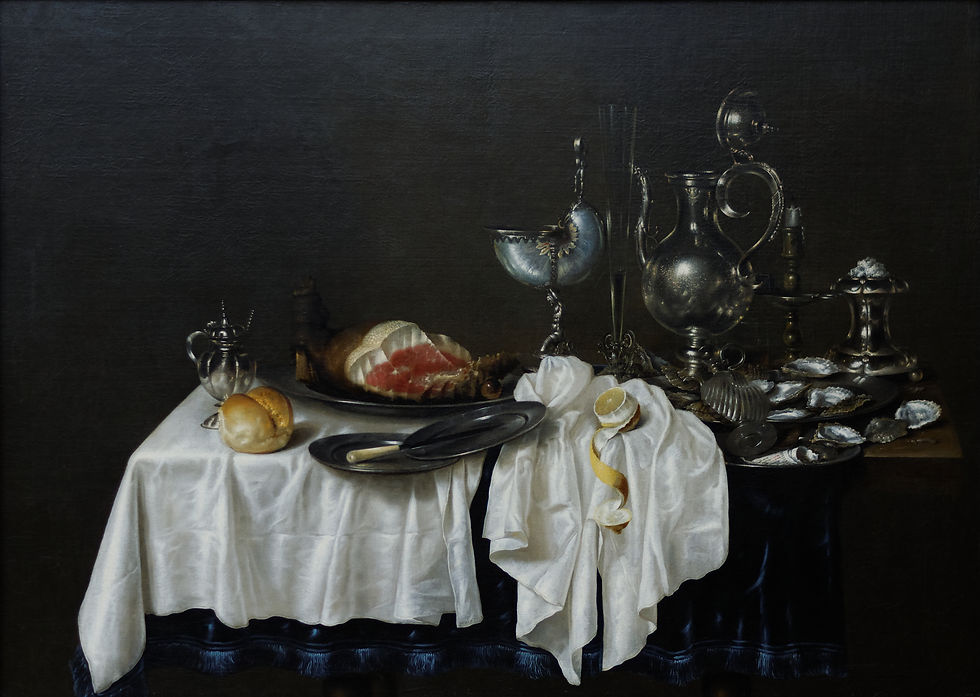
Why still life works in the kitchen
Three reasons. First, the subject matter rhymes with the room — fruit, glassware, bread, fish, the same things that occupy the counter. The art and the room belong to the same world. Second, the typical still-life palette (muted ochres, pewter greys, deep crimsons, white linen) sits well against the warm-end colours kitchens tend to lean on. Third, still life rewards close looking, which is what the eye does while waiting for a kettle to boil.
1. Heda — the monochrome banquet
Willem Claesz. Heda's mid-seventeenth-century banquet pieces are paintings of half-finished meals. Pewter platter, lemon peel curling off a knife, glass of white wine half-empty, ham, oysters, a fallen silver cup. The palette is built entirely from pewter greys, butter yellows, and the cold blue-white of polished glass against a near-black ground. The painting reads as a still life of a meal that someone has just walked away from.
2. Cézanne — apples

Cézanne painted apples for thirty years. The same wooden table, the same plain white cloth, three to five apples, sometimes a pear, occasionally a glass. He was not painting fruit. He was painting the relationship between curved volume and flat plane — geometry, mass, the way colour fields meet at an edge. A Cézanne still life is the entire foundation of Cubism telegraphed forty years early in a small panel of apples.
3. Vermeer — The Milkmaid
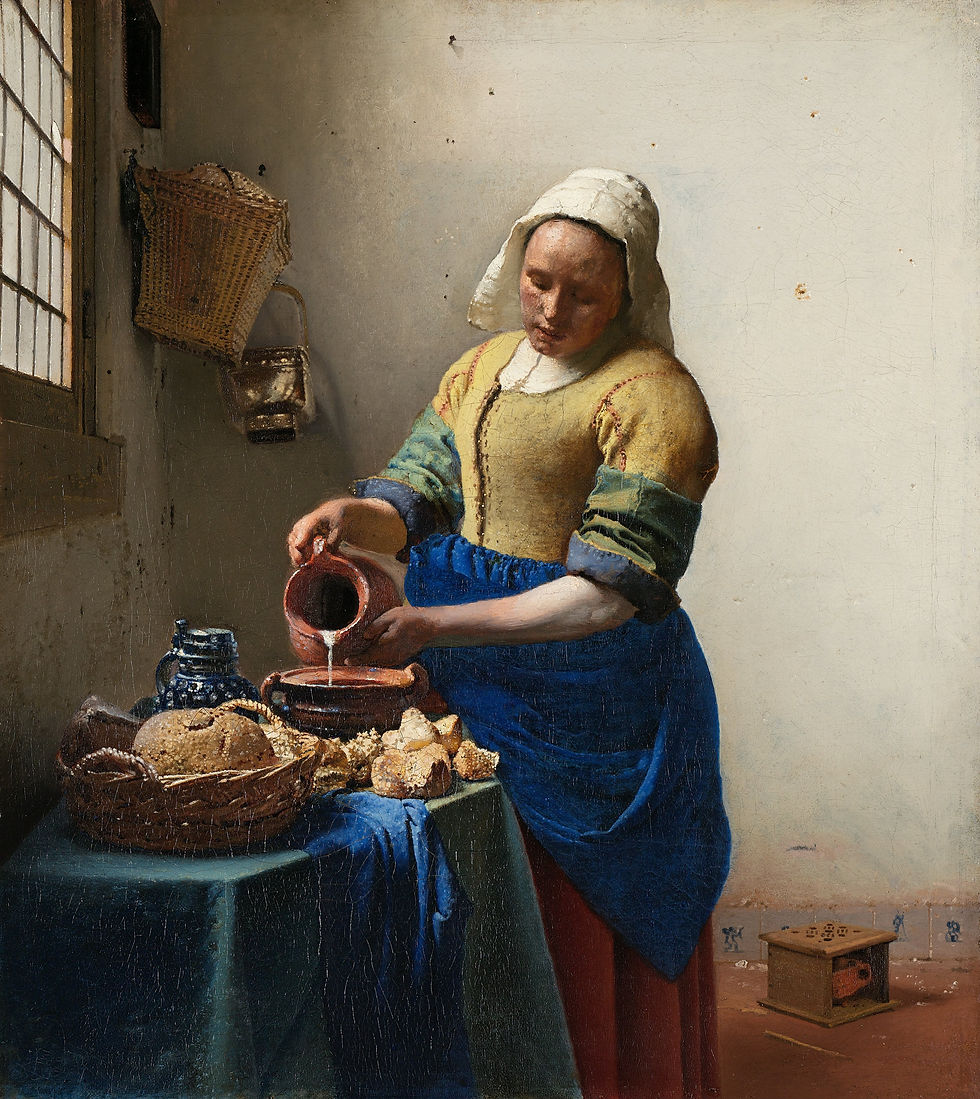
Vermeer's Milkmaid is the rare interior scene that belongs entirely in a kitchen. The maid is at her work surface, pouring milk slowly from a jug into a stoneware bowl. A loaf of bread, a basket, a copper pail hang on the wall behind her. The light comes from a window on the left. The palette is the warm whites and ochres of a working kitchen in 1660. Hang the print on the wall opposite the cooktop and the painting talks to the room.
4. Classical fruit — Italian still life
Italian still life of the seventeenth and eighteenth centuries — Caravaggio's Basket of Fruit, the Neapolitan school, the painters of fruit and game in Rome and Florence — has a darker, more theatrical palette than Dutch still life. Heavy crimsons, deep purples, glossy black grapes, a pear with a single perfect highlight. The paintings are the visual ancestors of every fine-dining menu cover for the last hundred years.
In a kitchen with dark cabinetry and a copper-pendant lighting scheme, an Italian fruit still life is the right anchor. The palette repeats the room. The composition gives the eye a single luminous object (a pomegranate, a pear) to rest on.
5. Botanical — Ernst Haeckel and the natural history prints
For a brighter, lighter kitchen — pale cabinets, north-light window, white tile — botanical prints are the cleaner choice. Ernst Haeckel's late-nineteenth-century natural-history plates are the canonical reference: detailed scientific drawings of jellyfish, orchids, ferns, sea anemones, all arranged in symmetrical compositions on a flat ground. The palette is muted — soft greens, pale ochres, the occasional flare of crimson — and the formal compositions give a modern kitchen the right kind of decorative rhythm without competing with the room's clean lines.
6. Hokusai — small Japanese still life
The third Japanese option — beyond Hokusai's waves and Hiroshige's landscapes — is the small still life of fish, fruit, or flowers from Edo-period ukiyo-e. The compositions are quieter than the wave prints. The palette is muted indigo, green, ochre. A single small Hokusai still-life print, framed in pale oak with a generous cream mat, anchors a quiet corner of the kitchen — over a coffee station, beside a window, above a small herb garden.
Composition rules for the kitchen
Three rules. One: hang higher than you would in a living room. Counter splatter zones extend about 80 cm from the work surface; anchor the frame at least 50 cm above the highest backsplash so a wet rag has a chance of reaching it. Two: glass under the frame, not behind the print directly — moisture creeps in through any unprotected seam, and a botanical print on uncovered paper will tide-mark within a year. Three: scale down. The kitchen is the room people walk through, not sit in. A 30×40 cm framed print at near-eye level reads more luxurious than a 60×80 cm canvas dominating the wall.
Key takeaways
Kitchen wall art has to survive steam, oblique light, and competition with the still life of the counter below.
Still life is the historically correct answer — Dutch banquet (Heda), Cézanne's apples, Vermeer's Milkmaid, Italian fruit, Hokusai still life, botanical Haeckel.
Match palette to room. Dark cabinets + copper light → Italian fruit. Pale cabinets + north window → botanical. Working farmhouse → Heda or Vermeer.
Hang at least 50 cm above the backsplash, with glass over the print, at a smaller scale than the equivalent living-room piece.
Featured prints
Vermeer, The Milkmaid — zocineartdesign.etsy.com/listing/1089363248
Caravaggio, Saint Jerome — Italian still-life mood — zocineartdesign.etsy.com/listing/982346924
Hokusai, The Great Wave — zocineartdesign.etsy.com/listing/1265846485
Browse the full archive at zocineartdesign.etsy.com.

Comments