The 19th-Century Romance Library Wall: Six Pre-Raphaelite Paintings for the Austen, Brontë, Eliot, Hardy, and James Reader
Updated: Aug 3
The 19th-century English novel and the Pre-Raphaelite painting were made at the same Victorian moment in the same English cities by people who knew each other socially. Charlotte Brontë wrote Jane Eyre in 1847 the same year Millais was completing his first Royal Academy submission; George Eliot's Middlemarch was published in 1872 the year Rossetti began the late Proserpine; Thomas Hardy's Tess of the d'Urbervilles arrived in 1891 inside a culture saturated with Pre-Raphaelite-mediated reading of Tennyson, Dante, and the Italian early-Renaissance. The novels and the paintings answer each other almost on cue. The six paintings below are chosen for the reader who has built her library around that century — Austen, the Brontës, George Eliot, Thomas Hardy, Henry James — and wants the wall above the reading shelf to operate in the visual register the books already operate in. The Pre-Raphaelite painting is the strongest single visual vocabulary the Victorian novel can be paired with.
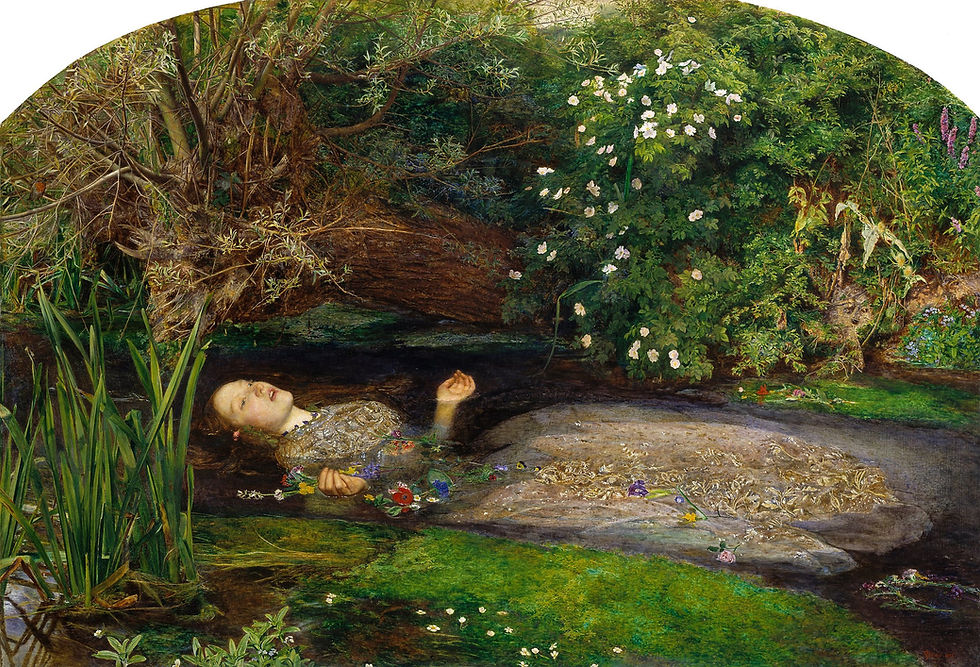
1. Millais, Ophelia (1851-52) → Charlotte Brontë, Jane Eyre / Emily Brontë, Wuthering Heights
Millais's Ophelia is the wall painting for the Brontë reader. The 1851-52 canvas depicts Hamlet's drowned Ophelia floating on her back in the Hogsmill river in Surrey, surrounded by accurate botanical specimens of English wildflowers (forget-me-nots, daisies, the willow she has fallen from, the violets that mean faithlessness in the Victorian flower-language). The painting reads as the canonical Pre-Raphaelite image of the Victorian female interior turned outward into landscape — Ophelia is the figure, the river is her interior weather, the wildflowers are the small attentions her grief has been keeping. Charlotte Brontë's Jane Eyre walking the moors after fleeing Thornfield, Emily Brontë's Catherine on the Wuthering Heights moors before her illness, both operate in the same register. Print at 70 × 100 cm horizontal, frame in slim unstained European oak with a wide cream-cotton mount, mount above the reading chair or above the bedside table. The Millais is the strongest single painting for the Brontë reader's wall.
2. Rossetti, Beata Beatrix (1864-70) → Thomas Hardy, Tess of the d'Urbervilles
Rossetti's Beata Beatrix is the wall painting for the Hardy reader. The 1864-70 canvas depicts Dante's beloved Beatrice at the moment of her death — her head tilted slightly back, eyes closed, a red dove descending toward her open hands with a white poppy, the city of Florence dissolving in the bronze-light background. Rossetti painted the canvas in the years following the suicide of his own wife and model Elizabeth Siddal; the painting is the visual statement of the Victorian female death that is simultaneously private grief and public allegory. Hardy's Tess walking toward Stonehenge at dawn in the novel's penultimate chapter is the same figure — beautiful, condemned by the social-religious machine, accepting the ending as the only ending available. Both works share a single thesis: the Victorian female self is destroyed by the system that produced her and the destruction is rendered as visual beauty. Print at 60 × 80 cm vertical, frame in dark walnut with a wide cream mount, mount in the reading nook or above the small bedroom dresser. The Rossetti is the painting Hardy readers tend to remember without immediately knowing why.

3. Hunt, The Hireling Shepherd (1851) → George Eliot, Middlemarch
Hunt's Hireling Shepherd is the wall painting for the Middlemarch reader. The 1851 canvas depicts a Hampshire shepherd who has abandoned his flock to flirt with a country girl in the foreground — the sheep are wandering into the corn field, a lamb is being fed inappropriate green apples, the entire Hunt-style botanical detail of the painting is a moral allegory about negligent provincial pastoral leadership. The painting is the visual companion to George Eliot's Middlemarch — Eliot's novel is the same moral allegory in prose, set in the same Midlands province, with the same Hunt-style insistence that small social negligences accumulate into community-scale failures. Dorothea's misjudgement of Casaubon, Lydgate's compromise on the Bulstrode money, Rosamond's social management of her own marriage — every Middlemarch plot-thread is a shepherd abandoning the flock for the country girl in some form. Print at 70 × 90 cm horizontal, frame in dark walnut, mount in the home-library. The Hunt is for the Eliot reader who has finished Middlemarch and is now reading it for the moral architecture rather than for the marriage plots.

4. Burne-Jones, The Golden Stairs (1880) → Henry James, The Portrait of a Lady
Burne-Jones's Golden Stairs is the wall painting for the Henry James reader. The 1880 canvas depicts a vertical procession of eighteen identically-dressed young women descending a long curving golden staircase in classical robes, carrying musical instruments. The painting reads as the strongest Victorian visual statement of refined female sociability turned into a tableau — the women are not going anywhere specific, the staircase does not arrive at a specific destination, the procession is its own subject. Henry James's Portrait of a Lady performs the same operation in prose: Isabel Archer enters European refined sociability, the social procession becomes its own subject, the destination matters less than the descending-the-staircase itself. Both works share a Jamesian thesis: refined social-form is enough to organise a life around even when the form has no specific external purpose. Print at 50 × 110 cm vertical (the Burne-Jones is a tall narrow composition), frame in slim unstained European oak with a thin gold-leaf inner line, mount in the hallway leading into the library or beside the reading shelf. The Burne-Jones is the gift for the James reader who has read Portrait of a Lady for the prose-form rather than for the plot.

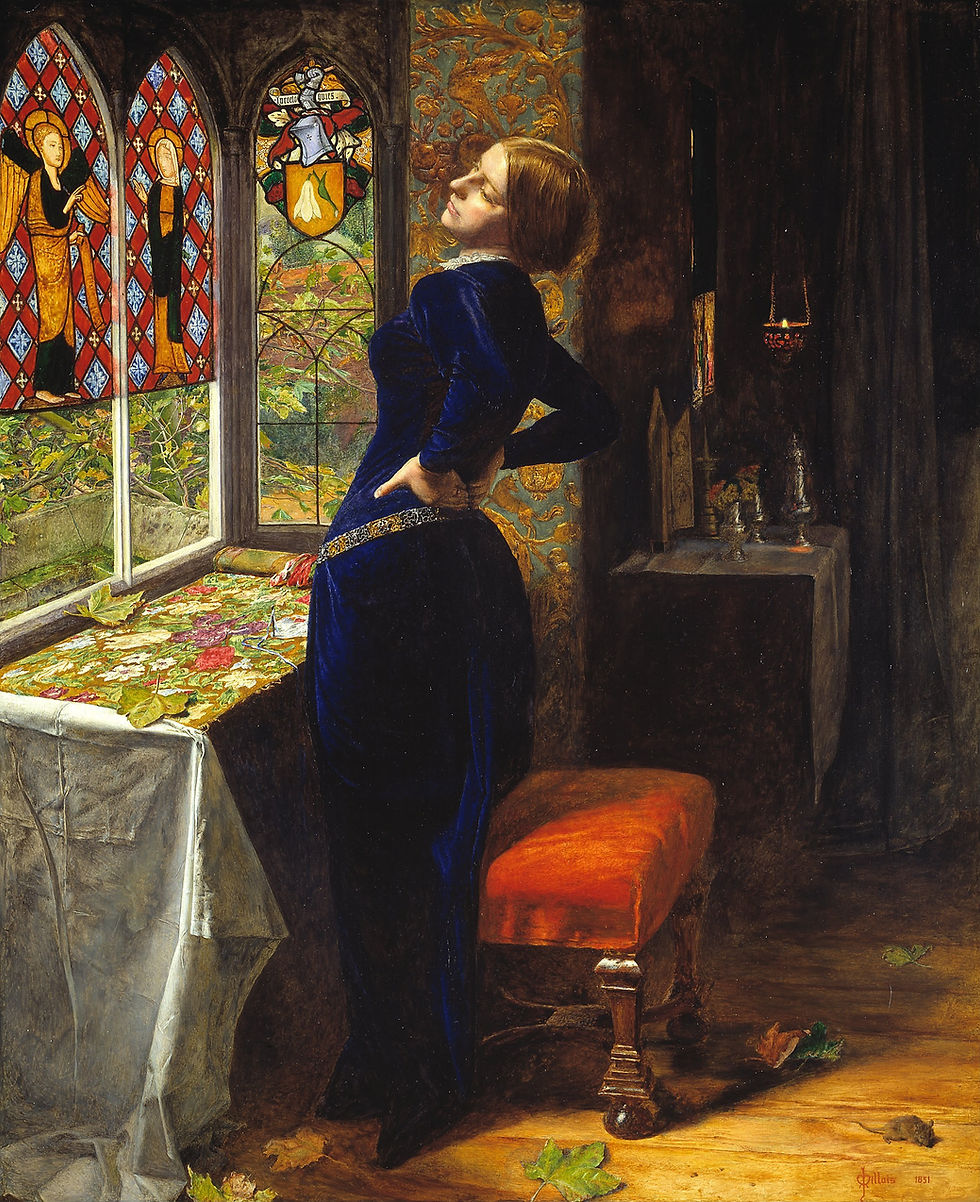
5. Millais, Mariana (1851) → Jane Austen + Tennyson's Mariana mood
Millais's Mariana is the wall painting for the Austen reader who also keeps the Tennyson on the shelf. The 1851 canvas depicts the title character of Tennyson's poem (itself a development of Shakespeare's Mariana in Measure for Measure) standing at her embroidery frame in a moated grange, stretching her back, gazing toward a stained-glass window — the painting catches the specific Victorian female mood of the small wait that is the whole life. Austen's Anne Elliot in Persuasion waiting eight years for Captain Wentworth to return, Charlotte Lucas in Pride and Prejudice accepting Mr Collins because the wait would otherwise be permanent — both operate in the same register. The painting is the wall companion for the Austen reader who has read the novels for the female social-economic architecture rather than for the romantic resolution. Print at 50 × 70 cm vertical, frame in slim unstained European oak, mount in the bedroom above the small writing desk. The Millais is the calmest wall pairing in this series.
6. Rossetti, Proserpine (1874) → the contained-female-self register
Rossetti's Proserpine is the wall painting for the female reader who keeps the Victorian canon on the shelf for the contained-female-self register that runs through the entire century. The 1874 canvas depicts Proserpine in the underworld holding the pomegranate she has just bitten — the bite that will keep her in Hades for half of each year. Rossetti rendered the figure as the model Jane Morris (William Morris's wife and Rossetti's long-term obsessive subject); the painting reads as the strongest Victorian visual statement of the female self contained inside a situation she did not choose and cannot leave. The Pre-Raphaelite painting and the Victorian female novelist were doing the same work from different angles — Brontë's Jane in the red-room, Eliot's Dorothea in Casaubon's library, Hardy's Tess at Talbothays — all are versions of Proserpine in the underworld holding the pomegranate. Print at 60 × 100 cm vertical, frame in dark walnut with a narrow black-cloth mount, mount in the reading nook or above the bedroom dresser. The Rossetti is the wall painting that does not pair with a single novel but with the entire 19th-century female-novelist project.

How to build the Pre-Raphaelite-coded library room
Three rules govern the 19th-c romance library room. First: WARMER WALL COLOUR. Pre-Raphaelite paintings ask for a warm-cream or warm-sage wall rather than the dark moss-green of the Dark Academia library; the Pre-Raphaelites painted on white-prepared canvases for luminosity, and the paintings want the wall to be warm-light rather than warm-dark. Second: FRAMED IN PAIRS. The Pre-Raphaelite paintings work in pairs — Millais Ophelia and Millais Mariana on the same wall; Rossetti Beata Beatrix and Rossetti Proserpine on the same wall. Two paintings of similar register read as a Victorian salon-hang rather than as separate decorative objects. Third: WIDE CREAM MOUNT, NOT NARROW BLACK MOUNT. The dark walnut frame plus narrow black mount belongs to the Gothic Dark Academia register; the Pre-Raphaelite register asks for slim unstained oak or dark walnut with a 5-7 cm wide cream-cotton mount — the wider warmer mount lets the painting breathe and matches the Pre-Raphaelite white-canvas luminosity.
Key takeaways
The 19th-century English novel and the Pre-Raphaelite painting were made at the same Victorian moment by people who knew each other socially. The novels and the paintings answer each other almost on cue.
Six text-painting pairings: Brontë Jane Eyre / Wuthering Heights → Millais Ophelia. Hardy Tess → Rossetti Beata Beatrix. Eliot Middlemarch → Hunt The Hireling Shepherd. James Portrait of a Lady → Burne-Jones Golden Stairs. Austen + Tennyson → Millais Mariana. The female-novelist project across the whole century → Rossetti Proserpine.
Three room rules: (1) WARMER WALL COLOUR — warm-cream or warm-sage, not the dark moss-green of the Dark Academia room. Pre-Raphaelite painted on white-prepared canvas; the wall wants to match. (2) PAINTINGS WORK IN PAIRS — Millais pair on one wall, Rossetti pair on another wall, reads as Victorian salon-hang. (3) WIDE CREAM MOUNT — slim oak or dark walnut frame plus 5-7 cm cream-cotton mount, never the Gothic narrow-black mount.
Print sizes: 50-70 cm wide for the vertical portrait pairings (Mariana, Beata Beatrix, Proserpine, Golden Stairs). 70-100 cm wide for the horizontal landscapes (Ophelia, Hireling Shepherd). The Burne-Jones Golden Stairs is a tall narrow composition — calibrate accordingly.
Reading-room mood: lamplight evening but warm-bright rather than the Dark Academia candle-light — 2700-3000K rather than 2400-2700K. The Pre-Raphaelite register is romantic-melancholic rather than Gothic-melancholic; the room's lighting should match the difference.
The 19th-century romance library is built around the Victorian female interior — the wait, the social architecture, the contained self, the small attentions grief keeps. Every painting in this series rewards the female reader who has been through the canon and now returns to it for what it actually contains rather than for the marriage plots.
Browse fine prints for the Pre-Raphaelite reader's library in the archive at zocineartdesign.etsy.com.
New in the Journal: The Most Famous Muses in Art History
New in the Journal: The Pre-Raphaelite Brotherhood Explained Through Seven Paintings

Comments