Dining Room Wall Art: The Vermeer and Caravaggio Approach to a Room That Feeds People
Updated: Aug 28
A dining room has only one function and the art on its walls should answer to it: a room where people eat together for an hour, sometimes two, sometimes longer. The art does three things at once. It warms the room when the lights drop for dinner. It deepens the colour of the wall behind the table. And it gives the eye somewhere to rest while the conversation moves.
Below are seven paintings from the Western canon that were either made for or have come to belong on a dining room wall — Caravaggio's Supper at Emmaus, Vermeer's domestic interiors, Manet's bar scene at the Folies-Bergère. Each entry explains why the painting works and how to hang it. The Caravaggio is the lead — painted around 1601 and built, structurally, for a dinner table.
Three rules for dining room art
The dining wall is the second-most-important wall in the house after the bedroom anchor. Three rules:
Scale to the table. The single painting above the table should be about two-thirds the table's width. A 180 cm table wants a 110–120 cm wide painting. A 240 cm table wants 150–180 cm. Smaller paintings on a dining wall look orphaned at scale.
Hang lower than you think. Centre the print 145–150 cm from the floor — about 60–75 cm above the table top. Above a dining table, art lives at sitting eye-level, not standing. Wallpaper-height paintings hover.
Warm tonal palette, dim lighting, no gloss. Dining rooms read by candlelight and 2700K bulbs. Choose paintings with warm earth-browns, oxblood, ochre, ink, charcoal — not pale pastels (read flat under low light) and not glossy reproductions (catch every candle reflection).
1. Caravaggio — Supper at Emmaus (1601)
Caravaggio painted Supper at Emmaus for a Roman dining room. The painting is, literally, a meal: Christ at the centre, an attendant offering a basket of fruit, two disciples mid-gesture as they recognise him. The light pours in from the upper left exactly the way light pours into a 17th-century European dining room from a high window. Hang this painting directly above the dining table. The painting will eat with you. Frame in dark walnut or oxidised brass; never gilt.
2. Vermeer — The Milkmaid (c. 1657)
Vermeer's Milkmaid is the quietest painting on this list — a single woman pouring milk into a bowl by a cool window. The painting is small in the original (45 × 41 cm) and translates to dining-room scale at 24×30 or 30×36. The yellow bodice, the blue apron, the soft window light: the colour values are tuned exactly to a warm-lit dining room. Hang on a sideboard wall or above a console — not directly over the table (the painting is too small for that scale). Pair with a tall pewter pitcher or a stack of linen napkins on the console below.
3. Manet — A Bar at the Folies-Bergère (1882)
Manet's last great painting is a bar scene: a barmaid stands behind a mirrored counter, bottles of champagne and crème de menthe lined up before her, the reflected crowd of the Folies-Bergère floating behind her. The painting is structurally a dining painting — bottles, glassware, a serving counter, the human exchange of food and drink. Hang above a sideboard or bar cabinet. The painting's mirrored composition makes it especially good across from a window or another mirror.
4. Vermeer — The Astronomer (1668)
The Astronomer is Vermeer's companion piece to the Geographer — a quiet study of a scholar at his table, reaching for a celestial globe by window light. The painting belongs in a dining room that doubles as a study or a long farmhouse table where conversation runs late. The browns, the cream, the deep cobalt of the scholar's robe: all dining-room colours. Hang at the head of the table, not above it. 24×30 framed in oxidised brass or dark walnut.
5. Caillebotte — Paris Street; Rainy Day (1877)
Caillebotte's panoramic view of a Paris boulevard in the rain is a dining painting in a different register — instead of an interior scene, it gives the dining wall a deep urban perspective that travels the room. The grey-blue palette reads beautifully against warm-cream dining walls and oxidised brass fixtures. Hang above a sideboard along the long wall of a rectangular dining room. The painting's strong horizontal composition reinforces the table's length.
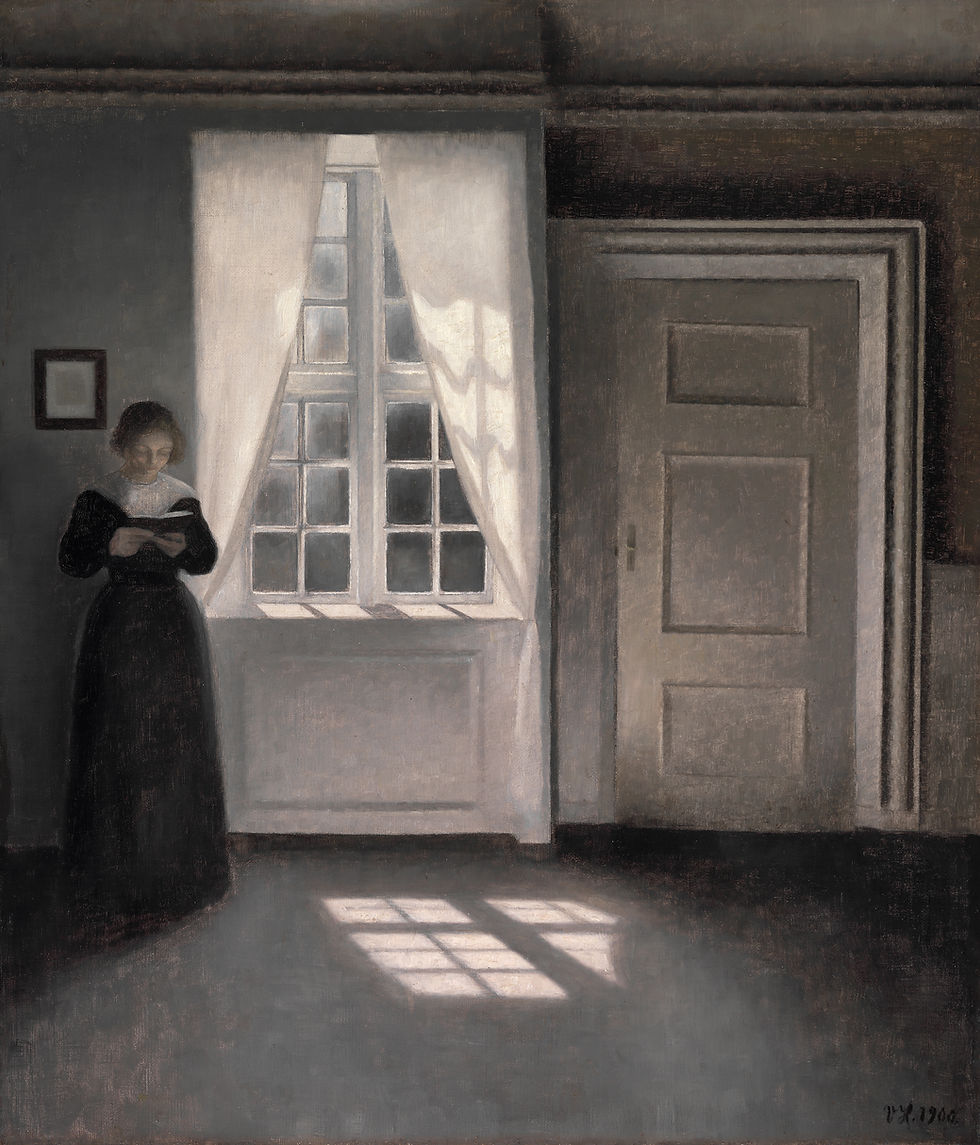
6. Hammershøi — Interior, Strandgade 30 (1900)
For a dining room that prefers stillness to drama — Hammershøi. The painting is an empty room rendered in cool grey light, with a door ajar and no human figure. As a dining-wall anchor it does something specific: it makes the room read as larger than it is by extending the apparent depth past the wall. Hang on the wall opposite the principal window so the painted light source aligns with the room's real one. Frame in matte black or pale oak.
7. Sargent — El Jaleo (1882)
El Jaleo is Sargent's twelve-foot painting of a Spanish flamenco dancer mid-performance in a tavern, dark figures clapping in the background, a glass of wine catching the lamplight on the table. It is, formally, a dining painting — a performance in a room where food is served. Hang on the long wall of a wide dining room (the original is 237 × 352 cm; a print at 30×45 or 36×54 honours the proportion). Frame in dark walnut. Pair with deep oxblood or charcoal walls; never against pale.
Choosing for your specific dining room
Long rectangular table: Caillebotte Paris Street or Sargent El Jaleo — horizontal compositions reinforce table length.
Round or square table: Caravaggio Supper at Emmaus or Vermeer Astronomer — centred compositions anchor a centred table.
Small dining nook or kitchen-dining hybrid: Vermeer Milkmaid 18×24 framed in pale oak. Single anchor.
Modern dining room with pale walls: Manet Folies-Bergère or Caillebotte Paris Street — French modern energy reads against modern interiors better than 17th-century chiaroscuro.
Traditional dining room with deep walls: Caravaggio, Vermeer Astronomer, or Hammershøi — earth tones against oxblood/ink walls.
Key takeaways
A dining painting works at 60–75 cm above the table top, sitting eye-level — not standing height.
Choose two-thirds of the table's width for the painting's width.
Warm earth-browns and oxblood read best under candlelight and 2700K bulbs.
Caravaggio's Supper at Emmaus is the canon's dining-table painting; Manet and Caillebotte give the same room a modern register.
Frame in dark walnut, oxidised brass, or matte black — never gilt, never glossy.
Where the prints live
A short list of the anchors that live as fine prints in the archive:
The full archive lives at zocineartdesign.etsy.com.

Comments