What AI Still Cannot Paint: Six Details Classical Masters Got Right That Generative Image Models Continue to Miss
Updated: Jun 17
Generative image models trained on billions of paintings can imitate the surface look of a Vermeer or a Caravaggio in seconds. The imitation is real and the imitation is also limited in specific structural ways that are not improving as fast as marketing suggests. The six classical-master details below have been tested repeatedly against the major 2024-26 generative models (DALL·E 3, Midjourney v6+, Stable Diffusion XL with classical-style LoRAs, Flux dev/schnell, Google Imagen) and each detail has continued to fail in the same way across model generations. The failures are not aesthetic preferences. They are structural — they trace back to specific information the training corpus did not encode, specific physical constraints the diffusion process cannot enforce, and specific cultural-historical context that no model has access to. The point of this post is not that AI image generation is bad. The point is that the classical masters were doing six specific things that AI in 2026 still has not learned to do, and noticing what they were doing is the basic argument for why the original paintings matter. The fine-print editions of the originals do something the AI image cannot do, even when the surface looks similar.

1. Caravaggio, Calling of Saint Matthew (1599-1600) — single light source physics
Caravaggio's Calling of Saint Matthew demonstrates the first detail AI image models fail to enforce: a single coherent light source. The 1599-1600 canvas in a Roman chapel is lit by one beam of late-afternoon sunlight from the upper-right window. Every shadow direction in the painting, every illuminated edge, every dark patch, every gleaming surface follows mathematically from that one source. Matthew's hand pointing at himself is illuminated on the upper side and shadowed on the lower side because the light is above-right; Christ's hand pointing across the table is illuminated on the upper side for the same reason; the wall behind the figures is gradient-shadowed in the same direction. The painting is the strongest Western demonstration of single-source tenebrism. AI generators trained on Caravaggio canvases reproduce the dramatic-contrast look but routinely render multiple incompatible light sources in the same image — a figure shadowed from the upper-left, a hand shadowed from the upper-right, a wall lit from the lower-left, all in the same generated canvas. The viewer's eye registers the physical impossibility unconsciously. The Caravaggio original feels structurally solid because the light is coherent; the AI imitation feels structurally wrong because the light is not.
2. Cézanne, Mont Sainte-Victoire late versions (c. 1904) — the deliberate unfinished patch
Cézanne's late Mont Sainte-Victoire canvases demonstrate the second detail AI image models fail to render: the deliberate unfinished patch. Cézanne painted the mountain more than sixty times between 1882 and his death in 1906; the late versions leave specific areas of the canvas unpainted — bare canvas showing through between the structured colour-patches — as a positive compositional decision rather than as an oversight. The unfinished patches argue that the mountain is being approached again, that the rendering is provisional, that the painter is refusing to declare the canvas finished because the canvas is not finished. AI image generators trained on Cézanne canvases either over-render the patches (filling in what Cézanne deliberately left out) or under-render the entire canvas (producing a uniformly sketchy result that looks like Cézanne-style but is not Cézanne-decisional). The deliberate unfinished patch is a load-bearing compositional structure that the generative model cannot reproduce because the generative model has no concept of "finished as a positive decision to refuse to finish." The original Cézanne reads as patient discipline; the AI imitation reads as either polish or roughness.

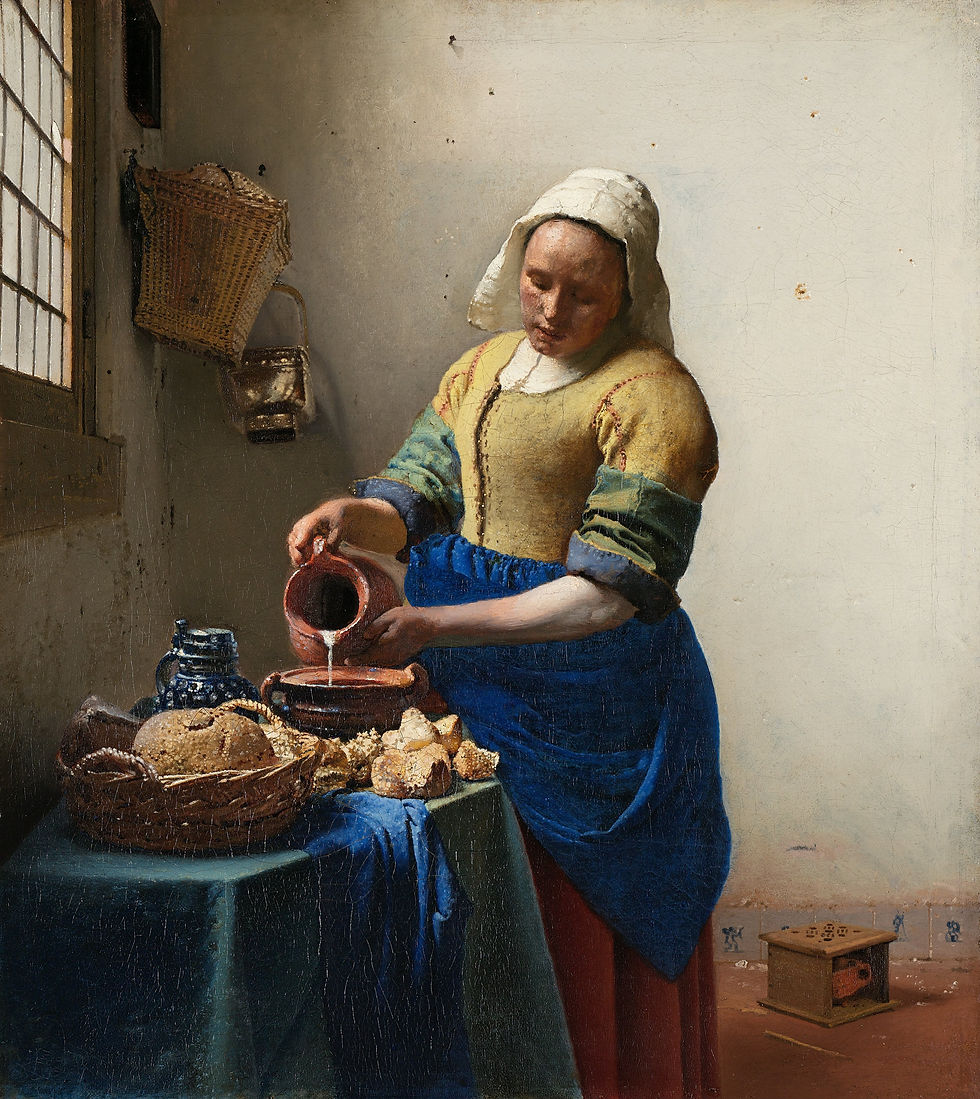
3. Vermeer, The Milkmaid (c. 1658-60) — ultramarine pigment depth
Vermeer's Milkmaid demonstrates the third detail AI image models fail to reproduce: the optical depth of multiple pigment layers built up over weeks. Vermeer used real ultramarine (ground lapis lazuli imported from Afghanistan) for the milkmaid's apron — a pigment that cost more per gram than gold leaf at the same Delft moment. The pigment was applied in multiple thin layers, each allowed to dry, then over-painted with subtle gradient adjustments. The optical effect is a blue that has structural depth — light enters the upper layers, refracts inside the pigment, exits at a slightly different angle than it entered. The viewer's eye perceives the blue as physical-three-dimensional rather than as flat-coloured. AI image generators render Vermeer-style blues as flat surface colour because the generative model has only the visual-output information of the trained images, not the per-layer pigment-buildup information that produced the optical effect in the first place. The AI Vermeer-imitation looks blue. The original Vermeer looks blue and also looks lit-from-inside. The difference is the pigment physics the model cannot access.
4. Friedrich, Wanderer above the Sea of Fog (1818) — atmospheric perspective mathematics
Friedrich's Wanderer demonstrates the fourth detail AI image models fail to enforce: the precise mathematical logic of atmospheric perspective. The 1818 canvas depicts a dark-coated male figure on a rocky outcrop gazing across a sea of fog at indistinct mountains beyond. The painting's depth is constructed via specific physics: distant mountains are rendered in cooler blue-grey hues with reduced contrast and reduced edge-sharpness because that is what real atmospheric particles do to light over long distances. Friedrich painted this from direct observation in the Saxon Switzerland mountains; the depth-effect is mathematically correct. AI image generators trained on Friedrich landscapes reproduce the romantic-figure-on-cliff composition but routinely render the far-distance with the same contrast and edge-sharpness as the near-distance — atmospheric perspective is one of the things the generative model does inconsistently because the model is sampling visual surface, not modelling the underlying physics. The Friedrich original reads as a real specific mountain range at a real specific distance; the AI imitation reads as a flat tableau where the far mountains and the near figure occupy the same depth.

5. Hokusai, Red Fuji (c. 1830-32) — woodblock fiber and printed registration
Hokusai's Red Fuji demonstrates the fifth detail AI image models fail to reproduce: the specific material register of a Japanese woodblock print. The c. 1830-32 print is not a painting at all — it is a five-block woodblock print on washi paper, each block carved separately for one colour, each colour registered in sequence onto the same sheet. The print has specific material properties: the paper's mulberry-bark fibre is visible inside the ink-saturated areas; the boundary between colour-blocks has a small wood-grain texture from the carved block; the colour-registration shows micro-misalignments where the printer's hand was not perfectly precise. AI generators trained on Hokusai images reproduce the recognisable composition (the red mountain, the cobalt sky, the cloud-bands) but render the result as digital flat-colour on a synthetic substrate. The fibre, the wood-grain, the registration micro-misalignments are absent. Hokusai's original print has a specific tactile material identity that an AI image cannot have because the AI image is pixels on a screen rather than ink on washi.

6. Rembrandt, Self-Portrait at the Age of 63 (1669) — the moral charge of a specific face
Rembrandt's last self-portrait demonstrates the sixth detail AI image models fail to reproduce: the moral charge of a specific human face the painter knew. Rembrandt painted dozens of self-portraits across forty years; the 1669 final canvas depicts the painter at sixty-three in the year of his death, financially ruined, recently bereaved. The face is not generally-aged. It is specifically-aged: the loss is in the slight downturn of the mouth, the alertness in the eyes that have not given up, the cheek-sag that registers the recent bereavement, the slight skin-tone shift from the studio-confined late life. AI image generators trained on Rembrandt self-portraits produce "old painter's face" composites that average across the dozens of self-portraits and produce a generic-aged face. The generic-aged face is not Rembrandt-in-1669 because the generic-aged face is no specific person; the Rembrandt original is the specific person Rembrandt was looking at in the studio mirror that year. The moral charge of the original is the recognition of one specific human at one specific moment. The AI imitation has no specific human and no specific moment — it has only the average of the surface.

Why this matters for the print buyer
The six failure modes above are not arguments that AI is worthless. They are arguments that a fine-print reproduction of a classical-master original carries information the AI imitation does not carry. The Caravaggio print carries the single-source-light physics because the original had it. The Cézanne print carries the deliberate unfinished patch because the original made it. The Vermeer print carries the ultramarine optical depth because the original built it. The Friedrich print carries the atmospheric mathematics because the original observed it. The Hokusai print carries the woodblock material identity because the original was printed it. The Rembrandt print carries the specific face's moral charge because the original recognised it. The decision to hang a fine reproduction of a classical-master original is a decision to share a room with the load-bearing structural information the master encoded. That information is not nostalgia; it is the specific content the wall hangs to carry. AI-generated images may eventually close one or two of these gaps, but the originals carry the gaps already-closed.
Key takeaways
Generative image models can imitate the surface look of a Vermeer or a Caravaggio in seconds. The imitation has six specific structural failure modes that have continued across 2024-26 model generations.
Six failure modes + master demonstrations: (1) Single-source light physics → Caravaggio Calling of Saint Matthew (1599-1600). (2) Deliberate unfinished patch → Cézanne Mont Sainte-Victoire late (c. 1904). (3) Ultramarine pigment optical depth → Vermeer Milkmaid (c. 1658-60). (4) Atmospheric perspective mathematics → Friedrich Wanderer above the Sea of Fog (1818). (5) Woodblock fibre + registration material identity → Hokusai Red Fuji (c. 1830-32). (6) Moral charge of a specific human face → Rembrandt Self-Portrait at 63 (1669).
Why each fails structurally: the diffusion model samples visual surface from training images; it does not model the underlying physics (light source coherence, atmospheric refraction, pigment-layer optics, woodblock material), the underlying compositional decision (unfinished patch as positive choice), or the underlying biographical specificity (one face on one specific day in one specific year).
The fine-print buyer's argument: a reproduction of a classical-master original carries the load-bearing structural information the master encoded. The Caravaggio print carries the light physics, the Cézanne carries the unfinished patch, the Vermeer carries the ultramarine depth — even at print-resolution, the structural decisions are visible.
This is not an argument that AI is worthless. AI image generation has its own appropriate uses (mood-boards, concept iterations, low-stakes decoration). The argument is that the classical-master originals are doing six specific things AI is not doing, and the wall that hangs the original is hanging the structural decisions that produced it.
Browse fine prints of the six classical masters discussed above in the archive at zocineartdesign.etsy.com.


Comments