The Existential Library Wall: Six Paintings for the Camus, Kafka, Beckett, and Plath Reader
Updated: Jun 17
The existentialist and modernist library has its own visual register and its own philosophical demands on the wall. The reader of Camus's L'Étranger, Kafka's The Trial, Sartre's Nausea, Beckett's Waiting for Godot, Plath's Bell Jar, and Woolf's Mrs Dalloway is not the reader of Anna Karenina or Middlemarch — the room reads differently because the books read differently. The six paintings below are chosen for that specific reader. Each painting answers the philosophical position of one specific text: Friedrich's emptied beach for Camus's beach, Bosch's juridical hellscape for Kafka's juridical labyrinth, Böcklin's funereal island for Plath's bell-jar suspension, Hammershøi's quiet Copenhagen interior for Woolf's London morning. When the painting on the wall and the book on the bedside table operate in the same philosophical register, the room stops being a decorated reading-corner and starts being the reader's actual position.

1. Friedrich, The Monk by the Sea (1808-10) → Camus, The Stranger
Friedrich's Monk by the Sea is the canonical wall painting for the Camus reader. A single Capuchin figure stands at the lower-left edge of an emptied beach and faces an indistinct horizon across a flat black sea under an enormous overcast sky that occupies four-fifths of the canvas. The painting was scandalous in 1810 specifically because it refused to provide a religious or narrative resolution — the monk faces the sea, the sea does not face him back, the painting does not pretend the encounter means anything. Camus's Meursault on the Algiers beach under the same sun is the same figure. Both works are exact statements of the absurdist position: meaning is asked for, the universe declines to answer, the figure remains. Print at 70 × 100 cm horizontal, frame in slim unstained European oak, mount above the reading shelf. The Friedrich is for the reader who keeps L'Étranger on the shelf for re-reading rather than for first-reading.

2. Bosch, Garden of Earthly Delights, right panel (c. 1490-1510) → Kafka, The Trial
Bosch's right-panel hellscape is the wall painting for the Kafka reader. Both works share a structural premise: the world is a fully-functional bureaucratic machine that follows a coherent internal logic the protagonist cannot access from inside it. Bosch's hellscape depicts Renaissance theological-bureaucratic punishment as a system of organised cruelty — knife-eared rabbits, bagpipe torture chambers, the bird-headed devil consuming and excreting damned souls in a glass throne; Kafka's K. enters a city-wide juridical machine that operates on the same internally-coherent-yet-inaccessible principle. Both works refuse to translate themselves for the viewer. Print the right panel alone at 50 × 90 cm vertical, frame in dark walnut, mount in the home-office or above the work-desk where the daily juridical machine is dealt with. The Bosch is the wall pairing for the reader of Kafka who has worked inside a large bureaucracy and recognised the architecture from inside.

3. Böcklin, Isle of the Dead (1880-86) → Plath, The Bell Jar
Böcklin's Isle of the Dead is the wall painting for the Plath reader. A pale-coated figure in a small black boat approaches a vertical limestone island ringed with funereal cypress trees; the painting is rendered five separate times across 1880-86 in five small variations, each in subtly different evening light. The painting is the strongest Western image of the closed bell of melancholic suspension — the state Plath's Esther Greenwood describes when the bell descends and the world's sounds go muffled. Both works are about a single female interior holding still inside an enclosure that no one else can see. The painting is also the closest visual representation of the specific Plath sentence: "To the person in the bell jar, blank and stopped as a dead baby, the world itself is the bad dream." Print at 60 × 80 cm horizontal, frame in dark walnut with a narrow black-cloth mount, mount in the bedroom or in the reading nook. The Böcklin is for the reader who has been through the bell themselves and is reading Plath as recognition rather than as introduction.
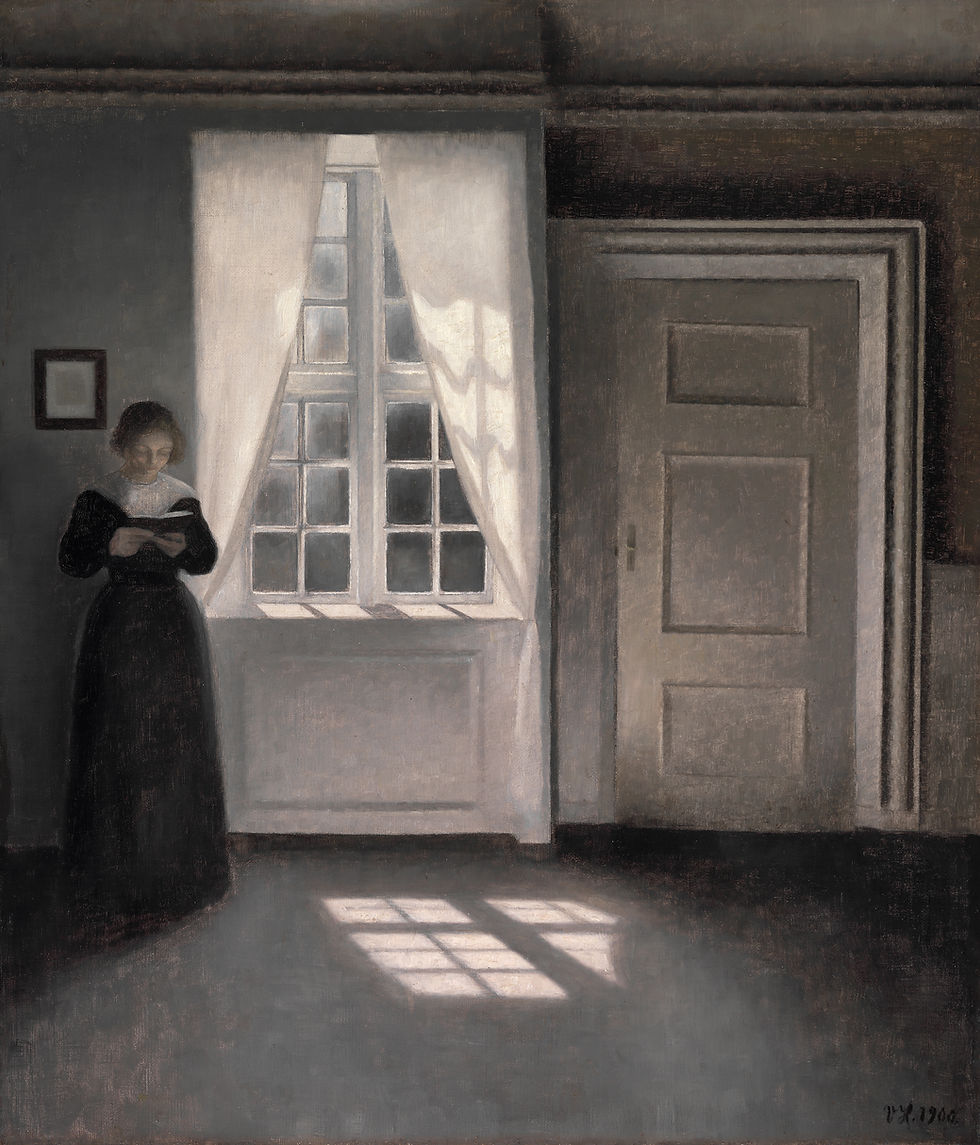
4. Hammershøi, Interior, Strandgade 30 (1900) → Woolf, Mrs Dalloway
Hammershøi's Interior, Strandgade 30 is the wall painting for the Woolf reader. A single woman in a high-collared dark dress is seen from behind, standing at a door in a quiet Copenhagen apartment interior, surrounded by cool grey light, an empty parquet floor, an empty table, a closed second door. The painting is the strongest Northern-European visual statement of the female interior morning — the woman alone in the room, the room alone in the city, the city briefly indifferent to the woman. Woolf's Clarissa Dalloway buying flowers and walking through London on a single June morning operates in the exact same emotional register. Both works share a thesis: the interior life is enough. Hammershøi painted Strandgade 30 — his own Copenhagen apartment — more than sixty times across his career; Woolf rendered Bloomsbury's interior monologue across an equivalent obsessive return. Print at 60 × 75 cm vertical, frame in unstained European oak, mount in the bedroom or in the small reading nook. The Hammershøi is the calmest wall pairing in this series.
5. Fuseli, The Nightmare (1781) → Beckett, Waiting for Godot
Fuseli's The Nightmare is the wall painting for the Beckett reader. A sleeping woman in a white nightdress lies thrown back across a red-curtained bed with one arm trailing the floor; an incubus crouches on her chest; a wide-eyed horse-head pushes through the curtain at the rear. The 1781 canvas reads at distance as Gothic theatre and rewards close looking with a specific recursive nightmare-logic — the dreamer cannot wake, the incubus has been there too long, the horse arrived from somewhere outside the dream and refuses to leave. Beckett's Vladimir and Estragon waiting on the country road for the Godot who does not arrive operate in the same recursive trap. Both works share a single principle: the situation is permanent, the situation does not improve, the figure cannot leave. Print at 60 × 75 cm horizontal, frame in dark walnut, mount in the home-office or in the hallway. The Fuseli is for the reader who has read Beckett as comedy rather than as despair.

6. Vermeer, The Astronomer (1668) → Sartre, Nausea
Vermeer's The Astronomer is the wall painting for the Sartre reader. A solitary man in a teal-coloured house-coat stands at his sun-lit window-side table, his hand resting on a celestial globe, a book of star-charts open in front of him. The painting reads as the rationalist's quiet morning study — the man is alone with the universe's mathematical structure, the universe is alone with the man's effort to model it. Sartre's Antoine Roquentin sitting in the café in Nausea trying to think his way back to a coherent universe is the same figure encountering the same problem from the other side: the rationalist effort, the world's resistance to being modelled, the recognition that the modelling itself is the burden. Both works are about the male mind confronting the universe's indifference to its categories — and choosing to keep modelling anyway. Print at 50 × 60 cm vertical, frame in unstained European oak, mount above the desk in the study. The Vermeer is the gift for the reader who has read Sartre as a discipline rather than as a mood.

How to mount the existential library wall
The existential library wall obeys three specific rules that differ from the general reading-shelf rules. First: DARKER FRAMES, NOT LIGHTER. The existential library room operates in lamp-light and shadow rather than in daylight; dark walnut and black-stained ash frames hold the paintings in the room's prevailing tone. Unstained light oak is acceptable for the two cooler-rationalist pairings (Hammershøi for Woolf, Vermeer for Sartre) but should not be the dominant frame material in a room dedicated to this literature. Second: LOWER LIGHT TEMPERATURE. The existential library wants 2400-2700 Kelvin warm-white, lower than the general reading-shelf's 2700-3000K — closer to candle-light than to morning-light. The room is being read in late evening; the painting should be lit accordingly. Third: NO GALLERY GRID. The existential library wall takes one or at most two paintings, never four-up grids — the room's philosophical premise is single-figure-confronting-universe, the wall should match. A grid of small paintings on this wall reads as decorative-cluttered and undoes what the books are doing.
Key takeaways
The existentialist and modernist library has its own visual register — the closed room, the indifferent universe, the female mind under glass, the bureaucratic labyrinth. The wall above the reading shelf wants a painting that argues what the books are arguing.
Six text-painting pairings: Camus L'Étranger → Friedrich Monk by the Sea. Kafka The Trial → Bosch Garden of Earthly Delights right panel. Plath Bell Jar → Böcklin Isle of the Dead. Woolf Mrs Dalloway → Hammershøi Strandgade Interior. Beckett Godot → Fuseli The Nightmare. Sartre Nausea → Vermeer The Astronomer.
Print sizes: 50-70 cm wide for vertical/portrait pairings, 60-100 cm wide for horizontal landscapes. Most existential library walls are above-shelf or above-chair walls, narrower than living-room walls — calibrate to wall width.
Three universal rules: (1) DARKER FRAMES — dark walnut + black-stained ash as defaults; unstained oak only for the two cooler-rationalist pairings (Hammershøi, Vermeer). (2) LOWER LIGHT TEMPERATURE — 2400-2700K warm-white, closer to candle-light. (3) NO GALLERY GRID — one painting, possibly two, never four-up.
Frame guidance per pairing: Friedrich Monk = slim unstained oak. Bosch hellscape = dark walnut. Böcklin Isle = dark walnut + narrow black-cloth mount. Hammershøi Strandgade = unstained European oak. Fuseli Nightmare = dark walnut. Vermeer Astronomer = unstained European oak.
Browse fine prints for the reader's library and reading nook in the archive at zocineartdesign.etsy.com.

Comments