Dark Cottagecore Kitchen: 8 Paintings From the Canon That Already Are
Updated: Jun 17
Dark cottagecore wasn't invented on Pinterest. It was painted in 1658.
The aesthetic is older than the algorithm: dim window light, copper and tin, slow work at a long wooden table, bread laid out without ceremony, a single tallow candle doing the work of a lamp. You can scroll a thousand kitchen reels and not find it, then turn one page in a Vermeer monograph and find it three times over.
These eight paintings are not cottagecore-inspired. They are cottagecore, painted four centuries early. Here is where each one belongs in your kitchen, and why.

01. Above the herb shelf — Vermeer's The Milkmaid (1658)

If dark cottagecore had a patron saint, she pours milk from a brown jug, in a wedge of slow Delft window light, beside a basket of broken bread.
Vermeer paints her with the same gravity he gives to scholars and saints. Her sleeves are rolled. Her apron has been worn down to a quiet ochre. There is a foot warmer on the floor and a nail with a single missing thread on the wall behind her. None of this is decorative — it is the kitchen, painted as if the kitchen mattered.
Hang her over the herb shelf or beside the spice cabinet — anywhere a soft northwest window already does the same work she is doing. Frame her in dark walnut or oxidized brass. Do not put a bright LED in the same line of sight.
02. By the side door — de Hooch's Courtyard of a House in Delft (1658)

Vermeer's Milkmaid is the interior. De Hooch is the threshold — the courtyard you see through the open back door, the place a kitchen secretly opens onto in your imagination.
Painted the same year as the Milkmaid, de Hooch's courtyard is a study in worn brick, a vine trained to a wall, a young woman and a child on the way out for water. There is no dramatic light here, only the steady afternoon kind that flatters terracotta and old plaster.
Hang him by the side door of the kitchen — the door that opens to the garden, the bins, the herb pots. He extends the room. The eye believes you really do have a courtyard out there.
03. Above the dining table — Caravaggio's Supper at Emmaus (1601)
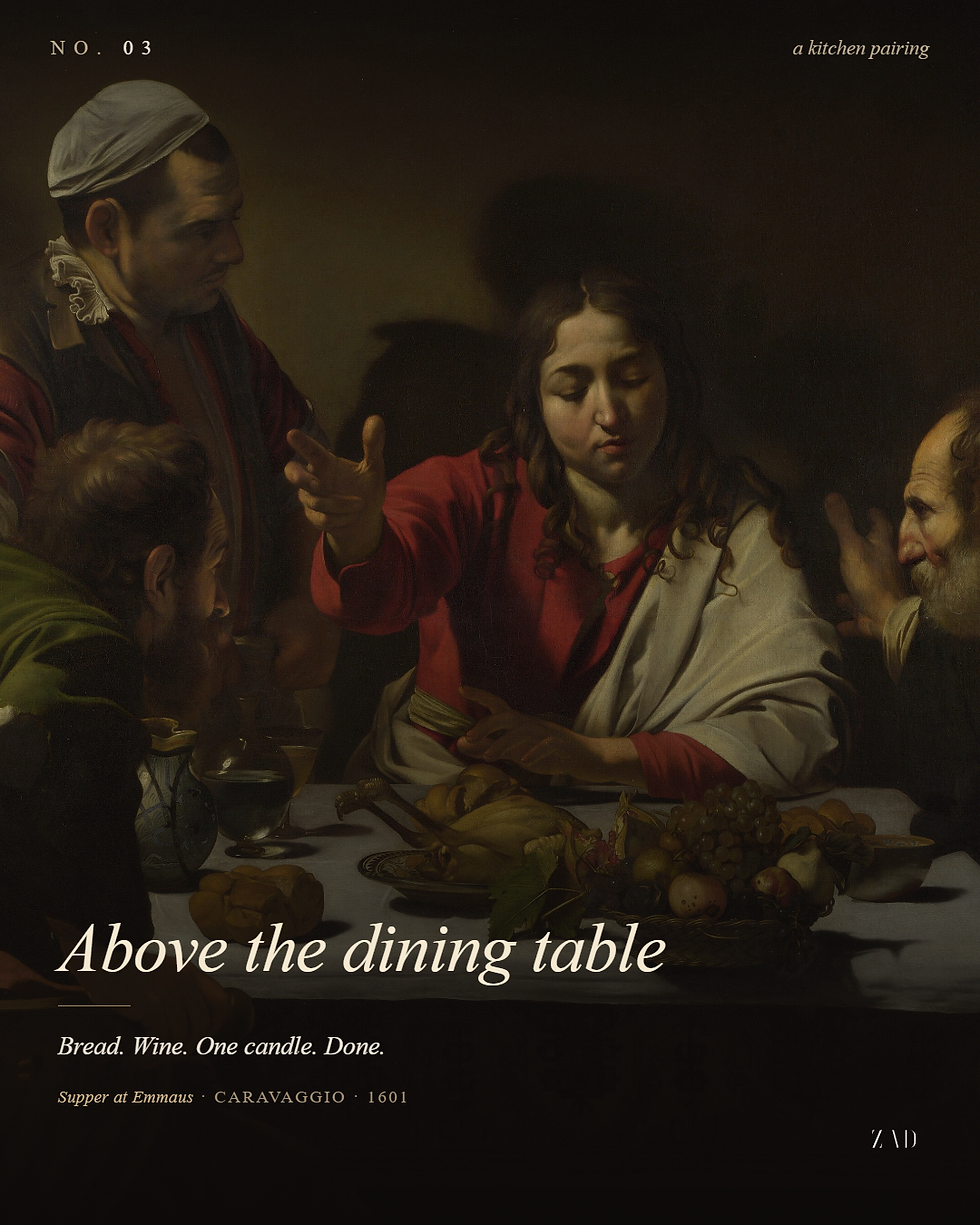
Bread. Wine. One candle. Done.
Caravaggio gives us the moment Christ is recognized at the table, but stripped to its kitchen vocabulary: a roasted fowl, a basket of fruit on the edge of turning, two earthenware vessels, the same tablecloth your grandmother kept in the drawer for company.
Hang him directly above the dining table. He is theatrical — chiaroscuro pulls the eye into a single pool of light — and so will your candles. The painting and the room cooperate.
04. Above the wine rack — Caravaggio's Bacchus (1596)

Bacchus is twenty, drowsy, half-undressed, holding out a glass of red and not bothering to fix his expression. The fruit at his elbow is already past peak — a wormhole bored through one apple, the leaves of the grapes browning at the edge. Caravaggio paints decay and youth in the same gesture.
It is the most cottagecore still life ever painted. Hang him over the wine rack, the bar cart, or the long-neck-jugs shelf. He earns his keep beside anything fermenting.
05. Above the breakfast nook — Jan Steen's The Feast of Saint Nicholas (1668)

Jan Steen knew that a real kitchen is not silent. There is a child crying, another child gloating, a grandmother smuggling sweets, a spaniel underfoot. The painting is loud. It is also warm: clay-pipe yellow, brick red, undyed linen.
Hang him above the breakfast nook — the spot where children eat and adults give up trying to keep things tidy. A painting that already knows what mornings are. He gives the chaos permission.
06. By the morning window — Hammershøi's Dust Motes Dancing in the Sunbeams (1900)
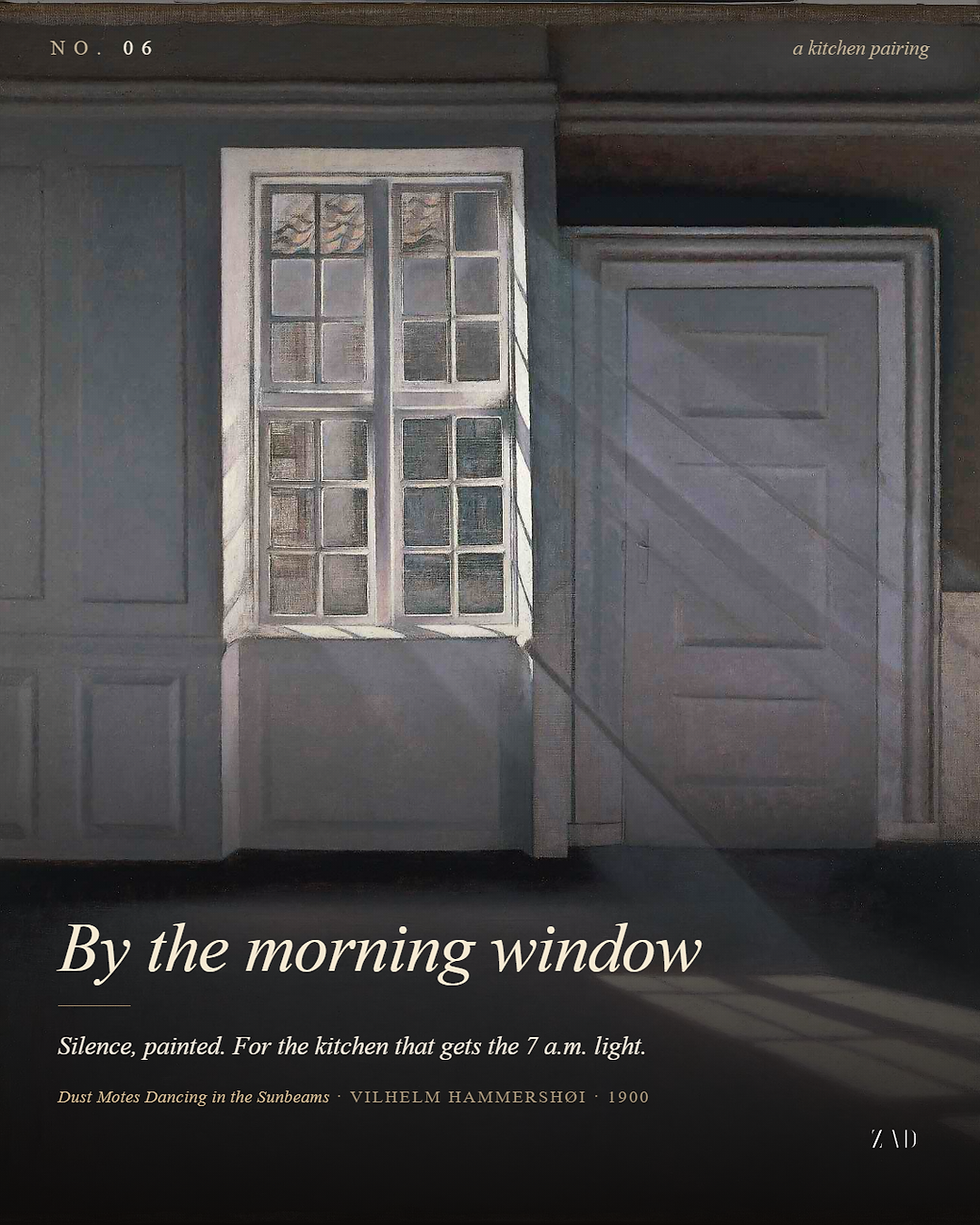
Hammershøi paints empty rooms the way Vermeer paints women — with reverence. Here there is no figure, no story, only a single tall window, a column of slanting light, and dust visible in the air.
It is silence, painted. For the kitchen that gets the 7 a.m. light — the breakfast corner before anyone is up, the moment between the kettle starting and the kitchen filling. Hang him on the wall the morning light hits last; let the painting and the room belong to the same hour.
07. Above the apron hook — Vermeer's The Lacemaker (1670)

Vermeer's smallest painting is a portrait of slow work. She is leaning into her lacework with the same intensity a sourdough baker watches a starter. Her hands are blurred — caught mid-stitch — and the threads in the foreground spill in a careless red fan.
She is the patron saint of slow living. Hang her over the apron hook, the recipe shelf, the spot where you stand and wait for the bread to rise. She will keep you company.
08. Above the bread board — Millet's The Angelus (1859)
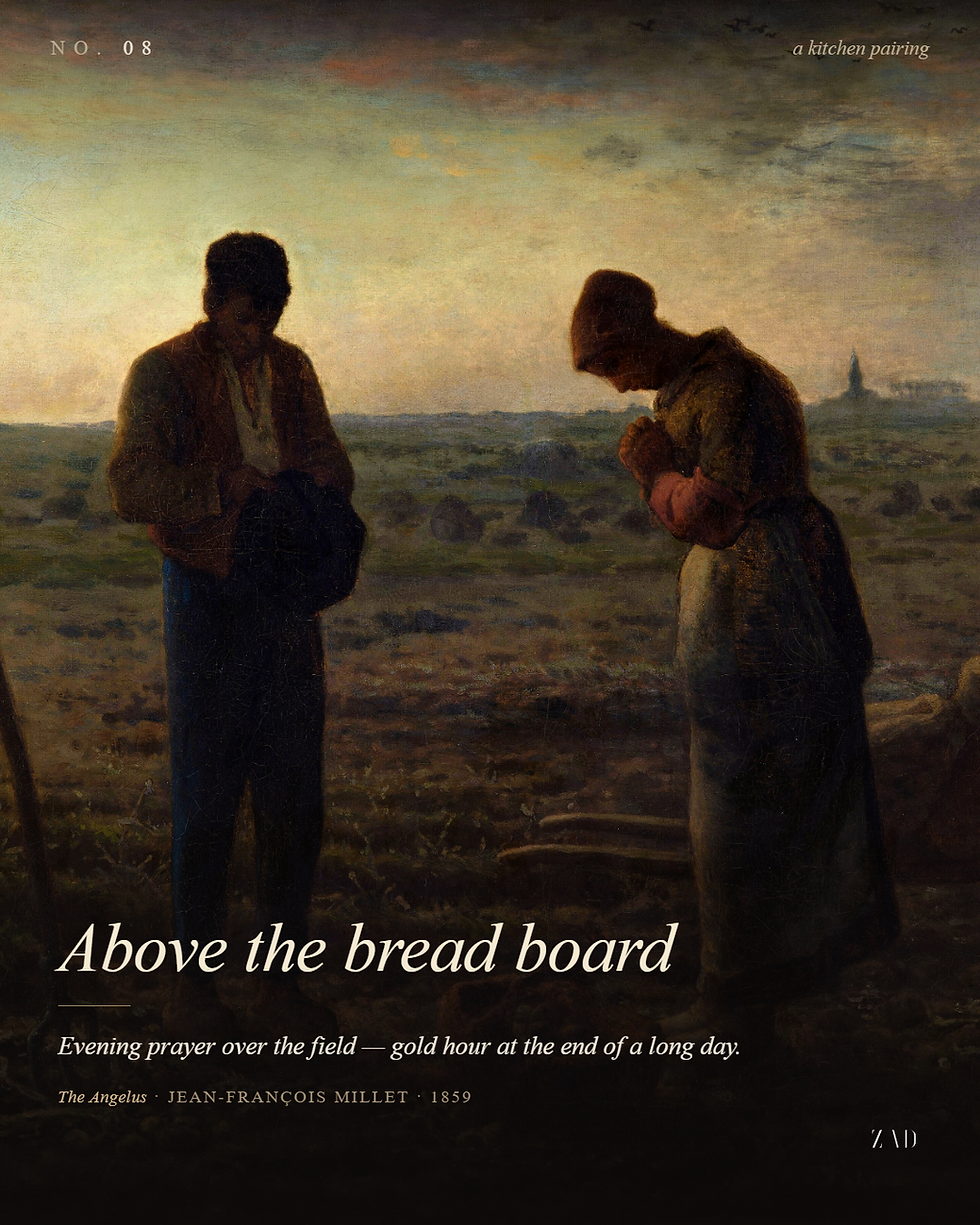
Two peasants stand in the field at the end of a long day. A church bell, off-canvas, has rung the evening Angelus. They have stopped — heads bowed, baskets at their feet, the cart half-loaded with potatoes — to pray. Behind them, the horizon is gold.
It is the painting of the meal before the meal: the field that fed the kitchen. Hang him above the bread board, the cutting block, the place where work that started outside becomes dinner. The painting reminds the room what it is for.
How to actually hang them
Dark cottagecore lives or dies on light. The rule: warm bulbs only — 2200K to 2700K, anything higher reads as office. Replace every kitchen overhead with a single linen pendant if you can; flank it with under-cabinet warm strips. The paintings will glow.
Frame in dark walnut, ebonized oak, oxidized brass, or unfinished pine. Avoid black aluminum, white gloss, and gold leaf — they belong to a different century.
Do not hang any of these over the stove. Steam, grease, and pigment do not get along. The wall behind the toast, beside the breakfast table, above the dry pantry shelf — these are the right walls.
A note on the aesthetic
Dark cottagecore is a Pinterest search query, but it is also four hundred years old. Vermeer painted it. Caravaggio painted it. Hammershøi painted it almost in silence. The trend will pass; the paintings will outlast it.
Which one is your kitchen?

Comments