Old Money Wall Art: Eight Paintings for the Quiet-Luxury Aesthetic
Updated: 4 days ago
Old money is recognisable, in a room, by what is missing. There is no oversized abstract canvas screaming above the sofa. No motivational quote in script font. No statement chandelier doing the work of the architecture. The walls hold what the family has held for two or three generations: a small portrait, a quiet interior, a landscape that has been there long enough that no one in the room remembers buying it.
Quiet luxury, the current name for this aesthetic, has been built into a brand category by fashion houses over the last five years. The interior version is older. It comes from a longstanding European convention — that the loudest object in a room should not be the art. The art should sit, register on the eye, and recede.

1. Sargent, Madame X (1884)
Virginie Gautreau in profile, the strap of her black evening gown originally slipping off her right shoulder (Sargent repainted it after the 1884 Salon scandal), her skin painted in lavender-grey against a near-black wall. The painting has been the founding object of the old-money portrait aesthetic for a hundred and forty years. It does what almost no other portrait of the period does: it gives you nothing — no expression, no narrative, no flattery — and trusts the viewer to find the composition itself sufficient.
2. Sargent, El Jaleo (1882)

A second Sargent because Sargent is the painter of the aesthetic. El Jaleo is a wide, dark, almost monochrome canvas of a flamenco dancer mid-step in a Spanish tavern. The dancer's white skirt is the only bright thing on the wall. Everything else is the colour of old wood and candle smoke. The painting hangs horizontally over a long console table or a fireplace and absorbs the room.
3. Cassatt, The Tea (c.1880)

Mary Cassatt painted American women drinking tea, reading, sitting with their daughters, holding their own children. Her subjects are educated, well-dressed, at home, and absolutely uninterested in being looked at. The Tea is the canonical example — two women, a silver service, a morning conversation. Nothing performs. The painting is the visual equivalent of a quiet apartment in Boston in 1885.
4. Hammershøi, Interior with Sun on the Floor (c.1900)
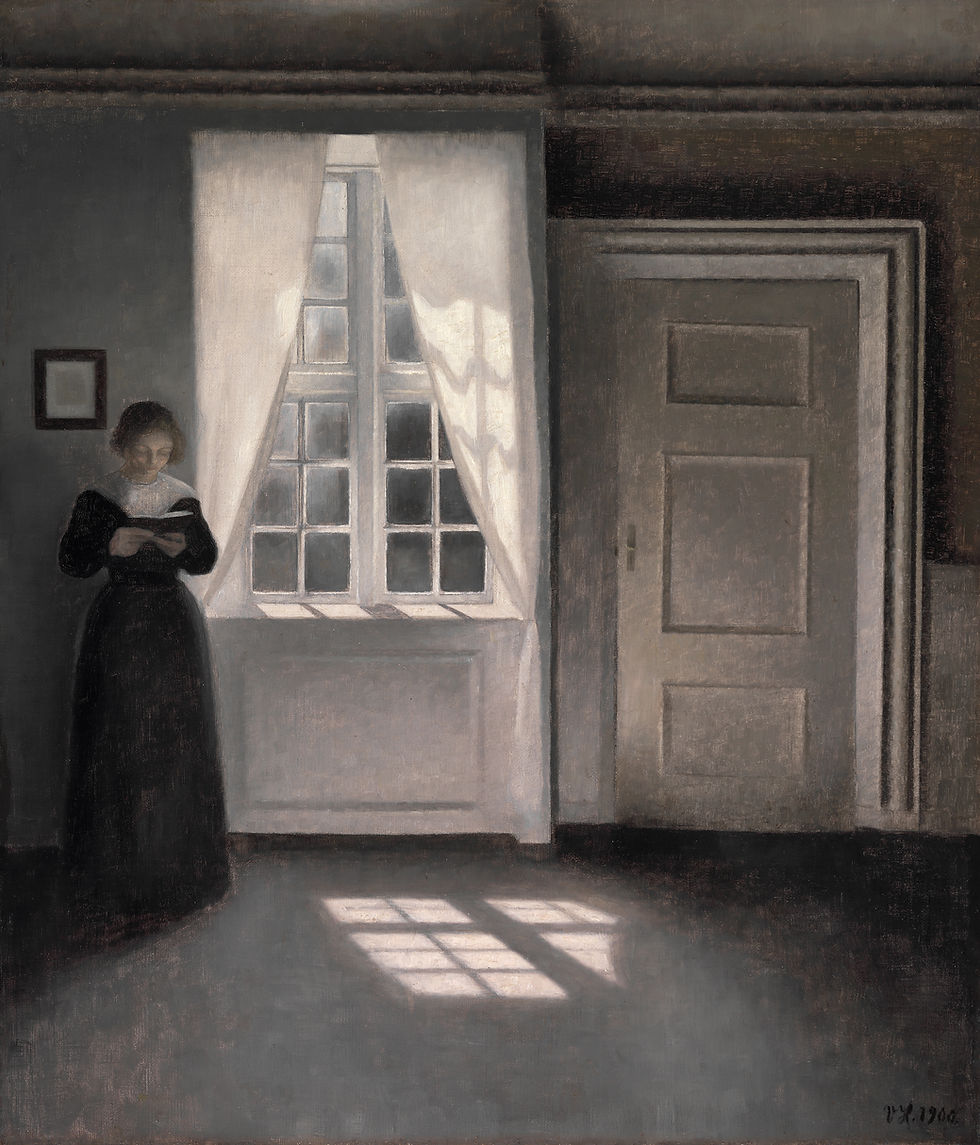
Vilhelm Hammershøi's Copenhagen interiors are paintings of nothing — empty rooms, north light, white walls, sometimes a woman from behind. The palette is built from greys, whites, and the occasional pale gold of late afternoon. Hammershøi has been the painter of choice for restrained interiors since at least the 1990s. In a high-ceilinged room with off-white walls a single Hammershøi anchors the space without doing anything visible.
5. Vermeer, The Astronomer (1668)

A Vermeer interior — Astronomer, Geographer, Lacemaker, Milkmaid — does for an old-money study what Hammershøi does for an old-money living room. The Astronomer in particular is the painting of a scholar working alone in north light, surrounded by books, charts, and a celestial globe. The aesthetic is intelligence at rest. The painting is small (about 50 by 45 cm in the original), and a quality print at near-original scale carries the entire feeling of the room.
6. Manet, A Bar at the Folies-Bergère (1882)

Manet's barmaid stares directly out of the canvas at the viewer, behind a counter loaded with champagne bottles, oranges, and roses. The mirror behind her reflects the crowd at the Folies-Bergère, the entire late-Paris world the painting comes from. The aesthetic is composed bourgeois Paris in the late nineteenth century — the same world the term old money is borrowed from. The black-and-gold palette anchors a dining room or a bar.
7. Whistler, Nocturne in Black and Gold (1875)

Whistler's Nocturnes are paintings of fog, river light, and fireworks over the Thames at night. The Nocturne in Black and Gold — which Ruskin in 1877 called a pot of paint flung in the face of the public, and which Whistler then sued for libel — is the most luminous of them. The palette is black, grey-blue, and pale gold. The painting reads as architecture: a small Whistler hung in a dim hallway becomes a window on a winter river.
8. Renoir, Two Sisters (On the Terrace) (1881)

A young woman in dark blue and a small girl with red hair and a basket of flowers on a terrace overlooking the river. Renoir at his most composed — none of the late, sweet-toothed nudes, just two figures in afternoon light, the palette a quiet study in dark blue, white, and small flares of red. The painting is the eighteenth-century French portrait tradition arriving in 1881 in colour-photograph clarity.
How to choose, in one paragraph
If the room reads cool, go Hammershøi or Vermeer. If the room reads warm, go Sargent or Manet. If the room is the family dining room, go El Jaleo or Folies-Bergère. If the room is a study or a library, go The Astronomer or Two Sisters. The single rule across all eight: the painting should be the second-quietest thing in the room. The first is the room itself.
Key takeaways
The old-money aesthetic is recognisable by what is missing — no loud abstract above the sofa, no motivational script, no statement chandelier doing the work of the architecture.
Eight paintings carry the register: Sargent (Madame X, El Jaleo), Cassatt (The Tea), Hammershøi (Interior with Sun), Vermeer (Astronomer), Manet (Folies-Bergère), Whistler (Nocturne), Renoir (Two Sisters).
The unifying choice is restraint of palette — blacks, greys, deep blues, controlled flares of white or gold — and the refusal of any image that performs its own importance.
A quality print at near-original scale carries the entire feeling. Oversize is the giveaway of new money; correct scale is the giveaway of old.
Featured prints
Sargent, Madame X — zocineartdesign.etsy.com/listing/1853177346
Sargent, El Jaleo — zocineartdesign.etsy.com/listing/1481785794
Cassatt, The Tea — zocineartdesign.etsy.com/listing/1870229593
Hammershøi, Interior — Sunlight on the Floor — zocineartdesign.etsy.com/listing/1145509895
Vermeer, The Astronomer — zocineartdesign.etsy.com/listing/1089389806
Manet, A Bar at the Folies-Bergère — zocineartdesign.etsy.com/listing/1870913363
Whistler, Nocturne in Black and Gold — zocineartdesign.etsy.com/listing/1269609092
Renoir, Two Sisters (On the Terrace) — zocineartdesign.etsy.com/listing/1866726077
Browse the full archive at zocineartdesign.etsy.com.
Related Reading
New in the Journal: Library Wall Art: Six Paintings That Belong on the Wall Beside a Bookshelf
New in the Journal: Hotel Lobby Wall Art: Six Paintings That Hold a Space Designed to Be Walked Through
New in the Journal: Bedroom Wall Art for Couples: Six Paintings That Don't Argue With Each Other


Comments