Light Academia Wall Art: 8 Paintings for a Bright, Quiet, Read-By-A-Window Aesthetic
Updated: Aug 29
Light academia is the bright cousin of dark academia. Same library, same study, same long afternoons with a book — but the curtains are open and the light pouring through is the colour of cream. Where dark academia builds its world in oxblood and ink and candle-lit Caravaggio, light academia builds its world in oat-linen, pale plaster, soft sunlight, and Impressionist gardens. The aesthetic is calmer. It reads later in the day, but it reads slower.
Below are eight paintings that anchor a light academia interior. The list draws from Impressionism (Monet, Renoir, Cassatt, Pissarro), late 19th-century French scenes (Caillebotte), and quieter interior work that translates the aesthetic to a study or reading room (Vermeer Milkmaid, Hiroshige museum print). Each anchors a different wall, a different room, a different time of day.
What makes a painting light academia
Three formal markers separate light academia from its darker cousin:
High-key palette. Cream, pale rose, dove grey, soft sage, oat, butter yellow, sky blue. No oxblood, no ink, no charcoal. The brightest values dominate; the darkest values barely descend below mid-grey.
Natural daylight as primary light source. Light academia paintings read at 10 a.m. or 4 p.m., not at midnight by a single candle. Impressionism — built on outdoor light study — is the foundational vocabulary.
Soft figurative subject. Mothers and children, gardens, breakfast tables, women reading by windows, dancers in studios. Light academia avoids religious chiaroscuro and political portraiture; it lives in the domestic interior and the garden.
1. Monet — Impression, Soleil Levant (1872)
The painting that named Impressionism is also the foundational light-academia anchor. The harbour at Le Havre at sunrise, painted in pale blue, soft peach, and a single hot orange disc at centre. Hang this anywhere natural morning light falls onto the wall — east-facing rooms, breakfast nooks, light-filled hallways. Frame in pale oak or thin matte black. The painting's restraint reads beautifully against cream linen walls.
→ Available as a print: Monet — Impression, Sunrise on Etsy
2. Renoir — Bal du moulin de la Galette (1876)
Renoir's open-air dance scene at Montmartre is the warmest painting on this list — dappled afternoon light, peach skin, soft pinks and greens, the entire scene held in a single warm midday glow. The painting is large in the original (131 × 175 cm) but reads well at 24×30 or 30×40 print scale. Hang in a living room or reading lounge where afternoon sun falls. Pale oak frame; here gilt also works if your interior leans more 19th-century classical.
3. Cassatt — The Child's Bath (1893)
Mary Cassatt's quiet domestic scenes are the canon's purest light-academia subject — a mother and a child, a basin of warm water, a striped dress, the soft afternoon light coming in from off-canvas left. Cassatt's high-key palette and her hard outline (borrowed from Japanese ukiyo-e prints) make her work read clearly even at small print scale. Hang in a bedroom, a nursery, or a private study. 18×24 framed in pale oak.
→ Available as a print: Cassatt — The Child's Bath on Etsy
4. Pissarro — Boulevard Montmartre, Spring (1897)
Pissarro's series of Boulevard Montmartre views — painted from the same hotel window in different seasons and times of day — are the urban anchor of light academia. The Spring view is the brightest: pale sky, soft new-leaf green, the boulevard's broad sweep below. Hang in an apartment hallway or above a writing desk. The composition's deep perspective adds the illusion of depth to a small room. Frame in pale oak or oxidised brass.
→ Available as a print: Pissarro — Boulevard Montmartre on Etsy
5. Monet — Water Lilies (1906)
The late Monet water lily paintings are the most reproduced light-academia anchors in the world. The Giverny pond reflects pale sky, soft willow, lavender lilies — the painting is essentially an abstract field of high-value colour. Hang in a calm room — bedroom, study, sitting room. The painting calms a wall rather than dominating it. Pale oak or thin gilt frame; the abstraction means the frame can carry more decoration than for sharper figurative work.
→ Available as a print: Monet — Water Lilies on Etsy
6. Caillebotte — Paris Street; Rainy Day (1877)
Caillebotte's panoramic Paris boulevard in light grey rain is the silver light-academia anchor — cooler than Renoir or Monet, but still high-key. The grey-blue palette reads particularly well in north-facing rooms or rooms with cool daylight. Hang above a sideboard, a console, or a long bench. The painting's strong horizontal composition makes it especially good in rectangular rooms with long walls.
→ Available as a print: Caillebotte — Paris Street, Rainy Day on Etsy
7. Vermeer — The Milkmaid (c. 1657)
Vermeer's Milkmaid is a 17th-century painting but its values land squarely in light academia: a cool grey-blue wall, soft cream linen, pale window light, a single quiet figure absorbed in a domestic task. The painting bridges the gap between Dutch Golden Age interior painting and the Impressionist domestic scenes that came two centuries later. Hang in a kitchen or breakfast nook. 18×24 in dark walnut.
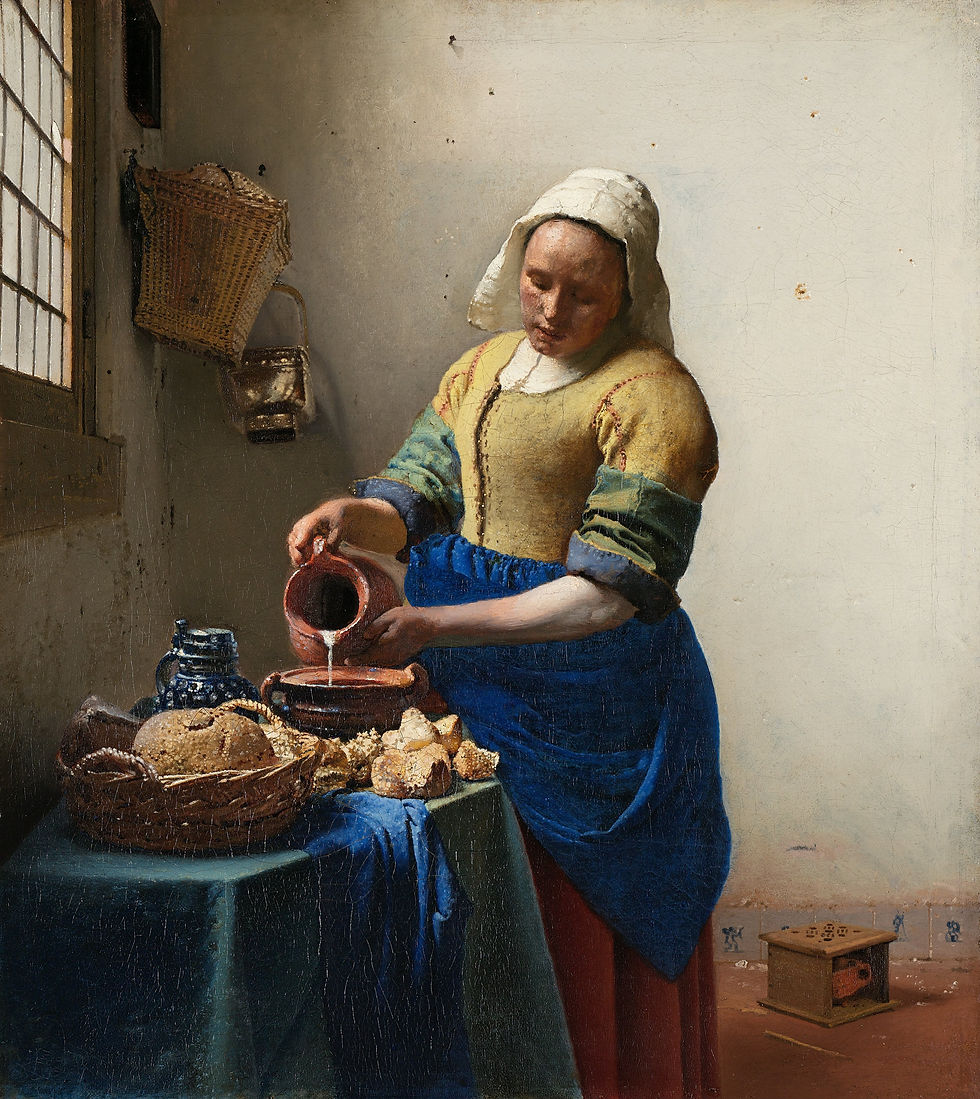
→ Available as a print: Vermeer — The Milkmaid on Etsy
8. Hiroshige — Museum Print
A Hiroshige ukiyo-e print is the Japanese parallel to light academia — cool palette, soft light, restrained figurative composition. The block prints translate beautifully to modern light-academia interiors because the colour values, the precision of the linework, and the calm subject matter all map onto the same aesthetic. Hang in a hallway, a powder room, or as a vertical pair beside a tall window. 18×24 or 16×20 in pale oak or thin matte black.
→ Available as a print: Hiroshige — Museum Print on Etsy
Choosing for your specific light-academia room
Cream walls, oak floor, lots of natural light: Monet Impression Soleil Levant or Renoir Bal du Moulin. The warm palette doubles the natural daylight.
Cool grey walls, north-facing room: Pissarro Boulevard Montmartre or Caillebotte Paris Street. Cool greys read clean.
Bedroom or quiet study: Cassatt Child's Bath or Monet Water Lilies. Calmest tonal values.
Kitchen or breakfast nook: Vermeer Milkmaid. The cream-and-yellow palette is built for morning rooms.
Hallway or powder room: Hiroshige museum print. Small scale, vertical orientation, calm palette.
Key takeaways
Light academia is the bright cousin of dark academia — same study, same library, same long afternoons; cream rather than oxblood.
Impressionist paintings (Monet, Renoir, Cassatt, Pissarro) are the foundational vocabulary.
Pale walls, oak floors, oat linen, soft sunlight — never gilt frames against the brightest paintings; pale oak or thin matte black.
Hang at sitting eye-level in reading rooms and breakfast nooks where daylight falls naturally on the wall.
Vermeer Milkmaid and Hiroshige museum prints bridge into light academia from outside the Impressionist canon.
Where the prints live
A short list of the anchors that live as fine prints in the archive:
The full archive lives at zocineartdesign.etsy.com.


Comments