Wabi-Sabi Wall Art: Eight Paintings for Imperfect Stillness
Wabi-sabi is the Japanese aesthetic of imperfection, impermanence, and incompleteness. It is the cracked tea bowl repaired with gold lacquer. It is the wooden floorboard worn smooth by a hundred years of feet. It is the painting that has faded a quarter-shade in the corner where the morning sun fell on it for a century. The aesthetic resists the symmetry of luxury and the polish of new construction. It is the visual language of things that have been quietly used for long enough to settle.
On a wall, wabi-sabi reads as restraint. The painting is small, or muted, or asymmetric. Empty space carries equal weight to the image. The frame is unfinished oak or natural maple, not glossed gilt. The room around the painting is allowed to remain partially empty. The eight paintings below carry the register across four centuries and three continents — Japanese, Dutch, French, English. The common quality is that none of them performs.

1. Hokusai, Mishima Pass in Kai Province (c.1830)
From the Thirty-six Views of Mount Fuji series. Three small travellers stand at the base of an enormous cypress trunk, hands joined around its girth, trying and failing to encircle it. Mount Fuji is a distant blue shape on the horizon. The composition is asymmetric — the tree dominates the right two-thirds of the print, the figures and the mountain occupy the left third. The empty space above the tree is the actual subject of the print. The aesthetic is the human scale against the patient continuity of an old tree.
2. Hiroshige, Plum Garden at Kameido (1857)

A late Edo-period print of plum blossoms in pink against a soft green ground. The composition is famously unconventional — a single ancient plum trunk runs vertically through the dead centre of the print, cutting the image in half. The convention says you do not do this. Hiroshige did it anyway, because the gnarled, twisted trunk was the point. The blossoms are the visual contrast. Van Gogh copied this print in 1887 and could not understand how Hiroshige had pulled it off.
3. Hammershøi, Interior with Sunlight on the Floor (c.1900)
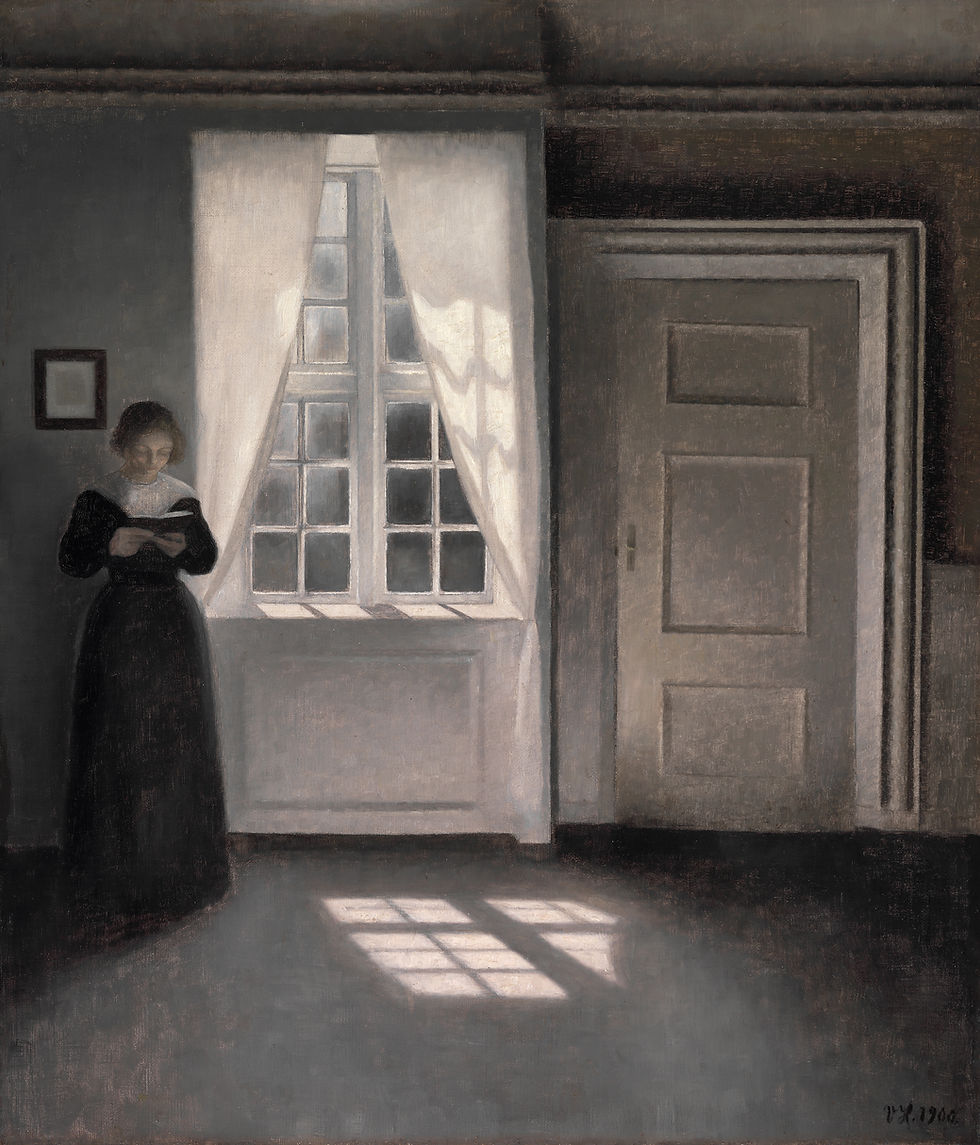
Vilhelm Hammershøi spent most of his career painting his Copenhagen apartment at Strandgade 30 — empty rooms, north light, white walls, bare floorboards. The Interior with Sunlight on the Floor (c.1900) is the canonical work: a single rectangle of pale afternoon light falls across worn wood. Nothing else. The painting is the closest thing in Western art to a Japanese tea room. Restraint, asymmetric placement of light, empty space treated as compositional weight.
4. Vermeer, The Milkmaid (c.1660)
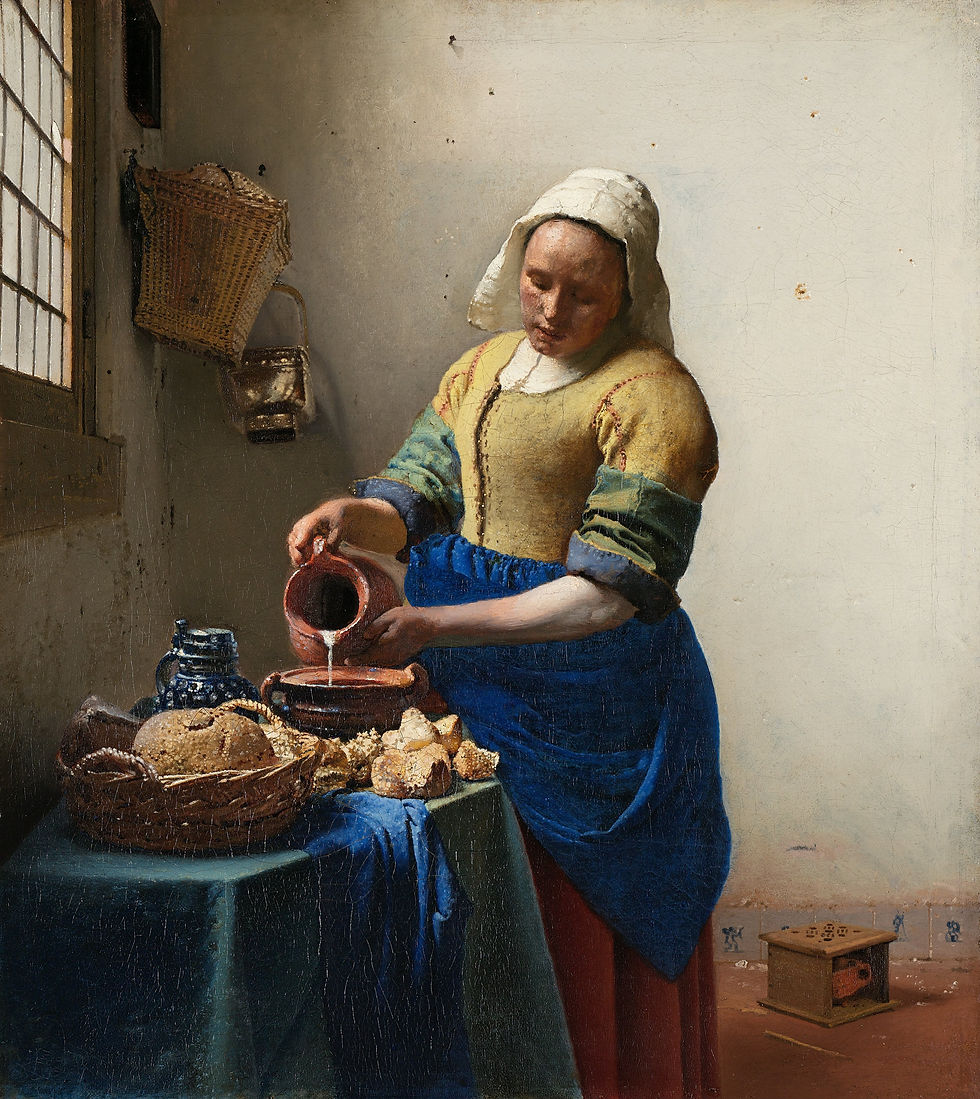
Vermeer's Milkmaid is the European painting that comes closest to the wabi-sabi attention to ordinary materials. The maid pours milk slowly from a stoneware jug into a brown earthenware bowl. The wall behind her is plain plaster, cracked in one corner. A loaf of bread sits broken on the table. Vermeer paints the cracks in the wall with the same care he paints the maid's face. Nothing in the scene is new, polished, or arranged for display. The painting is the visual texture of a working kitchen in 1660, observed without judgement.
5. Cézanne, Still Life with Apples and Peaches

Cézanne painted apples on a plain wooden table for thirty years. The cloth underneath is creased and slightly off-centre. The apples are not uniform — one is bruised, one is slightly green, one has a small dark spot. The composition is deliberately asymmetric, with most of the weight pushed to the left of the canvas. Cézanne is not painting fruit; he is painting the way ordinary objects sit in afternoon light when no one has bothered to arrange them. The aesthetic is the patient observation of imperfect things in their normal state.
6. Whistler, Nocturne (1875)

Whistler's Nocturnes are paintings of the Thames in fog at night. The palette is built almost entirely from blue-grey, pale gold, and the faint flicker of distant lights. Most of the canvas is empty — the water and the sky merge into a single soft wash. The painting refuses every Victorian convention of detail and finish. Whistler was sued for it in 1877. He won the case. The Nocturnes are the closest Western painting comes to a Japanese ink wash — restraint, monochrome, the emptiness of fog as the subject.
7. Manet's late asparagus (1880)
Édouard Manet's small still life of a single bundle of asparagus, painted in 1880, is the canonical example of late-career restraint in French painting. The bundle sits on a plain pewter platter against an undefined grey-brown ground. The brushwork is loose, the colour palette muted to greens, whites, and dull silvers. The painting was commissioned for 800 francs; Manet's patron paid 1000; Manet then painted a single additional spear of asparagus, sent it as a thank-you note, and wrote 'There was one missing from your bunch.' The aesthetic is the modest subject treated with serious attention — exactly the wabi-sabi register.
8. A monochromatic ink botanical
The eighth slot is intentionally generic: any small ink-on-paper botanical print — a single fern frond, an iris stem, a branch of plum or cherry, painted in muted ink wash and reproduced at modest scale. The Edo-period painters worked this subject extensively, and the modern reissues of the eighteenth- and nineteenth-century botanical plates are widely available. The print should be small (no more than 30×40 cm), framed in pale unfinished oak with a generous cream mat, and hung at slightly below eye level on an otherwise empty wall.
How to compose the room
The wabi-sabi room is built around what is missing. Empty wall space is not a problem to be solved; it is part of the composition. Hang one painting per wall, with at least 1.5 metres of clear wall on either side. Frame in pale oak or natural maple, not gilt. Mat with cream or soft grey, not pure white. Pair the wall art with a single piece of weathered wood furniture — a low table, a small bench, an old wooden bowl — and leave the surface of the table empty most of the year.
The single rule across all eight paintings: the work should look like it has been on that wall for a long time, and that no one in the room remembers when it arrived. New, glossy, large, symmetric, and bright are the failure modes. Worn, matte, small, asymmetric, and quiet are the targets.
Key takeaways
Wabi-sabi is the aesthetic of imperfection, impermanence, and the beauty of what is worn — the cracked tea bowl repaired with gold, the worn floorboard.
Eight paintings carry the register: Hokusai (Mishima Pass), Hiroshige (Plum Garden), Hammershøi (Interior with Sun), Vermeer (Milkmaid), Cézanne (apples), Whistler (Nocturne), Manet (late asparagus), and a small ink botanical.
Frame in pale unfinished oak or natural maple, mat with cream or soft grey, hang small and slightly below eye level on an otherwise empty wall.
The wabi-sabi room is built around what is missing — empty wall space is compositional weight, not a problem to solve.
Featured prints
Hokusai, Mishima Pass in Kai Province — zocineartdesign.etsy.com archive
Hiroshige, Plum Garden at Kameido — zocineartdesign.etsy.com archive
Hammershøi, Interior with Sunlight on the Floor — zocineartdesign.etsy.com/listing/1145509895
Vermeer, The Milkmaid — zocineartdesign.etsy.com/listing/1089363248
Whistler, Nocturne in Black and Gold — zocineartdesign.etsy.com/listing/1269609092
Browse the full archive at zocineartdesign.etsy.com.


Comments