Entryway Wall Art: Six Compositions for the First Wall Guests See
Updated: Jun 17
Most homes spend the entryway badly. A row of coat hooks, a mirror at the wrong height, a small framed print bought to fill a gap. The wall a visitor sees in the first three seconds of walking through your door is the wall that sets the register for the entire house, and it is almost always the wall least thought through.
This is a guide to composing that wall. Six compositions, each built around one principle, and the paintings that prove the principle works.

Why the entryway wall matters more than the living-room wall
A guest enters the living room already settled into the house. They are sitting, often with a drink, looking around at leisure. The entryway is the opposite — a four-second walk between the front door and wherever they are going next. The wall has to do its work fast.
Three rules. The art is sized for a glancing read, not a long sit. The colour palette answers the floor and the door, not the rooms beyond. The frame should match the door's hardware if at all possible — brass to brass, matte black to matte black, warm oak to warm oak.
1. Single horizontal anchor
The simplest entryway composition is one large horizontal painting hung above a console table or a bench. The painting reads as architecture — a wide rectangle that organises the whole wall around it. Caillebotte's Paris Street; Rainy Day is the canonical horizontal anchor: nineteenth-century Paris in muted grey-blues and umbers, figures arranged across a wide foreground, a composition that reads instantly from twelve feet away.
→ Available as a print: Caillebotte — Paris Street; Rainy Day
2. Vertical portrait at scale

Narrow entryways with high ceilings are wasted by horizontal art. The wall wants vertical weight. Sargent's Madame X — Virginie Gautreau in profile against a near-black ground, in a black evening dress that exposed one shoulder and shocked the Salon of 1884 — gives you the entire wall in a single vertical lockup. The black ground will pick up the colour of dark flooring; the skin tone reads like the warm bulb in the entryway pendant.
→ Available as a print: Sargent — Madame X
3. Quiet still life or interior

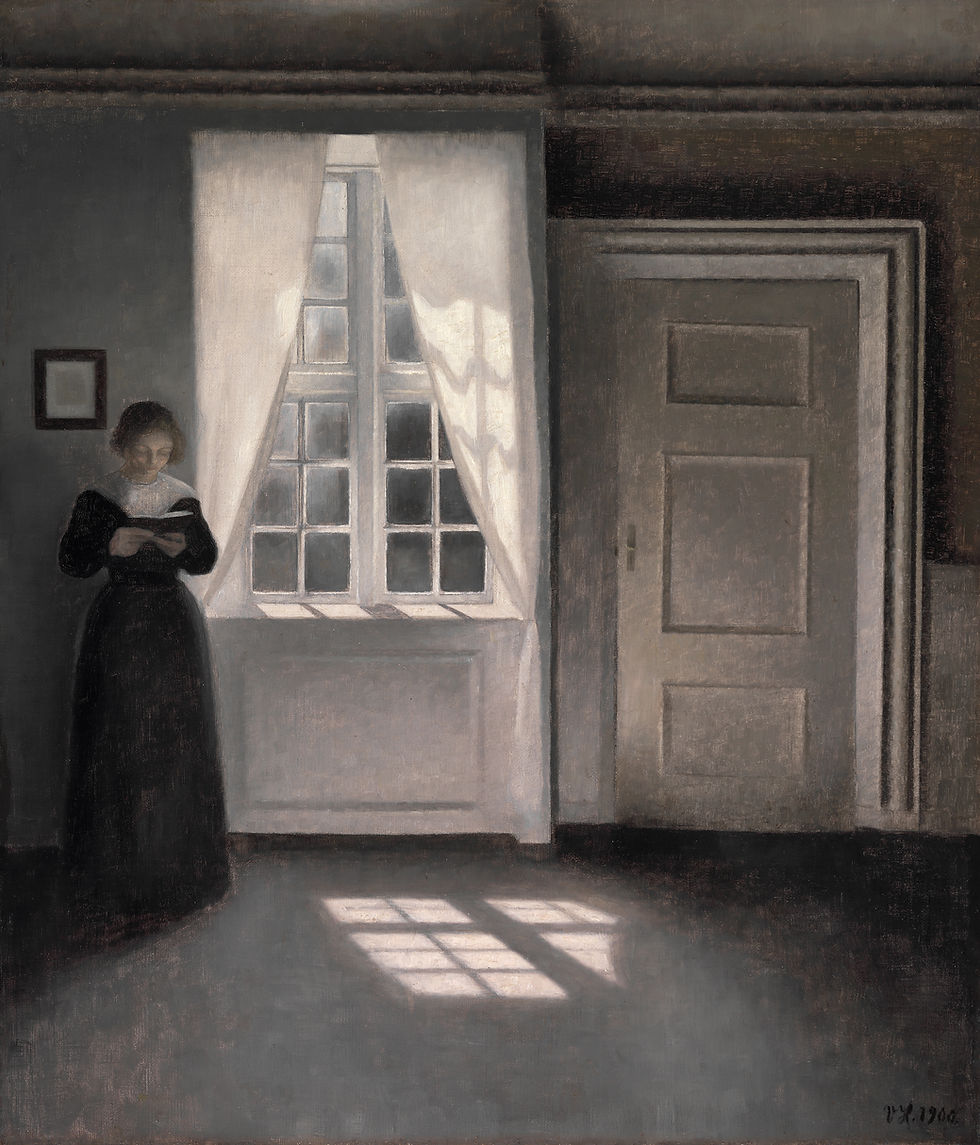
A loud entryway — too much pattern, too much colour, too much subject — sets visitors slightly on edge before they reach the living room. The opposite move is a quiet interior or still life. Hammershøi's empty Copenhagen rooms in north light hold the entryway without demanding anything of the visitor.
→ Available as a print: Vilhelm Hammershøi — Interior Print
4. Gallery cluster of three to five

If a single large anchor doesn't fit the wall — too short, too narrow, too broken by a coat rack — build a cluster. Three to five smaller framed prints in a tight grid or a vertical column. The trick is to keep the cluster smaller than the wall — leave at least 30 cm of negative space on every side. A cluster that fills the wall edge-to-edge looks like clutter. A cluster floating in the middle of the wall looks composed.
Pick one bright anchor — a Vermeer interior, a Cassatt portrait, a single landscape — and let the surrounding prints be quieter. The cluster reads as the anchor + supporting cast, not as six pieces of equal weight.
→ Available as a print: Vermeer — The Astronomer
5. Large-scale landscape
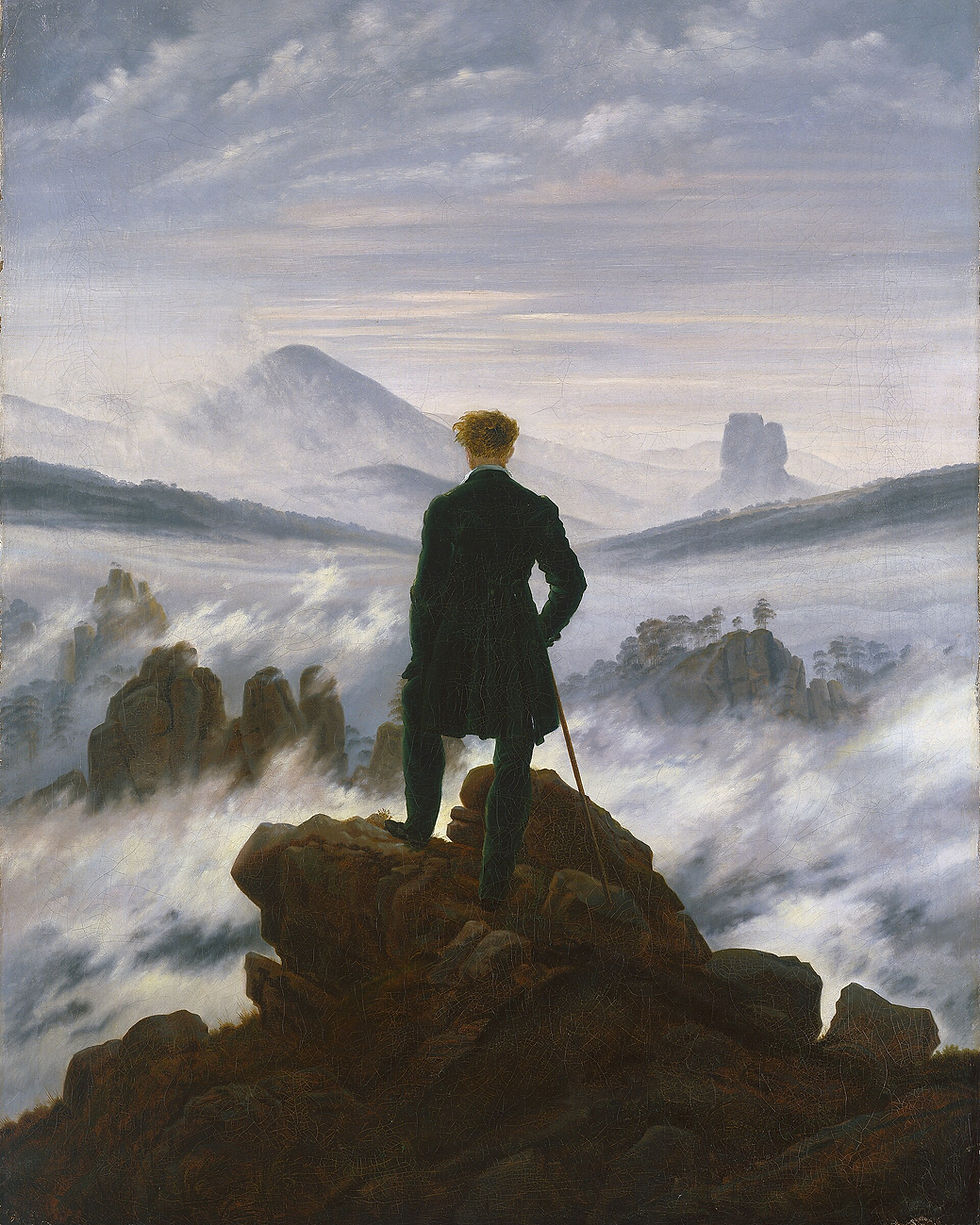
A long landscape — Friedrich's Wanderer above the Sea of Fog, Hokusai's Great Wave, a wide Pissarro Paris boulevard — turns the entryway wall into a kind of window. The visitor walks through the front door and immediately into a view. The trick is sizing: the landscape needs to be roughly two-thirds the width of the visible wall. Anything smaller becomes decoration.
→ Available as a print: Friedrich — Wanderer above the Sea of Fog
6. Intimate scale — Renoir, Cassatt, Botticelli
Smaller entryways with low ceilings — most apartments — call for a different move. Drop the scale. A small luminous portrait at eye height — Renoir's Young Girl Reading, a Cassatt mother-and-child, a Botticelli figure — gives the visitor something to look at without demanding the wall.
The painting should be hung so the centre of the figure's face sits roughly at 155 cm above the floor — average human eye level. Visitors meet the gaze, register the painting, walk on. This is the museum hanging rule, and entryways are essentially compressed gallery walks.
How to choose between the six
Wide horizontal wall, tall ceiling → single horizontal anchor (Caillebotte, Pissarro, Hokusai).
Narrow wall, tall ceiling → single vertical portrait at scale (Sargent, Vermeer Astronomer, Cassatt portrait).
Soft warm-light entryway → quiet interior or still life (Hammershøi, Vermeer Milkmaid, Cézanne fruit).
Broken or interrupted wall (coat rack, light switch, niche) → gallery cluster of 3–5.
Long blank wall, want a window-feeling → large-scale landscape (Friedrich, Hokusai, Pissarro).
Small apartment, low ceiling → intimate-scale portrait at eye height (Renoir, Cassatt, Botticelli).
Frame and finish
Match the frame to the door's hardware. Brass door knob → brass frame. Matte black hardware → matte black frame. Warm oak floors and warm wood door → warm oak frame in the same tone. A mismatched frame is the single most common entryway failure — visitors don't consciously notice it but read the room as slightly disorganised.
Key takeaways
The entryway wall is glanced at, not read; the composition has to work in three seconds.
Six compositions cover almost every entryway: horizontal anchor, vertical portrait, quiet interior, gallery cluster, large landscape, intimate portrait.
Sizing rule: art width ≈ two-thirds of visible wall width.
Eye-level hanging rule: centre of the figure's face at roughly 155 cm above the floor.
Frame finish should match the door's hardware — brass, matte black, or warm oak — not the rooms beyond.
Featured prints
Caillebotte, Paris Street; Rainy Day — zocineartdesign.etsy.com/listing/1852693210
Sargent, Madame X — zocineartdesign.etsy.com/listing/1853177346
Hammershøi, Interior Print — zocineartdesign.etsy.com/listing/1541895465
Vermeer, The Astronomer — zocineartdesign.etsy.com/listing/1089389806
Friedrich, Wanderer above the Sea of Fog — zocineartdesign.etsy.com/listing/962847872
Renoir, Young Girl Reading — zocineartdesign.etsy.com/listing/1261335386
Browse the full archive at zocineartdesign.etsy.com.

Comments