Reading Nook Wall Art: 7 Quiet Compositions That Make the Chair Feel Finished
Updated: Jun 17
A reading nook is the most demanding interior in the home. The room is small. The lamp is on. The chair holds you for hours. The art on the wall has to compete with neither the book in your hand nor the light overhead — it has to deepen both. Loud paintings exhaust the corner. Decorative posters thin it out. The right anchor reads as company.
Below are seven compositions that work in a reading nook. Each centres on a single quiet painting from the canon — Caravaggio, Vermeer, Hammershøi, Whistler, Hiroshige — and explains how to place it against the chair, the lamp, the shelf. Pick the one that matches your light.
Three rules before you pick the print
A reading nook is small enough that bad art ruins it. Three structural rules first:
Match the value to the lamp. A reading lamp pools warm light onto the chair. The painting behind it should be tonally close to that pool — deep earth-browns, oxblood, ink, charcoal. Pale paintings glare under a 2700K bulb. Dark paintings absorb the light and the corner reads as deeper than it is.
Hang at sitting eye level, not standing. Centre the print 145–150 cm from the floor if the chair sits low. Walk into the room sitting down on the chair before committing the nail.
One anchor, not three. A reading nook is for one painting. Gallery walls compete with the book. Save grids and salon hangs for the living room. Here, choose one work and let it settle.
1. The reading saint, above the desk
Caravaggio's Saint Jerome Writing (1605) is the patron painting of every reading corner ever built. The saint sits at a writing desk, one arm extended toward the page, the skull beside him a memento mori. The light source is just out of frame to the left — the same direction a 2700K reading lamp falls. Hang this directly above a small writing desk in a corner where you do your reading. Frame in oxidised brass or matte black; the warm reds of Jerome's robe read against deep walls (oxblood, ink, charcoal sage).
2. The quiet interior, behind the chair
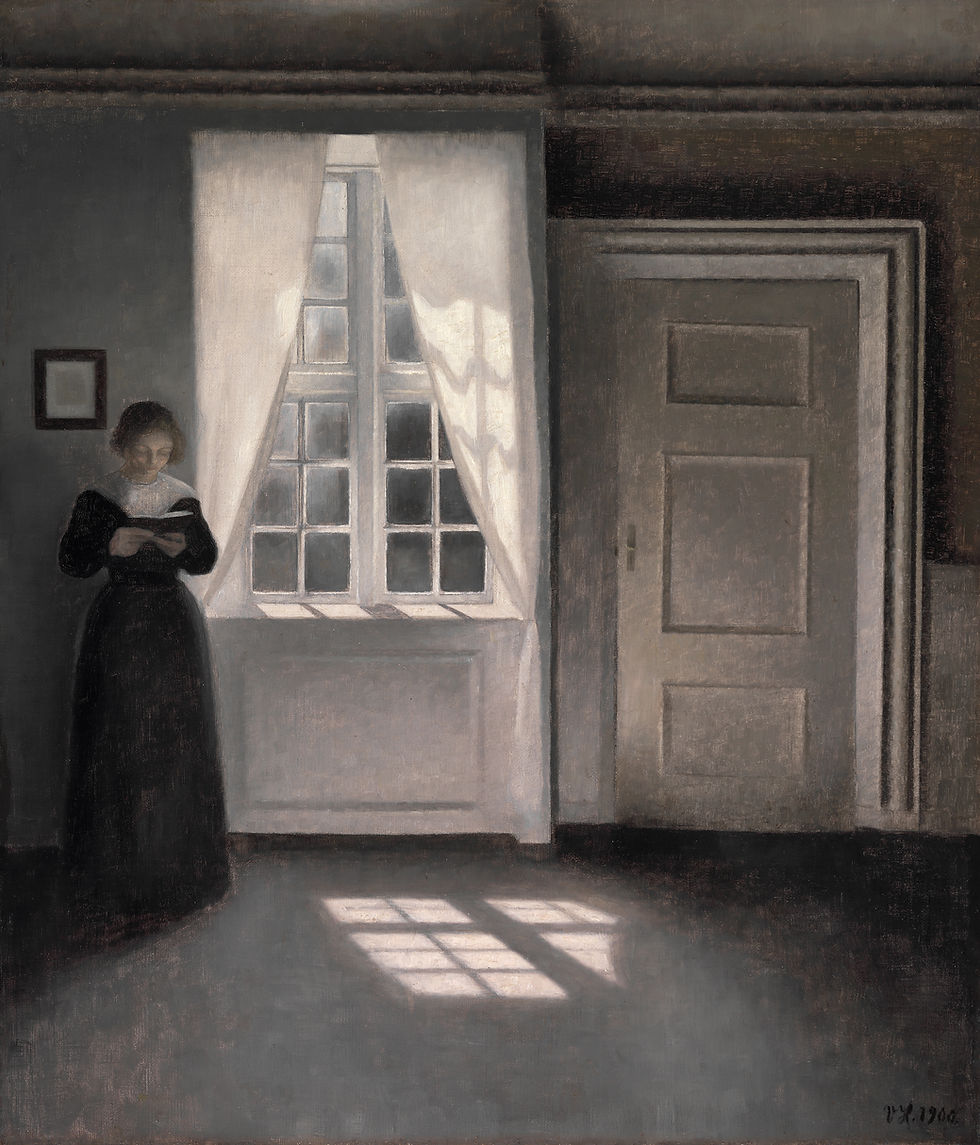
Vilhelm Hammershøi's interior paintings of Strandgade 30 are the visual equivalent of a long held breath. Cool grey light, empty rooms, a single door ajar. Hang one behind a low armchair on a deep neutral wall. The painting will absorb the room around it and make the chair feel like it sits inside the canvas. Frame in matte black or pale oak; the muted greys of Hammershøi read against off-white linen and warm wood.
3. The small intimate scene, by the lamp
Vermeer's Milkmaid (c. 1657) is the most companionable Vermeer — the milkmaid is absorbed in her own task, exactly the way you are absorbed in your book. The yellow bodice, the blue apron, the cream wall: Vermeer's palette belongs in the same warm room as the reading lamp. Hang at chair-height beside the lamp, not above the chair; the painting becomes a parallel reader.
4. The nocturne, on the deep wall
Whistler's Nocturne in Black and Gold (1875) is the quietest fireworks painting in the canon — dark blue-black sky with gold sparks dissolving across it. The painting takes itself low in tonal value, which lets it almost disappear into a deep wall colour at first glance and then reveal itself slowly. Hang on a navy, ink, or charcoal wall directly behind a leather chair. Frame in oxidised brass. The painting becomes the chair's silent partner.
5. The Japanese print, above the bookshelf
Utagawa Hiroshige's museum studies are the cleanest small-scale prints to hang above a low bookshelf in a reading corner. The compositions are uncluttered, the palettes restrained, the linework precise. They read clearly even at 18×24 size and will not fight the spines of books below. Hang one centred above a low bookcase, framed in pale oak or thin matte black.
6. The portrait, beside the chair
Egon Schiele's Self-Portrait with Physalis (1912) is a strange and intimate work — the artist with a sprig of orange Chinese lantern flowers, his face turned in three-quarter view, the background blank. Schiele worked at small scale for portraits, which means the original size (32 × 39.8 cm) translates directly to a print at 16×20 or 20×24 — the right scale for a reading-nook pair-with-chair, not a feature wall. Frame in dark walnut. Pair with no other portrait in the room.
7. The dance scene, opposite the window
Renoir's Bal du moulin de la Galette (1876) is light, music, conversation — the opposite tonal register of the rest of this list and useful for one specific case: when the reading nook has natural daylight from a window and you want the wall opposite to lift the mood rather than deepen it. The warm peach-and-cream palette reads beautifully against pale walls (sage, oat, off-white plaster). Hang opposite the window where afternoon light catches it. Frame in pale oak or gilded oak (here gilt actually works — Renoir was painting at the moment gilt was right).
Choosing for your specific corner
Warm lamp, deep wall: Caravaggio Saint Jerome or Vermeer Milkmaid. The reds and creams hold the warm pool of light.
Cool natural daylight: Hammershøi or Whistler. Cool greys read clean against grey walls.
Small wall, low chair: Hiroshige museum print at 18×24 above the bookshelf. Schiele at chair-side.
High ceiling, vertical wall: Sargent Madame X (vertical), or stack two small Hiroshige prints with thin black frames.
Key takeaways
A reading nook needs one anchor painting, not a gallery wall.
Match the painting's tonal value to the lamp pool — warm to warm, cool to cool.
Hang at sitting eye level (145–150 cm), not standing.
Caravaggio Saint Jerome is the patron painting of every reading corner.
Frame in dark walnut, matte black, or oxidised brass — not gilt (except Renoir).
Where the prints live
A short list of the anchors that live as fine prints in the archive:
The full archive lives at zocineartdesign.etsy.com.

Comments