Above-Sofa Living Room Wall Art: Six Paintings at the Right Scale and the Right Height
The wall above the sofa is the largest single visible wall surface in most living rooms and the painting hung on it determines the room's emotional register more than any other decorative decision. The six paintings below are chosen for that scale. Each carries a controlled palette that survives the living room's mixed daylight + lamp + screen-glow lighting environment, a single legible compositional focal point that registers from the seated sofa position at approximately 2.5-3.5 metres viewing distance, and subject matter that does not insist on conversation (the painting needs to be in the room without dominating it during evenings when the room is being used for television, reading, or guests). All six work at standard sofa-wall mounting height — approximately 20-25 centimetres above the back of the sofa cushions, with the centre of the canvas at approximately 145 centimetres from the floor.

1. Botticelli, Birth of Venus (c. 1485) — the warm-luxury statement
The Botticelli is the warm-luxury default for the above-sofa wall. The 172.5 × 278.5 cm original is in a Florence collection; print at 80 × 130 cm for a standard 200 cm sofa or at 100 × 160 cm for a 240+ cm sectional. Frame in dark walnut. The painting's horizontal landscape composition matches the horizontal sofa-wall proportion, the warm pink-and-cream-and-blue palette survives the warm lamp-light of the living room evening, and Venus's pale figure provides the room's primary visual focal point. The Botticelli is the strongest single decision for living rooms where the household wants the room to read as warm, classical, and culturally literate.
2. Monet, Water Lilies (Orangerie panels, c. 1916-26) — the calm room
The Monet Water Lilies horizontal panels are the alternative to the Botticelli for living rooms where the household wants quiet over warm. Print at 80 × 150 cm — the proportion approximates Monet's Orangerie panels — and frame in slim unstained European oak or in a floating-frame plexiglass mount for the more contemporary register. The painting's all-over green-and-blue chromatic field reads as the visual continuation of the room's outdoor garden view (if there is one) or as the visual replacement for an outdoor view (if there is not). The Water Lilies are the calmest possible above-sofa decision and the cleanest single signal that the room is for quiet rather than for conversation.

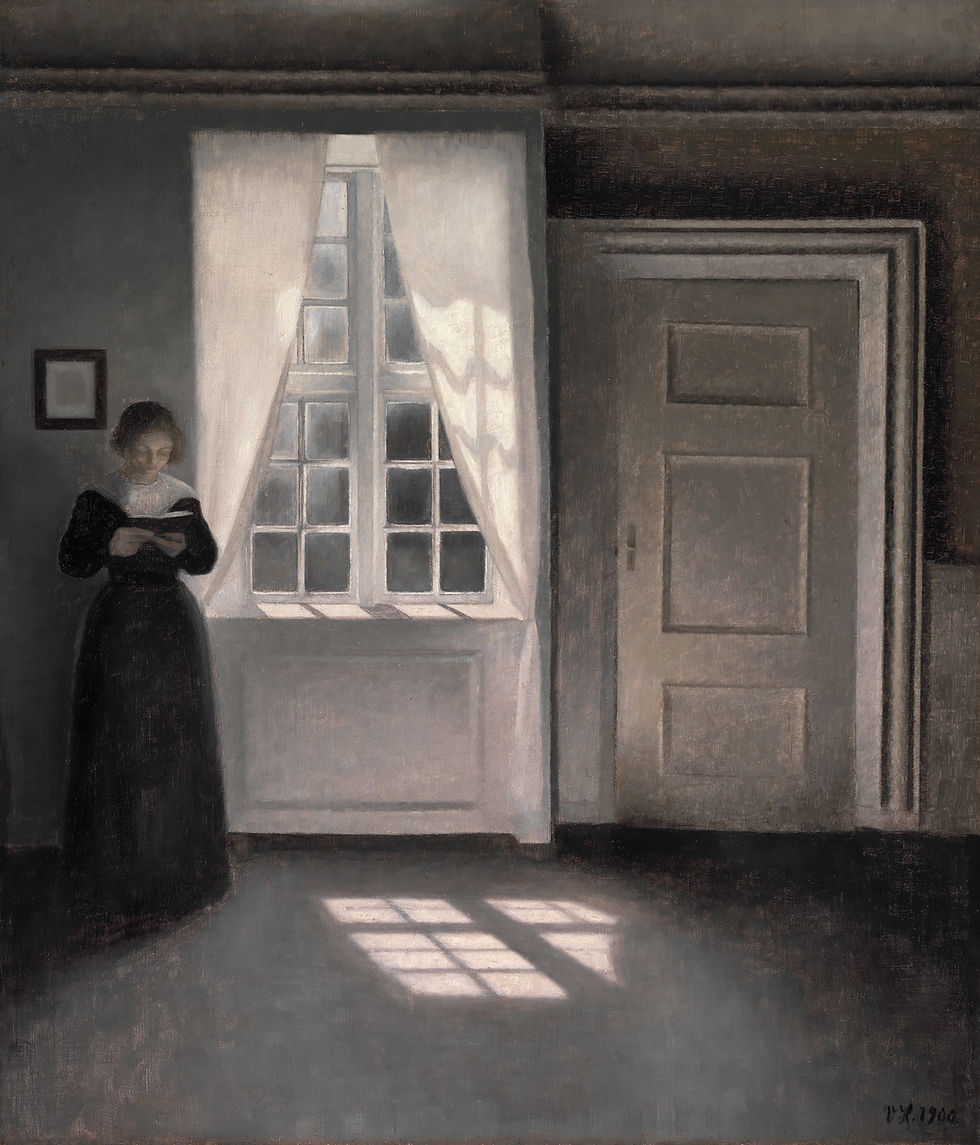
3. Hammershøi, Interior Strandgade 30 (1900) — the cool-palette small living room
The Hammershøi is for the small living room (anything under 3 metres wall length) where the warm-Botticelli or all-over-Monet would overwhelm the available wall surface. Print at 60 × 70 cm vertical, frame in unstained European oak, mount centred above a small two-seater sofa or a love-seat at standard sofa-wall height. The painting's cool grey-and-dove-white palette enlarges the apparent room dimensions (cool palettes visually retreat; warm palettes advance) and the single back-turned female figure provides the room with the quiet focal point that small living rooms benefit from more than large ones.
4. Cassatt, Tea (c. 1890) — the conversation-friendly living room
Cassatt's Tea is for living rooms that host conversation — book clubs, dinner-and-discussion evenings, three-friends-with-wine. Two women in pale cream and dove grey are seated side-by-side at a low table with the silver tea-service; the viewer is positioned at conversational distance. The painting is the visual rhyme for the room's actual function. Print at 70 × 100 cm horizontal, frame in black-stained European ash, mount centred above the sofa at standard height. The Cassatt operates at the same emotional register as the conversation the room is hosting — the painting acknowledges what the room is for without insisting on participating.

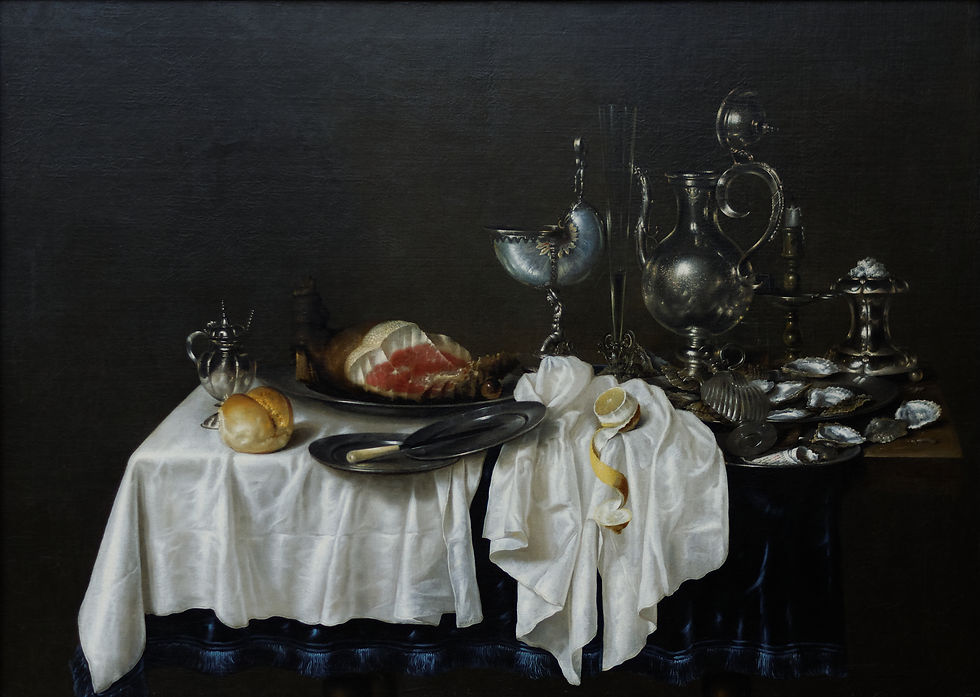
5. Heda, Still Life with Nautilus Cup (c. 1640) — the dining-living open plan
The Heda is for the dining-living open plan where the sofa wall is also visible from the dining table. A half-eaten meal arrangement on a polished wooden table: an overturned silver tazza, a lemon with its peel coiled, a green-glass römer wine glass, the nautilus-shell cup of the title. The painting works in the open-plan because it reads as both still-life (above-sofa register) and as table-arrangement (dining-table register) — the painting therefore bridges the two functions of the room. Print at 80 × 120 cm horizontal, frame in dark walnut, mount centred above the sofa at standard height. Particularly effective when the dining table is in the room's same chromatic palette (dark wood + brass-or-pewter hardware) — the Heda completes the visual case the room is making.
6. Caravaggio, Calling of Saint Matthew (1599-1600) — the cultural-anchor living room
The Caravaggio is for the living room that wants to read as the household's primary cultural-anchor space — the room where serious conversations happen, where guests are received for intellectual rather than social purposes, where the household's identity is being communicated. The Calling's specific composition (a Roman tax collector and his small group of card-playing collectors illuminated by a single beam of daylight from upper-right, Christ's figure standing in the deep shadow at the right pointing across the table at Matthew) reads at distance as sharply-lit figural group and rewards close looking with the actual subject. Print at 100 × 130 cm horizontal, frame in dark walnut, mount centred above the sofa at standard height. The Caravaggio is the strongest single decision for households that want the living room to signal cultural-seriousness rather than warm-hospitality.

Mounting height, frame, lighting — the universal above-sofa rules
Three universal rules govern all six placements. First: HEIGHT. The centre of the canvas should sit at approximately 145 centimetres from the floor — at standing-eye-level for the average viewer entering the room from the door, at the upper-eye-line for a seated sofa viewer. The painting should clear the back of the sofa cushions by approximately 20-25 centimetres (less and the painting reads as touching the sofa; more and the painting reads as floating away from the sofa). Second: SCALE. The painting's horizontal width should be approximately 60-70 per cent of the sofa's horizontal width. A 200 cm sofa takes a 120-140 cm wide painting; a 240 cm sofa takes 150-170 cm wide; a 300 cm sectional takes 180-210 cm wide. The 60-70 per cent rule produces the canonical above-sofa proportions; smaller paintings read as undersized; larger paintings read as overwhelming. Third: LIGHTING. The above-sofa painting needs a dedicated picture-light or a wall-washer LED at 2700-3000 Kelvin warm-white temperature. An unlit painting above the sofa at evening reads as a dark rectangle and contributes nothing to the room's settle-down register. The picture-light should be controllable from the room's primary lamp switch.
Key takeaways
The above-sofa wall is the largest single visible wall surface in most living rooms — the painting on it determines the room's emotional register more than any other decorative decision. Standard mounting: 145 cm floor-to-canvas-centre, 20-25 cm above sofa-back cushions.
Six paintings + room positioning: Botticelli Birth of Venus (warm-luxury statement, 80×130 cm), Monet Water Lilies (calm room, 80×150 cm), Hammershøi Strandgade (small living room cool-palette, 60×70 cm), Cassatt Tea (conversation-friendly, 70×100 cm), Heda Nautilus Still Life (dining-living open plan, 80×120 cm), Caravaggio Calling of Matthew (cultural-anchor, 100×130 cm).
Three universal rules: (1) HEIGHT — 145 cm floor-to-canvas-centre, 20-25 cm above sofa cushions. (2) SCALE — painting width = 60-70% of sofa width. 200 cm sofa → 120-140 cm painting. 240 cm sofa → 150-170 cm. 300 cm sectional → 180-210 cm. (3) LIGHTING — dedicated 2700-3000K picture-light or wall-washer, controllable from primary lamp switch, mandatory at evening.
Frame material guidance per painting: Botticelli + Heda + Caravaggio = dark walnut. Monet Water Lilies = slim unstained European oak or floating Plexiglas mount. Hammershøi = unstained European oak. Cassatt = black-stained European ash. The single-frame-material-per-room rule still applies — pick one + use across the whole living room.
Pre-purchase calibration: measure the actual sofa-wall and the actual sofa, calculate the 60-70% rule before ordering any print. The single most-common above-sofa art mistake is buying an undersized painting (a 50×70 cm print on a 240 cm sofa wall reads as a postage stamp). Spending $150 on a correctly-sized print produces a measurably better above-sofa result than spending $400 on an undersized print.
Browse fine prints for the living room in the archive at zocineartdesign.etsy.com.


Comments