Home Office and Study Wall Art: Five Paintings That Do Not Interrupt Concentrated Work
A home office or study is the rare interior optimised for sustained concentrated work over hours of stationary screen-facing position. The wall art has to satisfy a specific constraint that no other domestic interior shares: the painting must be present in the room without becoming a focal point during work, must survive the daily video-call backdrop position, and must do its work entirely in the peripheral vision rather than the central one. The painting that fascinates on first installation will become an active distraction by week three of sustained office use; the painting that is too quiet to register at all contributes nothing to the room. The five paintings below are chosen for that narrow constraint — present but not insistent, visible but not central, durable across years of daily exposure without losing the small reward they give to the worker who occasionally looks up from the screen.

1. Rembrandt, late Self-Portrait (1659-69) — the desk-facing wall
Rembrandt's late self-portraits are the canonical home-office wall painting. A single weathered face emerges from a near-black background, the brushwork loose and visible in the impasto highlights, the eyes steady and intelligent and tired. The painting belongs on the wall directly behind the worker's screen — visible in peripheral vision during work but not central enough to interrupt concentration. The face becomes a kind of working companion who has spent forty years looking carefully at things. Print at 60 × 80 cm, frame in dark walnut with narrow gilt inner liner, mount at approximately 160 cm floor-to-canvas-centre (above the worker's seated-eye-level so the painting reads when the worker looks up but does not register when looking straight ahead at the screen).
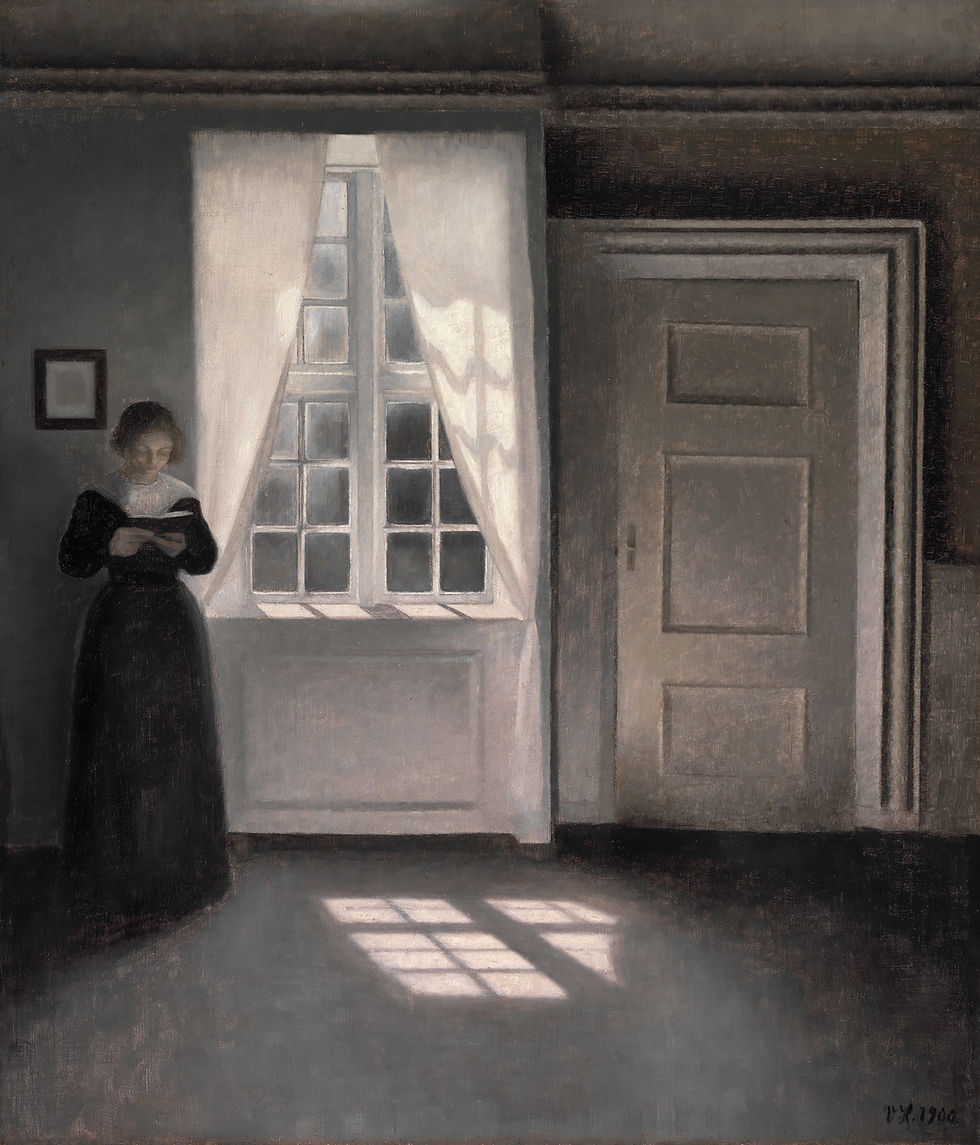
2. Hammershøi, Interior Strandgade 30 (1900) — the Zoom-call backdrop
The Hammershøi is the strongest possible Zoom-call backdrop painting. A single back-turned female figure walks through an empty room toward an open doorway; cool grey and dove white with yellow afternoon sun on the floor. The painting reads on video as a calm visual environment without becoming the topic of the call. Print at 70 × 60 cm, frame in unstained European oak, mount on the wall behind the worker's video-call position approximately 180 cm floor-to-canvas-centre (so the painting frames the worker's head-and-shoulders on the standard webcam shot without distracting from the speaker). The Hammershøi outperforms generic Zoom-virtual-backgrounds because it signals personal taste and craft without insisting on either.
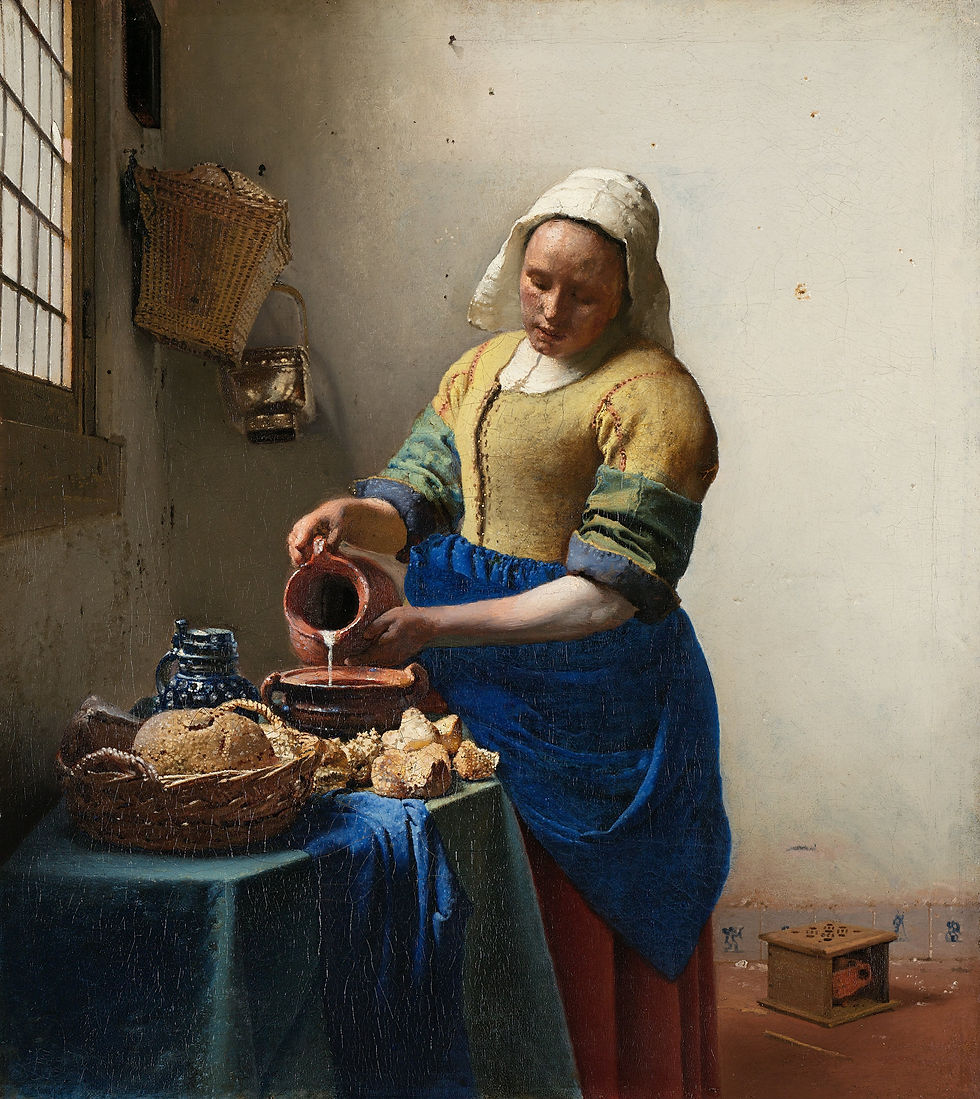
3. Vermeer, The Milkmaid (c. 1660) — the side wall (printer alcove)
Vermeer's Milkmaid is for the side wall of the home office — typically the wall the printer, scanner, or supply alcove is mounted against. The painting's small scale (the original is 45.5 × 41 cm) makes it perfect for the narrow alcove wall. Print at 35 × 30 cm, frame in dark walnut with narrow brass inner liner, mount at standing-eye-level (155 cm). The Milkmaid reads when the worker walks across the office to retrieve a printed document — a small visual reward for the routine errand. Particularly effective placed near a window so the painting's own depicted morning light matches the actual sunlight from the office window.
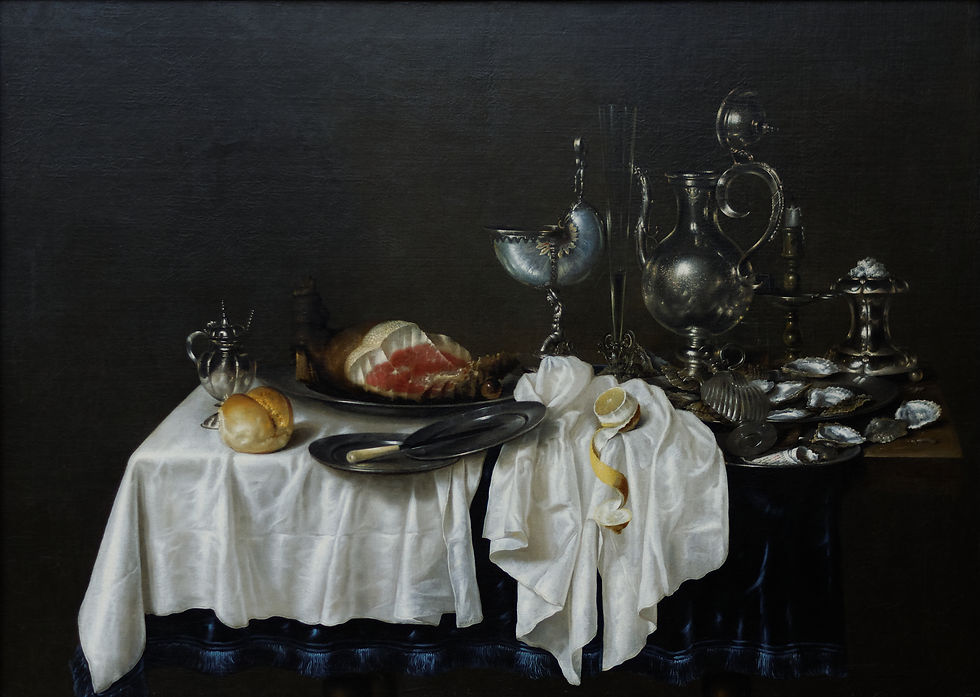
4. Heda, Still Life with Nautilus Cup (c. 1640) — the bookshelf wall
Heda's Nautilus Cup canvas works above the home-office bookshelf — the wall that holds the worker's reference library, the printed-research folders, the small collection of professional certificates and framed degrees. The painting's specific subject (a half-eaten meal with careful arrangement of beautiful objects) carries the same quiet competence the bookshelf is trying to communicate. Print at 60 × 90 cm horizontal, frame in dark walnut, mount centred above the bookshelf at the height the bookshelf's top edge sits — typically around 195-210 cm. The Heda signals that the worker takes the room's working environment seriously.
5. Cezanne, Still Life with Apples (c. 1893) — the reading-chair corner
Cezanne's apples canvas is for the reading-chair corner — the secondary seat in the home office where the worker reads physical documents, drafts handwritten notes, or takes phone calls away from the desk. Print at 50 × 60 cm horizontal, frame in slim dark-walnut moulding, mount above the reading chair at seated-eye-level (~105 cm). The painting's flattened-perspectival space (the tilted tabletop, the multi-viewpoint apples) provides the visual variety that the screen-fatigued worker's eye benefits from during reading-chair sessions. Particularly effective in offices where the worker conducts long phone calls — the painting gives the eye somewhere to rest during the audio-only attention shift.

Practical rules for the home-office wall programme
Three rules govern the home-office placement. First: AVOID SCREEN-FACING. No painting should sit directly behind the screen the worker faces during the day — the constant peripheral-vision presence becomes a barrier to concentration after approximately 4-6 weeks of daily use. The desk-facing wall (Rembrandt) is the exception — the painting is mounted high enough to be above the screen's primary visual register. Second: VIDEO-CALL FRAMING. The Zoom-call backdrop painting (Hammershoi) should be positioned so it appears on the standard webcam shot at the worker's head-and-shoulders level — approximately 180 cm floor-to-canvas-centre on a typical work-from-home seated position. Third: PERIPHERAL-ONLY SCALE. Home-office paintings should be smaller than equivalent paintings in living rooms or dining rooms. The 60-70% sofa-wall rule does not apply; home-office paintings should be sized at approximately 40-60% of the wall surface they hang on. Larger paintings become distracting; smaller ones contribute meaningfully to the room without competing with the work.
Key takeaways
Home office / study art has a specific constraint NO other domestic interior shares: the painting must be present without becoming a focal point during work, must survive the daily video-call backdrop position, must do its work in peripheral vision rather than central one.
Five paintings + placements: Rembrandt late Self-Portrait (desk-facing wall above screen, 60×80 cm, mounted at 160 cm), Hammershoi Strandgade Interior (Zoom-call backdrop, 70×60 cm, mounted at 180 cm), Vermeer Milkmaid (side wall printer alcove, 35×30 cm), Heda Nautilus Still Life (above bookshelf, 60×90 cm, mounted at 195-210 cm), Cezanne Still Life with Apples (reading-chair corner, 50×60 cm).
Three universal rules: (1) AVOID SCREEN-FACING — no painting directly behind the screen worker faces; peripheral-vision presence becomes distraction after 4-6 weeks. (2) VIDEO-CALL FRAMING — Zoom backdrop painting positioned to appear at worker's head-and-shoulders on standard webcam shot (~180 cm). (3) PERIPHERAL-ONLY SCALE — home-office paintings smaller than living-room equivalents, ~40-60% of wall surface vs the 60-70% sofa rule.
The Rembrandt-self-portrait-as-working-companion placement is the most-specific home-office art move and the strongest single recommendation. The painting gives the screen-facing worker a presence in the room that is not their own reflection in the screen, not the room itself, not a printed photograph of family — a face that has spent 40 years looking carefully at things, mounted just above the screen's primary register so it does not interrupt but is available when needed.
The Hammershoi-Zoom-backdrop placement is the strongest single video-call recommendation for any work-from-home professional. Outperforms generic Zoom-virtual-backgrounds because it signals personal taste + craft without insisting on either. Cost: ~$220 for fine print + frame + dedicated picture-light vs $0 for the generic virtual background but with a non-zero professional-presentation cost.
Browse fine prints for the home office and study in the archive at zocineartdesign.etsy.com.


Comments